Business Electricity Rates in NZ: Why There Is No Single Price, and What Actually Sets Your Bill

Ask a room of business owners what they pay for power and you will get a room full of different answers. A café in Invercargill, a panel beater in Hamilton and a coolstore in Hawke’s Bay can all buy electricity from the same retailer and face per-unit prices that barely resemble each other. That is not a failure of shopping around. It is how the New Zealand market is built.
Unlike a phone plan, business electricity is not sold off a national price list. The price attached to your premises depends on where the site sits, which local network delivers the power, how the site is metered, when your business draws its heaviest load, and the contract structure you sign up to. Retailers will not usually quote until you hand over details of the site, starting with its ICP number.
This guide explains how business electricity pricing is put together, what each part of the bill pays for, how small business pricing differs from large commercial and industrial arrangements, and how to compare quotes on a like-for-like basis. Its sources are the Electricity Authority, retailers’ plan terms, a distribution network’s pricing methodology and Inland Revenue’s GST guidance.
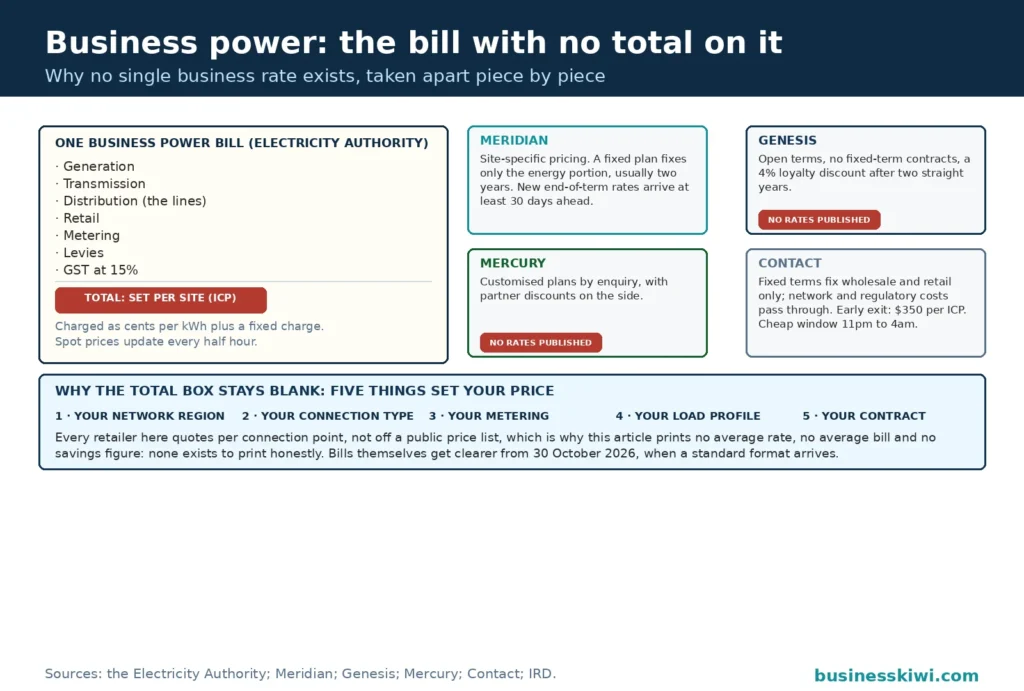
There is no single business electricity rate
The first thing to accept is that “the business rate” does not exist. The Electricity Authority, which regulates the electricity market, puts it plainly in its bill guidance: your power company sets the price for your electricity. Retailers generally charge in cents per kilowatt-hour, plus a fixed charge for keeping the connection live. Nothing in the system sets one business tariff for the whole country.
Several variables sit underneath that headline price:
- Location. Your local distribution network charges for delivering power across its lines, and those delivery charges differ from network to network. The Commerce Commission regulates how much revenue distributors can earn, but the resulting prices still vary by region and by customer category.
- Connection category. Networks group connections into categories, because a small shop and a large manufacturer use the network in very different ways. Orion, the Canterbury network, describes separating connections into groups such as residential and small business connections, major customers, irrigation connections, and large capacity connections whose prices are negotiated individually because of their size and impact on the local network.
- Metering. Whether your site has a basic meter or a communicating smart meter determines what pricing structures are even available to you. Time-based pricing needs half-hourly data.
- Load profile. Two businesses using the same total energy across a year can cost very different amounts to supply if one draws steadily and the other spikes hard at peak times.
- Contract structure. A fixed energy price, an open-term variable price and a spot-linked price expose you to the wholesale market in completely different ways.
This is why the big retailers handle business pricing the way they do. Meridian asks prospective commercial customers to request a quote and to include their ICP numbers so the right specialist picks up the enquiry. Mercury’s small business page likewise asks you to complete a form so it can customise a plan, rather than publishing a rate card. Genesis markets its PowerBusiness offer around open terms and tailored service. Business electricity in New Zealand is, in the main, quoted rather than listed.
What a business bill actually pays for
A business power bill looks like one product, but the money is split across a chain of services. Both the Electricity Authority and Meridian publish versions of the same breakdown, and the components line up closely.
Generation is the cost of producing the electricity itself. The Authority notes that generation’s share of the average bill has grown over the past decade as wholesale prices have risen, with peak demand periods, dry weather and gas supply uncertainty all pushing prices up.
Transmission pays for the national grid, the high-voltage network that moves power around the country.
Distribution pays for the local lines that carry power from the grid to your street and your building. Transmission and distribution together are often called lines charges or delivery charges. Networks charge retailers for this delivery service, and retailers recover it from customers, either itemised or bundled into the overall price.
Retail costs are the power company’s own operating costs: billing systems, customer service, sales and the work of managing your account.
Metering covers reading and maintaining your meter. The Authority notes metering’s share of bills has edged up with the rollout of smart meters.
Government levies fund the operation and regulation of the electricity market.
GST is added at 15 percent on top of the GST-exclusive total, as Meridian states in its own breakdown of what makes up its rates. It matters when comparing quotes, because business pricing is often quoted exclusive of GST.
The Authority also makes a point worth knowing before you compare two bills side by side: there are currently no requirements for bills to be presented the same way or for charges to be separated out in a standard format, so bills from different retailers do not always look alike. It says bill information will become clearer and more consistent from 30 October 2026.
Your ICP, your network and your meter decide what you can be offered
Every connection point on the national electricity registry has an ICP number, short for installation control point. The Authority describes it as the identifier that tells a power company how your property is connected to the network, and retailers use ICPs to locate your connection both physically and on the registry. The ICP pins down your network, your price category and your metering setup, and those three things drive the quote.
Metering deserves particular attention because it quietly sorts businesses into two pricing worlds. The Authority explains that smart meters record power use every half hour and send it to your retailer electronically. Meridian draws the commercial distinction clearly: most connections are what it calls Non-Half Hourly, meaning they are not billed on time-of-use unless a specific meter tariff such as Night/Day applies. Larger connections, which Meridian calls Commercial and Industrial or Time of Use connections, are billed based on time of use and require a formal Corporate Customer Electricity Supply Agreement before supply starts.
In practice, a small business with a basic meter gets simpler pricing, while a bigger user with half-hourly metering can be offered pricing that follows its actual load shape through the day.
Small business pricing versus commercial and industrial pricing
For most small and medium businesses, pricing is comparatively simple. You will typically see a daily fixed charge plus one or more per-unit rates, possibly split into day and night if your meter tariff supports it. The Authority notes that fixed charges cover the basic costs of maintaining a connection, including lines charges, metering and, where relevant, connections to a secondary network such as those found in apartment buildings, subdivisions and retirement villages.
As usage grows, the pricing conversation changes character. Larger users are quoted individually, and the structures on offer at the top end, as Meridian describes them for commercial and industrial customers, include:
- Fixed price variable volume, where energy rates are fixed while the volume you use can move up and down.
- Proportional pricing, where you nominate a share of your usage to be charged at a fixed rate and the balance follows the spot market, plus an administration charge.
- Spot market pricing, where your price tracks the wholesale market directly, plus an administration charge.
The wholesale spot price is not a single daily number. The Authority explains that spot prices are updated every half hour, rising during winter and at peak times such as weekday mornings and evenings, and falling when conditions are favourable. Spot-linked pricing can reward a business that can ride out the spikes, but it transfers wholesale risk from the retailer to you.
Scale also changes how network costs reach you. A large connection has a bigger footprint on its local network, and networks can price that explicitly. Orion’s methodology describes large capacity connections being negotiated individually, and major customers being treated as their own category. So when you read a large-site quote, check how its network component is charged. For bigger connections it may reflect the site’s maximum demand or contracted capacity, not just the units consumed, and a quote that hides that component is not directly comparable with one that shows it.
One more threshold is worth knowing about, because it shows where retailers draw the small business line for time-based pricing. Meridian’s published plan list makes its Small Business Time of Use Plan available to small-to-medium business customers with expected annual consumption of less than 50,000 kWh, provided the site has an operational, communicating smart meter that can supply half-hourly data.
Time-of-use pricing and shifting your load
Time-of-use pricing charges different rates at different times, and it exists because electricity genuinely costs different amounts to supply at different times. Networks build for their peaks. Orion describes its network’s rush hour as very cold winter mornings and evenings, and explains that it uses price signals, higher prices at high-demand times and lower prices when demand is low, to encourage consumption to shift rather than building ever more capacity.
Retailers pass those signals through in different wrappers:
- Meter tariff structures such as Night/Day pricing, where the split depends on your metering configuration rather than the plan name.
- Defined off-peak windows inside a business plan. Contact’s Good Business plan terms, for example, describe discounted variable usage rates between 11pm and 4am every day, with the daily charge and other services billed at standard rates, and the plan depends on a communicating smart meter sending readings every 30 minutes.
- Full time-of-use billing for larger sites, where half-hourly consumption is priced against half-hourly rates.
Whether shifting load saves you money depends on your operation. A bakery that fires ovens before dawn, a business that can run refrigeration, water heating, EV charging or batch processes overnight, or a manufacturer able to reschedule a heavy process away from winter evenings is well placed. A retail store whose load is locked to opening hours has less to move. Check your half-hourly data before signing up: the window only helps if a real share of your consumption can land inside it.
Genesis makes the same point from the other side, suggesting time-varied pricing could suit businesses that use most of their power overnight. That is the right way to think about it. Time-of-use is not cheaper electricity in the abstract. It is cheaper electricity at specific times, priced for businesses whose load can follow.

Fixed, variable and open term: how business contracts actually behave
Business plan names can mislead, because “fixed” rarely means every number on the bill is frozen. Look at what the retailers’ own terms say.
Meridian’s Fixed Energy Plan fixes only the energy portion of the rate for the term, usually two years. That energy portion covers the cost of the electricity and retail services such as meter reading and customer support. Other charges, including network, government and regulatory charges, may change on notice during the term.
Contact’s fixed term business plan terms draw the same line from the other direction. During a fixed term, Contact says it will not adjust your price because of changes in the wholesale cost of energy or its own retail service costs. But it may pass on increases in costs from your network company, and costs arising from new regulation or government-imposed taxes and levies.
So a fixed business plan is best understood as fixing the parts your retailer controls, while the regulated and pass-through parts of the cost stack can still move.
At the flexible end, open-term plans trade certainty for freedom. Genesis sells PowerBusiness on the basis of no fixed-term contracts at all. Meridian’s Simple Flexi Plan is an open-term option for small-to-medium businesses. Contact’s standard position is that a business plan without a fixed term simply runs with no specified end date. Variable pricing on an open term can change, and Meridian says it will endeavour to email customers their new rates at least 30 days before they take effect when a plan term ends, stating clearly which option applies by default if you do nothing.
Discounts sit on top of these structures and differ by retailer. Genesis applies an ongoing loyalty discount of 4 percent after two consecutive years, by its own account. Contact replaced prompt payment discounts with a monthly discount for customers signing new business plans from September 2023, with the value set at Contact’s discretion. Treat any discount as one component of the total price.
GST on business electricity: what you can and cannot claim
Power bills are GST-inclusive documents, and business quotes are often discussed GST-exclusive, so GST handling is a genuine source of confusion rather than a bookkeeping footnote.
Inland Revenue’s position is straightforward. A GST-registered business can claim back, as input tax in its GST return, the GST charged on goods and services bought and used in its taxable activity. Electricity used in running the business falls squarely in that category. The GST you claim is subtracted from the GST you charge your own customers to work out what you owe or are owed.
There are limits worth respecting. IRD says you can only claim GST to the extent supplies are used in your taxable activity, and you cannot claim GST for supplies used privately or to make exempt supplies. That matters for the many businesses run from premises that mix business and private use, such as a home-based business or a farmhouse on the same supply as the farm. IRD describes two adjustment routes: an apportionment method, where you estimate and claim only the business percentage, and a principal purpose method for smaller purchases. You also need to keep taxable supply information for the supplies you receive, which in practice means keeping your power bills.
Two practical consequences follow. First, when you compare quotes, compare them on the same GST basis; a GST-exclusive quote will always look roughly 15 percent lighter than a GST-inclusive one for the same deal. Second, if you are not GST-registered, you cannot claim the GST back at all, so the GST-inclusive total is your real cost and the only figure that matters for comparison.

How to compare business electricity offers properly
Because there is no standard rate card, comparison is a process, not a lookup. The retailers themselves describe it the same way: Meridian tells business customers they will need a quote from each provider they are considering, and offers to prepare a quote and comparison if you send in your latest bill. Work through the following steps to keep quotes honest.
Start with your own data. Give each retailer the same material: your ICP number or numbers, at least 12 months of bills, and your half-hourly data if you have a smart meter. A quote built on an estimate of your usage is not comparable with one built on your actual load profile.
Price the whole bill, not the unit rate. Ask for every quote to be expressed as an estimated total cost over the contract term at your actual consumption. A low per-unit rate paired with a high daily charge can lose to a higher unit rate with low fixed charges, especially for low or seasonal users. The Authority’s breakdown is a useful checklist here: generation, delivery, metering, levies and GST all have to be in the quote somewhere.
Check what is bundled and what is passed through. Some quotes bundle network charges into the unit rate; others show delivery separately and reserve the right to adjust it. Ask directly which components are fixed for the term and which can change, and how much notice you get. Contact’s and Meridian’s terms both show network and government charges moving during fixed terms, so assume this is in play unless a quote explicitly says otherwise.
Read the end-of-term and exit provisions before you sign. Ask what happens when the term finishes, what price you roll onto, and what it costs to leave early. The costs are real and they are published. Contact’s business terms set an early termination fee of $350 per ICP for non-account managed customers who end a fixed term plan early, while account managed customers face a minimum $350 charge plus a further amount based on their consumption band and how much of the term remains. Meridian takes a different approach tied to incentives: if you accepted a sign-up credit or similar incentive, an incentive recovery fee may apply if you cancel inside the specified period, and if you took no incentive, it says it will not charge anything to cancel. Both belong in your comparison maths.
Line up the discount conditions. Prompt payment discounts that vanish if you pay a day late, discretionary monthly discounts, loyalty discounts that only start after two years and partner discounts through buying groups all change the effective price. Mercury’s small business offering leans on partner discounts through organisations such as the Early Childhood Council, PGG Wrightson and n3. Price the deal you will actually get, for the full term.
Do not forget the non-price terms. Billing frequency, payment terms, whether multiple sites can sit on one account, and what happens to your plan if you move premises all matter. Meridian notes that moving sites usually means the plan transfers but the new site’s rates apply, and those may differ from what you pay now. Contact’s plan ends if you move to another property.
Traps that catch businesses out
Comparing against residential rates. Residential pricing is a different product. Households may qualify for low user options and residential plan structures that do not apply to a business connection, and networks price categories differently. Using a home rate as your benchmark will mislead you in both directions.
Taking an unbundled quote at face value. A quote that leads with a sharp energy rate but lists network charges, metering, levies or other components as “pass-through at cost” is not finished. The total can drift well past a bundled competitor once those lines are added. Always ask for the all-in estimate at your usage.
Letting a fixed term roll over by default. When a fixed term ends, you do not stay on the old price. Contact’s terms move customers onto its Business Freedom Plan or the closest equivalent, and Meridian will apply a default option from the new rates it sends you if you do not choose. Diarise your contract end dates and renegotiate from a position of having other quotes in hand.
Signing a fixed term when your usage is about to change. Fixed terms hold the retailer’s energy price, but they do not protect you from early termination fees if you close, sell or move the business, and a price struck on wrong information, such as an incorrect meter setup or network price category, can be revisited by the retailer under their terms. If big operational change is likely, the flexibility of an open term may be worth more than a marginally lower fixed price.
Chasing the discount and ignoring the base price. A generous percentage off a high base rate can cost more than a small discount off a low one, and discounts conditional on payment behaviour or tenure are worth less than they appear in year one. Compare totals after discounts, over the whole term.
Assuming “fixed” covers everything. As the retailers’ own terms show, network and government charges typically sit outside the fix. Budget for movement in those components even on a fixed term plan, particularly around 1 April, when network prices are commonly reset.
Frequently asked questions
Is there a standard business electricity rate in New Zealand?
No. Retailers set their own prices, and the price for a given site depends on its network region, connection category, metering and load profile as well as the contract structure. That is why major retailers quote individually instead of publishing a national rate.
Why does my business pay a different rate from the business next door?
You may be on different networks’ price categories, different meter tariffs, or different contract types, and your usage patterns almost certainly differ. Even on the same street, one site might be billed as a small business connection while another, with larger capacity requirements, is priced as a major or individually negotiated connection.
What is an ICP and why do retailers ask for it before quoting?
An ICP is the installation control point number that identifies how your property is connected to the network on the national registry. It tells the retailer your network, price category and metering setup, which are the main inputs into a business quote.
Do fixed term business plans fix my whole price?
Generally not. Retailers’ terms typically fix the energy and retail service components, while network charges, government levies and new regulatory costs can still be passed through during the term. Ask any retailer, in writing, exactly which components are fixed before you rely on the word.
What is time-of-use pricing and does my business qualify?
Time-of-use pricing charges different rates depending on when electricity is used, reflecting higher supply costs at peak times. Larger commercial and industrial connections are billed this way as standard. Smaller businesses generally need a communicating smart meter that records half-hourly usage; one published example, Meridian’s Small Business Time of Use Plan, is limited to businesses expected to use less than 50,000 kWh a year.
Can my business claim the GST on its power bill?
If your business is GST-registered and the electricity is used in your taxable activity, yes: the GST is claimed as input tax in your GST return. If the supply is shared with private use you can only claim the business portion, and if you are not GST-registered you cannot claim it at all.
What happens if I leave a fixed term business plan early?
Expect a charge of some kind. Contact’s published business terms set an early termination fee of $350 per ICP for non-account managed customers, with higher, formula-based charges for account managed customers. Meridian instead may recover sign-up incentives if you cancel within the period specified in your offer. Check your own terms before switching.
Should I choose a fixed price or spot pricing for my business?
That depends on your risk tolerance and load flexibility. A fixed energy price buys budget certainty for the fixed component, while spot pricing, offered to larger users alongside fixed and proportional options, can be cheaper when wholesale prices are low and punishing during winter peaks. Businesses that cannot shift load or absorb a bad month usually lean towards fixing at least part of their volume.
Sources
- Electricity Authority, “Your power bill”, ea.govt.nz: what a bill pays for, pricing and rates, fixed charges, ICP numbers, metering types and spot pricing.
- Electricity Authority, billing guidance material on invoice content, ea.govt.nz (referenced for the point that bills are not currently presented in a standard format; see also “Your power bill” on clearer bills from 30 October 2026).
- Meridian Energy, “Plans and pricing” help page for business and farm customers, meridianenergy.co.nz: what makes up electricity rates, plan changes, end-of-term process, exit and incentive recovery fees.
- Meridian Energy, “Business power plans and pricing”, meridianenergy.co.nz: Non-Half Hourly versus Commercial and Industrial (Time of Use) connections, Corporate Customer Electricity Supply Agreements, quoting by ICP.
- Meridian Energy, “Agribusiness: Pricing and Power Plans”, meridianenergy.co.nz: Fixed Energy Plan structure, fixed price variable volume, proportional pricing and spot market pricing for larger users.
- Meridian Energy, “List of Plans, Add ons and Offers”, meridianenergy.co.nz: Small Business Time of Use Plan and Simple Flexi Plan eligibility criteria.
- Genesis Energy, “Energy supplier for your business”, genesisenergy.co.nz: PowerBusiness open-term positioning, loyalty discount and time-varied pricing for overnight users.
- Mercury, “Small Business Electricity, Broadband and Mobile Plans”, mercury.co.nz: customised small business plans and partner discount arrangements.
- Contact Energy, “Contact business plan special terms and conditions”, contact.co.nz: fixed term price adjustment clauses, rollover to Business Freedom Plan, early termination fees, and Good Business plan off-peak terms.
- Orion New Zealand, “Methodology for deriving delivery prices, for prices from 1 April 2026”, oriongroup.co.nz: connection categories, peak price signals and individually negotiated large capacity connections.
- Inland Revenue, “Claiming GST”, ird.govt.nz: input tax claims, apportionment for mixed business and private use, and record-keeping requirements.
This article is general information about how business electricity pricing works in New Zealand. It is not financial, legal or energy procurement advice, and it does not recommend any retailer or plan. Prices, plan terms and eligibility criteria change over time and vary by site, so confirm the current terms of any offer directly with the retailer before signing, and consider advice from a qualified adviser for significant contracts.