Ferrymead Preschool and Nursery in Christchurch: Hours, Fees and How the Centre Works
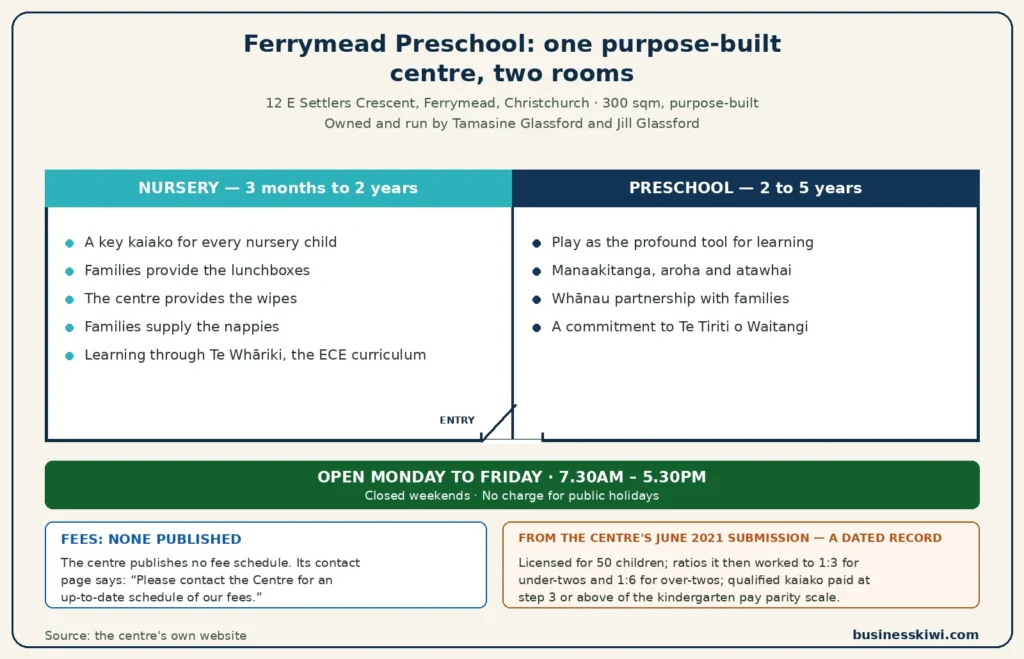
Ferrymead Preschool and Nursery is a small, family-owned early childhood centre on Settlers Crescent in Ferrymead, Christchurch. It takes children from three months to five years old, split between a nursery for the under-twos and a preschool room for children aged two to five, and it opens for a full ten-hour day, 7.30am to 5.30pm, Monday to Friday. It is owned and run day to day by the family who founded it, and its centre manager is also one of its owners.
This profile brings together what the centre itself publishes: its own website, and its own written submission to a parliamentary select committee in 2021, in which the centre described its licence, its ratios and its staffing in its own words. Two limits need saying plainly at the start. The centre’s profile on Education Counts, the Ministry of Education’s official directory, could not be loaded for this research, so the current roll and equity index are not stated below. The centre’s Education Review Office report could not be retrieved either, so no ERO judgement is quoted. Everything else traces to pages published by the centre and read in full.
Ferrymead Preschool and Nursery at a glance
Where it is, and who runs it
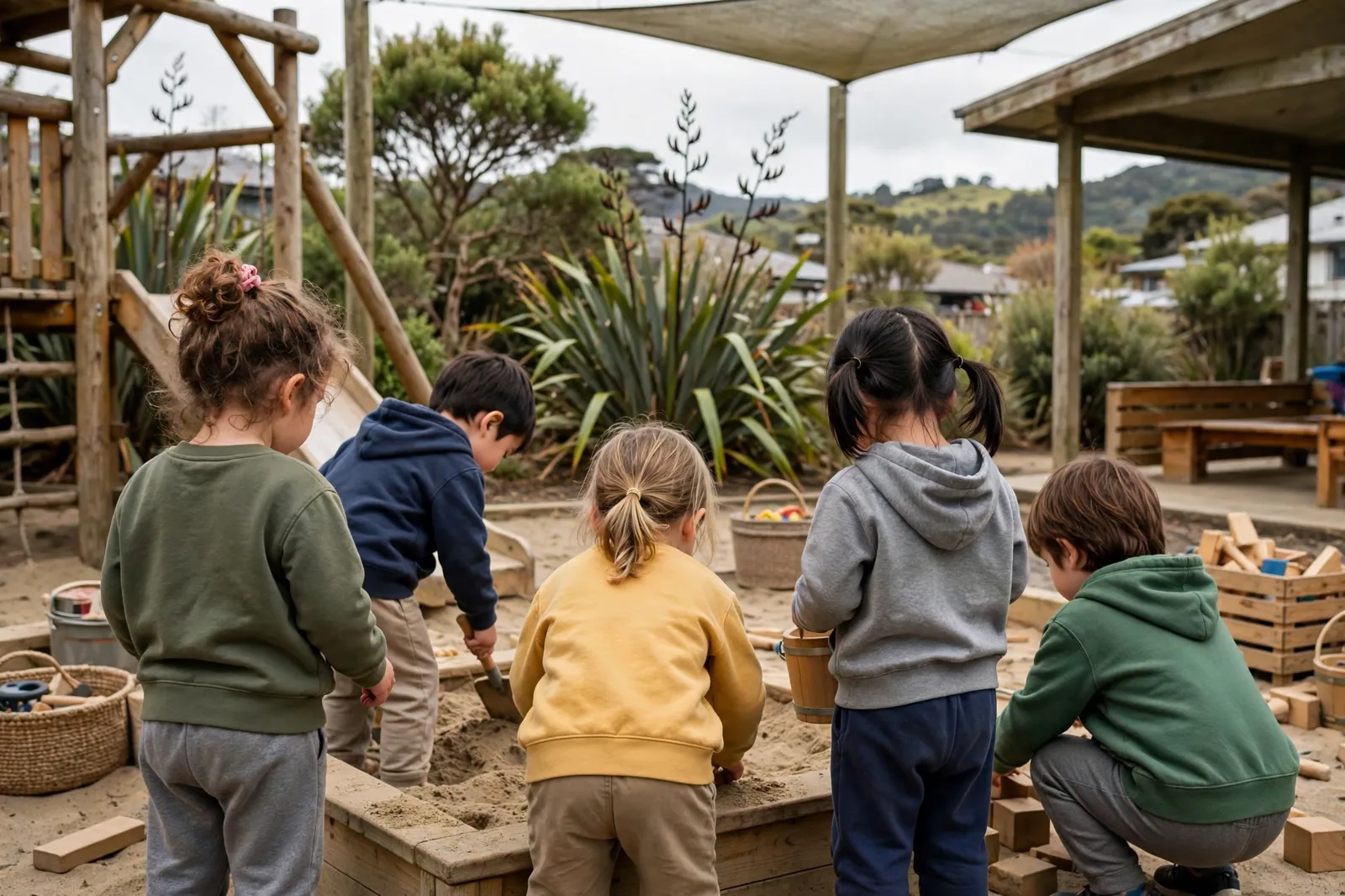
The centre sits at 12 E Settlers Crescent in Ferrymead, a quiet residential street in the east of Christchurch, in postcode 8023. On its own website the centre describes drawing families from Ferrymead and the nearby coastal and hillside suburbs, including Sumner, Redcliffs, Mt Pleasant, Heathcote and Brookhaven. It is a purpose-built building of 300 square metres, with what the centre describes as a large, natural outdoor play area where children have room to move, discover and create in the fresh air.
Ownership is unusually hands-on for a centre of any size. Ferrymead Preschool and Nursery is owned and operated by Tamasine Glassford and Jill Glassford, a mother and daughter-in-law team from Mt Pleasant. Tamasine is the centre manager as well as an owner, and Jill is the centre administrator and the other owner. When a family phones the centre about enrolling, the contact page directs them to Tamasine by name. In its 2021 parliamentary submission the centre described itself, in its own words, as a small family-owned ECE centre licensed for 50 children. That licence figure is the centre’s own published statement from 2021; it is a licence capacity, not a roll, and families who need the current capacity position should confirm it with the centre.
The centre is not part of a chain. There is no head office setting its fees, hours or philosophy from elsewhere in the country, and the pages on its own website, from its philosophy statement to its nursery information, are written for this one centre in this one suburb.
Two rooms: the nursery and the preschool
The centre is organised into two spaces by age. The nursery cares for children from three months to two years. The preschool caters for children from two to five years. That split follows the way the centre itself presents its service on its home page, and each room has its own teaching team.
The nursery page opens with a whakataukī, “Ahakoa he iti he pounamu”, translated on the page as “Although it is small, it is a treasure”. The centre says its nursery team aims to look after each baby as the family would, treating every baby as special and unique, with individual needs met while babies explore what it calls a safe, sunny and calm environment. Communication is a stated focus: teachers encourage positive interactions through the day, and children are given space, time and support to be themselves as they learn to explore in their own way. Resources are provided to support imagination and creativity, along with art, craft and sensory experiences, and the nursery programme follows Te Whāriki, the national early childhood curriculum.
The preschool room is described as a stimulating and fun environment for two to five year olds, led by the centre’s creative and passionate preschool teachers. The centre’s wider description of its indoor setting is of a relaxed, well-resourced and spacious environment, with the outdoor area doing much of the work of challenge and discovery: the centre says these environments give children endless opportunities to explore, be challenged, experiment and extend all areas of their development.

Hours and the shape of the day
The centre is open Monday to Friday from 7.30am to 5.30pm, and closed on Saturday and Sunday. That is a ten-hour day, five days a week, which places it at the full-day end of early childhood provision rather than the sessional pattern of a kindergarten. In its 2021 submission the centre itself made the comparison, noting that it is open ten hours a day where kindergartens are open for six, and that this shapes everything from staffing release time to when staff meetings can be held.
One fee-related point about the calendar is published prominently on the centre’s home page: the centre does not charge for public holidays. Its reasoning, in its own words on the site, is that families should not pay for something they cannot use. That is a published policy position of this centre, and it is worth confirming how it applies to a specific enrolment pattern when a family talks fees with the centre, because centres handle public holiday charging in different ways.
Within the day, the centre’s philosophy describes secure, unhurried routines and rhythms, with play experiences planned for each child and resources selected to support individual learning. Beyond those published descriptions, the centre does not publish a timetable of the day on its website, so this profile does not invent one. Families wanting the detail of drop-off routines, rest times and meal arrangements will find the centre expects to discuss those things directly, and the nursery page does answer the food question, covered in the practical notes below.
The teaching team
The centre publishes its staff by name and role on its About page, and the list is worth giving in full because it shows the structure of a small centre. Tamasine Glassford is Centre Manager and Owner. Jill Glassford is Centre Administrator and Owner. The preschool teachers named are Tania McDougall, Anita Bates, Kathryn Chitty, Rachel Drummond and Victoria Goodman. The nursery teachers named are Genna Ryan, Lauren Pirie, Corrie Taplin and Rachael Paterson.
That is the centre’s own published list. Staff lists change as people come and go, so treat it as the team the centre currently presents on its website rather than a guarantee of who will teach a particular child, and expect the centre to introduce the actual teachers during a visit.
On qualifications and pay, the most detailed published statement is again the centre’s own 2021 submission. In it, the centre said it employs qualified, experienced ECE teachers, that all of its qualified kaiako were paid at step 3 or above of the kindergarten pay parity scale at that time, and that most of its teachers would move up that scale if it opted into pay parity funding. Those are statements from 2021 about the centre’s position then, made in the context of a funding debate, and they are reported here as exactly that. The centre does not publish a current staffing qualification breakdown on its website.
The same submission gives the centre’s own statement of the ratios it worked to in 2021: one teacher to three children in the under-twos, and one to six in the over-twos. The centre argued in that submission that the regulated minimum ratios were, in its view, unsafe, and it recommended minimums of 1:3 for under-twos, 1:6 for two to four year olds and 1:8 for four to six year olds. Ratios are dated, operational facts, and a 2021 statement cannot be presented as the centre’s current roster. What it does show, on the record, is the direction of the centre’s own thinking about group sizes: smaller groups than the legal minimum requires, particularly for the youngest children. Any family for whom ratios matter should ask the centre for its current position.
Fees: what is published, and what is not
Ferrymead Preschool and Nursery does not publish a fee schedule on its website. That is stated plainly here because it shapes what this profile can and cannot tell you. The centre’s contact page says, in its own words: “Please contact the Centre for an up-to-date schedule of our fees.” So there are no fee figures in this article, for the simple reason that the centre has not published any on a page that could be read in full for this research. Any fee figure for this centre on a third-party directory site is not the centre’s published price, and families should not rely on one.
What the centre does publish about cost is structural rather than numerical. It does not charge for public holidays. It discusses 20 Hours ECE, the government scheme under which children aged three to five can receive up to 20 hours a week of funded early childhood education, in its own submission: the centre noted that children at the centre claim their funded hours there, and it raised a structural point about the scheme, that the six-hour daily cap means a child attending three eight-hour days (24 hours in total) could claim only 18 of the 20 hours. That is the centre’s own published account of how the scheme interacts with a full-day centre, and it is a useful thing for families at any long-hours centre to understand: at a centre open ten hours a day, how 20 Hours ECE is attested across the week matters, and it is a conversation to have with the centre before enrolling, not after the first invoice.
The centre’s About page also links families to Work and Income for information about childcare subsidies that may be available to their family. Subsidy eligibility and rates are Work and Income matters, set by government and changed from time to time, so no rates or thresholds appear here. The practical position for a family costing this centre is: get the current fee schedule from the centre itself, ask how 20 Hours ECE is applied across your child’s actual hours, ask how public holidays and absences are treated, and check any subsidy entitlement with Work and Income.
The centre’s philosophy
The centre publishes a full philosophy statement, headed “Ngā Kaupapa / Our Philosophy”, and it is the most substantial document on its website. Summarised in the centre’s own terms, management and teachers aim to provide a holistic early education service grounded in warm, trusting and respectful relationships. Its primary values are named as manaakitanga (respect), aroha (love) and atawhai (kindness), and it treats those values as the foundation of a healthy and safe learning environment.
Partnership with families runs through the statement. Authentic partnership and collaboration between teachers and whānau is described as a priority, so that parents’ aspirations form a critical part of teaching considerations, and the centre aims for whānau of every background, culture and identity to feel welcome and to belong. The statement acknowledges the partnership inherent in Te Tiriti o Waitangi and commits to nurturing te reo me ngā tikanga Māori.
On learning itself, the centre says it has confidence in play as the most profound tool for learning. Teachers plan specific play experiences for all children, design the environment and choose resources to support each child’s individual learning, and work within secure, unhurried routines. The setting is meant to feel homelike, where play, fun and challenge go together, imagination is celebrated, and the curriculum is one where, in the centre’s phrase, “we say ‘yes’ to trying new things”. Social and emotional development is a stated primary concern: teachers see themselves as role models, offer consistent and patient guidance, and support children’s growing language, social capability and cultural identity in an inclusive setting where children are empowered to make choices about their participation.
The statement also names the theory underneath the practice, which is unusual in its specificity for a centre website: the socio-cultural perspectives of Lev Vygotsky and Uri Bronfenbrenner, Mary Ainsworth’s attachment concepts, Erik Erikson’s lifespan theory, and the pedagogical guidance of Magda Gerber, Emmi Pikler and RIE. Underpinning it all, the centre views every child as bringing their own mana and wairua, as a competent learner with the right to learn, the right to peace and the right to loving and supportive adults. The statement closes with a standing commitment: unbiased, child-focused services, advocacy for the youngest citizens, listening to families, and always aiming to improve its professional provision and practice. The nursery programme, like the preschool’s, follows Te Whāriki, the national early childhood curriculum document.
Enrolling, and the question of waiting lists
The enrolment process, as the centre publishes it, starts in person or online. Families are invited to call in, have a look around and pick up an enrolment pack. Alternatively, the contact page carries an online enquiry form, and the centre manager will then contact the family to discuss their care and educational needs. The contact page names Tamasine as the person to talk to, on the centre’s phone number or mobile.
The centre does not publish waiting list information on its website: no list length, no expected wait, and no statement of current vacancies in either room. This profile therefore makes no claim about availability. In a centre licensed for a small number of children, places in the nursery in particular can turn on timing, because children move up to the preschool room and on to school in a steady flow. The honest advice the published material supports is to enquire early, visit, and ask directly about the position for your child’s age group and start date.
What about the ERO report and the roll?
Most profiles of this kind summarise the service’s Education Review Office report and its official roll. This one does not, and the reason is access, not judgement. ERO’s report for this centre could not be retrieved for this research, and no ERO report for Ferrymead Preschool and Nursery was read in full, so no ERO finding, rating or recommendation is stated anywhere in this article. Treat any ERO rating attached to this centre on a third-party directory or comparison site with caution until you have read the report itself on ERO’s website.
The same applies to the roll. The Education Counts profile, which holds the official roll and the equity index, could not be loaded for this research either, so no roll figure or equity index is stated. The figures this article does give, service number 46822 and a licence for 50 children as the centre stated in 2021, are labelled for what they are. A parent who needs the official numbers today can ask the centre directly, or open the Education Counts profile when it is accessible.
Practical notes for parents
The centre’s nursery page answers several of the everyday questions families ask, in a short frequently asked questions list. Families provide lunchboxes with food for their children; the centre does not supply meals. Every nursery child has a key kaiako, a named teacher who is that child’s key person. The centre provides wipes. Families are responsible for supplying nappies for their child, and those can be disposable or cloth.
From the centre’s other pages, a few more practical points. Children can start from three months old, which makes the centre an option for parents returning to work during a baby’s first year. The centre closes at weekends and does not charge for public holidays. Its About page provides links it considers useful for families, including KidsHealth for child health information, the Brainwave Trust on early brain development, the Ministry of Education’s parents site for early childhood information, and Work and Income for childcare subsidy information. And because the owners are on site, with the centre manager being an owner, questions about fees, availability and a child’s settling in go to the people who run the centre, which is the practical difference a family-run centre offers.
Frequently asked questions
Where is Ferrymead Preschool and Nursery?
It is at 12 E Settlers Crescent, Ferrymead, Christchurch 8023. The centre says it draws families from Ferrymead and nearby suburbs including Sumner, Redcliffs, Mt Pleasant, Heathcote and Brookhaven. Its phone number is 03 384 8026 and its email is admin@ferrymeadpreschool.co.nz.
What age children does Ferrymead Preschool and Nursery take?
Children from three months to five years. The nursery takes babies and toddlers from three months to two years, and the preschool room takes children from two to five years.
What are Ferrymead Preschool and Nursery’s hours?
Monday to Friday, 7.30am to 5.30pm, and closed on Saturday and Sunday. That is a ten-hour day, and the centre says it does not charge for public holidays.
How much does Ferrymead Preschool and Nursery cost?
The centre does not publish its fees on its website, so no figure can be given here. Its contact page asks families to contact the centre for an up-to-date schedule of fees. Ask also how 20 Hours ECE would apply across your child’s hours, because the scheme’s six-hour daily cap affects children attending long days.
Who owns and runs Ferrymead Preschool and Nursery?
It is family owned and operated by Tamasine Glassford and Jill Glassford, a mother and daughter-in-law team from Mt Pleasant. Tamasine is the centre manager and an owner; Jill is the centre administrator and an owner. It is not part of a chain.
Does my child need to bring food and nappies?
Yes to both, on the centre’s published nursery information. Families provide lunchboxes with food for their children, and families supply nappies, which can be disposable or cloth. The centre provides wipes, and every nursery child has a key kaiako.
How do I enrol my child at Ferrymead Preschool and Nursery?
Call in to look around and pick up an enrolment pack, or fill in the online enquiry form on the centre’s contact page and the centre manager will contact you to discuss your family’s needs. The centre does not publish waiting list information, so ask directly about availability for your child’s age group.
What is Ferrymead Preschool and Nursery’s ERO rating?
This profile does not state one. The centre’s ERO report could not be retrieved for this research, and no report was read in full, so no rating or finding is quoted. Read the report itself on the Education Review Office website rather than relying on a rating shown by a third-party directory.
Sources
- Ferrymead Preschool and Nursery, home page (ferrymeadpreschool.co.nz): the nursery and preschool age ranges, the public holiday charging position, the enrolment invitation, address, hours and contact details.
- Ferrymead Preschool and Nursery, About page: the purpose-built 300sqm centre, ownership by Tamasine and Jill Glassford, the named staff list with roles, and links for families including Work and Income.
- Ferrymead Preschool and Nursery, Philosophy page (“Ngā Kaupapa / Our Philosophy”): the centre’s values, its commitment to Te Tiriti o Waitangi and te reo me ngā tikanga Māori, play-based learning, and the theorists it names.
- Ferrymead Preschool and Nursery, Nursery page: the nursery’s approach, its key kaiako system, Te Whāriki, and its frequently asked questions on lunchboxes, wipes and nappies.
- Ferrymead Preschool and Nursery, Contact page: the address, the enrolment pack and online enquiry process, contact through Tamasine, and the statement that families should contact the centre for an up-to-date schedule of fees.
- Ferrymead Preschool and Nursery, written submission to the Education and Workforce Select Committee on the Education (Training Grants Budget and Measures) Amendment Bill, June 2021 (published on parliament.nz): the centre’s own statements that it is a small family-owned centre licensed for 50 children, open ten hours a day, working to ratios of 1:3 in the under-twos and 1:6 in the over-twos, employing qualified kaiako paid at step 3 or above of the kindergarten pay parity scale, and its account of how the 20 Hours ECE six-hour daily cap applies to children attending long days.
- Ministry of Education, Education Counts directory: the profile for this service, service number 46822, could not be loaded for this research (access error on every route); no roll or equity index figure is taken from it.
- Education Review Office: the report for this service could not be retrieved for this research; no ERO finding is stated in this article.
This article is general information about Ferrymead Preschool and Nursery, based on the centre’s own published pages and its own 2021 submission to Parliament, as read in October 2026. Fees, hours, staffing, ratios and availability change, and several of the centre’s own published statements used here date from 2021 and are labelled as such. Confirm the details that matter to your family, including the current fee schedule, current ratios and availability, directly with Ferrymead Preschool and Nursery before making enrolment decisions.