Glenbrook School: Enrolment, Uniform and Daily Life at a Rural Waiuku Primary

Glenbrook School is a state full primary school on Glenbrook-Waiuku Road, in the farming country north-east of Waiuku in Franklin, South Auckland. It teaches children from Year 1 to Year 8, with its youngest classes taking Year 0 and Year 1 children, and its roll sits just under 300. Few New Zealand schools can match its longevity. Teaching began on the site in 1877, when the school was known as Brookside, and it still carries its rural heritage proudly: a long-running Calf Club, a school pool, and a curriculum built around ako, learning as something you do.
The school’s stated purpose is “Realising Potential”, and its principal is Lysandra Stuart. This profile draws on what the school itself publishes, on the Ministry of Education’s Education Counts data, and on the Education Review Office’s published reports. One gap should be flagged at the outset: the school’s Education Counts directory profile page could not be loaded when this article was researched, so the school’s Equity Index (EQI) figure is not stated here. Everything else in this article comes from an official or primary source read in full.
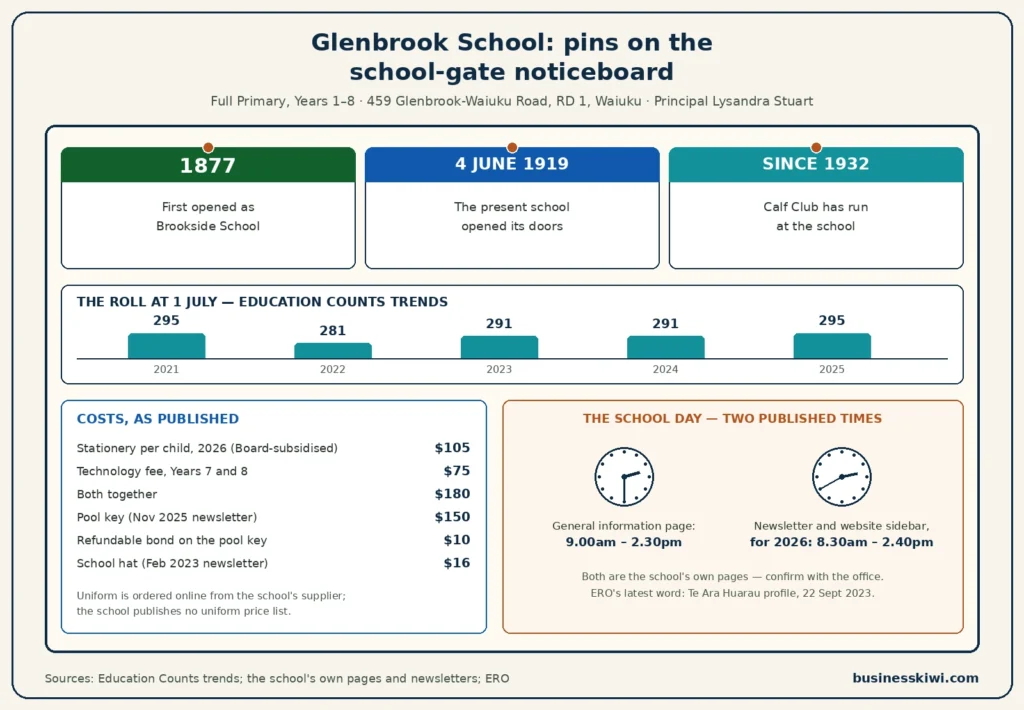
Glenbrook School at a glance
Where it is, and a history that starts in 1877
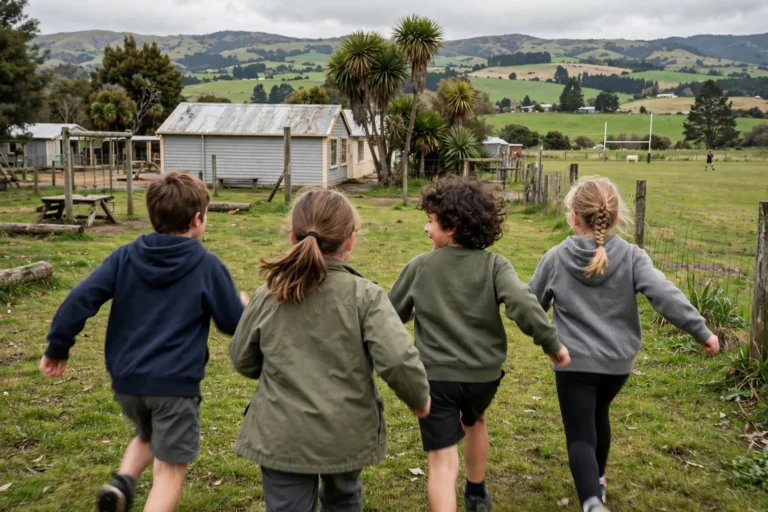
Glenbrook School stands on the main road between Waiuku and the Glenbrook steel mill area, in open farming country about seven kilometres from Waiuku township. The Education Review Office describes it as a school in a rural environment near Waiuku, and the school’s published material reinforces that identity. It is an active member of the Waiuku Kāhui Ako, the local community of learning, and of the wider group of Franklin district schools.
The school’s published history, prepared for its 125th jubilee in 2002, traces schooling at Glenbrook back to the 1870s. The district was known at various times as Pakington, Waiuku East, Ruakohua and Brookside, and the first school took the Brookside name from Brookside Farm, owned by E. Hamlin, who donated the school site to the Education Department in July 1876. The first teacher, Mrs Jane Dromgool, was appointed in January 1876, and the jubilee history concludes the school most likely opened in 1877, possibly with children taught in a shed or another building at first. The school’s website header marks the span “1877-2026”.
Those early decades were precarious. Brookside spent a period as a half-time school, sharing a teacher with Karioitahi, and was more than once threatened with closure. The original school stood across the road from the present buildings. The district adopted the name Glenbrook in 1912, although Education Board records kept calling the school Brookside until 1914. In 1918 the school came under its own school committee, four acres were bought for a new site, and the present school opened on 4 June 1919.
Twentieth-century Glenbrook was a classic country school. Calf Club began in 1932 and, apart from a few years, has been held ever since; the school still sets aside a Saturday in September for it. A swimming “bath” was completed in early 1945, and the school pool remains in use today, with families able to buy a pool key for the season. The roll passed 100 for the first time in 1950 and hovered around that level for decades, so today’s roll of close to 300 marks substantial growth.
The former school motto was “faith and work”. The current framing is different in language but similar in spirit: the school says it is bound strongly to its rural community, and aims to develop the whole child while holding high expectations for every student.
The roll: who learns at Glenbrook School
Education Counts publishes the school’s 1 July roll returns, and they show a roll that has been broadly stable in recent years after growing over the longer term. The totals were 295 in 2021, 281 in 2022, 291 in 2023, 291 in 2024 and 295 in 2025. For comparison, ERO recorded a roll of 264 at its December 2018 review.
The 2025 return breaks the roll down by ethnic group. Because ethnicity in these returns is multiple response, meaning a student who identifies with more than one group is counted in each, the group figures add to more than the total roll. Of the 295 students, 238 identified as European/Pākehā, 77 as Māori, 55 as Pacific, 43 as Asian, 16 as MELAA (Middle Eastern, Latin American and African) and 5 as another ethnic group. There were no international students. Girls numbered 145 and boys 150.
Two points stand out from those figures. The Māori roll has grown from 49 in 2021 to 77 in 2025, and the Pacific roll from 33 to 55 over the same period, so the school is becoming more diverse while remaining majority Pākehā. And this is the roll of a local community school, not one drawing fee-paying students from overseas or large numbers from outside its district.
What Education Counts does not give us here, because the school’s profile page could not be loaded, is the school’s Equity Index figure. The EQI has replaced decile ratings as the Ministry’s measure of socioeconomic barriers to achievement. Parents who want the current figure can find it on the school’s Education Counts profile or ask the school office.

Year levels, the school day and term dates
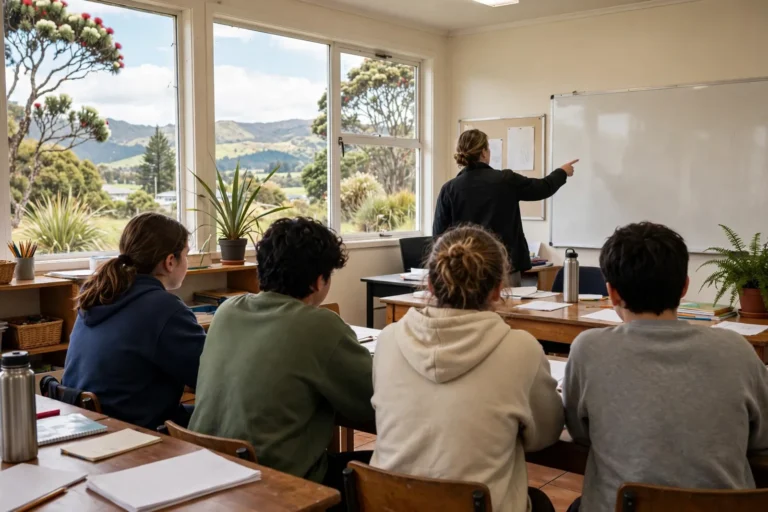
Glenbrook is a full primary school, so a child can start at five and stay through to the end of Year 8 before moving on to secondary school, usually Waiuku College. Teaching is organised into four teams named for native birds. Team Pīwakawaka covers the junior school, with classes for Years 0 and 1 and for Years 1 and 2. Team Tui teaches Years 3 and 4, Team Kererū teaches Years 5 and 6, and Team Haast teaches Years 7 and 8. Alongside the teams, the school has whānau groupings named for native trees, Tōtara, Taraire, Pūriri and Kahikatea, each with student whānau leaders.
Families should be aware that the school’s published pages give two versions of the school day, and the more recent advice is the one to plan around. The school’s general information page lists gates opening at 8.15am, classes beginning at 9.00am and school ending at 2.30pm, with staggered breaks and three bus runs after school. However, in its November 2025 newsletter the school told families that in 2026 the school day starts at 8.30am and finishes at 2.40pm, and its website sidebar gives the same times, with gates opening at 8.00am. The safest reading is that the 8.30am to 2.40pm day applies for 2026 and the general information page has not caught up; if the exact times matter, confirm them with the school office.
The school publishes its 2026 term dates as set by the Ministry of Education. Term 1 runs from Monday 2 February to Thursday 2 April, and includes a teacher only day on Monday 9 February when the school is closed for instruction. Term 2 runs from Monday 20 April to Friday 3 July. Term 3 runs from Monday 20 July to Friday 25 September, with Calf Club held on Saturday 26 September. Term 4 starts on Monday 12 October, and the school has said the end-of-year date was still to be confirmed because it depends on Ministry curriculum teacher only days.
Enrolment and the home zone
Glenbrook School has an enrolment scheme, and the Board of Governors has implemented a home zone. Children who live inside the zone are entitled to attend the school. The school describes its zone as starting at the westernmost point of Waitangi Falls Road, following the coastline around to Glenbrook Road, where addresses numbered 913, and 946 and above, are included. The boundary then travels west along Glenbrook Road to Gearon Road, runs south on Gearon Road and Glenbrook Station Road, takes in Farm Park Road while excluding Quinn Road, crosses farmland to Morley Road, and follows Morley Road west back to the coastline. Zone boundaries are legal descriptions, and the school links to a zone map from its enrolments page; any family close to the edge of the zone should check their address against the map or ask the school office rather than rely on a summary.
The school encourages families to pre-enrol as early as possible, because early enrolments help it plan, and it asks parents to complete enrolment documentation at least four weeks before a child starts. New entrant children whose pre-enrolment is completed in good time get two introductory transition visits before they start. To enrol, the school requires a birth certificate, an immunisation record, proof of address and the completed enrolment form; where a child is covered by a parenting agreement, it also requires the most up-to-date parenting order or custody agreement. Enrolment can be completed online through the school’s enrolment portal or on paper forms from the school office. Once the school has the completed forms and documents, it contacts the family to confirm acceptance and advises new entrant families of transition visit dates.
Out-of-zone enrolments are handled once a year. The school advertises out-of-zone places each September, after the Board has determined how many places will be available for the following year. For the 2026 school year, applications closed at 12pm on Wednesday 8 October 2025. The Board advised there were limited places across Years 1 to 8, and that preference would be given in the priority order set by the enrolment scheme guidelines: second priority to siblings of current students, third to siblings of former students, fourth to children of former students, and fifth to children of board employees or board members. If applications exceed places, a ballot is held. The school also asks families who live in the home zone to apply by the same date, purely so it can plan; living in zone carries the entitlement regardless.
Uniform, stationery and the other costs
Glenbrook School has a uniform, and it is bought online rather than through the school. Uniforms are ordered from the school’s supplier, Uniform Works, through its website, and can be couriered home or delivered to the school for pickup from the office. The school office keeps samples to try on, and holds a limited amount of older stock at discounted prices. The school does not publish a full uniform price list on its own website; prices sit with the supplier. One published price is the school hat: all students must wear a Glenbrook School hat in Terms 1 and 4, and the school listed hats at $16, from the office or online, in its February 2023 newsletter, so treat that figure as the last price the school itself has published rather than a current quote.
Stationery works differently from many schools. Glenbrook organises all stationery itself, so families pay a set charge and the school supplies everything, an approach it says ensures equity for all students. For 2026 the stationery charge is $105 per child, with the Board of Governors subsidising part of the cost to hold it at that level. The charge covers exercise books, student textbooks, pens, pencils, glue sticks, tape, colouring markers and outline pens. In Years 0 to 3 it also covers the disposable items junior children use heavily, and in Years 3 to 8 it covers access to digital platforms the school uses at school and at home, including Education Perfect, STEPs and Writers Toolbox. Teachers label everything so it is ready for the first day of term, and stationery stays at school until the end of the year. Payment can be made at the school office or online, and for 2026 it was due by Monday 16 February. The stationery charge does not cover additional activity or sports fees.
Years 7 and 8 students pay one extra charge. Their technology programme is taught at View Road School in Waiuku, which they attend once every two weeks across the year. The technology fee is $75 per student, on top of stationery, taking the total for Years 7 and 8 students to $180 in 2026. The programme covers art, cooking (food technology or biotechnology), sewing (textile technology), hard materials and electronics. On technology days students must wear covered shoes and be at Glenbrook by 8.15am to catch the technology bus; if a student misses it, parents need to drop them at View Road School themselves.
On donations, the position is simple to state: the school does not publish a school donation amount on the pages of its website read for this article, so no donation figure is given here. Families wanting to know whether a donation is requested should ask the school office.
Teaching, programmes and school culture
The school’s vision, developed in 2012 and reconfirmed through community consultation since, is that everyone at Glenbrook should be able to realise their own potential. Its purpose statement pairs that vision with an action: realising potential as learners, and accelerating ako agency. Ako is the school’s organising idea. It treats learning as an action, and teachers, students and whānau as partners in it, with connections, reciprocity and relationships at the centre.
That idea is given structure through the school’s Qualities of Learning, the capabilities it wants every learner to build: collaboration, thinking (using metacognition and problem solving), self-managing, communicating confidently and effectively, and being future focused. The school also celebrates what it calls FAILs, First Attempts In Learning, as a normal and useful part of learning. Its four values are whakawhanaungatanga (working as a community together), manaakitanga (caring for and valuing people and the world), mana (being respectful, strong and resilient) and ako (we are all learners). The vision, values and qualities are drawn together in what the school calls its Korowai of Learning.
In the classroom, the school says it develops the whole child, aims for excellence in English, mathematics and science, and balances the curriculum through integrated learning experiences, with opportunities across sport, outdoor education, culture, te reo Māori, STEAM, community events and the arts. Senior students take on leadership through a Roles and Responsibilities programme, while younger students learn through purposeful play and discovery. The Ministry of Education has published the school’s own account of this work: Glenbrook ran a Teacher-led Innovation Fund project, led by principal Lysandra Stuart, on developing ako agency with learners, coaching students to understand and lead their own learning and bringing whānau into learning conversations.
Te ao Māori is woven through the school’s charter in concrete ways. The school recognises Ngāti Te Ata as mana whenua. Every child and teacher learns and shares their pepeha, the day begins with a non-denominational karakia, kapa haka and waiata run weekly for the whole school, and te reo is taught weekly. A carving by local kaumatua George Flavell sits above the entrance to the school hall, telling the story of the school’s connections to te ao Māori and the development of the whole learner. The school also takes part in cultural exchanges and in the Franklin Cultural Festival, the Waiuku Matariki Concert and Franklin te reo competitions.
Parents are brought into learning formally as well. The school runs Akonui Hui, parent-teacher-student conferences, twice a year, and reports to parents against New Zealand Curriculum levels, with end-of-year achievement reports sent home. A parent portal gives families access to school and class information, their child’s assessment and progress, contributions and attendance.
What ERO found
The Education Review Office’s most recent published report on Glenbrook School is a Te Ara Huarau School Profile Report dated 22 September 2023. Te Ara Huarau is ERO’s improvement-focused approach, used in most English medium state and state-integrated schools, in which ERO works with the school over time rather than delivering a one-off verdict. The profile report was written within four months of ERO and the school working together under that approach.
In the 2023 report, ERO records that the school and ERO were jointly evaluating how effectively the school’s curriculum challenges learners to excel and achieve excellent, equitable outcomes for all learners. ERO identified three strengths the school can draw on: collaborative, strategic leadership highly focused on continuous improvement; comprehensive systems, processes and practices that create effective conditions for learners to succeed; and consistency in teaching and learning practices that is increasingly building evaluative skills within a positive school culture. Looking ahead, the school’s priorities were to keep strengthening its collective approach to equitable and excellent outcomes, and to keep implementing targeted actions that align the curriculum and challenge learners to excel. ERO said the next public report, a School Evaluation Report, would be due within three years of the profile report.
ERO’s previous full education review, in December 2018, gives a more detailed picture, though it is now dated. That review found the school achieving excellent outcomes for almost all students, with equitable outcomes for Māori students, and almost all students achieving within or above national expectations in reading, writing and mathematics on the school’s 2018 data. It praised high-quality teaching, leadership that built teacher capability, a responsive curriculum, effective governance and strong reciprocal relationships with parents and the community. Its suggested next steps were embedding learning progressions so students could better assess their own learning, and a more sequential school-wide approach to te reo Māori in classroom programmes. Readers should treat the 2018 judgements as history rather than a current verdict; the 2023 profile report is the latest word from ERO.
Practical notes for parents
A few published details are worth knowing before the first day. New entrants get two transition visits if the pre-enrolment is done in time, so the four-week documentation lead time matters. The school does not close early on wet days. Buses are a big part of life at a rural school: three bus runs leave after school, and on technology days the Years 7 and 8 bus leaves early enough that students need to be at school by 8.15am.
Swimming is part of the programme from the start of the year, using the school pool. During the swimming season students are expected to bring named togs, a rash shirt and a towel in a waterproof bag each day, and a note to the teacher is expected if a child cannot swim for medical or health reasons. Families can also buy a pool key for out-of-school use in season, priced at $150 with a $10 refundable bond in the school’s November 2025 advice, subject to numbers and to accounts being up to date or a payment plan being in place.
End-of-year prizegiving is an evening occasion; students in Years 0 to 7 wear full school uniform, while Year 8 students wear semi-formal dress. Before that, students spend a transition morning with their next year’s teacher and class. For everything else, the office is the first port of call: enrolments, portal logins, uniform samples and payment plans all run through it, on 09 235 3888 or admin@glenbrook.school.nz.
Frequently asked questions
What year levels does Glenbrook School teach?
Glenbrook is a full primary school teaching Years 1 to 8, and its junior team includes Year 0 classes, so children can start at five and stay until the end of Year 8. Teaching is organised into four teams: Pīwakawaka (junior), Tui (Years 3 and 4), Kererū (Years 5 and 6) and Haast (Years 7 and 8).
How many students go to Glenbrook School?
Education Counts records a roll of 295 at 1 July 2025. The roll has sat between 281 and 295 across the last five 1 July returns, and ERO recorded 264 at its 2018 review, so the school has grown over the longer term.
Is Glenbrook School zoned?
Yes. The school has an enrolment scheme with a home zone covering the Glenbrook area, roughly from Waitangi Falls Road along the coast to Glenbrook Road, taking in Gearon Road, Glenbrook Station Road and Farm Park Road, and back along Morley Road. Children living in zone are entitled to attend. Check your address against the school’s zone map if you are near the boundary.
How do out-of-zone enrolments work at Glenbrook School?
Out-of-zone places are advertised each September for the following year, in whatever numbers the Board determines are available. Applications for 2026 closed on 8 October 2025. Places are allocated in the priority order set by the enrolment scheme, favouring siblings of current and former students, children of former students, and children of board employees or board members, with a ballot if applications exceed places.
What does it cost to send a child to Glenbrook School?
The main published charge is stationery, which the school organises itself: $105 per child for 2026, partly subsidised by the Board. Years 7 and 8 students pay an additional $75 technology fee, a total of $180. Uniform is bought online from the school’s supplier, and the school does not publish a donation amount on its website, so ask the office about any donation or contributions.
Does Glenbrook School have a uniform?
Yes. Uniform is ordered online from Uniform Works and can be delivered home or to the school office, where samples are available to try on. All students must wear a Glenbrook School hat in Terms 1 and 4; the school last published the hat price at $16.
Who is the principal of Glenbrook School?
The principal is Lysandra Stuart. She is listed as principal in the school’s own staff and board information, signs the school’s newsletters as Principal/Tumuaki, and led the school’s Ministry-published innovation project on ako agency.
What did ERO say about Glenbrook School?
ERO’s latest report is a Te Ara Huarau School Profile Report from September 2023. It noted collaborative, strategic leadership, comprehensive systems that support learners to succeed, and consistent teaching practices within a positive school culture, with the school prioritising equitable and excellent outcomes. ERO’s earlier full review in 2018 found excellent outcomes for almost all students.
Sources
- Ministry of Education, Education Counts: Glenbrook School Student Population Trends (1 July roll returns 2021 to 2025), educationcounts.govt.nz
- Glenbrook School: Home page and School Charter page, glenbrookschoolnz.com
- Glenbrook School: General Information page (staff, board, school information and school hours), glenbrookschoolnz.com
- Glenbrook School: Our Stories page (125th jubilee history of the school), glenbrookschoolnz.com
- Glenbrook School: Learning at Glenbrook School page and Qualities of Learning page, glenbrookschoolnz.com
- Glenbrook School: Enrolment page, Enrolments page and Enrolment Zone page, glenbrookschoolnz.com
- Glenbrook School: Stationery page (2026 stationery costs) and Technology page, glenbrookschoolnz.com
- Glenbrook School: Uniform Order Form page, glenbrookschoolnz.com
- Glenbrook School: Term Dates page (2026 term dates), glenbrookschoolnz.com
- Glenbrook School: Week 5, Term 4 Newsletter, November 2025, and Week 1, Term 1 2023 newsletter, glenbrookschoolnz.com
- Education Review Office: Glenbrook School Te Ara Huarau School Profile Report, 22 September 2023 (published on the school’s website)
- Education Review Office: Glenbrook School Education Review, 21 December 2018 (published on the school’s website and on ero.govt.nz)
- Ministry of Education, Education Counts: Glenbrook School Teacher-led Innovation Fund project summary (Learning as an action: How to develop reciprocal ako agency with learners), educationcounts.govt.nz
This article is general information about Glenbrook School based on official and primary sources published by the Ministry of Education, the Education Review Office and the school itself, as read in October 2026. School details such as rolls, charges, term dates and bell times change, and the school’s own pages currently give two versions of the school day, so confirm anything you are relying on with the school office before making decisions for your family.