Internships in NZ: Paid vs Unpaid, Your Rights and How to Land One

An internship can be the bridge between study and a career, or it can be unpaid labour dressed up in a friendlier word. Both versions exist in New Zealand, and the difference is not always obvious from the advertisement. What separates a genuine learning opportunity from a business getting free work is partly the quality of the placement, and partly the law. New Zealand employment law draws a clear line between a volunteer and an employee, and where an internship falls on that line decides whether you must be paid, what agreement you should have, and what rights you can rely on if things go wrong.
This guide explains how internships work in New Zealand, what the official guidance says about paid and unpaid placements, where internships are offered, and how to check an opportunity before you commit your time to it.
What an internship is, and what it is not
An internship is a fixed period of work with an organisation, taken to gain experience, skills and contacts in a field you want to enter. Tahatū, the government careers service run by the Tertiary Education Commission, describes an internship as one of several forms of work experience, alongside job shadowing, volunteering, and part-time or seasonal jobs that may lead somewhere permanent. The unifying feature is purpose: you are there to learn how a workplace and an occupation actually function, not simply to fill a vacancy.
In practice, internships here come in three broad forms. The first is the paid summer or graduate-entry internship, common in larger private firms, councils and government agencies, where the intern is hired as an employee for a set period. The second is the course-integrated placement, where the internship is part of a qualification and is organised or approved through a university or polytechnic, often with coursework attached. The third is the unpaid placement, lawful only in narrow circumstances, usually where the work is genuinely voluntary, is for a community or charitable organisation, or forms part of a course.
Two neighbouring arrangements are often confused with internships. Work experience, in the school and early-career sense, is usually shorter and more observational: you watch, help with basic tasks and get a feel for a workplace. Volunteering is different again. A volunteer, as Employment New Zealand puts it, does not expect payment for the work they do and must not receive any. Universities also offer studentships, a form of scholarship often tied to research, which are not employment either. The label an organisation puts on an arrangement matters far less than its substance, and that is where the law comes in.
The legal position: employee or volunteer
New Zealand does not have a separate legal category for interns. Every arrangement falls on one side or the other of a single line. Employment New Zealand states the position plainly: volunteers and unpaid interns are not employees and are not covered by employment law, although health and safety law still applies to them. Paid interns, by contrast, are employees with the full set of employment rights.
Whether someone is a genuine volunteer depends on the reality of the arrangement. A volunteer does not expect payment and must not receive payment, though reimbursement of out-of-pocket costs and a koha or thank-you gift do not count as payment. Employment New Zealand advises employers offering an unpaid work trial, internship or work experience placement to do four things: put it in writing that the position is a volunteer position and the person does not expect payment or other reward; avoid getting an economic benefit from the volunteer’s work; avoid having the volunteer do work integral to the business, such as work an employee would ordinarily do; and limit the duration and hours, because the longer someone volunteers and the more hours they work, the more likely they are to be considered an employee.
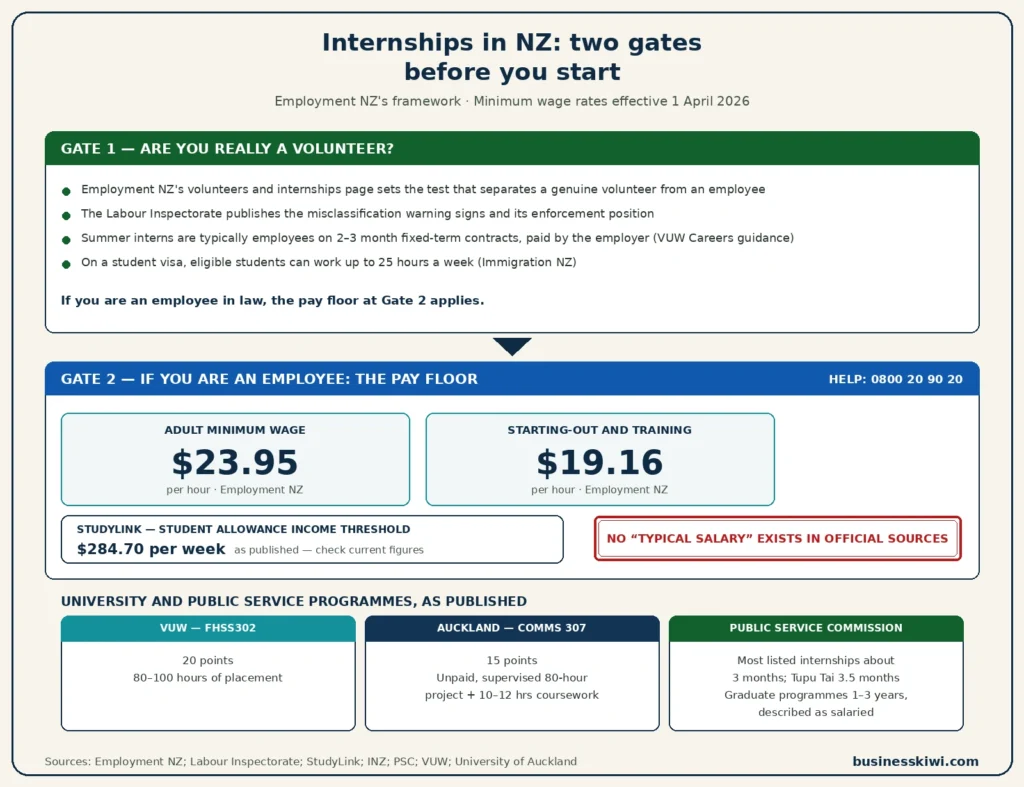
If an internship is paid, the ordinary rules of employment apply. Employment New Zealand says a paid intern should be paid at least the relevant minimum wage and should have an employment agreement, usually for a fixed term matching the internship, with the reason for the fixed term set out in it. All the usual employment rights apply. The adult minimum wage is $23.95 an hour, effective from 1 April 2026, with starting-out and training rates of $19.16 an hour for the narrower groups those rates cover. If you are 16 or over and working as an employee, you must be paid at least the minimum wage for every hour worked.
The Labour Inspectorate, the enforcement arm of the Ministry of Business, Innovation and Employment, approaches the same question from the other direction. Its position statement on work in a business without payment of wages lists indicators that a worker should not be classified as a volunteer and is potentially an employee: the worker is being paid or rewarded, including with free accommodation or food; the worker expected to be rewarded; the business gains economically from the work; the work is integral to the business and is work an employee would normally perform; and the worker’s hours are controlled by the business. The Inspectorate’s starting position is that people working in a business in exchange for rewards of that kind are employees, in which case the employer must provide a written employment agreement, pay at least the minimum wage in money, keep records of hours and wages, provide holiday entitlements and meet obligations such as PAYE and ACC. Where a business has misclassified workers, enforcement action is likely. If you believe you are being paid less than the minimum wage, Employment New Zealand advises reporting it by calling 0800 20 90 20.
One more distinction matters. An unpaid work trial, where a job applicant demonstrates their skills, sits in the same legal territory: it is only defensible if it is genuinely unpaid by agreement, short, and not productive work the business profits from. A “trial” that stretches into regular shifts doing staff work is not a trial. It is a job, and it should be paid as one.
Red flags: when an unpaid internship crosses the line
Because the legal test turns on substance, you can assess an unpaid offer by comparing it against the official indicators. Treat the following as warning signs:
- You would be doing work an employee would ordinarily do, such as serving customers, producing client work or covering a vacancy.
- The business gains economically from your work, for example by charging clients for your time or avoiding a hire it would otherwise need.
- The hours are long, regular or open-ended. Full-time weeks over many months look like employment whatever the arrangement is called.
- Your hours are controlled like a staff member’s, with set shifts and required attendance.
- You are promised a reward instead of wages, such as accommodation, food, vouchers or a future paid job held out as payment for work now.
- Nothing is in writing. A genuine volunteer arrangement should be recorded as one. Vagueness about status suits the business, not you.
- You are replacing paid staff, or the organisation runs on a rotating cast of unpaid interns doing core work.
- The placement is with a commercial business, not a charity or community organisation, and it is not part of your course. That combination is the hardest to justify as volunteering.
None of this means every unpaid placement is unlawful. A short, supervised placement with a community organisation, or a course placement where the learning is structured and assessed, can be both lawful and worthwhile. The red flags matter because they show who is really benefiting.
Where internships sit: sectors and providers
Internships cluster where employers hire graduates in volume or where a qualification requires workplace learning. In the private sector, the most visible are the summer internships run by larger firms in law, accounting, engineering, construction, banking, technology and consulting. These are generally paid employment: Victoria University of Wellington’s careers service notes that during what is typically a summer experience, interns are classed as employees of the organisation on a fixed-term contract of two or three months, and are generally paid directly by the employing company. Smaller businesses take interns less formally, sometimes through a university programme and sometimes through direct approaches.
The public sector is a significant provider in its own right, covered in more detail below. Local and regional councils also run internships and cadetships; Tahatū suggests checking your council’s own website to see what it offers. Health, education and social services generate large numbers of course-required placements, because many qualifications in those fields cannot be completed without supervised practice.
The community and not-for-profit sector is the third main setting. Tahatū notes that these organisations are often small and may not advertise internships, but may still offer project-based, short-term internships that may be paid, unpaid or volunteer based. This is also where genuine volunteering is most defensible, because the work is charitable or civic rather than commercial. Creative and media industries have a long tradition of unpaid experience, which is exactly why the legal tests above matter when you assess an offer there.
Finally, be aware that a private matching market exists. Tahatū points out that some private programmes and organisations will match you with an internship for a fee. A fee-charging placement service is a commercial product, not an official channel, and paying for a placement is no guarantee of its quality or legality. Check whether your own institution’s careers service can help you free of charge first.

University and polytechnic programmes
For many students, the safest route into an internship is through their own institution, because the placement is structured, supervised and connected to credit. Universities build internships into degrees in two main ways: as a dedicated work-integrated learning course, and as a placement requirement inside professional programmes such as teaching, nursing, social work and clinical psychology.
Victoria University of Wellington’s Faculty of Humanities and Social Sciences runs an internship course, FHSS302, open to undergraduate students from across the university. As the university publishes it, the course is worth 20 points, is assessed pass/fail, and combines an internship of 80–100 hours with workshops, readings and assignments. Entry is limited. If your application succeeds, the internships coordinator works with you to identify a suitable project and organisation, you build a detailed plan with your host, and a workplace supervisor guides your tasks. Hosts include businesses, government departments, charities, NGOs and cultural and sporting organisations around Wellington.
The University of Auckland’s Communication internship programme works on a similar model at a smaller scale. It is a 15-point Stage III course (COMMS 307) for third-year Bachelor of Arts and Bachelor of Communication students, built around an unpaid, supervised 80-hour project in a workplace plus 10–12 hours of coursework. Projects come from media, public relations, advertising, broadcasting and corporate communication, as well as NGOs and charities. Students can apply for a listed project or organise their own, and the process includes a tailored CV, which the university reviews before it goes to the organisation, and an interview arranged by the host. The internship is unpaid because it is short, supervised, project-based and completed for course credit.
Polytechnics and institutes of technology take an applied approach, and placements, industry projects and internships are built into many of their programmes as a condition of completing the qualification. Details differ by programme, so the reliable source is always your own provider: its programme pages, your tutor, and the institution’s careers or employability service.
Both universities also illustrate the support that should come with a course placement. Wellington’s careers service tells students to be clear on their workplace rights and obligations before they start, to read the contract in advance, and to raise concerns during the internship with a senior person, university staff or support services. It also points students to Employment New Zealand’s free introductory e-learning module on employment rights, designed for all employees, including people on internship contracts.
Government and public service internships
The Public Service Commission maintains a directory of graduate programmes and internships across government agencies, and it is the natural starting point for public sector opportunities. The Commission notes that internships are available across the public service with a range of focus areas, intake timeframes and application processes, and that they can expose you to different kinds of work, experience across agencies and diverse role models. Some programmes are run by a single agency for its own needs; others are cross-agency programmes placing interns across several participating agencies.
Most of the internships listed run for about three months, typically over summer. Examples in the Commission’s directory include the Ministry of Education Summer Internship Programme for students, the Ministry of Social Development’s cross-agency Analytics and Research in Government Internship Programme for people with a passion for data, analysis or research (three months), the Government Health and Safety Summer Internship coordinated by the Ministry for Primary Industries (three months), the Department of Corrections’ Summer Internship Programme (three months), and the Ministry of Business, Innovation and Employment’s Tupu Tai programme, a cross-agency Pasifika public sector summer internship running three and a half months. Some listed programmes are recorded as currently on pause, including the Department of Conservation summer internship and several Ministry of Foreign Affairs and Trade programmes, so treat the directory as a map of what exists and check the agency’s own careers pages for whether applications are open. Longer placements exist too: the Ministry of Education’s Psychology Internship, for postgraduate psychology students completing required supervised practice, runs for eleven months.
Graduate programmes are a separate category and should not be confused with internships. They are for people who already hold a tertiary qualification, run from one to three years depending on the agency, and the Commission describes them as offering early-career exposure, formal training, feedback and a competitive salary: ordinary paid employment with a development structure. If you are finishing study and weighing an unpaid internship against applying for a graduate programme, that difference in status and pay is the central fact.
Money matters: student support while you intern
If you receive a Student Allowance, paid work during an internship affects it, and the obligation to report sits with you. StudyLink states that if you or your partner receive any income, you need to tell StudyLink straight away, because it could affect your entitlement, and failing to declare income can leave you with a debt to repay. On StudyLink’s published figures, the first $284.70 a week before tax of your personal income is not counted; income above that reduces your allowance cent for cent. You declare income through MyStudyLink by the Sunday of the week you earn it, not the week you are paid, and the declared amount continues each week until you say it has changed. Rates and thresholds change over time, so check the current figures on StudyLink before budgeting around a paid placement.
Two practical consequences follow. First, a short, full-time paid internship over summer can reduce or pause your allowance for those weeks, which is manageable if you declare it on time. Second, an unpaid internship creates no income to declare, but it also does not pay the rent, which is a legitimate factor in deciding whether you can afford to accept one. Run the numbers before you start rather than after.
How to find and apply
Start with the channels that cost nothing and carry some oversight. Your university or polytechnic careers service is the first port of call: it administers course placements, advertises employer programmes, reviews CVs and can tell you which employers have hosted students before. Tahatū publishes guidance on work experience and internships and is a useful second source of structured advice, particularly if you are not currently studying. From there, go to employers’ own careers pages: agencies, councils and larger firms publish their internship and graduate intakes on their own sites, and the Public Service Commission’s directory links through to agency programmes.
Tahatū’s advice on applying for work experience applies equally to internships. Choose an area you are already interested in and a role you would genuinely like to try. Think about who can help you find a placement: friends, whānau, teachers, career advisers, and people in your clubs, sports teams and community groups, as well as organisations you find online. Prepare your CV so it shows your skills, strengths and achievements, and tailor it to the opportunity; Auckland’s communication programme makes a tailored CV a formal part of the process, reviewed before the organisation sees it. A good cover letter that explains why you want that placement, with that organisation, will usually carry more weight than a generic one sent to twenty places.
If an employer wants to meet, treat the meeting like a job interview: dress neatly, arrive on time, and be ready to answer questions about yourself. Tahatū specifically advises using that conversation to ask what you will be doing, what hours you will work and what you will be paid. Those questions are not presumptuous; they are the basic facts of the arrangement, and an employer who cannot answer them clearly has not thought the placement through. Direct approaches also work: community organisations may not advertise, and contacting one directly, with a specific project or offer of help in mind, is a legitimate way to create an opportunity that was never listed anywhere.
What to check before you accept
Before you agree to any internship, paid or unpaid, get the essentials clear and, wherever possible, in writing.
Status and agreement. Establish whether you are an employee or a volunteer, and expect the paperwork to match. A paid internship should come with an employment agreement, usually fixed-term, stating the reason for the fixed term. An unpaid arrangement should be recorded in writing as a volunteer position with no expectation of payment or reward. If the organisation will not put anything in writing, walk away.
Pay. If you are an employee, confirm the rate and check it against the minimum wage: $23.95 an hour from 1 April 2026, with starting-out and training rates of $19.16 for the specific groups they cover. Ask how and when you will be paid, and remember that wages must be paid in money; rewards in kind do not discharge a wage obligation. If the role is unpaid, be clear about what you are getting instead: course credit, a defined project, supervision and a reference are real value; vague promises of exposure are not.
Hours and duration. Agree the start and finish dates, the days and hours, and what happens if the work runs over. Duration is part of the legal picture for unpaid placements, and part of the practical picture for you: an open-ended commitment can quietly consume a semester.
Learning value and supervision. Ask who will supervise you, what work you will actually do, and what you will be able to show for it at the end: a portfolio piece, a project, skills you can describe in your next application, a referee. Both Wellington’s careers guidance and Tahatū advise asking for feedback during the placement and asking your manager to act as your referee afterwards. Build those asks in from the start rather than hoping they happen.
Support and problems. Know who to contact if something goes wrong, whether that is a university coordinator, a careers adviser or a senior person in the organisation. Paid employees have the full protection of employment law; volunteers are covered by health and safety law but not employment law, another reason to be certain which side of the line you are on before you start. If an arrangement you have already started turns into unpaid staff work, Employment New Zealand can advise, and suspected underpayment of the minimum wage can be reported on 0800 20 90 20.
International students: internships on a student visa
If you are studying in New Zealand on a student visa, your visa conditions decide what work you can do, and Immigration New Zealand is explicit that you should check the conditions on your eVisa or visa letter. Many tertiary students may work part-time for up to 25 hours a week, and full-time during scheduled breaks where their course meets the stated conditions. Those are general work rights, and an internship has to fit within them unless it counts as practical experience for your course.
That category matters. Immigration New Zealand publishes a section on working to get practical experience: if practical experience is a requirement of your course, it will normally grant a student visa with conditions that allow you to work to complete it, provided it is satisfied the work is an approved course requirement. An internship your provider requires and approves therefore sits in a different position from one you arrange independently. Two limits apply regardless: international students cannot be self-employed, so you must work for an employer under an employment agreement; and the employment law position described above applies to you as to any other worker, including the minimum wage if you are an employee. If your visa does not currently allow the work an internship involves, Immigration New Zealand advises contacting it for help rather than starting anyway, because working outside your visa conditions puts the visa itself at risk.
Frequently asked questions
Are internships in New Zealand paid?
Some are and some are not. Paid interns are employees and must be paid at least the relevant minimum wage, with an employment agreement and full employment rights. Unpaid internships are lawful only where the intern is a genuine volunteer under the tests Employment New Zealand publishes, or where the placement forms part of a course. No official figure exists for a typical internship wage or stipend.
Can an employer legally offer me an unpaid internship?
Only in narrow circumstances. The arrangement must be genuinely voluntary: it should be in writing that the position is a volunteer position with no expectation of payment or reward, the business must not gain an economic benefit from your work, you must not do work integral to the business that an employee would ordinarily do, and the hours and duration must be limited. If those conditions are not met, you are likely an employee and should be paid.
What is the minimum wage for an intern?
If you are an employee aged 16 or over, at least the relevant minimum wage for every hour worked. The adult minimum wage is $23.95 an hour effective from 1 April 2026. Starting-out and training rates of $19.16 an hour apply only to the specific groups of workers Employment New Zealand defines. There is no separate, lower intern rate.
Do I need an employment agreement for an internship?
If the internship is paid, yes. Employment New Zealand says a paid intern will need an employment agreement, usually for a fixed term matching the internship, with the reason for the fixed term stated. If the internship is unpaid and voluntary, there is no employment agreement, but the volunteer status should still be set out in writing.
Will a paid internship affect my Student Allowance?
It can. StudyLink requires you to declare any income straight away. On its published figures, personal income up to $284.70 a week before tax is not counted, and income above that reduces your allowance cent for cent. Declare income by the Sunday of the week you earn it, and check the current thresholds on StudyLink, as they change.
I am an international student. Can I do an internship?
That depends on your visa conditions, which you should check on your eVisa or visa letter. If the internship is practical experience required by your course, Immigration New Zealand will normally grant visa conditions allowing you to work to complete it, where the work is an approved course requirement. You cannot be self-employed, so the internship must be with an employer under an employment agreement.
How long do internships usually last?
There is no standard length. University course internships can be as short as 80 to 100 hours spread across a trimester. Public service internships listed by the Public Service Commission mostly run for about three months over summer, while its listed psychology internship runs eleven months, and private sector summer internships are commonly fixed-term contracts of two or three months. For unpaid placements, shorter is legally safer: the longer an unpaid arrangement runs and the more hours it involves, the more likely the intern is an employee in law.
What can I do if my unpaid internship turns into unpaid staff work?
Raise it first with the organisation if you feel able to, and with your university coordinator or careers service if the placement came through your institution. Employment New Zealand can advise on your status and rights, and if you believe you are being paid less than the minimum wage as an employee, it advises reporting this by calling 0800 20 90 20. Keep your own records of hours worked and tasks done.
Sources
- Employment New Zealand, “Volunteers, internships and studentships”, employment.govt.nz
- Employment New Zealand, “Minimum wage rates and types”, employment.govt.nz
- Labour Inspectorate (MBIE), “Position Statement: Work in a Business Operation Without Payment of Wages”, published on employment.govt.nz
- Tahatū (Tertiary Education Commission), “How internships work”, tahatu.govt.nz
- Tahatū (Tertiary Education Commission), “How to get work experience”, tahatu.govt.nz
- Public Service Commission Te Kawa Mataaho, “Graduate programmes and internships”, publicservice.govt.nz (page dated 27 August 2026)
- Te Herenga Waka, Victoria University of Wellington, “FHSS Internship”, wgtn.ac.nz
- Te Herenga Waka, Victoria University of Wellington, Wellington Careers and Employment, “Health, safety, rights and responsibilities” (internships guidance), wgtn.ac.nz
- University of Auckland, “Communication internship programme”, auckland.ac.nz
- Immigration New Zealand, “Working on a student visa”, immigration.govt.nz
- StudyLink (Ministry of Social Development), “How income affects Student Allowance”, studylink.govt.nz
This article is general information about internships in New Zealand, based on official sources published at the time of writing. It is not legal, employment or immigration advice, and it does not assess any individual arrangement. Whether a particular internship is lawful, and whether you are an employee or a volunteer, depends on the facts of the arrangement. For advice on your own situation, contact Employment New Zealand, your institution’s careers service, or Immigration New Zealand for visa questions, and consider independent legal advice for employment disputes.