Media Jobs in New Zealand: Roles, Pay and How to Get In

“Media jobs” covers a wider range of work than most people picture. It includes the reporters filing stories for news websites and radio bulletins, the producers and camera operators behind television programmes, the editors who shape raw footage into finished stories, and the growing group of content writers and creators who publish directly to online audiences. Sitting next to the industry, rather than inside it, are communications and public relations roles, where the job is to promote an organisation rather than report on it.
This guide maps the main media roles in New Zealand, what each one involves, and how people get into them. Pay and job outlook figures come from Tahatū Career Navigator, the Tertiary Education Commission’s careers database (the service that replaced careers.govt.nz), whose dataset covers more than 800 jobs with descriptions, tasks, pay data and entry information. Tahatū publishes pay in three bands: a lower figure, the range most people in the role earn, and an upper figure. All pay is before tax. Where Tahatū publishes no data for a role, this guide says so rather than filling the gap with estimates from job boards or salary surveys, which are not used here.
The New Zealand media landscape
News and journalism. Newsrooms employ journalists, editors and producers to gather and publish news across print, online, radio and television. Public broadcaster RNZ sits alongside commercial news organisations such as Stuff and NZME, plus smaller regional and community outlets. Tahatū counts about 1,800 people employed as journalists in New Zealand and describes employment change in the occupation as steady.
Broadcasting. Television and radio employ presenters, producers, journalists, camera operators and broadcast technicians. Tahatū’s film, broadcasting and publishing group puts broadcast technicians at a most common pay range of $59,000 to $97,000 a year and camera operators at $60,000 to $111,000. Presenting is rarely a standalone occupation in the official data. It usually sits inside other roles: Tahatū’s journalist profile covers multimedia journalists who report on air, and broadcasting degrees list presenter among their graduate roles.
Digital and social content. Media organisations now publish first to websites, apps and social platforms, and many businesses employ content staff of their own. Tahatū lists a content creator occupation in its film, broadcasting and publishing group, covering people who produce and share imagery, audio and written content for online platforms, with a most common pay range of $61,000 to $107,000 and no specific training required. Its content writer profile, which covers copywriters and digital writers, is covered in the role profiles below.
The screen sector. Film and television production is project based: a production is funded, a crew is assembled, and the team moves on when the work wraps. Public funding shapes much of the local industry. NZ On Air, the Broadcasting Commission, funds public media content across television, radio, music and digital media, including scripted and non-fiction production, and provides platform funding for public media services. Producers, directors, editors, camera operators and technicians all work within this funding driven structure.
Behind the scenes and publishing. Around the on air and bylined roles sits a layer of technical and craft occupations. In Tahatū’s film, broadcasting and publishing group, audio visual technicians (most common pay $61,000 to $96,000) set up and operate the equipment behind live and recorded production, and casting directors ($67,000 to $137,000) find and select performers. Publishing still appears in the same group: desktop publishers, who lay out pages and prepare material for print and digital publication, show a most common range of $68,000 to $93,000, and creative writers, covering authors and scriptwriters among others, $50,000 to $106,000. These roles rarely make headlines, but productions and publications do not happen without them.
Communications and public relations (adjacent, not journalism). Communications professionals work for organisations, including government agencies, councils, companies and charities, and their job is to promote and protect the organisation’s public image. Public relations specialists and media advisors sit inside this occupation in Tahatū’s data. The skills overlap with journalism, and people do move between the two, but the purpose is different: a journalist reports for an audience, while a communications professional advocates for an employer. This guide covers the occupation because it is a major destination for media skills, but it is labelled as adjacent wherever it appears.
The main roles
Journalist
Journalists research and write stories and report news and issues for broadcast, print, web and digital media, interviewing people as part of their investigative work. Tahatū also lists columnist, reporter, reviewer, writer and multimedia journalist as other names for the role. The work ranges from filing short news stories on deadline to longer investigations, and in smaller newsrooms one journalist may report, record, photograph and publish the same story across several platforms.
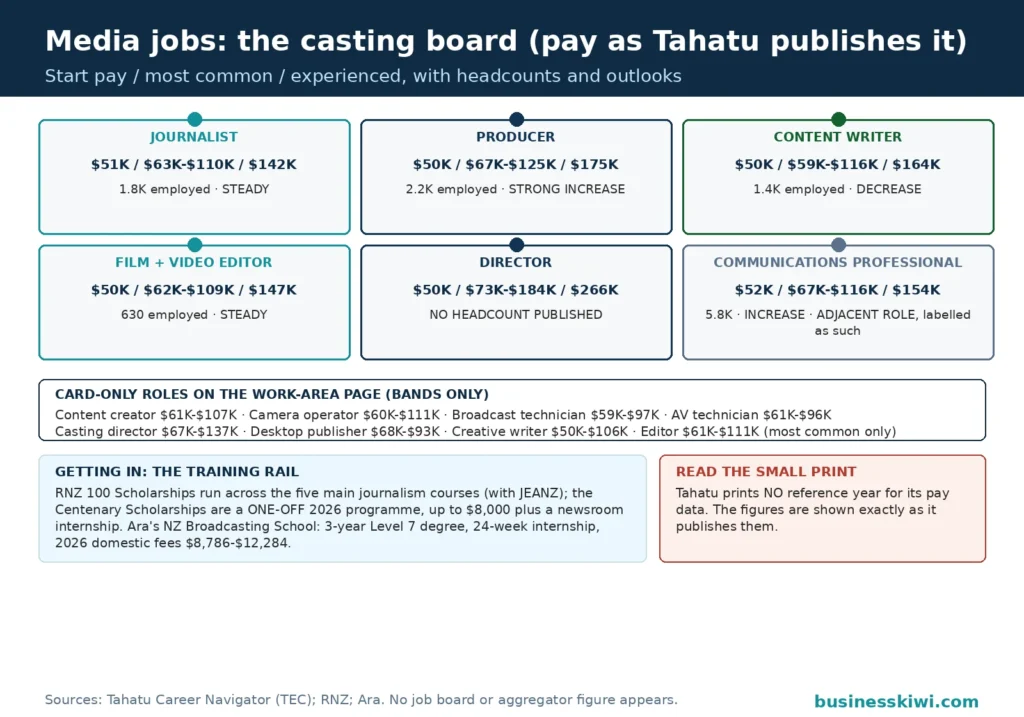
Tahatū puts typical training for journalists at 0 to 2 years, and the standard entry route is one of the country’s journalism courses, covered in the pathways section below. Pay: a lower band of $51,000, a most common range of $63,000 to $110,000, and an upper figure of $142,000 a year. About 1,800 people are employed as journalists, and Tahatū describes employment change as steady.
Editor
Editors oversee the editing of written material. They review proposals and drafts for publication and manage editorial staff, according to Tahatū, which lists the occupation in its marketing and communications group. In news media, editors decide what gets covered, assign stories, check copy for accuracy and legal risk, and carry final responsibility for what is published. Editing is normally a step up from reporting or writing roles rather than a first job.
Tahatū puts typical training at 0 to 2 years and publishes a most common pay range of $61,000 to $111,000 a year for editors.
Producer
Producers plan and make films, television, music, theatre, digital content and other creative productions. They develop and present ideas and manage people and budgets, in Tahatū’s description. The occupation covers film and TV producers, music producers, radio producers and production assistants, so it spans both the person running a production and the junior roles learning the trade on one. Radio producers shape programmes and line up talent; television and film producers pull together funding, schedules and crews.
Tahatū puts typical training for producers at 0 to 2 years. Pay: a lower band of $50,000, a most common range of $67,000 to $125,000, and an upper figure of $175,000. About 2,200 people are employed as producers, and Tahatū records employment change as a strong increase, the strongest outlook of any role in this guide.
Film and video editor
Film and video editors use editing software and other tools to turn raw film or video footage into a finished version. The occupation includes video editors, assistant editors, visual effects editors, motion graphics editors and supervising editors, and Tahatū also lists videographer among its other names. Editors work in television, film, advertising and online video, often on contract through post production companies.
Tahatū puts typical training at 0 to 4 years, the longest training range in this guide, reflecting the technical depth of the craft. Pay: a lower band of $50,000, a most common range of $62,000 to $109,000, and an upper figure of $147,000. About 630 people are employed in the occupation, and employment change is described as steady.
Director
Directors control the creation of film, television, radio and stage productions, directing cast and crew to achieve an artistic vision, in Tahatū’s description. In practice, directing is a senior creative role that people usually reach after years in other production jobs, and much directing work is freelance and project based.
Tahatū puts typical training at 0 to 3 years. Pay has the widest spread of any role here: a lower band of $50,000, a most common range of $73,000 to $184,000, and an upper figure of $266,000 a year. Tahatū publishes no employment count and no employment change rating for directors, so there is no official figure for how many directors work in New Zealand or whether their numbers are growing.
Content writer
Content writers develop and write copy for media such as advertisements, blogs, websites, books and magazines. Tahatū’s other names for the role include copywriter, content creator, feature writer, content developer, content marketer and digital writer. The role sits in Tahatū’s marketing and communications group, because much content writing is done for brands and organisations rather than newsrooms, but it is core media work in the digital economy and overlaps heavily with the content creator occupation described in the landscape section.
Tahatū puts typical training at 0 to 2 years. Pay: a lower band of $50,000, a most common range of $59,000 to $116,000, and an upper figure of $164,000. About 1,400 people are employed as content writers, and Tahatū records employment change as a decrease, the weakest outlook in this guide and a useful counterweight to the assumption that all digital roles are growing.
Communications professional (adjacent to media)
Communications professionals plan and develop strategies that promote the public image of an organisation. They may write press releases, articles and speeches, and use social media and advertising, in Tahatū’s description. Its other names for the role include press secretary, communications advisor, public relations specialist and media advisor. Employers include ministries, councils, large companies, universities and charities, as well as public relations agencies.
Tahatū puts typical training at 0 to 2 years, with communications and media degrees the common preparation. Pay: a lower band of $52,000, a most common range of $67,000 to $116,000, and an upper figure of $154,000. At about 5,800 people, it is the largest occupation in this guide, and Tahatū records employment change as an increase. Tahatū groups the role with marketing occupations, and its neighbouring marketing specialist occupation is larger again at about 13,000 people, which is worth knowing if you are weighing a communications degree: the same study feeds both fields.
Media roles at a glance

Pathways into media work
Study. Journalism has the most clearly defined training pathway in media. RNZ, working with the Journalism Education Association of New Zealand, identifies five main journalism courses in the country: the New Zealand Diploma in Journalism (Level 5) at Wintec in Hamilton; the Graduate Diploma in Journalism or journalism major in the Bachelor of Communication at the University of Canterbury; the Bachelor of Communication Studies in Journalism, Postgraduate Diploma and Masters at Auckland University of Technology; the Bachelor of Communication in Journalism, Postgraduate Diploma in Journalism and Masters at Massey University in Wellington; and the Bachelor of Broadcasting Communications (Journalism) at the New Zealand Broadcasting School, Ara Institute of Canterbury.
The Ara degree shows what broadcasting training looks like in practice. It is a three year, Level 7 degree that combines two years of on campus learning with a third year spent working in the industry, including a 24 week industry internship. Entry requires University Entrance or an equivalent preparation certificate. The same degree offers Radio and Screen Production specialisations alongside Journalism, and Ara lists reporter, digital editor, presenter, producer and researcher among the roles its journalism graduates move into. Domestic fees for 2026 are published at $8,786 to $12,284 per year. Communications roles are usually entered through communications, media or marketing degrees, matching the 0 to 2 years of training Tahatū records for the occupation.
Internships and scholarships. Structured entry points exist but are limited, and they are worth watching for because they are rarely open all year. RNZ’s Centenary Scholarships, a one off programme for the 2026 academic year marking 100 years of RNZ, offered five journalism students up to $8,000 towards one year of course fees, an internship in an RNZ newsroom, mentoring from a senior journalist and training with RNZ’s Director of Editorial Quality and Training. One scholarship was allocated to each of the five main journalism courses listed above, with recipients chosen through the courses themselves. Ara’s built in internship year works the same way from the training side: the placement is part of the degree rather than something students arrange alone afterwards.
Experience and portfolios. In every part of media, evidence of work matters as much as the qualification. Student media, campus radio and community publishing give journalism students published work before they graduate, and Ara’s students broadcast on the school’s own radio, television, online and social platforms during their studies. For content and screen roles, a portfolio or showreel is the standard proof of skill: short videos you have shot and edited, writing you have published, channels you have built. Keep your CV focused on that published and broadcast work rather than coursework alone, and be ready to explain the choices behind each piece. Tahatū itself publishes practical guides on looking for a job and on how to write a CV, which are a sensible starting point before you apply anywhere. When you apply, expect to tailor your CV and write a short cover letter for each role, because a generic application reads as one in a small industry where editors and producers see the same names repeatedly.
Freelance and contract work
A large share of screen work, and a growing share of content work, is done on contract rather than on salary. Productions hire crews for the life of a project, broadcasters use casual and fixed term staff, and writers and editors often work for several clients at once, sometimes as remote work for clients in other centres or overseas. No source used for this guide publishes an official count of how many media workers are contractors, so treat any percentage you see quoted elsewhere with caution.
The tax side is the part new freelancers most often get wrong. Inland Revenue’s schedular payment rules cover many contracting arrangements: where they apply, the person paying you deducts tax from your payments and pays it to Inland Revenue on your behalf. You give each payer a completed IR330C form (Tax rate notification for contractors) setting out your tax rate. If you do not provide one, the payer must deduct at the non notified rate of 45 percent for most individuals, so the form is worth doing on day one. Some contractors apply to Inland Revenue for a tailored tax rate that better matches their income pattern, and some hold a certificate of exemption from schedular deductions. Whether you are paid under schedular payments or invoice as a business, contracting income is still your responsibility to account for at tax time, and keeping clean records from the first job is far easier than reconstructing them later.
Frequently asked questions
How much do journalists earn in New Zealand?
Tahatū Career Navigator puts most journalists in a pay range of $63,000 to $110,000 a year before tax, with a lower band of $51,000 and an upper figure of $142,000. Senior editors, presenters and journalists in large newsrooms sit towards the top of that range, while cadets and reporters in small regional newsrooms sit towards the bottom.
Do I need a degree to work in media?
There is no single required qualification across media roles. Tahatū records typical training of 0 to 2 years for journalists, producers, content writers and communications professionals, and no specific training for content creators. In practice, journalism employers recruit heavily from the recognised journalism courses, broadcasting employers recruit from broadcasting degrees with built in industry placements, and content and screen employers lean on portfolios and showreels.
What is the difference between a journalist and a communications professional?
A journalist gathers and reports news for an audience and is expected to be independent of the people they cover. A communications professional, including public relations specialists and media advisors, works for an organisation and promotes its public image, in Tahatū’s description. The writing and media skills overlap, and people move between the two, but communications work is advocacy for an employer, not journalism.
Are media jobs growing in New Zealand?
It depends on the role, according to Tahatū’s employment change ratings. Producers show a strong increase and communications professionals an increase. Journalists and film and video editors are rated steady, content writers are rated as decreasing, and Tahatū publishes no rating for directors. Those labels describe the occupations as a whole, not the chances for any individual jobseeker.
How do I get into broadcasting or presenting?
Presenting usually grows out of other broadcasting work rather than being a first job. The New Zealand Broadcasting School’s Bachelor of Broadcasting Communications is the main specialist route: its Radio specialisation prepares students for roles including on air presenting, and its Journalism graduates are listed as moving into presenter roles among others. The degree includes industry placement time, which is where most students make the contacts their first jobs come from.
Which media job pays the most?
Directors have the highest upper figure in Tahatū’s data, at $266,000 a year, and the widest most common range, $73,000 to $184,000. That reflects a senior, often freelance occupation where a small number of established directors command high fees. Among salaried roles, producers (most common $67,000 to $125,000) and communications professionals (most common $67,000 to $116,000) sit at the higher end.
Is most media work freelance?
A lot of screen production work is contract based because productions are funded project by project, and NZ On Air’s funding model, which supports scripted, non fiction, music and platform content, works the same way. Newsrooms and communications teams, by contrast, employ mostly salaried staff. No official source used here publishes a reliable split between employees and contractors across media, so be wary of precise percentages quoted without a source.
Sources
- Tahatū Career Navigator (Tertiary Education Commission), tahatu.govt.nz: Journalist occupation profile
- Tahatū Career Navigator, tahatu.govt.nz: Communications professional occupation profile
- Tahatū Career Navigator, tahatu.govt.nz: Producer occupation profile
- Tahatū Career Navigator, tahatu.govt.nz: Content writer occupation profile
- Tahatū Career Navigator, tahatu.govt.nz: Film and video editor occupation profile
- Tahatū Career Navigator, tahatu.govt.nz: Director occupation profile
- Tahatū Career Navigator, tahatu.govt.nz: Film, broadcasting and publishing work area page
- Tahatū Career Navigator, tahatu.govt.nz: Marketing specialist occupation profile (Editor listing)
- Tahatū Career Navigator, tahatu.govt.nz: Tahatū occupations API page
- RNZ, rnz.co.nz: RNZ 100 Scholarships page
- Ara Institute of Canterbury, ara.ac.nz: Bachelor of Broadcasting Communications (Journalism)
- Ara Institute of Canterbury, ara.ac.nz: Bachelor of Broadcasting Communications (Radio)
- Ara Institute of Canterbury, ara.ac.nz: Bachelor of Broadcasting Communications (Screen Production)
- NZ On Air, nzonair.govt.nz: Funding page
- Inland Revenue, ird.govt.nz: Deductions from payments to contractors
This article is general information about media careers in New Zealand. Pay figures are those published by Tahatū Career Navigator when this guide was prepared and are before tax; they describe occupations as a whole and are not a promise of what any individual employer will pay. Course details, fees and scholarship programmes change over time, so check the provider’s or organisation’s own website for current information before making decisions about study or work.