Revolving Credit Mortgages in NZ: How They Work, What They Cost and the Traps

A revolving credit mortgage replaces the tidy world of fixed repayments with something closer to a very large overdraft secured against your home. Your pay goes into the same account your mortgage lives in, your bills come out of it, and interest is worked out each day on whatever balance happens to be sitting there. Handled well, every dollar of income starts earning its keep the moment it lands, because it shrinks the balance you are charged interest on. Handled badly, the facility becomes a permanent pool of spendable money and the mortgage never moves.
Every major New Zealand bank sells a version of this product under its own name. ASB calls its facility the Orbit Home Loan. ANZ calls its the Flexible Home Loan. Westpac’s is Choices Everyday Floating. BNZ’s revolving product is Rapid Repay, and Kiwibank simply calls its a revolving home loan. The branding differs; the machinery underneath is the same. This guide explains how the balance moves day to day, how interest is calculated, what happens to the credit limit over time, what the facility costs, who it suits and where the traps sit.
One account that is both your banking and your loan
With a standard table mortgage, your loan sits in one place and your everyday money in another. A revolving credit facility collapses the two into a single account. The bank approves a credit limit, and the amount you owe at any moment is simply how far into that limit you currently are. ANZ describes its Flexible Home Loan as a revolving credit facility sitting on your everyday transactional account, a bit like an overdraft, and Kiwibank uses almost the same words, calling its revolving loan a big overdraft you can spend from directly with a Visa Debit or Eftpos card. ASB describes Orbit as combining your transaction, savings and home loan accounts into one.
Because the account is your everyday account, the habits are everyday ones. Your salary, wages or business income are credited straight into the facility, along with anything else you point at it: a partner’s pay, a bonus, money from selling a car. Spending comes back out of the same account as you pay for groceries, power, insurance and everything else. There is no separate savings account earning a low rate while your mortgage charges a higher one. Money is either reducing your loan balance or it has been spent.
That also means there is no set repayment in the way a table loan has one. ANZ states there are no regular repayments on its Flexible Home Loan as long as you stay within your credit limit, and Kiwibank is equally blunt: you do not pay the loan down as such, you only pay interest on what you have used. The interest itself is debited to the account (calculated daily and charged monthly, in Kiwibank’s description), so the balance creeps up by the interest amount each month unless your income more than covers it.
Interest is calculated daily, and that is the whole game
The feature everything else hangs on is daily interest calculation. BNZ puts it plainly on its home loan explainer page: interest on a revolving loan is calculated on the daily balance, so the lower you keep the balance, and the longer you keep it there, the less interest you pay. Sorted, the personal finance service run by the Retirement Commission, describes the same mechanic in its mortgage guide: income flows in, expenses flow out, and you are charged interest on the daily balance.
Two habits follow from that. The first is timing. Money that arrives on the first of the month saves interest for the whole month; money that arrives on the twenty-eighth saves almost nothing until next month. This is why both ANZ and Kiwibank raise the credit card technique on their own product pages: run your day-to-day spending through a credit card with interest-free days, then pay the card off in full from the revolving account just before interest would apply. Your spending money stays inside the facility, holding the balance down, for most of the month, and leaves in one lump at the end.
The second habit is that lump sums work immediately. There are no prepayment penalties to negotiate and no fixed-term break costs on a floating facility. Westpac notes lump sum repayments on Choices Everyday can be made without prepayment costs, and BNZ points out you can make as many as you like and redraw them again up to your limit. A tax refund, an inheritance or a good commission month reduces your interest bill from the day it lands.
The credit limit: three different designs
What happens to the limit over time is the biggest structural difference between banks, and it decides how much discipline the product itself supplies.
The limit stays fixed. On ASB’s Orbit Home Loan, the credit limit stays the same over the life of the loan. Nothing forces the balance down. Repay $20,000 of it and that $20,000 stays available to redraw indefinitely: convenient for renovations staged over years, dangerous for anyone who treats headroom as savings.
The limit reduces on a schedule. Westpac’s standard Choices Everyday option is a reducing limit: there are no set repayments, but the limit decreases over time, so as long as your balance stays under the falling ceiling you can move money in and out freely, and the shrinking limit is what guarantees the loan is repaid within the agreed term. Westpac also allows a small non-limit reducing period at the start, after which the limit falls faster to still finish on time. BNZ’s Rapid Repay works the same way, its limit reducing monthly so the borrower stays on track to being debt free. Sorted notes that reducing limits exist on some revolving mortgages precisely to make sure the borrower actually pays the home off.
The limit is on demand. ANZ gives its Flexible Home Loan no maximum term, but reserves the right to ask for repayment or a reduction of the credit limit at any time. The facility lasts exactly as long as the bank is comfortable it lasts. That is standard for overdraft-style lending, but worth understanding before you build long-term plans around permanent access to the money.
Whichever design you have, going over the limit is expensive. Westpac states that amounts over the limit on Choices Everyday attract your normal rate plus an additional 5 percent per annum. The limit is not a target, and it is not a soft boundary.

A worked example: one month, three ways
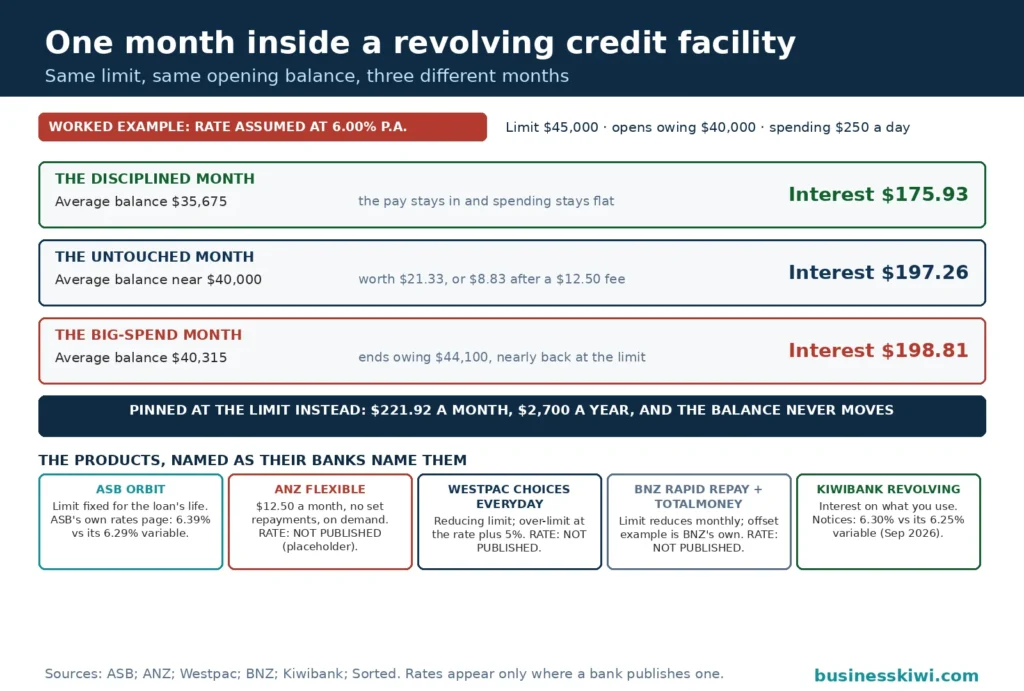
Numbers make the daily-interest effect concrete. The example below is illustrative only. It uses an assumed interest rate of 6.00 percent per annum, a round number near current floating rates; it is not any bank’s actual rate, and revolving credit rates sit above standard home loan rates at most banks, as the costs section below explains. Interest is calculated as the average daily balance multiplied by the rate, multiplied by 30/365, matching the daily calculation the banks describe.
The household has a revolving facility limit of $45,000 and owes $40,000 of it at the start of the month. Combined take-home pay of $8,200 is credited on day one. Ordinary spending is $250 a day, $7,500 across the month, so in a normal month they finish $700 ahead.
The disciplined month. Pay day drops the balance from $40,000 to $31,800. Spending then rebuilds it by $250 a day, ending the month at $39,300. The balance rises in a straight line, so the average daily balance is $35,675. Interest for the month: $35,675 × 6.00% × 30/365 = $175.93.
The untouched comparison. If that same $40,000 had sat in a separate loan all month while the household’s pay waited in a transaction account earning nothing, interest would be $40,000 × 6.00% × 30/365 = $197.26. Channelling the pay through the facility saved $21.33 in the month. That is the honest scale of the benefit on a balance this size: real, worth having, and roughly $250 a year if repeated, but not magic. It grows when more money sits in the account for longer, for example a renovation fund or a tax provision held inside the facility, and it shrinks to very little when little income passes through the account.
The month it goes wrong. Same household, same pay, same ordinary spending, but on day two they put $4,800 of car repairs and holiday flights through the account. The balance jumps to $37,100 on day two and climbs to $44,100 by month end, $900 short of the limit. The average daily balance is $40,315, and interest is $40,315 × 6.00% × 30/365 = $198.81: $22.88 more than the disciplined month, and $1.55 more than if the loan had been left completely untouched. The entire benefit of the structure has been spent, and the household ends the month owing $4,100 more than it started with, even though $8,200 of pay came in. Repeat that pattern and the balance parks itself at the limit: interest on a permanently maxed $45,000 facility at the same assumed rate is $221.92 a month, $2,700 a year, with the debt not moving at all.
One more cost belongs in this picture. ANZ charges a $12.50 monthly account fee on its Flexible Home Loan. Set that against the disciplined month and the $21.33 interest saving becomes $8.83. Small fees quietly eat small savings, which is why the worked example matters more than the marketing version of this product.

Who revolving credit suits
The banks and Sorted are unusually consistent about who benefits, because the product only pays when money regularly sits in the account.
People with surplus or chunky income. If your household reliably spends less than it earns, every surplus dollar sits against the loan instead of in a savings account. Sorted adds a second-order benefit: money parked in the facility saves mortgage interest rather than earning savings interest, and savings interest is taxable while avoided interest is not.
People with uneven income. ASB says a revolving facility may suit people with fluctuating income, because directing income in lowers the balance whenever it arrives. Sorted makes the same point for freelancers, the self-employed and seasonal workers: with no fixed repayments, you can pay more in high-income periods and less when money is tight. BNZ echoes it for Rapid Repay, adding that the monthly limit reduction still keeps the loan on schedule. Contractors and commission earners paid in lumps are the natural audience: a $15,000 invoice paid into the facility saves interest from that day, and the money can come back out for tax, GST and quiet months as needed.
Renovators and staged spenders. Kiwibank markets its revolving loan at people building or renovating: you draw only what each stage costs, and pay interest only on what you have used. Its own example is a $100,000 facility where spending $20,000 means interest on $20,000, and another $30,000 means interest on $50,000. For spending that comes in bursts, that beats drawing a lump sum on day one and paying interest on all of it.
Confident budgeters. Every source lands here eventually. ASB says outright that if you are not confident budgeting or actively managing your finances, its loan is not suitable for you. Kiwibank gives the same warning in its own words: only opt in if you trust your budgeting and will not be tempted to max out the limit on spending you do not need.
Who it does not suit, and the traps
The traps are the mirror image of the benefits, and they are structural, not accidental.
There is no forcing mechanism. A table loan makes you repay principal every month whether you feel like it or not. A revolving facility with a fixed or on-demand limit never does. Sorted’s mortgage guide puts it directly: with no fixed repayments there is nothing forcing the mortgage down, and the product suits organised people, not set-and-forget types. Sorted’s guide to managing a revolving mortgage adds the behavioural version: it is easy to drift into using the facility as an overdraft instead of leaving enough in it to reduce the mortgage, and over a long term, compound interest costs can get out of hand. There is also a rate risk: because the whole facility floats, a rate increase sends more of your money to interest and less to principal unless you cut spending to compensate.
Your home starts to look like an ATM. Sorted warns against treating the house as a cash machine: every withdrawal adds to the mortgage balance and to interest costs. The classic version is borrowing through the facility for a car, a boat or a holiday because the rate looks cheap next to a personal loan. The rate is lower, but the debt is then spread across the remaining life of a home loan instead of a two or three year car loan, and it rebuilds a balance you had already repaid once. BNZ makes the long-run version of the point: keep borrowing up to your credit limit and you pay interest on the full amount year after year.
The rate is the price of flexibility. Revolving facilities are floating rate products: the rate moves with the market, and there is no fixed-rate shelter inside the facility itself. They also tend to sit at the top of a bank’s price list. ANZ says its Flexible Home Loan often has the highest interest rate of its loan types. On ASB’s own rates page, the Orbit variable rate was 6.39 percent per annum (for borrowers with at least 20 percent equity) while ASB’s standard housing variable rate on the same page was 6.29 percent. Kiwibank’s published rate notices show the same ordering: its revolving rate was set at 6.30 percent per annum from September 2026, above its variable home loan rate of 6.25 percent. ANZ and Westpac did not display a carded revolving rate on the product pages read for this guide, so none is quoted for them here; expect to be quoted a rate when you apply, and expect it to be at or above the bank’s floating rate.
What it costs beyond the interest rate
Beyond the rate, the costs are a set of small, specific fees, and they differ enough between banks that the only safe figures are each bank’s own.
- Monthly account fees. ANZ publishes a $12.50 monthly account fee for its Flexible Home Loan. Because the facility doubles as a transaction account, BNZ also warns that usual transaction fees can apply to deposits, withdrawals and automatic payments.
- Establishment and application fees. Sorted’s fee guide says application fees on revolving credit mortgages can reach $500, alongside small transaction fees for day-to-day use. BNZ states an establishment fee of up to $150 may apply across its home loans. Banks sometimes waive establishment fees for new customers, which Sorted suggests is worth negotiating.
- Over-limit costs. Going over your limit triggers penalty pricing, as Westpac’s additional 5 percent per annum on over-limit amounts shows.
- Low equity pricing. Revolving specials generally assume at least 20 percent equity: ASB’s published Orbit rate is for borrowers with minimum 20 percent equity, Westpac notes a low equity margin may apply below that, and Kiwibank says you will generally require 20 percent equity to get a revolving loan.
What you do not pay: there are no break fees, because there is no fixed term to break, and no charge for repaying early or redrawing beyond the transaction fees above. The real cost of the product, for most people, is not a fee line at all. It is the gap between the higher revolving rate and the fixed rate they could have had, applied to any balance that never comes down.
Revolving credit or an offset account?
The two products are routinely confused, and Sorted’s mortgage guide draws the distinction cleanly. A revolving credit facility merges the loan and your banking into one account: income goes in, expenses come out, there are no fixed repayments, and the money reducing your interest bill is the money sitting in the loan account. An offset mortgage keeps the loan and the savings in separate accounts: the savings balances are subtracted from the loan balance when interest is calculated, you keep making regular repayments on the loan, and the savings stay accessible. Sorted suggests offset suits set-and-forget savers, while revolving credit suits people who actively manage daily cash flow.
BNZ sells both, which makes the contrast concrete. Its TotalMoney loan is the offset version: the combined balances of your linked everyday accounts are subtracted from what you owe before interest is calculated, so a $100,000 loan with $20,000 across the linked accounts is charged interest on $80,000, while the loan itself still has minimum repayments that steadily reduce principal. Its Rapid Repay loan is the revolving version, where the money has to actually be in the loan account. ASB, notably, offers no offset account at all: its help pages say so directly and point customers to Orbit instead. If keeping savings visibly separate from debt keeps you honest, offset’s structure does that job; if you are comfortable living inside the loan account, revolving credit removes the middle step.
Your rights, briefly
A revolving credit facility is still a consumer credit contract, and the lender responsibility principles in the Credit Contracts and Consumer Finance Act apply to it. Consumer Protection summarises the practical effect: before lending, the bank must check the loan is suitable for your needs and affordable for you without substantial hardship, and must help you understand what you are signing up to, including how interest is calculated. Lenders must be certified by the Commerce Commission or authorised by the Financial Markets Authority or the Reserve Bank, and must belong to an approved dispute resolution scheme. If a lender has not met those obligations, complain to the lender first, then to its scheme. None of that protects you from a facility that is simply a poor fit, though: the checks happen at application, and the daily discipline afterwards is yours.
Frequently asked questions
Is a revolving credit mortgage just a big overdraft?
Structurally, yes. The banks describe it that way themselves: a credit limit attached to your everyday account, secured against your home, with interest charged only on the balance you have used. The differences from a personal overdraft are the size, the much lower interest rate, and the fact that your house is the security.
Do I have to put my whole mortgage on revolving credit?
No. All of the banks describe splitting a home loan across fixed, floating and revolving portions, and most borrowers who use revolving credit keep only part of the loan in the facility. Sizing the revolving portion to the income that will actually flow through it is what makes the daily-interest benefit real instead of theoretical.
How much will I actually save?
Less than the advertising implies, and it depends entirely on the average balance you run. The worked example shows a household saving about $21 in a disciplined month on a $40,000 balance at an assumed 6.00 percent rate, before fees. Larger amounts held in the account, such as a renovation fund, a tax provision or several months of surplus income, save proportionally more. If your balance sits near the limit all month, you save nothing and may pay more than a standard loan, because the revolving rate is higher.
Can I redraw money I have repaid?
Yes, that is the defining feature. Anything you have repaid is available again up to your credit limit, without reapplying, unless your limit has since reduced below your balance on a reducing-limit facility. All five banks describe redraw up to the limit as a standard part of the product.
What happens if I go over my credit limit?
Expect penalty pricing and a prompt problem. Westpac charges its normal rate plus an additional 5 percent per annum on over-limit amounts. ANZ’s Flexible terms require the facility to stay under its limit, and ANZ may decline transactions that would breach it or charge excess interest on amounts over the limit. Either way, an over-limit balance needs fixing immediately, not next month.
Is revolving credit good for paying off the mortgage faster?
It can be, and the mechanism is the surplus: if income exceeds spending every month and the difference stays in the account, the balance ratchets down and interest falls with it. But on a fixed-limit facility the product supplies no repayment discipline of its own. Borrowers who clear a mortgage faster this way are generally borrowers who would have made extra repayments anyway; the facility just makes each dollar of surplus work from the day it arrives.
Can the bank cancel or shrink my facility?
On some products, yes. ANZ states it can ask you to repay its Flexible Home Loan or reduce the credit limit at any time, and there is no maximum term. Reducing-limit facilities such as Westpac’s and BNZ’s shrink by design on a set schedule instead. Read the limit terms before relying on the facility being there in five years.
Does a revolving credit facility affect my other borrowing?
It can. The full credit limit is a commitment a lender will count when assessing you for other loans, even if your current balance is low, because you could redraw it tomorrow. If you are planning another application, be ready for the limit itself, not just the balance, to be part of the affordability conversation.
Sources
- ASB, Orbit revolving credit home loan page and home loan rates, asb.co.nz
- ASB Help, “Does ASB offer a mortgage offset account?”, asb.co.nz
- ANZ, Flexible Home Loan product page, anz.co.nz
- ANZ, “How an ANZ Flexible Home Loan works” transcript, anz.co.nz
- Westpac NZ, Choices Everyday Floating home loan page, westpac.co.nz
- BNZ, “Explaining different types of home loans” (Rapid Repay and TotalMoney), bnz.co.nz
- Kiwibank, Revolving home loan page, kiwibank.co.nz
- Kiwibank, Public notices (variable, offset and revolving home loan rates, September 2026), kiwibank.co.nz
- Sorted (Retirement Commission), “Types of mortgages in New Zealand, and how to choose”, sorted.org.nz
- Sorted (Retirement Commission), “How to manage your revolving mortgage like a pro”, sorted.org.nz
- Consumer Protection (MBIE), “What lenders must do”, consumerprotection.govt.nz
This article is general information about how revolving credit home loans work in New Zealand. It is not personalised financial advice, and it does not recommend any bank or product. Rates and fees change; those quoted were published by each bank when this guide was prepared in October 2026, so check the current rate and fee schedule with the bank before applying. If you are deciding how to structure a home loan, consider talking to a licensed financial adviser about your own situation.