Rotorua Specialist School: Enrolment, Satellite Classes and Specialist Education on Kea Street
Rotorua Specialist School, known in te reo Māori as Te Kura Pūkenga o Rotorua, is the specialist school for the Rotorua district. From its base at 36 Kea Street in Selwyn Heights, and from satellite classes hosted inside mainstream schools across the city, it teaches students aged 5 to 21 who have intellectual and, or physical disabilities. It is a state school, it has no enrolment zone in the ordinary sense, and a child cannot simply be enrolled by walking in. A place here is arranged through the Ministry of Education, under a formal process that decides whether a specialist setting is the right one for that student.
This profile is drawn from the Ministry of Education’s Education Counts record for the school, from the school’s own website and its published strategic plan, and from the Ministry’s parent guidance on specialist education. Two gaps should be flagged at the outset. The school’s Education Counts profile page, as published when this article was researched, does not display an Equity Index figure, so none is given here; a figure seen on third-party property and directory sites was not used, because those sites are not official sources. And no current, published Education Review Office report for this school could be located on ERO’s website, so the ERO section below explains what is and is not on the record rather than inventing findings.
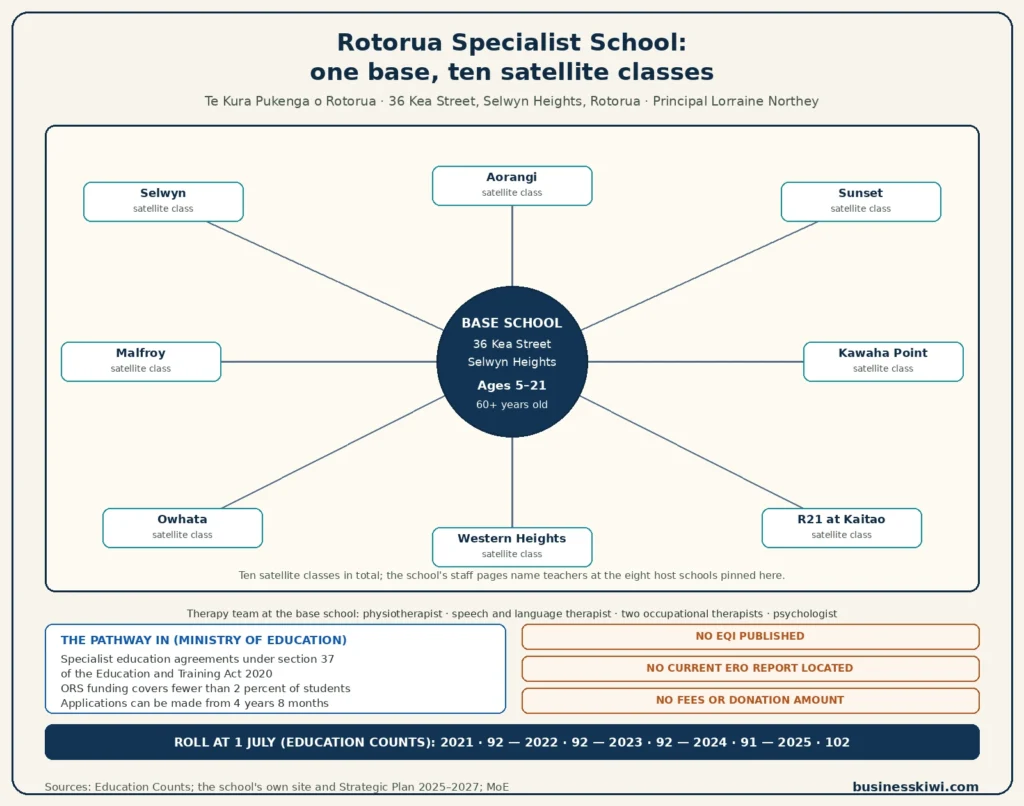
Rotorua Specialist School at a glance
A specialist school on Kea Street
The school sits in Selwyn Heights, a residential suburb in western Rotorua, close to several of the mainstream schools that host its satellite classes. Its Kea Street base is the administrative and teaching hub, but the school is deliberately not contained to one site.
Specialist schools are a distinct part of the state system. They are not mainstream schools with a unit attached; they are schools in their own right, staffed and resourced to teach students whose learning support needs are the highest and most ongoing. The Ministry of Education describes the wider resourcing framework through the Ongoing Resourcing Scheme, covered in the enrolment section below. Rotorua Specialist School’s principal, Lorraine Northey, describes the school on its website as the leading provider of specialist education in Rotorua for students aged 5 to 21 years with intellectual and, or physical disabilities, and notes that the school has been doing this work for over 60 years.
The school was previously known by the name its street gives it. Older documents published on the school’s own website, including its 2016 charter and its policy documents, are headed Kea Street Specialist School, and the school’s original web address, keastreet.ac.nz, still leads to its site. The Ministry of Education directory now records the school as Rotorua Specialist School, Te Kura Pūkenga o Rotorua, and that is the name the school itself uses today.
The school’s mission, published on its website, is about collaborating with families, whānau and community to develop its tamariki to their full potential in a caring, safe and supportive environment. Its shorter mission statement is “Together we care, learn and excel”, or “Kia tātou ka awhi, ka ako, ka piki ake”. Its four published values are Respect (Whakamana), Independence (Whakatipuranga), Community (Hapori) and Empowerment (Whakakaha). Its strategic plan for 2025 to 2027 sets a vision of being a centre of excellence in specialist education in Aotearoa New Zealand, and records a student version of the mission: “See us, Hear us, Know us, Empower us.”
The plan also records the school’s partnership with Ngāti Whakaue, the mana whenua of Rotorua. The school’s stated objective is to give effect to Te Tiriti o Waitangi by, among other things, ensuring its plans, policies and curriculum reflect Ngāti Whakaue mātauranga and te ao Māori, taking all reasonable steps to make instruction in tikanga Māori and te reo Māori available, and seeking the guidance of local kaumātua and the Māori community so that ākonga Māori experience educational success as Māori. Around six in ten of the school’s students are Māori, on the Education Counts figures set out below, so this is not a decorative commitment; it describes the majority of the roll.
The roll: who learns at Rotorua Specialist School
Education Counts publishes the school’s 1 July roll returns. The roll was steady for four years and then grew: 92 students in 2021, 92 in 2022, 92 in 2023, 91 in 2024 and 102 in 2025. That makes it a small school by head count, which is normal for a specialist school, but a large organisation by staffing, because its teaching model pairs teachers with teacher aides and therapists in every class.
The 2025 return breaks the roll down by ethnic group. Because ethnicity in these returns is multiple response, meaning a student who identifies with more than one group is counted in each, the group figures add to more than the total roll. Of the 102 students, 64 identified as Māori, 43 as European, Pākehā, 12 as Pacific, 12 as Asian and 1 as MELAA (Middle Eastern, Latin American and African). There were no international students. Boys considerably outnumber girls, as is common in specialist settings: 79 students were male and 23 were female in 2025.
The roll is also spread across the full span of schooling. The 2025 return by funding year level shows students at every level from Year 1 to Year 13 and beyond, with the largest groups in the junior and middle years and 8 students recorded at Year 13 plus. That spread reflects the school’s 5 to 21 age range: students can remain at a specialist school into young adulthood, which is why the enrolment framework described below includes agreements covering attendance at secondary school after the age of 19.
What the returns cannot show is need. Every student at the school is there because a specialist setting was agreed to be the right place for them, and the school’s own documents describe a roll of students with high and complex learning support needs.
One figure is deliberately missing from this section. Education Counts profiles for most schools display an Equity Index, the Ministry’s measure of the socioeconomic barriers a school’s community faces. The profile page for this school, as published when this article was researched, does not display one, so no EQI figure is stated here. Families who need it should ask the school office or check the Education Counts profile directly, as profile pages are updated over time.
Enrolment: how a place at a specialist school is arranged
Enrolment at Rotorua Specialist School works nothing like enrolment at a mainstream school. There is no zone, no ballot and no right to enrol by address. Instead, a student enrols under a specialist education agreement, a formal arrangement made under section 37 of the Education and Training Act 2020 between the student’s parent or guardian and the Secretary for Education. The Ministry of Education is explicit that a student must have a specialist education agreement to enrol in a specialist school.
The Ministry’s parent guidance describes how the process runs. A family considering a specialist placement contacts the Ministry, usually through its regional office, and the conversation covers what is best for the student’s education, any health and safety issues, the specialist teaching and therapy the student needs, where the child lives and the transport options, whether the school has capacity, and the length of the enrolment. The school’s own admission criteria also form part of the discussion. Applications must be supported by both the Ministry and the school, so it is a three-way decision, not an application a school can approve alone.
The agreement also does other work. The same section 37 mechanism covers attending primary school before the age of 5 or after 14, and attending secondary school after 19 where the student is not in the Ongoing Resourcing Scheme, although the Ministry says it only considers those extensions in exceptional circumstances and all parties must agree the school is the best place for the student’s education. An agreement ends when the student leaves the school, and a fresh agreement is needed to enrol at another specialist school. If an agreement is declined, the Ministry will talk through other options for supporting the child’s education, and the decision can be reviewed by asking the regional office for help with the review process.
The Ongoing Resourcing Scheme, usually shortened to ORS, is the funding package that sits alongside this process, and the two are often confused. The Ministry describes ORS as support for students who have the most severe learning and disability needs; fewer than 2 percent of all enrolled students receive it. It is linked to the student rather than the school, follows them if they change schools, and continues until they leave the school system. It can be applied for at any time for children aged 4 years and 8 months or older, and it is for students with ongoing severe needs in one or more of five areas: learning, hearing, vision, physical needs, and language use and social communication. What ORS provides is a mix tailored to the individual student, which can include specialists such as therapists, psychologists and learning support advisors, additional teacher time, a contribution towards a teacher aide, and consumables grants. In practice the application is completed by an educator who knows the child, such as an early intervention teacher or a special education needs coordinator, working with the parents, whānau and specialists involved.
Two points in that framework matter for this school specifically. First, a student who is receiving ORS still needs a specialist education agreement to enrol at Rotorua Specialist School; ORS funding alone does not create a place. Second, the agreement and ORS are not the same door. The Ministry says it can talk about a specialist education agreement for a child who is not part of ORS, so families should not assume that missing out on ORS automatically closes the question of a specialist placement. Both conversations start in the same place: with the Ministry’s local office and with the school.
For its part, the school invites contact. In her welcome message on the school’s website, the principal encourages parents and whānau to visit, to talk with their child’s teacher about their learning and life at school, and to ring and make an appointment with her or a member of the leadership team for a look around the school. That is the practical first step for a Rotorua family weighing up this option alongside their local school.
On cost, the position is simple and is stated on the school’s Education Counts profile: donations should not be requested, unless for a school camp. The school publishes no fees and no donation amount on the sources read for this article, and none is quoted here.
Programmes, teaching and therapy
Teaching at the school is built around the individual student. Its class pages describe students working each term to goals in an Individual Education Plan, usually called an IEP, with whānau invited to IEP hui twice a year to set and review those goals. Class programmes combine class-based learning with regular access to the community. One class page, describing a class of seven ākonga supported by a teacher and three teacher aides, lists an interactive whiteboard, Lego Six Bricks, the Numicon mathematics programme and tablet apps among its tools, and describes life skills as a continuous focus: cooking, road safety, hygiene, communication and social interaction are regular features, practised on trips to the supermarket, the library, local parks and the Redwoods forest.
The school’s strategic plan names the structured programmes its teachers are implementing across 2025 to 2027. They include Better Start Literacy Approach professional development, Numicon for mathematics, Bal-A-Vis-X, a movement-based programme the plan extends across the school, and Team Teach training to support students through emotional regulation and the teaching of prosocial behaviour. The plan also records the introduction of the HERO platform so teachers can share students’ achievements and successes with parents and whānau, and continued work on a culturally responsive curriculum developed in consultation with Ngāti Whakaue.
Therapy is part of the school’s own staffing, not an outside service visited on the school. The school’s staff page lists its therapy team by role: a physiotherapist, a speech and language therapist, two occupational therapists and a psychologist, alongside two specialist teacher roles, a Cultural Leader and a Learning Support Coordinator. The strategic plan describes what those roles do in the school’s own terms: the occupational therapists and physiotherapists support hauora and physical wellbeing through individualised programmes, the speech language therapists advance communication skills so students can amplify their life skills, the school psychologists provide support where required for individual students and whānau, and an orientation and mobility instructor supports students who qualify as low vision. Class pages show the same team at work at classroom level; the junior satellite class at Aorangi Primary School, for example, records weekly input from its speech language therapist and physiotherapist to extend students’ language, communication and physical skills.
The satellite model is the school’s defining structural feature. As well as its base classes on Kea Street, the school runs classes hosted inside mainstream schools, where its own teachers and teacher aides teach its students within a partner school’s grounds. The principal’s welcome counts ten satellite classes. The school’s staff list places its satellite teachers at Selwyn School, Aorangi School, Sunset Primary, Malfroy School, Kawaha Point School, Owhata School and Western Heights, with a further class known as R21 based at Kaitao. The welcome message describes the purpose plainly: the satellites foster collaboration between the school and its host schools to promote inclusion, and class pages describe satellite students joining their host school peers for activities, including mainstream inclusion in physical education and cooking at one host school.
Senior students follow a programme aimed at life after school. The school employs a dedicated transition teacher, named on its staff page. Its oldest class, Room 6, takes twelve students aged 13 to 21, and its teacher describes literacy and numeracy integrated through SPEC, which stands for Supported Preparation for Employment and Citizenship and is described as a skills for living programme, alongside Lego, music and kapa haka. Room 6 students spend time off site each week at a gym, the squash centre, the aquatic centre, the library and the Redwoods, and its older students aim to complete a job experience module within the community, depending on the availability of worksites, so they can experience working in a Rotorua business. The strategic plan adds a leadership goal of working on employment pathways for the school’s adult students, and lists camps and a sailing programme for senior learners among its regular activities.
Across the school, the plan’s activity programme includes an Active Sports Programme covering cross country, swimming, athletics and Special Olympics participation, the annual Special Schools Kapa Haka Festival, a school picnic, a Matariki market and ball, and an end of year production. They give a fair picture of a school week that extends well beyond the classroom.
Term dates and practical notes for parents
The school publishes its 2026 term dates on its website, and they appear on the footer of its pages:
- Term 1: Tuesday 27 January to Thursday 2 April (see the note below)
- Term 2: Monday 20 April to Friday 3 July
- Term 3: Monday 20 July to Friday 25 September
- Term 4: Monday 12 October to Wednesday 9 December, finishing with a half day
One detail needs care. The school’s pages print the end of Term 1 as “Thursday 2 March”, which does not fit the 2026 calendar: the Thursday at the end of that term, immediately before Good Friday on 3 April, is 2 April, and the school’s own holiday list places Good Friday within Term 1. The dates above give the term as ending on Thursday 2 April, which matches the school’s holiday list and the national term pattern, but families should confirm the exact finishing date with the school office, as the school’s published line appears to contain a typing error. The school’s listed public holidays during term time are Waitangi Day (6 February), Good Friday (3 April), Easter Monday (6 April) and Easter Tuesday (7 April) in the first part of the year, Anzac Day (25 April) and the King’s Birthday (1 June) in Term 2, Matariki (10 July), and Labour Day (26 October) in Term 4.
Transport deserves a question of its own, because for many students it is arranged rather than improvised. Specialised School Transport Assistance, known as SESTA, is the Ministry’s transport scheme for children with safety or mobility needs. The Ministry makes two points about it: SESTA is not part of a specialist education agreement, and it must be applied for separately. Transport options between home and school are, however, one of the matters discussed as part of the agreement process, so the conversation about a place and the conversation about the journey happen together even though the applications are separate. The school’s own planning documents also refer to a schedule for replacing its school vans, which is a reminder that the school itself runs vehicles as part of its programme of community access.
Three smaller practical points. First, the school’s office can be reached on 07 347 6717; the school’s own website gives its email as office@rsspukenga.school.nz, while the Education Counts profile lists an older address, office@rss.ac.nz, so the website address is the safer one to use. Second, leadership is accessible: the principal’s published invitation to ring for an appointment and a look around the school is the school’s stated practice, not a formality. Third, the school publishes its policies and procedures online through SchoolDocs, linked from its website, and invites families and whānau to review them and provide feedback.
What ERO found, and what is not on the record
This section is shorter than the equivalent section in most school profiles on this site, and it is worth explaining why. When this article was researched in October 2026, no current published report on Rotorua Specialist School could be located on the Education Review Office’s website, despite targeted searching of ERO’s site and the web. That is a statement about what could be read, not a judgement on the school: ERO reviews every state school, and its reports are the normal source for the independent findings this section usually summarises. Rather than fill the space with secondhand claims about ERO’s view, this profile records what the school’s own published documents say about its review cycle, and leaves the rest open.
What the school’s own documents do show is a school working through external recommendations in public. Its strategic plan for 2025 to 2027 commits the school to implementing the recommendations of its annual specialist school self review each year, and lists its response to ERO recommendations as a standing item in its learning and teaching goals. The ERO recommendation recorded in the plan is specific: to consult with mana whenua to collaboratively develop and integrate a culturally responsive curriculum tailored to the school’s local context, naming Ngāti Whakaue. The plan shows that work continuing across all three years, alongside consultation with whānau about their aspirations for their tamariki and rangatahi.
Readers who want ERO’s current position should go to the primary sources: the Education Counts profile for the school carries a link to its Education Review Office report, and ERO’s own website is the authoritative place for any report published after this article was researched. Findings will be added to this profile when a current report can be read in full.
Frequently asked questions
Does my child need ORS funding to attend Rotorua Specialist School?
Not necessarily, and the two things are separate. What a student must have is a specialist education agreement under section 37 of the Education and Training Act 2020. A student who receives Ongoing Resourcing Scheme funding still needs that agreement to enrol at a specialist school, and the Ministry of Education says it can talk about an agreement for a child who is not part of ORS. Start with the Ministry’s regional office and the school.
What ages does Rotorua Specialist School take?
The school teaches students aged 5 to 21, as its principal states on the school’s website. Its 2025 Education Counts return shows students at every funding year level from Year 1 through Year 13 and beyond. Older students work through a senior programme with a dedicated transition teacher, focused on life skills and preparation for employment and citizenship.
Where are the school’s classes held?
At the school’s base at 36 Kea Street in Selwyn Heights, and in satellite classes hosted by mainstream schools around Rotorua. The principal counts ten satellite classes; the school’s staff list places satellite teachers at Selwyn School, Aorangi School, Sunset Primary, Malfroy School, Kawaha Point School, Owhata School and Western Heights, plus a class known as R21 at Kaitao.
Is there an enrolment zone for Rotorua Specialist School?
No. Specialist schools do not enrol by zone. A place is arranged through a specialist education agreement between the family and the Secretary for Education, supported by both the Ministry of Education and the school, after discussion of the student’s needs, the school’s capacity and transport. The Ministry’s Education Counts profile records no school zoning for this school.
Does the school charge fees or ask for donations?
The school publishes no fees and no donation amount. Its Education Counts profile records the position that donations should not be requested, unless for a school camp. If a cost is ever raised with your family, ask the school office to explain what it is for.
Which therapists and specialists work at the school?
The school’s own staff page lists a physiotherapist, a speech and language therapist, two occupational therapists and a psychologist, together with a Learning Support Coordinator and a Cultural Leader, working alongside its teachers and teacher aides. Its strategic plan also describes orientation and mobility support for students who qualify as low vision.
How does transport to the school work?
Transport assistance for children with safety or mobility needs is provided through Specialised School Transport Assistance (SESTA), which is separate from the specialist education agreement and must be applied for on its own. Transport between home and school is one of the topics covered when an agreement is discussed, so raise it early in the process.
How many students are at Rotorua Specialist School, and who is the principal?
Education Counts recorded a roll of 102 students at 1 July 2025, up from 91 to 92 in each of the previous four years. The principal is Lorraine Northey, named as principal both on the school’s Education Counts profile and on the school’s own website, where she also signs the principal’s welcome.
Sources
- Ministry of Education, Education Counts: Rotorua Specialist School, Te Kura Pūkenga o Rotorua, Profile and Contact Details (institution 1772), educationcounts.govt.nz
- Ministry of Education, Education Counts: Rotorua Specialist School, Student Population Trends (1 July roll returns 2021 to 2025), educationcounts.govt.nz
- Ministry of Education, Education Counts: Rotorua Specialist School, Student Population by Year Level (as at 1 July 2025), educationcounts.govt.nz
- Rotorua Specialist School: Principal’s Welcome, Mission, Vision and Values page, Staff page, and class pages for the Aorangi satellite class, Room 6 and a base class, rsspukenga.school.nz
- Rotorua Specialist School: Strategic Plan 2025 to 2027 (approved strategic plan published on the school’s website), rsspukenga.school.nz
- Ministry of Education: Specialist education agreements (parent guidance), education.govt.nz
- Ministry of Education: Overview of the Ongoing Resourcing Scheme, education.govt.nz
This article is general information about Rotorua Specialist School, based on official and primary sources published by the Ministry of Education and the school itself, as read in October 2026. It is not advice about any individual child’s placement. Enrolment at a specialist school is decided through the Ministry of Education’s specialist education agreement process, and school details such as rolls, staffing, programmes and term dates change. Confirm anything you are relying on with the school office, on 07 347 6717, or with the Ministry of Education’s local office, before making decisions for your family.