Runanga School: A Parent’s Guide to Enrolment, Costs and What ERO Found

The short answer
Runanga School is a state full primary school for Years 1 to 8 in Runanga, a small township just north of Greymouth on the West Coast. The Education Counts directory lists it as institution 3495, co-educational, with Jess Lees as principal. ERO lists the roll as 22, which makes it a very small rural school. No enrolment scheme or home zone is published for the school, so enrolment starts with a visit or a call to the office for an enrolment pack. The school is in the government donations scheme, which means donations should not be requested, except for a school camp. ERO’s current public report, a Te Ara Huarau School Profile Report from January 2024, records strengths in how well staff know their students and whānau, a stable teaching team and tuakana teina relationships, alongside concerns ERO and the school share about achievement in the senior classroom and about strategic planning. Every child gets fresh fruit daily and a school lunch at no cost to families through the Fruit in Schools and Lunch in Schools programmes.
The school at a glance
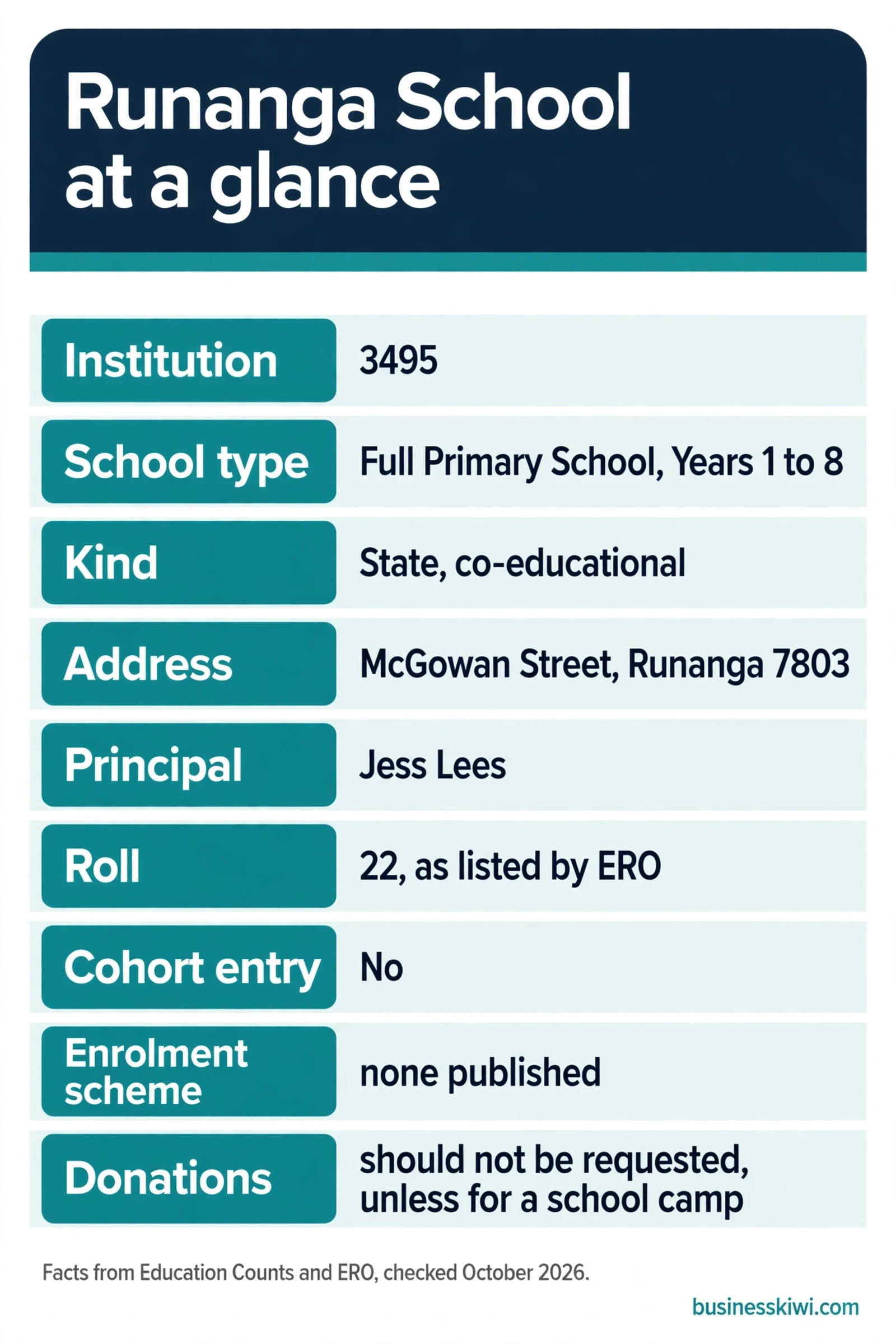
| Fact | Detail |
|---|---|
| Institution number | 3495 |
| School type | Full Primary School (Year 1-8) |
| Authority | State |
| Gender | Co-Educational |
| Address | McGowan Street, Runanga 7803 |
| Principal | Jess Lees |
| Roll | 22 (as listed by ERO) |
| Enrolment scheme | None published |
| Cohort entry | No |
| Donations scheme position | Donations should not be requested, unless for a school camp |
| Boarding | No |
| Phone | 03-762 7873 |
| principal@runanga.school.nz |

Roll and community
ERO lists the school’s total roll as 22. The Education Counts profile does not publish a roll figure, so ERO’s 22 is the number used in this guide. A full primary roll of 22, spread across eight year levels, makes Runanga one of the smallest schools in the Grey district. Children learn alongside older and younger schoolmates rather than in single year level classes, and ERO’s report notes that tuakana teina relationships, where older students support younger ones, are a feature of the school.
The roll has been shrinking for some years, on ERO’s own record. ERO’s 2016 review reported a roll of 69, and its 2018 review reported 51. Families weighing up this school should understand what the current size means in practice: a very small teaching team, close knowledge of every child, and classes that combine year levels. ERO records that leaders and teachers know the students and their whānau well, and that the teaching staff is stable and plans collegiately.
ERO describes the school as a rural school north of Greymouth that caters for Year 1 to 8 learners from Runanga and the surrounding district. The principal’s welcome describes a school that sees itself as a family, where parents and community members volunteer their time, support the school’s large grounds and enrich learning experiences. ERO’s current profile report does not publish an ethnic or gender breakdown of the roll, and Education Counts does not publish one on the school’s profile either, so no breakdown is given in this guide.
Enrolment and the zone
There is no enrolment scheme to work through at Runanga School. The school does not publish an enrolment scheme or home zone on its enrolment page, and Education Counts publishes no enrolment scheme description for the school. That is the position as published, and it matters for how enrolment works. Under Ministry of Education guidance, a state school without an enrolment scheme accepts enrolments from anyone, because there is no home zone to live inside and no out-of-zone ballot to enter.
What the school’s enrolment page does say is simple. The school warmly welcomes new students and families, it invites parents to contact the school or call in for a look around, and enrolment packs are available from the school office at any time during school hours. The principal’s welcome repeats the invitation: the school runs an open-door policy and staff are happy to show prospective families around.
Children are entitled to free enrolment at a state school from their fifth birthday. Education Counts records cohort entry as No for Runanga School, so the school does not group new entrants into set cohort start dates. Each child’s start is arranged with the school individually. If your child is approaching five, the practical steps are to pick up an enrolment pack from the office, talk through the start date, and ask about visits before the first day. The school’s enrolment page describes its junior classroom as a blend of play-based and structured learning, designed to build literacy and numeracy while younger children explore and settle in.
What ERO found
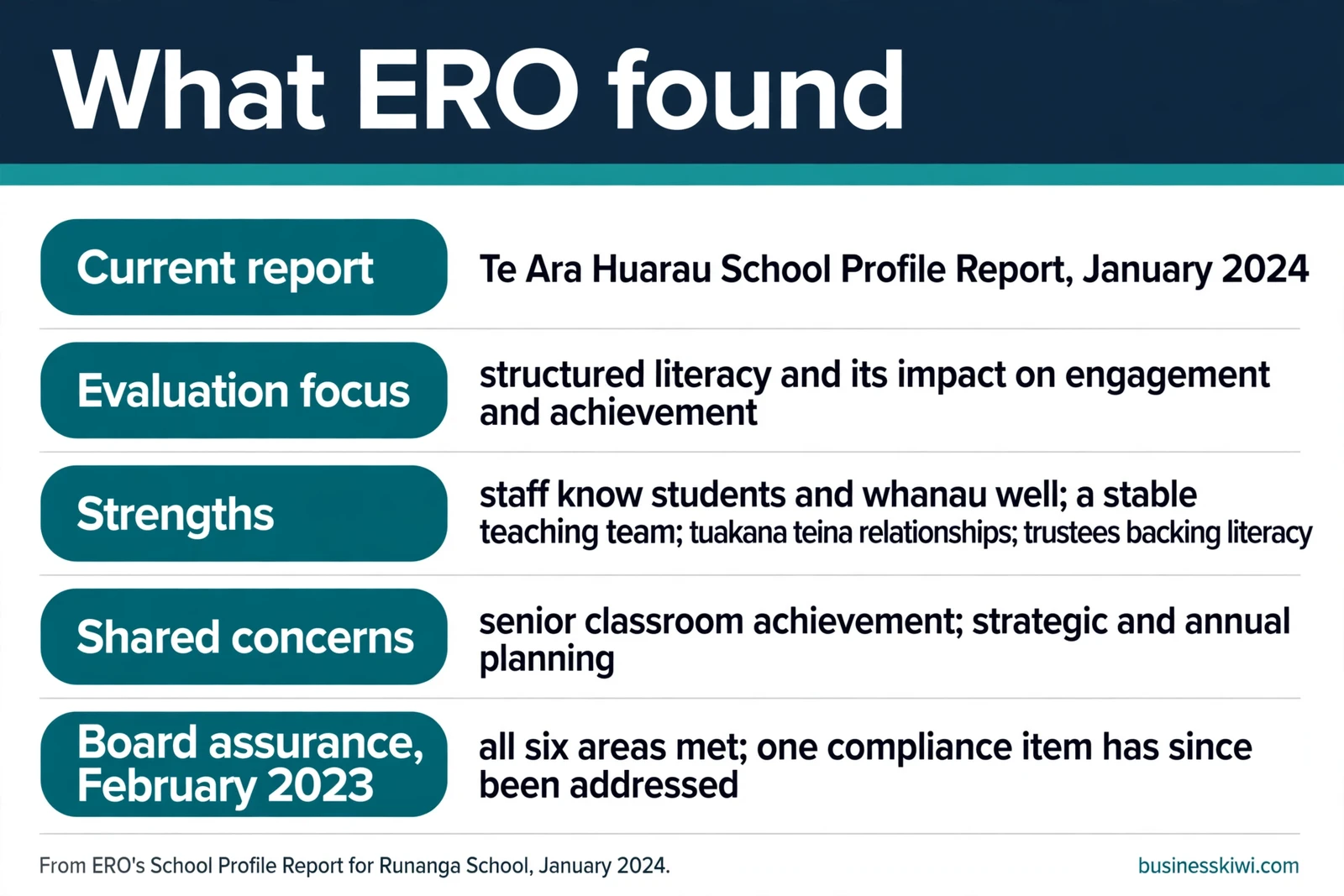
The Education Review Office works with Runanga School under Te Ara Huarau, its evaluation approach for English medium state schools. The current public report on ERO’s website is the Te Ara Huarau School Profile Report dated 22 January 2024. It is a profile report rather than a full evaluation report, and ERO says the next public report will be a School Evaluation Report, due within three years.
The evaluation the school and ERO chose together is the impact of structured literacy on student engagement and achievement. ERO records three reasons for choosing it: student achievement in reading and writing is variable, the school wants to better understand students’ attitudes to reading and writing, and it wants to measure the impact of professional development on teacher knowledge in literacy. The school’s strategic priorities, as ERO records them, are to improve levels of engagement, behaviour, progress and achievement across the school, to continue developing a localised curriculum, and to embed a tailored structured literacy approach.
ERO recorded four strengths the school can draw on. Leaders and teachers know the students and their whānau well. The teaching staff is stable and plans collegiately and collaboratively to improve outcomes. Tuakana teina relationships enable older students to support younger students. Trustees are well informed and supportive of improving literacy outcomes. ERO also recorded the school’s values at the time, expressed through its positive behaviour for learning approach, and its teaching model of direct instruction, inquiry and play-based learning.
The report is equally clear about the work ahead. The agreed next steps are to monitor engagement and attendance, to keep building positive relationships between the school and whānau, to develop rigorous formative assessment practice in reading, and to strengthen the curriculum so it is more localised and cohesive. ERO states plainly that ERO and school leaders have concerns about two things: achievement levels in the senior classroom, and strategic and annual planning focusing on outcomes for learners. Parents should read those concerns in the school’s own context, a very small roll in which the senior classroom carries the school’s oldest learners and its published results.
The same ERO page carries the Board Assurance Report for 2021 to 2024. As of February 2023 the board attested that it meets the requirements in all six areas: board administration, curriculum, management of health, safety and welfare, personnel management, finance and assets. ERO and the board did identify one area of non-compliance during that process: the board did not hold the names and positions of the staff who are trained and named as authorised staff members to use physical restraint. ERO records that the board has since addressed the area of non-compliance identified.
Two pieces of background help explain where this school has been. ERO’s previous full review, dated 29 March 2018, found the school moving ahead positively after serious concerns in its 2016 review, with significant progress at governance, leadership and health and safety levels under a commissioner and a new principal. Then, in May 2024, after the profile report was published, the Ministry of Education directed the appointment of a limited statutory manager for the school board, as published in the New Zealand Gazette. The direction vested the board’s employer, financial operations and policy functions in the limited statutory manager, who also advises the board on curriculum and communications. The board retained its health and safety duty of care and its property functions. That intervention is part of the school’s current story, and it is reasonable to ask the school how governance is running now when you visit.
Donations, costs and the school day
Runanga School is in the school donations scheme. Education Counts records its position in the standard wording used for scheme schools: donations should not be requested, unless for a school camp. In practice, the school does not ask parents for a general school donation. A camp, if one is held, is the cost that can still be passed to families.
Food costs are covered to an unusual degree. The school is a KidsCan school, and it takes part in both the Fruit in Schools and Lunch in Schools programmes. The school states that every child has access to fresh fruit daily and nutritious meals at no cost to families. Lunch in Schools is the Ka Ora, Ka Ako healthy school lunches programme, so a school lunch is provided rather than ordered and paid for.
The school has a uniform. On its enrolment page the school presents the uniform as more than clothing: something that represents belonging, pride and the spirit of the school community, and that helps every child feel a valued part of the school whānau. The enrolment material published on the school’s website does not include a full priced item list, so confirm the items your child needs, and what they cost, with the office when you collect the enrolment pack.
Two everyday details are not published on the school’s website, and this guide does not fill them in. The school does not publish its bell times, so the start and finish times of the school day need to be confirmed with the office. It also does not publish a stationery list online, so ask the office what your child needs to bring, and whether stationery is supplied or bought by families.
The school’s own term dates are likewise not published on the pages it makes available, so what can be stated is the national framework set by the Ministry of Education. Primary schools choose their own start and finish dates within the Ministry windows. For 2027, Term 1 starts between Thursday 28 January and Wednesday 3 February and ends Friday 9 April. Term 2 runs from Tuesday 27 April to Friday 2 July, Term 3 from Monday 19 July to Friday 24 September, and Term 4 from Monday 11 October to no later than Friday 17 December. Runanga’s own dates, including any teacher-only days, will sit inside that framework, and the office can confirm them.
Learning and school life
Teaching at Runanga blends three approaches, as both the school and ERO describe it: explicit direct instruction, inquiry-based learning and play. The school says it celebrates diversity and recognises that every learner is unique, with their own strengths, interests and ways of understanding the world, and that its staff bring experience, creativity and aroha to their work each day. It embraces digital technologies where appropriate, while putting equal weight on the social, physical and intellectual skills children need. In the junior classroom, the blend is play-based and structured learning, with the structured side building the literacy and numeracy foundations. Across the school, the current improvement focus is a tailored structured literacy approach, which is also the subject of the school’s evaluation with ERO.
Runanga is a Positive Behaviour for Learning (PB4L) school. The values the school now publishes are We Learn, We Care and We Show Respect, and it says these are woven into everything it does, guiding interactions and helping create a culture where everyone feels they belong.
School life is shaped by size and by community. With a roll of 22, every child is known, older children carry real responsibility for younger ones, and the principal describes parents and community volunteers as an active part of the school, including help with its large grounds. For a family wanting a small, relationship-led rural school, that is the offer. For a family wanting large peer groups in every year level, specialist facilities or a wide range of teams and groups, a school of this size cannot provide them, and the nearest larger schools are in Greymouth.
Other school guides: our Corinna School guide and our Gisborne Central School guide follow the same parent-guide pattern, and our reading levels guide explains how reading is organised by age. More education guides are in the Jobs and Education section.
Frequently asked questions
Does Runanga School have an enrolment zone?
No enrolment scheme or home zone is published for the school. The school’s enrolment page sets out no zone, ballot or priority categories, and Education Counts publishes no enrolment scheme description for it. Enrolment starts with the school office, where enrolment packs are available during school hours.
How many students does Runanga School have?
ERO lists the total roll as 22, across Years 1 to 8. Education Counts does not publish a roll figure on the school’s profile, so ERO’s listed roll is the figure used in this guide. ERO’s earlier reviews recorded a roll of 51 in 2018 and 69 in 2016, so the school is much smaller than it was.
Does the school ask for a donation?
No general donation should be requested. The school is in the school donations scheme, and Education Counts records that donations should not be requested unless for a school camp. A camp is the one cost that may still be passed on to families.
Are school lunches provided at Runanga School?
Yes. The school takes part in the Fruit in Schools and Lunch in Schools programmes and is a KidsCan school. It states that every child has access to fresh fruit daily and nutritious meals at no cost to families.
Does Runanga School have a uniform?
Yes. The school describes its uniform as representing belonging, pride and the spirit of the school community. Its published enrolment material does not include a full priced item list, so ask the office which items your child needs and what they cost.
What are the school hours at Runanga School?
The school does not publish its bell times on its website, so this guide does not state a start or finish time. Confirm the school day times, and the arrangements for dropping off and collecting children, with the school office.
When can my child start, and how do we enrol?
From their fifth birthday. The school does not use cohort entry, so starts are arranged individually rather than on set cohort dates. Collect an enrolment pack from the school office in McGowan Street, or contact the school first. The principal describes an open-door policy, and visits are welcomed.
The bottom line
Runanga School is a very small West Coast full primary with an open door: no published enrolment scheme, no general donation, free fruit and lunches for every child, and a teaching team ERO says knows its students and whānau well. It also carries a documented improvement story. ERO’s January 2024 profile report records shared concerns about senior classroom achievement and strategic planning, and the Ministry appointed a limited statutory manager for the board in May 2024. None of that is hidden, and a visiting family can ask about all of it. The practical points to confirm with the office are the bell times, the uniform items and costs, stationery arrangements, and the school’s own term dates, because none of those are published on its website.
Sources
- Ministry of Education, Education Counts: Runanga School profile and contact details (institution 3495, principal, type, cohort entry, donations position, address and contacts), https://www.educationcounts.govt.nz/find-school/school/profile?district=®ion=&school=3495
- Education Review Office: Runanga School institution page, including the Te Ara Huarau School Profile Report of 22 January 2024, the Board Assurance Report 2021 to 2024, and the Education Reviews of 29 March 2018 and 17 August 2016, https://www.ero.govt.nz/institution/3495/runanga-school
- Runanga School: homepage and principal’s welcome (Jessica Lees), including the school’s values, its KidsCan, Fruit in Schools and Lunch in Schools participation, and its teaching approach, https://www.runanga.school.nz/
- Runanga School: Enrolment (welcome to new families, enrolment packs, the junior classroom, and the school uniform), https://www.runanga.school.nz/our-school/enrolment
- New Zealand Gazette: Notice of Direction to Appoint a Limited Statutory Manager for the Runanga School Board (3495), 2024-go2295, 16 May 2024, https://gazette.govt.nz/notice/id/2024-go2295
- Ministry of Education: School terms and holidays dates (national term date framework, including the 2027 windows), https://www.education.govt.nz/school-terms-and-holidays-dates
This article is general information about Runanga School in Runanga, on the West Coast near Greymouth, based on Ministry of Education, Education Review Office, New Zealand Gazette and school sources published at the time of writing. It is not published by or for the school. Enrolment, governance and cost details can change, so confirm anything that matters for your family with the school office before you act on it.