Silverstream School, Upper Hutt: A Parent Guide to the School, Its Zone and Starting School
Silverstream School is the state primary school on Whitemans Road in Silverstream, Upper Hutt, in the Wellington region. It teaches children in Years 1 to 6, and it has been part of the Silverstream community for a century. The school marked its centenary in 2024, having opened in 1924 with two classrooms and a small staff.
This guide brings together what the Ministry of Education directory and the school itself publish about Silverstream School: what type of school it is, how its enrolment zone works, how children start, what is taught, and the practical details parents usually want first. Where the official record is silent, the guide says so.
Silverstream School at a glance
The Ministry of Education Education Counts directory lists the school as follows.
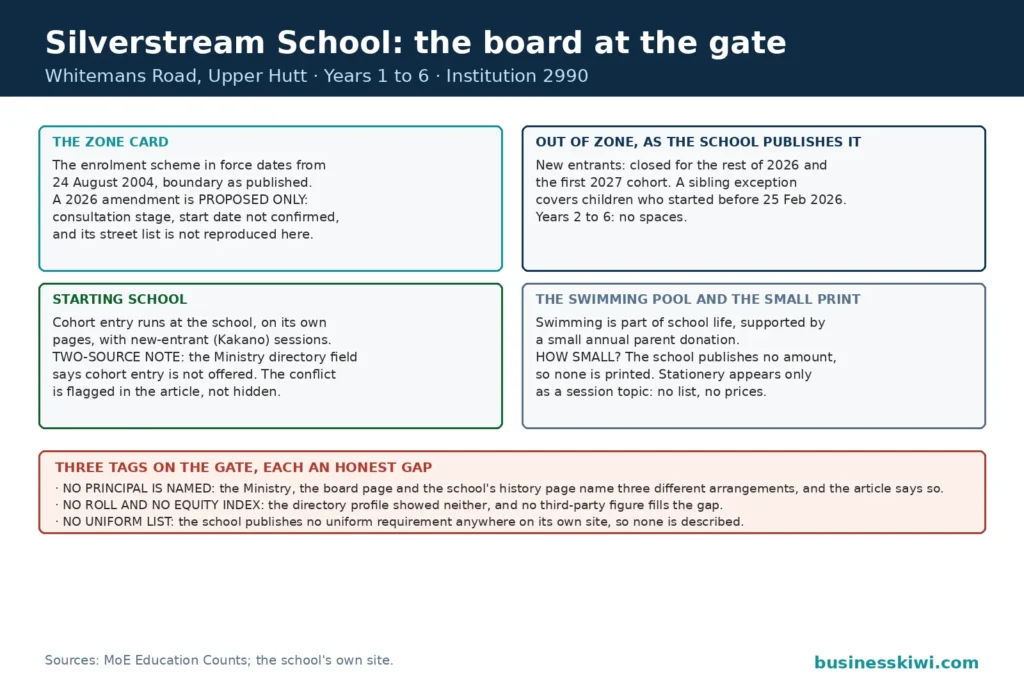
A contributing school finishes at Year 6, so children move on to an intermediate or another school covering Years 7 and 8. The directory records the language of instruction as English medium, and that the school has no boarding facilities. One directory point needs care. Its profile field for cohort entry reads No, yet the school’s own enrolment and starting school pages describe cohort entry as the system it currently uses, with set start dates for new entrants. Families should follow the school’s own starting school information for the practical position.
A century of schooling in Silverstream
The school’s own history page records that Silverstream School opened in 1924 with two rooms and a small staff, and that it celebrated its centenary in 2024. Houses have been part of school life for much of that time, although not continuously. The original house groups were Wakefield, Selwyn, Grey and Hobson. Houses fell out of use by 1969, then were re-established in 2014 with new names drawn from local geographical features. The current houses are Chatsworth (blue), Whitemans (yellow), Gloucester (orange) and Gard (green). This guide does not name the current principal, because the directory and the school’s own pages currently give different accounts of the school’s leadership. Parents who need current leadership details should check with the school office.
Values and everyday school culture
The school publishes five values, each expressed as a short instruction to children.
The first is to be kind, explained in terms of empathy, respect and compassion, and an inclusive atmosphere where everyone feels valued. The second is to be safe, covering physical and emotional wellbeing, responsible choices and a secure environment for learning and play. The third is to be responsible, meaning children take ownership of their actions, their learning and their contribution to the school community. The fourth is to be brave, about stepping outside a comfort zone and persisting when something is difficult. The fifth is to have fun, reflecting the school’s position that learning should be enjoyable and engaging. Those values are not only wall words. Children earn house points by demonstrating the values in class time.
What children learn: the curriculum
The school’s curriculum page describes a knowledge rich curriculum with a deliberate emphasis on foundations. It describes its approach as back to basics, combined with what it calls the Science of Learning, and it prioritises core literacy and numeracy through structured approaches.
In literacy, the school says it uses the Liz Kane Literacy approach, described as a systematic and explicit method for teaching reading, writing and spelling, with attention to phonics, phonemic awareness, vocabulary, spelling and comprehension. Spelling is taught through phonetic principles and awareness of word structure. Handwriting, grammar and vocabulary are explicitly taught and regularly practised across all year levels. In mathematics, the school describes a structured programme aimed at deep conceptual understanding alongside procedural fluency, with development of core number facts, including mastery of times tables.
Beyond those foundations, the school lists a broad curriculum. Science encourages inquiry and experimentation and understanding of the natural and physical world. There are dedicated programmes in the arts and in music. The school offers extension opportunities in te reo Māori, and in Years 4 to 6 it introduces Latin, presented as a way to support vocabulary development and understanding of where words come from.
How teaching works at Silverstream
The school’s published explanation of its teaching is unusually specific, and it is worth understanding because it shapes the classroom experience.
Teaching is informed, the school says, by cognitive science and by how the brain processes and retains information. Rosenshine’s Principles of Instruction are integrated into daily teaching, with clear explanations and plenty of practice, repetition and retrieval. Cognitive Load Theory shapes how lessons and classrooms are designed, so new information arrives in manageable chunks. Explicit teaching means teachers model skills and concepts directly, and new concepts are often introduced through whole class teaching, giving every child the same foundational knowledge.
Assessment during lessons is part of the model. The school describes regular, low stakes formative assessment woven into every lesson, giving immediate feedback to children and teachers. A no hands up approach is often used so that all students think and are ready to respond, and mini whiteboards are used extensively so teachers can see understanding across the whole class at once. The environment matches that philosophy: quiet, single classrooms designed to be calm and focused, and digital devices used in a limited way, only in Years 5 and 6 during core learning times.
A second page, on what the school knows about learning, explains that the school works closely with parents as first teachers, using a Personalised Education Plan for each child, updated two to three times a year.
Learning support
The school publishes a dedicated learning support page. It says the school has a full time Learning Support Coordinator and a Special Educational Needs Coordinator working together to oversee and implement support programmes.
Teachers are described as trained in working with neurodiverse students, with developing skill in supporting children with ADHD, autism and a range of other diverse needs. Support is organised in tiers, with targeted interventions for students who need additional help in specific areas, on top of the whole class teaching every child receives. Teacher aides form part of the team, and the school says many of its aides have specialised training, including diabetes care, high health needs and allergies, structured literacy and structured maths support, and developing oral language. The school asks parents who have concerns about a child’s learning or wellbeing to make contact earlier rather than later, so information gathering and collaborative planning can begin.
Swimming, the library and the wider week
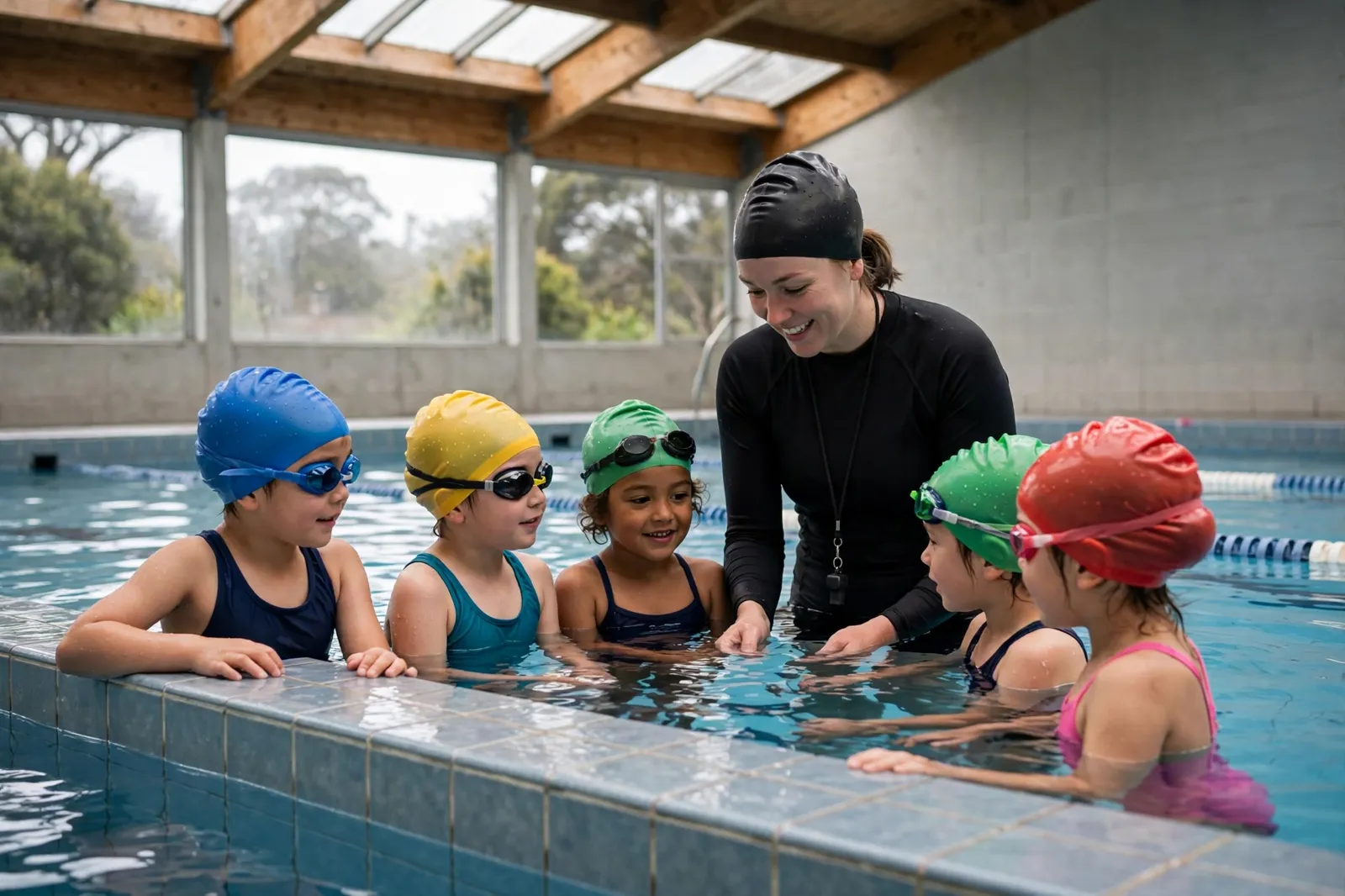
Silverstream has a heated school pool, and swimming is a formal part of the programme for the youngest children. The school says lessons run for Year 1 and Year 2 students, once a week throughout the entire school year. The pool is heated to 32 degrees Celsius, and the water depth ranges from 80 centimetres at the shallow end to 90 centimetres at the deep end. Each class is divided into three smaller groups, from beginners building water confidence through play based activities, to a middle group working on kicking, basic strokes and rolling from front to back, to a third group extending distance and refining strokes and breathing. Two groups in each session are taught by trained swim teachers from the Silverstream Swim Academy, which is based at the school, and the third by the child’s own classroom teacher, with teachers rotating roughly every two to three weeks. At the end of each term the programme runs a water safety circuit covering how to call for help, how to receive help and how to recognise someone who needs assistance. The school says the programme is supported by a small annual donation from parents, with details given during enrolment orientation. It does not publish the amount on the swimming page, so no figure is given here. The lessons teach basic swimming and survival skills and are not intended to replace after school or weekend swimming classes.
The library is open from 9am to 3pm daily, every class visits each week, and it opens at lunchtime from Monday to Friday, with activities including Lego, jigsaws and reading.
Houses run through the week as well as the year, with sports events, lunchtime competitions, an annual House Day, a House Week and end of year Christmas celebrations. On house event days children are encouraged to wear something in their house colour, and families are invited to join in. House Captains are selected by teachers each February, promote house spirit, update house points each week during assembly and help run house events, and a house trophy goes to the winning house at the end of the year.
Weekly assemblies are held every Friday from 2.00pm to 2.50pm, with principal’s awards, class items, music, singing and house points. Student Council members run the assembly, and the school says everyone is welcome to attend. Councillors are chosen after applications each February, selected by a team of teachers, and their responsibilities include welcoming visitors, running community facing events and hosting assemblies.
Lunch options are published for families who use them: a hot lunch on Tuesdays through Kindo, sushi on Wednesdays and Pita Pit on Thursdays through Ezlunch, and a pre-ordered sausage sizzle on Fridays, with vegetarian options available. Kindo is also the school’s channel for school payments, including trips and camps.
The Parent Teacher Association meets on the second Thursday of the month and raises funds that go directly to students and learning, including extra classroom resources, playground updates, and science and STEM equipment. Its events include quiz nights, school discos and spellathons.
Starting school: cohort entry and the Kākano programme
Silverstream does not start new entrants on their fifth birthday. Its starting school page says the school uses a cohort entry system with set start dates for all children beginning school for the first time. Parents choose the start date that best suits their child and family from the set cohort dates. The school encourages families to think about readiness, and reminds parents that compulsory schooling does not begin until a child is six, and that a child can be enrolled at any point between five and six years old.
Before a child starts, the school runs the Kākano programme for children about to start in the next cohort. Parents and children are invited to three morning sessions, from 9.00am to 10.40am, in the lead up to the starting day. The first week covers introductions, an information pack and school systems including stationery, timetables and food, and how to help a child settle. The second week focuses on literacy, including supporting reading and writing at home and what to do if a child has additional needs. The third week covers the school community, including setting up the Hero and Kindo apps, reporting absences, and meeting the Friends of Silverstream School team, the whānau group and Board representatives. Once a child is enrolled, the school writes closer to the start date to confirm the cohort entry and the dates for school visits. Families with questions about start dates are directed to the school office on 04 528 2596.
The enrolment zone and how enrolment works
Silverstream School operates under a Ministry of Education enrolment scheme. The scheme published on Education Counts is effective from 24 August 2004. Its core rule is simple: all students who live within the home zone described in the scheme are entitled to enrol at the school.
The home zone in the current scheme is described in three parts. It covers the area north of Stokes Valley, including the Manor Park and Haywards areas on the western Hutt side. To the south it runs from and including Barton Avenue, Sutherland Avenue and Messines Avenue, with Fergusson Drive South included from numbers 412 on the even side and 429 on the odd side. It also covers Silverstream Village and Blue Mountains Road to numbers 92A on the even side and 73 on the odd side, including Fendalton Crescent and Chichester Drive and any streets whose only exit is onto a street within the area.
A proposed amendment to the scheme was published by the Ministry in July 2026, with its commencement date still to be confirmed at the time it was published. The proposed description redraws the boundary in much finer street by street detail. Until an amendment commences, the operative entitlement remains the scheme in force, so families close to any boundary should confirm their position with the school office or the Ministry’s zone checker rather than relying on either description alone. The school’s enrolment page links directly to the zone checker for that purpose.
For in-zone families, the school says enrolment can proceed immediately once the family lives within the zone, through the school’s online enrolment form and a declaration. The documents asked for are a copy of the child’s birth certificate and two proof of address documents, one of which must be a sale and purchase agreement, rates account or contents insurance document for home owners, or a signed rental agreement or contents insurance document for renters, plus one further document such as a power account. For children who do not hold a New Zealand birth certificate and are not permanent residents, a copy of the child’s student visa is required. Families in a living with arrangement, where the living situation is temporary, are asked to contact the office directly.
Out-of-zone enrolment
Out-of-zone places depend entirely on capacity. Each year the Board determines how many places are likely to be available in the following year for students who live outside the home zone, and publishes that information by notice, including how to apply and the closing date.
The school’s own out-of-zone page gives the current position plainly. For 2026 it states that out-of-zone enrolments for new entrants, meaning Year 0 and Year 1, are closed for the remainder of 2026 and for the first cohort of 2027, with the only exception being siblings of current students who started prior to 25 February 2026, and that there are no out-of-zone spaces available for 2026 in Years 2 to 6 either. Families reading this guide after those dates should check the same page for the current year’s position, because spaces are set year by year.
When places are available, applications are processed in a strict order of priority set by enrolment scheme legislation: first, students accepted into an approved special programme, which does not apply at Silverstream because the school has no such programme; second, siblings of current students; third, siblings of former students; fourth, children of former students; fifth, children of Board employees or Board members; and sixth, all other applicants. If there are more applicants in a priority group than places, selection within that group is by ballot, and applicants claiming second or third priority may need to provide proof of the sibling relationship. To apply, the school asks families to complete the online enrolment form and the ballot application form, and to send the ballot form with a copy of the child’s birth certificate, or a valid visa where the child is not a New Zealand or Australian citizen, to the address the school publishes on that page.
The school day and term dates
The school day has a settled shape. Children may begin to arrive from 8.30am. School starts at 9.00am, morning tea is at 11.00am, the second session begins at 11.20am, lunch eating is at 12.50pm followed by lunch play, the third session begins at 1.40pm, and the day ends at 3.00pm.
The school publishes term dates for 2026 and 2027 on its term dates page. For 2026, Term 1 runs from Monday 2 February to Thursday 2 April, Term 2 from Monday 20 April to Friday 3 July, Term 3 from Monday 20 July to Friday 25 September, and Term 4 from Monday 12 October to Wednesday 16 December, with a teacher only day on Friday 29 May and a cluster wide teacher only day on Friday 23 October.
For 2027, Term 1 runs from Monday 1 February to Friday 9 April, Term 2 from Tuesday 27 April to Friday 2 July, Term 3 from Monday 19 July to Friday 24 September, and Term 4 from Monday 11 October to Wednesday 15 December, with teacher only days noted on Friday 4 June and Friday 20 August. Term dates can change, so families should treat the school’s page as the live source.
Costs, stationery and uniform: what the school actually publishes
The directory records the school’s donations position as: donations may be requested. The only specific contribution the school’s own pages describe is the small annual donation from parents that supports the Year 1 and Year 2 swimming programme, with details given during enrolment orientation. No amount for that donation, and no general donation amount, is published on the school pages read for this guide, so no figure is stated here.
Stationery is covered in the Kākano information pack and sessions for new entrants. The school’s public pages read for this guide do not publish a stationery list with prices, so parents should use the pack, or ask the office, for the current list for their child’s year level.
On uniform, the school’s own website does not publish a uniform list or a uniform requirement on the pages read for this guide, and there is no uniform page among its published parent pages. The only published clothing guidance found is for house event days, when children are encouraged to wear something in their house colour. Families should ask the school office what children wear day to day before buying anything, because the position may be covered in enrolment material rather than on the public website. School policies sit behind the school’s SchoolDocs portal, which the policies page links to with a published login for the community, and that is where operational policies, including any dress expectations the Board has adopted, can be read in full.
Governance and the Education Review Office
The school is governed by its Board, which the school describes as responsible for governance and strategic direction, overseeing operations and key decisions for the school community. Its membership, as the school publishes it, is drawn from parents, a staff representative and the school’s acting leadership.
On external review, the school’s ERO page explains that Silverstream is now engaged in Te Ara Huarau, the Education Review Office’s developmental evaluation approach, in which ERO and the school work collaboratively over time on continuous improvement, rather than through a single one-off review. The school says it worked with ERO to develop a Profile Report reflecting its strategic goals and shared evaluation focus areas, and that a Board Assurance Report has also been published, confirming how the school meets regulatory and legislative requirements. Both reports are made available from the school’s ERO page. The school also notes that the old four to five year review cycles no longer apply, and that schools performing well will typically receive a three year review. This guide reports no ERO findings, judgements or ratings for Silverstream School, because the school’s own ERO report document itself could not be read in full for this guide. Parents who want ERO’s own words should read the Profile Report and Board Assurance Report directly.
Frequently asked questions
What type of school is Silverstream School?
It is a state, co-educational contributing school for Years 1 to 6, institution number 2990, located on Whitemans Road in Silverstream, Upper Hutt. Contributing means it finishes at Year 6, so children move to another school for Year 7.
Does Silverstream School have an enrolment zone?
Yes. It operates under a Ministry of Education enrolment scheme effective from 24 August 2004. Children who live within the home zone described in the scheme are entitled to enrol. A proposed amendment to the scheme was published in July 2026 with its start date still to be confirmed, so boundary addresses should be checked with the school or the Ministry zone checker.
How do new entrants start at Silverstream School?
Through cohort entry. Children do not start on their fifth birthday. They start on a set cohort date chosen by the family, at any point between five and six years old, and they take part in the Kākano programme of three morning sessions before they start.
Are out-of-zone places available?
For 2026 the school states that new entrant out-of-zone enrolments are closed for the rest of 2026 and the first cohort of 2027, apart from siblings of current students who started before 25 February 2026, and that no spaces are available in Years 2 to 6. Availability is reset each year by the Board, so check the school’s out-of-zone page for the current position.
What documents does an in-zone family need to enrol?
A copy of the child’s birth certificate and two proof of address documents. One must be a sale and purchase agreement, rates account or contents insurance document for home owners, or a signed rental agreement or contents insurance document for renters, plus one further document such as a power account. A student visa copy is needed where the child does not hold a New Zealand birth certificate and is not a permanent resident.
Does Silverstream School have a school uniform?
The school’s public website does not publish a uniform list or requirement on the pages read for this guide, and its only published clothing guidance is to wear house colours on house event days. Ask the school office for the current day to day position before buying clothing, and check the enrolment pack and the school’s policies on SchoolDocs.
How is the school reviewed by ERO?
Through Te Ara Huarau, ERO’s developmental approach, in which ERO works with the school over time. The school says a Profile Report and a Board Assurance Report have been published and are available from its ERO page. This guide states no ERO findings, because the report itself could not be read in full.
Sources
- Ministry of Education, Education Counts directory profile for Silverstream School, institution 2990, educationcounts.govt.nz
- Ministry of Education, Education Counts enrolment scheme description for Silverstream School, effective 24 August 2004, educationcounts.govt.nz
- Ministry of Education, Proposed Enrolment Scheme Amendment Description for Silverstream School (2990), amended July 2026, web-assets.education.govt.nz
- Silverstream School official website, Enrolment Information page, silverstream.school.nz
- Silverstream School official website, Enrolling Out of Zone page, silverstream.school.nz
- Silverstream School official website, Starting School (Start Dates) page, silverstream.school.nz
- Silverstream School official website, Kākano Programme (Age 4-5) page, silverstream.school.nz
- Silverstream School official website, What do we teach: our curriculum page, silverstream.school.nz
- Silverstream School official website, What we know about learning page, silverstream.school.nz
- Silverstream School official website, Learning Support page, silverstream.school.nz
- Silverstream School official website, Our Vision and Values page, silverstream.school.nz
- Silverstream School official website, Our History page, silverstream.school.nz
- Silverstream School official website, Term Dates and School Times page, silverstream.school.nz
- Silverstream School official website, Swimming@Silverstream page, silverstream.school.nz
- Silverstream School official website, Library page, silverstream.school.nz
- Silverstream School official website, School Houses and House Captains page, silverstream.school.nz
- Silverstream School official website, Weekly Assembly page, silverstream.school.nz
- Silverstream School official website, Student Councillors page, silverstream.school.nz
- Silverstream School official website, Lunch Orders and Friday Sausage Sizzle page, silverstream.school.nz
- Silverstream School official website, Communication page, silverstream.school.nz
- Silverstream School official website, PTA page, silverstream.school.nz
- Silverstream School official website, ERO Report page, silverstream.school.nz
- Silverstream School official website, School Board page, silverstream.school.nz
- Silverstream School official website, Policies page, silverstream.school.nz
- Silverstream School official website, Staff page, silverstream.school.nz
This article is general information about Silverstream School based on official sources published by the Ministry of Education and the school itself at the time of writing. Enrolment availability, zone boundaries, term dates and school arrangements change, so confirm current details with the school office before making decisions about enrolment or moving house.