Tarpaulins in New Zealand: Types, Grades, Sizes and What to Pay
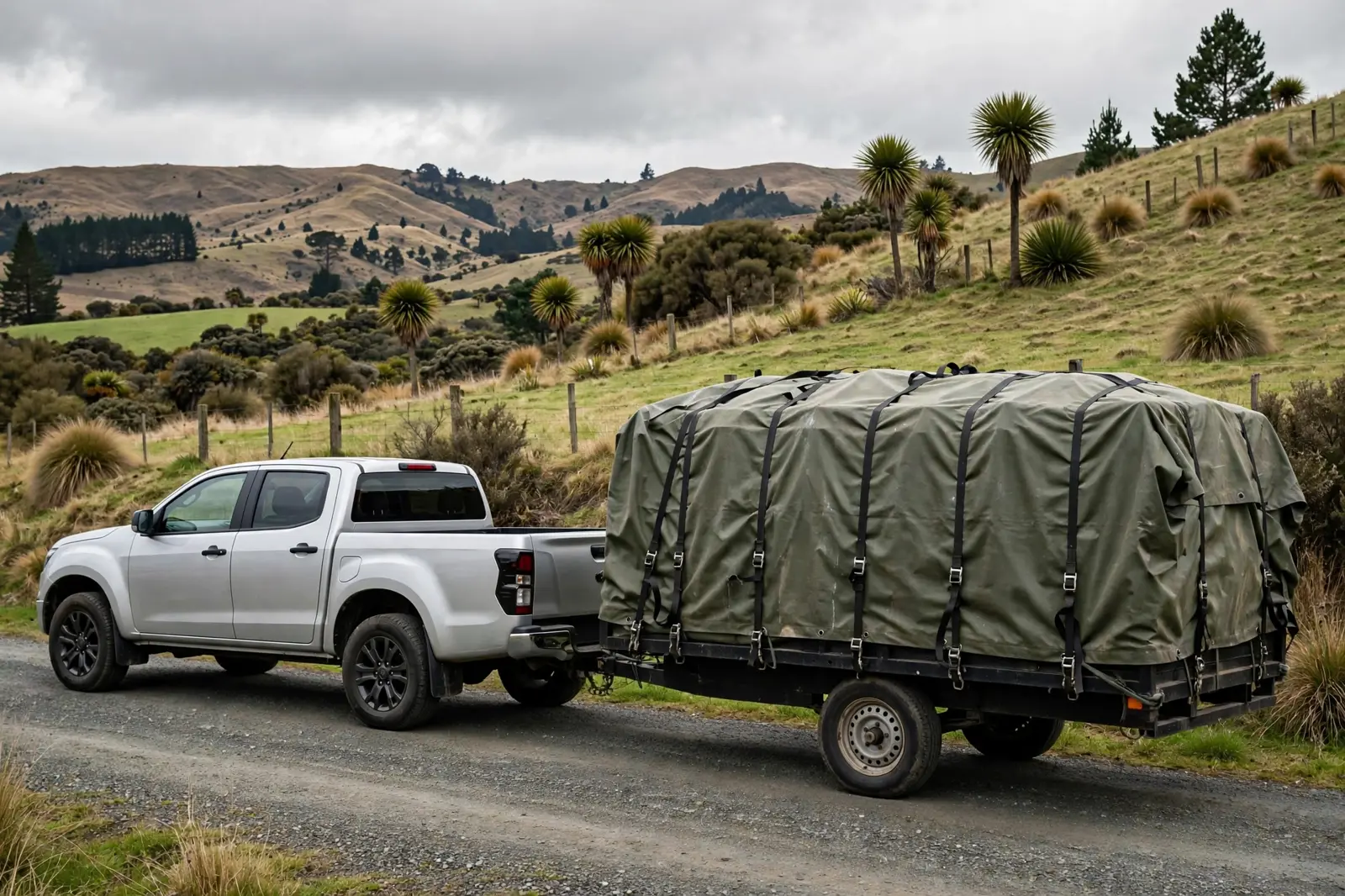
A tarpaulin looks like one of the simplest products on the shelf: a sheet of waterproof fabric with holes around the edge. In practice, the gap between a good tarp and a bad one is the gap between a cover that lasts five seasons and one that shreds in the first decent southerly. New Zealand suppliers sell everything from a light duty sheet costing less than a five dollar note to industrial covers costing more than a thousand dollars, and the difference is not just mark-up. It reflects real differences in fabric weight, weave, coating, edge construction and the hardware set into the hem.
This guide works through what tarpaulins sold in New Zealand are made of, how to read the specifications suppliers publish, which grade suits which job, how eyelets and hems differ, how to size a cover properly, and what named products actually cost on suppliers’ own websites. It finishes with the rules that apply when a tarp covers a load on a vehicle, where a tarpaulin has a legal job to do as well as a practical one.
One finding is worth stating early. Specification transparency varies a lot between suppliers. Some publish fabric weights, weave counts, eyelet sizes and prices for every product; others publish a grade name and a price and nothing else. Where this guide quotes a figure, it comes from the supplier’s own page; where a supplier does not publish a specification, the guide says so.
What tarpaulins are made of
Polyethylene: the default fabric
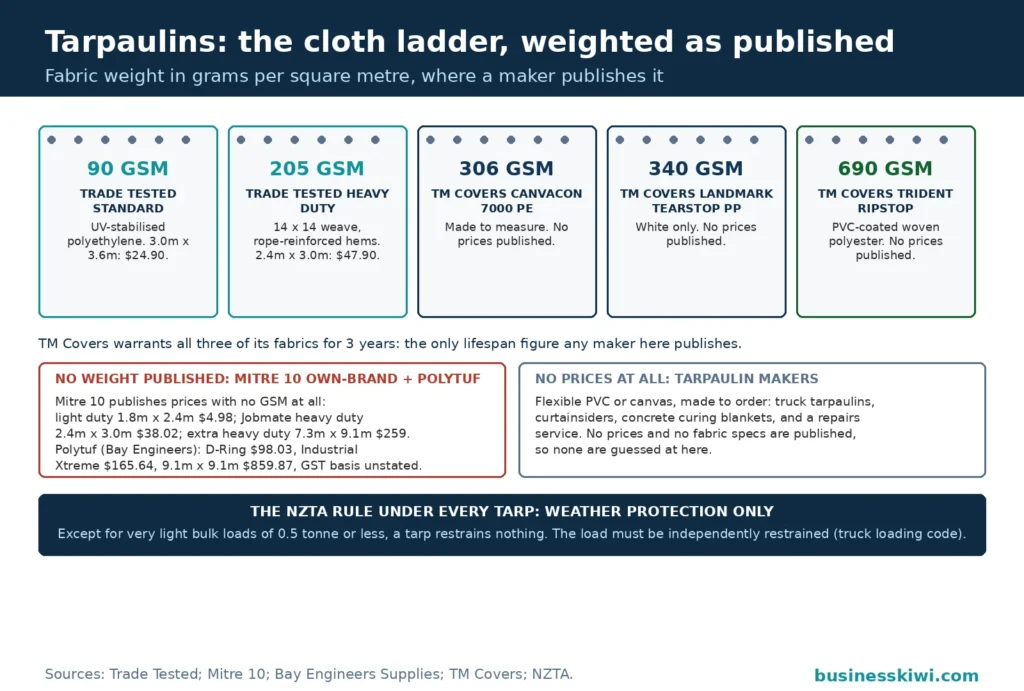
Most tarpaulins sold in New Zealand are polyethylene. The fabric is woven from polyethylene tape yarns into a base cloth, then coated or laminated so the finished sheet is waterproof. Trade Tested, which sells a standard and a heavy duty polyethylene range, describes its standard fabric as UV stabilised 90gsm polyethylene and its heavy duty fabric as UV stabilised 205gsm polyethylene in a 14 x 14 weave. Nelson manufacturer TM Covers sells a heavier polyethylene fabric, Canvacon 7000 at 306gsm, described as a high quality UV stabilised polyethylene fabric for medium to heavy duty industrial and agricultural tarpaulins.
Polyethylene’s strengths are price, weight and availability: it is light to handle, folds small, and costs far less per square metre than the alternatives. Its weakness is lifespan under load and sun. The woven tapes fray once the coating is damaged, and eyelets set into a thin hem are usually the first failure point.
PVC and coated fabrics: the heavy end
At the heavy end of the market, tarpaulins are made from a woven polyester base cloth coated with PVC on both sides. TM Covers’ heaviest recommended tarpaulin fabric, Trident Ripstop, is a woven polyester with a 1cm x 1cm ripstop weave and a flexible PVC coating on both sides, at 690gsm, described by TM as the first choice for heavy duty tarpaulins. Mount Maunganui manufacturer Tarpaulin Makers works in flexible PVC as its main material, manufacturing tarpaulins, curtainsiders and custom covers for transport, construction, concrete, fumigation and coolstore work.
PVC coated fabric is much heavier to handle and costs considerably more, but it can be welded into strong seams, resists tearing around fittings, and can be repaired by welding. It is the standard material for truck curtainsiders and made-to-measure covers expected to stay in service for years. TM Covers also lists a polypropylene fabric, Landmark Tearstop at 340gsm, described as lighter and easier to handle than PVC of similar strength, with good lay-flat characteristics and weather resistance. It is white only.
Canvas: the traditional option
Canvas is the oldest tarpaulin material and still part of the custom trade. Tarpaulin Makers lists canvas alongside flexible PVC as the fabrics it works in. Canvas is a woven natural or blended fabric rather than a plastic sheet: it is heavy, it can absorb water if its proofing wears, and it is rarely the cheapest option. Ready-made canvas tarpaulins have largely disappeared from general retail ranges in favour of polyethylene, so canvas is now mostly a made-to-order choice.
GSM, weave and coating: how to read a spec sheet
The single most useful number on a tarpaulin specification is its fabric weight in GSM, grams per square metre. As TM Covers puts it, the GSM rating makes it easy to calculate the weight of the finished tarp: multiply the GSM by the area in square metres and you have the fabric weight in grams. A 3m x 3.6m tarp at 90gsm uses fabric weighing just under a kilogram; at 690gsm the same size would weigh about seven and a half kilograms before hems and hardware.
Across the ranges New Zealand suppliers publish, the pattern is consistent:
- Light, general purpose polyethylene sits around 90gsm, as in Trade Tested’s standard blue range.
- Heavy duty polyethylene for regular outdoor work sits around 205gsm, again from Trade Tested’s published range.
- Industrial polyethylene and polypropylene fabrics from TM Covers sit at 306gsm and 340gsm.
- PVC coated polyester for the heaviest work reaches 690gsm in TM Covers’ range.
GSM is not the whole story. Weave density matters because the woven base cloth carries the tear strength: Trade Tested publishes a 14 x 14 weave for its 205gsm fabric. Coating matters because the coating makes the sheet waterproof and shields the weave from ultraviolet light; suppliers describe their polyethylene fabrics as UV stabilised, meaning UV inhibitors are added to slow the breakdown of the plastic in sunlight. Construction matters as much as fabric too: hem design, corner reinforcement and eyelet setting decide whether the fabric’s strength can actually be used.
One caution on comparisons: grade names are not standardised. One retailer’s “heavy duty” is a 205gsm polyethylene sheet; a manufacturer’s is a 690gsm PVC fabric. Mitre 10 sells light, medium, heavy and extra heavy duty tarpaulins under its Number 8 and Jobmate brands without publishing GSM figures on its category listings. Compare the published fabric weight and construction where they exist, and treat an unpublished specification as a question to ask the supplier.
Grades and what each one suits
Light and economy grades
Light duty tarpaulins are thin polyethylene sheets for occasional, short-term cover: garden waste, a trailer of firewood, furniture during a house move, a project in the garage. Mitre 10’s Number 8 light duty range starts at a 1.8m x 2.4m blue tarp listed at $4.98. Trade Tested’s 90gsm standard range is the better specified version of this grade, with UV stabilised fabric and welded eyelets, and uses Trade Tested lists include general outdoor cover, storage of cars, utes and boats, building sites, lean-to shelters and camping groundsheets. Used within their limits, light grades are good value. Used as permanent covers, tensioned tight and left flapping for a year, they are the tarps that give the category a bad name.
Medium and heavy duty grades
Stepping up buys thicker fabric, stronger hems and better eyelets. Trade Tested positions its 205gsm heavy duty range for home renovation, commercial work, construction, transportation and camping or tramping, with rope reinforced double stitched hems and heavily reinforced corners. Mitre 10’s medium duty Number 8 and heavy duty Jobmate ranges occupy the same territory for buyers who shop by grade name rather than specification. This is the sensible grade for a tarp that lives outdoors for a season or more, covers a boat or caravan between uses, protects building materials on site, or serves as a regular ute and trailer cover.
Industrial and made-to-measure grades
At the top end, tarpaulins stop being an off-the-shelf product. Bay Engineers Supplies sells the Polytuf range in grades listed as Industrial Xtreme, D-Ring Extreme Duty and Extra Heavy Duty, in sizes up to 9.1m x 9.1m and beyond. TM Covers and Tarpaulin Makers manufacture to order: TM lists standard sizes from 4m x 4m up to 10m x 12m and quotes custom sizes, with welded seams and reinforced lugs. Industrial buyers pay for fabric weight, welded construction, fittings that survive daily tensioning, and a cover made to the exact dimensions of what it protects.
Specialist uses
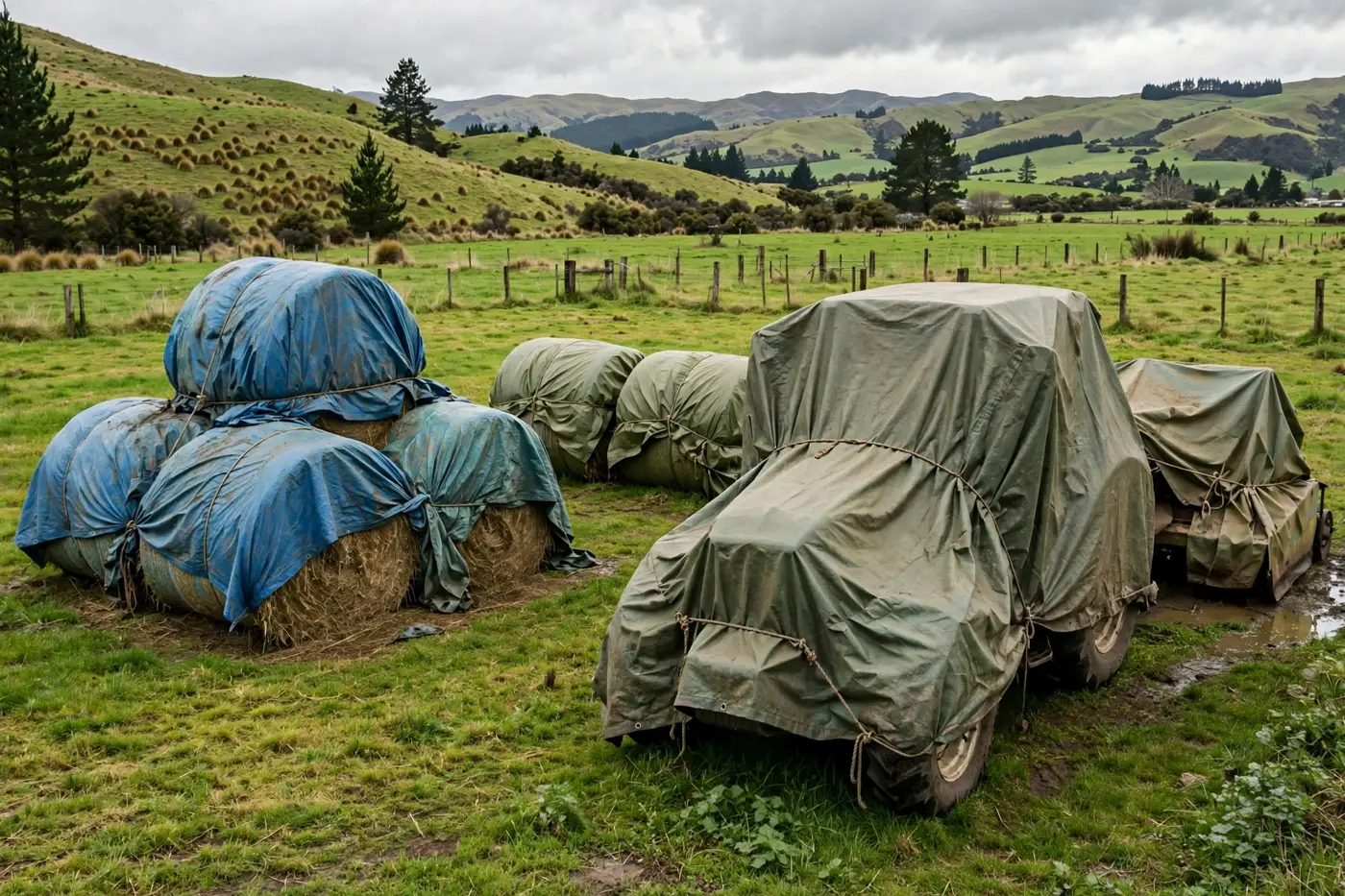
Some tarps are bought for one job. Farm covers are a large category in New Zealand: hay covers, silage and bale covers, and covers for machinery and fertiliser, the territory TM Covers’ agricultural fabrics are aimed at. Truck and trailer covers are another: Tarpaulin Makers builds truck tarpaulins and curtainsiders, and Polytuf’s D-Ring range is sold for tied-down transport work. Builders use tarps for weather protection over framing and materials, and Tarpaulin Makers also manufactures concrete curing blankets. Boat covers at the quality end are usually made to measure in PVC or canvas by a local maker; at the retail end, a heavy duty polyethylene sheet is the common choice for winter storage.
Eyelets, hems and ropes: where tarps actually fail
Failures rarely start in the middle of the sheet. They start at the edges: eyelets tear out, hems split, corners rip. Edge construction deserves as much attention as fabric weight.
Eyelets are the metal or plastic rings set into the hem that ropes and bungee cords pass through. Trade Tested publishes unusually complete detail. Its 90gsm tarps use reinforced welded eyelets with aluminium rings and 12mm eyelet holes. Its 205gsm tarps use welded eyelets with metal rings and 45mm eyelet holes as published, with eyelet spacing of approximately 100cm along the 3m side and 80cm along the 2.4m side, according to the company’s own answer on its product page. Closer spacing spreads load across more attachment points and reduces flapping between them, and flapping is what fatigues fabric and fittings.
Hems carry the eyelets, so hem construction sets the strength of every tie point. Trade Tested’s heavy duty range uses rope reinforced double stitched hems, with a rope worked into the hem edge, and heavily reinforced corners. TM Covers takes the welded approach for made-to-measure tarps: high frequency welded seams for a waterproof cover, and reinforced lugs spaced at 1m intervals with double eyelets and 1.8m ropes attached.
D-rings are the alternative fitting on heavier ranges. Both Mitre 10 (Jobmate) and Bay Engineers Supplies (Polytuf) sell D-ring tarpaulin ranges alongside eyeleted ones, aimed at tie-down work where straps and ropes are tensioned hard and often.
Sizes, and how to measure for a cover
Ready-made tarpaulins come in a fairly consistent set of rectangular sizes. Small covers start at 1.8m x 2.4m. Mid sizes run through 2.4m x 3m, 3m x 3.6m, 3.6m x 4.9m and 4.9m x 6.1m. Large sheets reach 6.1m x 9.1m and 9.1m x 9.1m in the Polytuf range at Bay Engineers Supplies, and 7.3m x 9.1m in Mitre 10’s Jobmate range. Made-to-measure manufacturers work to any size: TM Covers lists standard sizes up to 10m x 12m and quotes custom sizes.
Measuring is where buyers most often go wrong, because a cover has to fit over a three-dimensional load, not a flat rectangle. Work to this method:
- Measure the length and width of the footprint of what you are covering.
- Decide how far down the sides the tarp needs to reach, usually far enough to tie off below the widest point.
- Add twice that drop to both the length and the width. A stack 1m high that needs cover to the ground needs roughly 2m added to each dimension.
- Allow something extra for tying off, so the hem sits where rope can reach it without the sheet being drum tight over sharp corners.
- If your measurement falls between two standard sizes, go up a size. Excess fabric can be folded under or tied off; missing fabric cannot be added.
Two further points. Check whether the size quoted is the finished size of the tarp, and allow a small tolerance on inexpensive imported sheets. For anything valuable or awkwardly shaped, a made-to-measure cover from a local manufacturer removes the guesswork.
What tarpaulins cost in New Zealand
The table below sets out named products with the prices published on each supplier’s own website when checked. It also shows how uneven specification publishing is: Trade Tested publishes GSM, weave and eyelet detail, while several other listings publish a grade name only.
Three lessons come out of the numbers. First, size-for-size, price tracks construction and intended duty, not just area: at 2.4m x 3.0m, published prices run from $38.02 to $165.64. Second, the biggest sheets are serious purchases: a 9.1m x 9.1m extra heavy duty Polytuf is listed at $859.87, and Mitre 10’s largest Jobmate extra heavy duty tarp, 7.3m x 9.1m, is listed at $259. Third, check the fine print before comparing. Trade Tested and Mitre 10 publish consumer retail prices. Bay Engineers Supplies’ Polytuf listing does not state whether its prices include GST, so confirm the GST treatment when ordering. Prices also change, so treat every figure here as a published price at the time of checking, not a quote.
Made-to-measure tarpaulins from manufacturers such as TM Covers and Tarpaulin Makers are quoted per job rather than listed, because price depends on fabric, dimensions and fittings. TM Covers backs its three recommended tarpaulin fabrics with a limited warranty of 3 years, a useful benchmark for what a manufacturer will stand behind at the heavy end of the market.
Covering loads on vehicles: what the NZTA guidance says
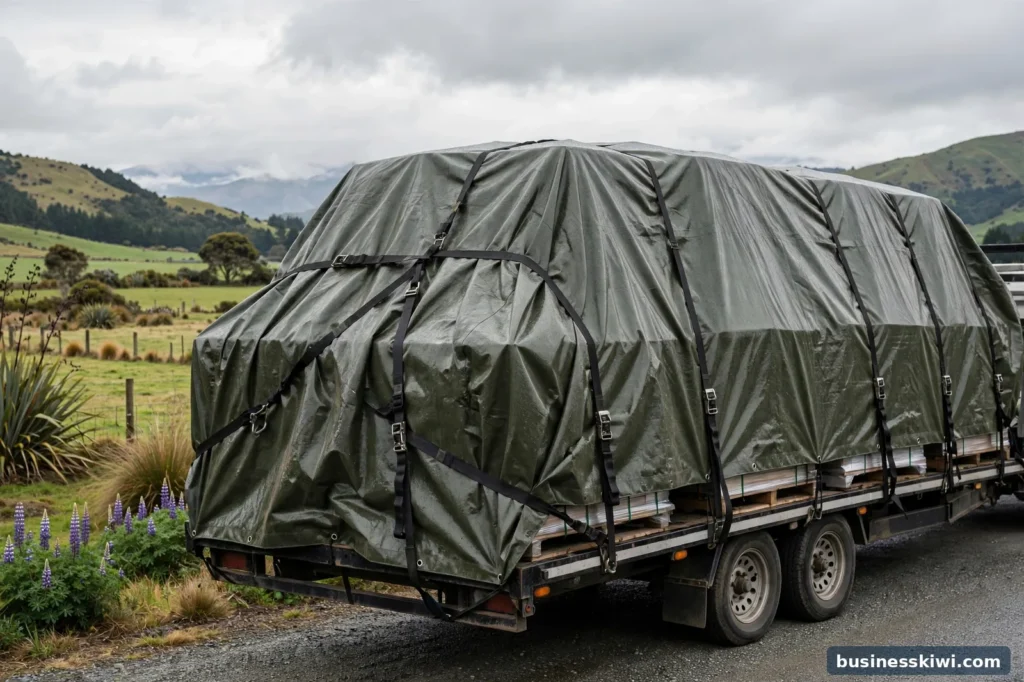
A tarpaulin used on a ute, trailer or truck is doing a legal job as well as keeping rain off. The NZ Transport Agency Waka Kotahi publishes a guide to safe loading and towing for light vehicles, and its position on covering is direct: all loads that may be affected by air flow or by the motion of the vehicle should be covered. Bulk unbagged loads, including sand, gravel, builder’s mix, leaves, grass clippings, wood chips, sawdust, coal, firewood, topsoil and general rubbish, should be covered by a tarpaulin to prevent the load spilling or shedding. For powdered or granular material carried loose on a flat deck vehicle with sides, the guide says to cover the load with a tarpaulin properly secured to the vehicle at appropriate anchorage points. Garden refuse carried in bulk should likewise be inside a closed vehicle or covered by netting or a tarpaulin.
The critical limit is in the official New Zealand truck loading code, published by NZTA. The code states that, except in the case of very light bulk loads of 0.5 tonne or less, sheets or tarpaulins should be regarded as providing no more than weather protection, and the load must be independently restrained against movement. In plain terms, a tarpaulin keeps a load dry and stops loose material blowing or spilling off; it does not hold a load on the vehicle. Restraint has to come from lashings, straps, racks or the vehicle structure, and the light vehicle guide sets out the same principle: loads should be properly restrained so they cannot shift while the vehicle is moving, and lashings should be tightened before the journey and checked during it.
For buyers, the takeaways are simple. Choose a tarp big enough to cover the load fully and reach proper anchorage points, tension it so it cannot flap or work loose, and never treat the tarp and its eyelets as the restraint system for anything heavy or solid.
Care, lifespan and repairs
Ultraviolet light is the main enemy of a polyethylene tarpaulin in New Zealand conditions. Suppliers sell UV stabilised fabric across their ranges, from Trade Tested’s 90gsm standard sheet to TM Covers’ 306gsm Canvacon, because unstabilised polyethylene goes brittle in the sun. UV stabilisation slows that process; it does not stop it. Expect a light grade tarp in permanent outdoor use to have a short life, heavy duty polyethylene to last longer, and welded PVC or heavy coated fabrics at the manufactured end to last longest. TM Covers’ 3 year limited warranty on its tarpaulin fabrics gives one manufacturer’s own benchmark.
Mechanical wear does the rest of the damage. A flapping tarp fatigues at its eyelets and corners, so tension it evenly, use as many tie points as the job needs, and avoid dragging sheets over sharp edges or rough concrete. Trade Tested’s setup guidance is basic and correct: roll the tarpaulin over the item, secure the corners through the eyelets, then the remaining eyelets along the edges, pulling it taut. Store tarps dry, clean and out of the sun; a sheet folded away wet grows mildew.
Repairs divide by material. PVC and coated fabrics can be patch welded, and both TM Covers and Tarpaulin Makers offer repair services; Tarpaulin Makers notes it has a contractor network around the country for repairs. Welded repairs restore strength in a way stick-on patches on woven polyethylene generally do not, which is one more reason heavy covers are worth repairing and cheap ones are usually replaced. Eyelets can be replaced on sound fabric, but once the hem fabric itself has gone brittle or torn, replacing the whole tarp is the honest answer.
Buying checklist
- Choose the material first: polyethylene for price and convenience, PVC coated fabric for long service and repairability, canvas through a maker for traditional custom work.
- Compare GSM and weave where published, not grade names. Around 90gsm is light duty; around 205gsm is heavy duty polyethylene; 300gsm and above is industrial territory.
- Check the edges: rope reinforced or welded hems, reinforced corners, and eyelet material, size and spacing.
- Measure over the load, not across the floor: footprint plus twice the side drop, plus tying allowance, then round up a size.
- Check whether quoted prices include GST and whether the size is a finished size.
- For vehicle loads, the tarp is weather protection. Restraint is a separate job, done with lashings and anchorage points.
- For big or valuable covers, get a made-to-measure quote and ask what warranty the fabric carries.
Frequently asked questions
What GSM tarpaulin should I buy?
Match the fabric weight to the duty. Around 90gsm polyethylene suits short-term and occasional cover. Around 205gsm suits regular outdoor use, building sites and transport work. Fabrics at 300gsm and above, including TM Covers’ 306gsm polyethylene, 340gsm polypropylene and 690gsm PVC coated fabrics, are industrial materials for covers expected to work hard for years. GSM is the fabric weight per square metre, so it also tells you how heavy the finished tarp will be to handle.
Why do two tarpaulins of the same size cost such different prices?
Because size is only one input. At 2.4m x 3.0m, prices published by New Zealand suppliers run from $38.02 for a Mitre 10 Jobmate heavy duty tarp to $165.64 for a Polytuf Industrial Xtreme tarp at Bay Engineers Supplies. The difference is fabric, hem and fitting construction, and intended duty. A cheap tarp is not necessarily poor value for light work, but it is not the same product as an industrial sheet with the same dimensions.
Is a tarpaulin enough to secure a load on my trailer or truck?
No, except for very light bulk material. NZTA’s truck loading code states that, apart from very light bulk loads of 0.5 tonne or less, tarpaulins provide no more than weather protection and the load must be independently restrained. NZTA’s light vehicle guide adds that loose bulk loads such as gravel, firewood, green waste and rubbish should be covered with a tarpaulin so nothing spills or blows off, with the tarp properly secured at anchorage points.
How do I work out what size tarpaulin I need?
Measure the footprint of the load, then add twice the depth you need the tarp to drop down the sides, to both the length and the width. Add a little more for tying off, and round up to the next standard size if you land between sizes. For something valuable or an awkward shape, a made-to-measure tarp from a local manufacturer avoids the compromise.
How long will a tarpaulin last outside?
It depends on the fabric and how it is used. UV light breaks polyethylene down over time even when it is UV stabilised, and flapping accelerates wear at eyelets and corners. Treat light grades in permanent sun as short-life consumables. At the manufactured end, TM Covers offers a 3 year limited warranty on its tarpaulin fabrics, an indication of the service life a maker expects from heavy fabrics that are properly fitted and tensioned.
Can a damaged tarpaulin be repaired?
Often, yes, if the fabric itself is still sound. PVC and coated fabrics can be patch welded, and manufacturers such as TM Covers and Tarpaulin Makers run repair services. Torn eyelets can be replaced where the surrounding hem is healthy. Once woven polyethylene has gone brittle from UV exposure, or the hem has torn away, repair is rarely economic.
Do tarpaulin prices include GST?
Retail prices on consumer websites such as Trade Tested and Mitre 10 are the prices you pay at checkout. Trade listings are not always as clear: Bay Engineers Supplies’ Polytuf listing does not state whether its prices include GST, so confirm before ordering, especially for business purchases.
Sources
- Bay Engineers Supplies, Polytuf Tarpaulins range and prices (bayengineerssupplies.co.nz)
- Mitre 10, Tarpaulins and Covers range, Number 8 and Jobmate (mitre10.co.nz)
- TM Covers (Transport and Marine Covers), Tarpaulins fabric guide: Canvacon 7000, Landmark Tearstop, Trident Ripstop (tmcovers.co.nz)
- Tarpaulin Makers, custom tarpaulins in PVC and canvas (tarpmakers.co.nz)
- Trade Tested, Tarpaulins range: standard 90gsm and heavy duty 205gsm product specifications (tradetested.co.nz)
- NZ Transport Agency Waka Kotahi, Guide to safe loading and towing for light vehicles (nzta.govt.nz)
- NZ Transport Agency Waka Kotahi, The official New Zealand truck loading code: basic criteria and precautions (nzta.govt.nz)
This article is general information about tarpaulin types, specifications and prices in New Zealand, based on suppliers’ published product information at the time of writing. Prices, ranges and specifications change, and a supplier’s current listing is the only reliable quote. It is not professional, legal or safety advice. For load restraint on public roads, follow NZTA guidance and, for heavy vehicles, the official New Zealand truck loading code.