Moving Companies in NZ: Costs, Quotes, Insurance and Your Rights

Most moving day problems start weeks earlier, on paper. A vague quote, a survey that never really happened, and a line in the terms about risk that nobody read until a table leg snapped.
Quick answer
Moving companies in New Zealand charge in two main ways. Local moves are often priced by the hour, for a truck and crew, usually with a minimum charge and sometimes a call-out fee. Longer and full house moves are more often priced as a fixed quote based on volume, distance and services included.
Two things decide how most moves turn out. First, a written, itemised quote based on an actual survey of your goods, in person or by video. Second, written clarity on who carries the risk if something is lost or damaged. Under the Contract and Commercial Law Act 2017, that depends on the kind of carriage contract you sign. Many household moves are offered at owner’s risk, meaning the carrier pays no compensation for accidental loss or damage unless it was caused intentionally. Without insurance, you may have no cover at all for a dropped box.
How movers charge
Hourly pricing for local moves
Hourly work suits short, simple shifts. You pay for time, so you also pay for traffic, a shared lift, a long carry, or a sofa that will not turn on the stairs.
Auckland Kiwi Movers, a local firm, publishes an example of the structure on its own website: hourly rates that vary by truck size for a crew of two, a call-out fee that also varies by truck size, and a minimum charge of two hours including the call-out fee. Extra time is charged in 15 minute increments after the first hour, an additional mover is charged per hour, and oversized items such as pianos, double door fridges, spa pools and pool tables may attract an extra charge. That is that firm’s structure, shown as an example only, not as a market rate.
Read any hourly offer for: crew and truck size, minimum hours, when the clock starts and stops, how part hours are charged, fuel and mileage, and extras.
Fixed quotes for larger and longer moves
For a full house, a move between cities, or anything involving packing and storage, movers generally work to a fixed quote built from a survey, a volume estimate, the distance, crew and truck needs, and the services you have chosen.
NZ Van Lines describes its process on its own site. For a small shipment it may quote from the information you supply. For larger relocations it arranges for a consultant to visit your home or survey your goods by a virtual meeting using a phone or tablet, and it says it includes insurance costs in its quotations. The Moving Company offers a similar step, called an in home appraisal, where a consultant surveys your goods and identifies special packing needs. A fixed quote is only as good as that survey. Crown Relocations makes the point in its domestic material: if you add or remove furniture after the survey, tell the move manager so the quote can be recalculated.
Quote or estimate: the words matter
Consumer Protection, part of the Ministry of Business, Innovation and Employment, draws a clear line here. A quote is an offer to do a job for a specified price. Once you accept it, the provider cannot charge more unless you agree to extra work or the scope changes while the job is under way. That change is a variation to the contract. An estimate is a best guess. The final price can be more or less, although Consumer Protection says it should generally sit within 10 to 15 percent of the estimate.
Ask whether your document is a fixed quote or an estimate, what would trigger a variation, and how it would be priced before the extra work is done. If a mover charges a fee to prepare a quote, they must tell you beforehand.
What drives the price
Volume. More goods mean a bigger truck, more trips, or both, and more loading time. Decluttering before the survey is the one saving that costs nothing.
Access at both ends. Stairs, steep driveways, narrow streets, long carries, lift bookings and tight doorways slow a crew down. On an hourly job they lengthen the day. On a fixed quote they belong in the survey.
Distance. Local hourly work may include fuel and mileage up to a point, as the Auckland example shows, while long distance work is commonly quoted separately. Intercity and inter-island moves also involve linehaul and ferry timetables.
Packing. Professional packing adds labour and materials, and changes who is responsible for how goods were prepared, which matters if you later claim for breakage. Part packing, for fragile items only, sits between doing it all yourself and handing the whole house over.
Special items. Pianos, pool tables, spa pools, large fridges and antiques need extra hands or crating. The Moving Company’s terms treat this work as outside a standard proposal unless expressly included. Name these items at survey stage.
Timing, storage and extras. Weekends, month end and summer are busy. NZ Van Lines gives rule of thumb lead times on its own site: 4 to 6 weeks for a local move, 6 to 8 weeks inter-island, and 2 to 3 months international. Storage, packing materials, dismantling, cleaning, vehicle and pet transport are separate lines on movers’ service lists. If it is not in the quote, assume it is not included.
Getting quotes properly
Get more than one quote for anything beyond a small local shift. Consumer Protection’s general guidance is to seek several, ask for them in writing, and give each business as much information as you can, because the quality of the quote depends on it.
A useful survey works room by room. Open cupboards. Show the garage and the shed. Disclose the awkward parts: items you plan to add or leave behind, heavy or fragile items, access problems at either address, dates that cannot move, and work you expect beyond carrying, such as packing or disconnecting a washing machine.
Consumer Protection lists the basics a quote should show: what work will be done, any other costs such as materials, the hourly rate where time based charging applies, and how long the work will take. For a house move, check also both addresses and the date, the volume the price is based on, packing included or excluded, special item charges, storage, the insurance offer, the kind of carriage contract, payment terms, and what is not included. The Moving Company’s terms list exclusions such as tradesperson work on fittings, lifting carpet, and reconnecting plumbed appliances, unless expressly included. Note the acceptance window too: that firm’s proposal is not binding unless written acceptance is received within 28 days.
Some households send documents or a work laptop separately, rather than leaving them in a truck overnight. If you do, keep the tracking details with your moving file. Our postage costs guide explains how NZ postage and courier pricing is structured.

Choosing a mover: checks that are factual
Check the legal business exists. Search the Companies Register, run by the Companies Office, for the entity name. The register lets you search by entity name or number and shows whether an entity is registered or has been removed, along with directors, shareholders and registered addresses. If the name on the quote, the truck and the register cannot be reconciled, ask why before you pay anything. A sole trader will not appear as a company, which is not a fault in itself, but should still give you a trading name, a physical address and written terms.
Insist on written terms stating the charging basis, risk basis, exclusions, claim time limits and payment terms. Get the insurance offer in writing: product name, who underwrites it, what it covers, its excess, and how to claim. Look for a physical address and more than one contact route. Be cautious with social media only operators: a page, a phone number and low cash pricing, with no terms, no register presence and no insurance offer, leaves you with very little if goods are damaged. Ask who does the move. Some bookings are subcontracted, and the other firm’s terms matter too.
Risk: who pays if something breaks
The carriage contract kinds
Two laws interact here, as Consumer Protection explains. The Contract and Commercial Law Act 2017 (CCLA), which replaced the old Carriage of Goods Act position, covers the carrier’s liability for loss or damage while goods are with the carrier. The Consumer Guarantees Act 1993 (CGA) covers the service itself.
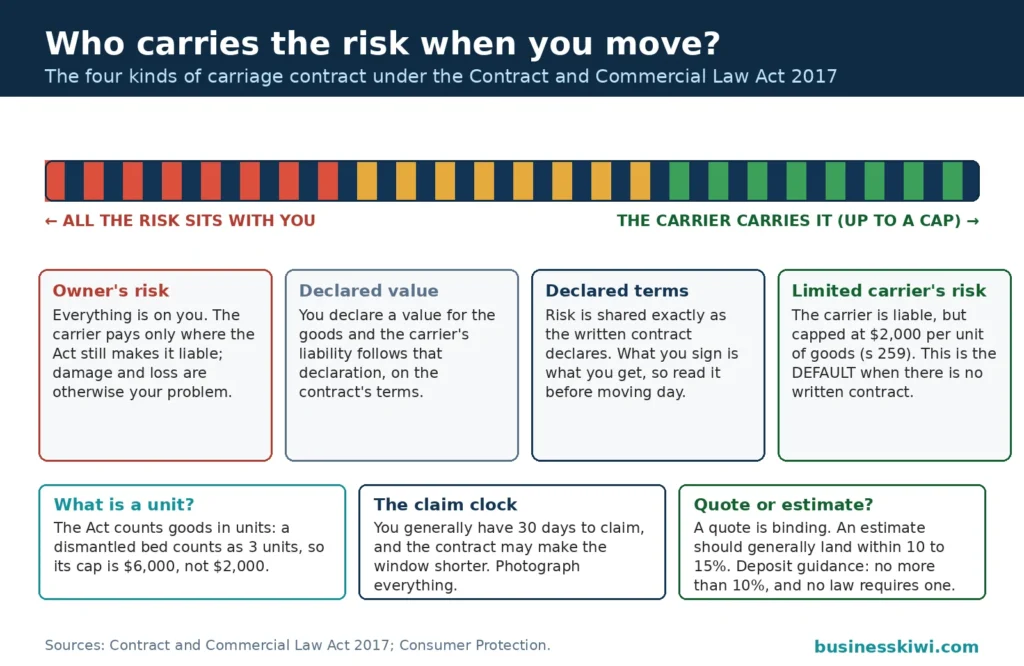
Under the CCLA, as Consumer Protection summarises it and as the Act itself sets out, there are four kinds of carriage contract:
Section 259 of the Act caps liability at limited carrier’s risk, and at declared value risk, at $2,000 for each unit of goods lost or damaged or, for declared value risk, the amount specified in the contract. Consumer Protection explains that a unit is each separate item given to the carrier, usually a box, and gives the example of a dismantled bed counting as three units: base, headboard and mattress.
If you do not have a written contract, Consumer Protection states your goods are carried at limited carrier’s risk. Most written mover contracts are offered on a specific basis, and owner’s risk is common for household removals. Read which kind yours is before you sign. The difference between $2,000 per unit and nothing for accidental damage is the difference between a limited claim and funding the repair yourself.
Consumer Protection adds points that are easy to overlook. Carriers are not liable for loss or damage resulting from an inherent defect in the goods, goods not properly packed, a legal requirement that was not met, goods taken by legal process, or the carrier saving life or property. Under the CCLA you have 30 days to claim for loss or damage, and your contract may set a shorter period. Carriers often exclude liability for delay.
Its worked example, in brief: a customer who packed his own goods, signed an owner’s risk contract and took no insurance found broken kitchenware at the new flat. He could not claim under the CCLA. A CGA claim was still open in principle, but he would have to prove the movers had not used reasonable care and skill. Intentional damage stands apart: Consumer Protection states the person at fault must pay up to the full value, whatever kind of contract you signed.
What the Consumer Guarantees Act adds
The CGA gives guarantees for services bought for personal or household use. Consumer Protection’s services guide lists four: reasonable care and skill, fitness for the particular purpose you told the provider about and they accepted, completion within a reasonable time where no time was agreed, and, where no price was agreed, a reasonable price.
For a move, reasonable care and skill is the guarantee with teeth. Blanketing furniture, stacking a truck sensibly, using enough crew for a heavy item and securing the load are service matters, not just luck. The CGA route is separate from the carriage contract, but it turns on evidence: photos before loading, an inventory noting existing marks, and prompt written notice of damage. A business cannot tell you the CGA does not apply or get you to sign it away for a consumer service.
Insurance options
Mover arranged transit protection
NZ Van Lines says it includes insurance costs in its quotations, strongly recommends transit cover, and states its plans are underwritten by Vero. Crown Relocations offers CrownCare Transit Protection, administered by Crown, and advises customers to take it up because household policies may give very limited cover in transit. Crown’s material also requires telling your move manager about damage within 7 days of delivery, with repair or replacement costs submitted within 60 days.
Compare documents, not brochure lines. Check whether cover is replacement or indemnity (depreciated value), whether packing by you limits cover for your own boxes, the excess and single item limits, cover during storage, and the deadline for notifying damage. If you choose declared value risk, the amount in the contract caps liability, so under declaring your goods only looks clever until something is damaged.
Your own contents policy
Do not assume your contents insurance follows your furniture into a truck. Insurer initio explains on its own site that its standard policy gives limited cover while contents are moved to another permanent residence in New Zealand, and only for specified events: fire, lightning or explosion, theft following violent and forceful entry to a vehicle or building, storm or flood, natural disaster, aircraft impact and impact by a motor vehicle. It does not cover accidental breakage, such as a dropped box, and initio does not offer an option to extend cover beyond those events.
Other insurers structure this differently. MAS publishes a separate goods in transit and storage policy, and its wording distinguishes between property moved by a professional carrier, where accidental loss cover can apply under that policy, and property you move or store yourself, where cover is limited to restricted perils. Ring your insurer before the move and ask whether your contents are covered in transit, for what events and limits, whether that changes if a mover carries them or you pack them, and what happens during storage.

Contracts and moving day paperwork
Inventory. For intercity, international and storage moves, movers prepare a detailed inventory as a matter of course, to customs and insurance standard on The Moving Company’s terms. For a local move, ask what list will be made and get a copy.
Condition notes. Record existing scratches and marks at uplift. Add dated photos of high value items before wrapping, including serial numbers on appliances.
Access and timing. Confirm parking, lift bookings, keys, settlement timing and contacts for both addresses, in writing, the day before, plus what happens and what it costs if settlement is delayed.
Payment terms. Consumer Protection’s general advice on accepting a quote is that there is no legal requirement to pay a deposit, and if one is asked for, not to pay more than 10 percent of the total cost. If a mover seeks a larger amount before a long distance move, ask for the reason in writing. Keep receipts and the final invoice with the quote.
At delivery, check items off against the inventory, note visible damage on the paperwork before you sign, and keep damaged packaging. Claim deadlines run from delivery, and some are short.
Inter-island and international moves in brief
An inter-island move is a domestic move with a Cook Strait crossing in the middle. Goods are linehauled and scheduled around ferry sailings, so delivery windows are wider than a local shift. The same CCLA and CGA framework applies, and the same risk questions need written answers.
International moves add export packing, shipping, customs and biosecurity controls at destination, and delivery by a partner agent. Ask who handles your goods at the other end. Crown and NZ Van Lines both describe sole use and shared container options on their own sites, with air freight for priority items. Shared containers cost less and usually take longer.
For goods coming into New Zealand, the Ministry for Primary Industries (MPI) publishes the biosecurity process. In outline: shipping personal items by sea or air requires an unaccompanied personal baggage declaration form, NZCS218, through NZ Customs; a voluntary personal effects supplementary declaration may reduce clearance costs and speed clearance; MPI screens declarations against import health standards; inspection of sea containers is mandatory, by MPI or an accredited person at an approved transitional facility; and a full container carries extra requirements, including a quarantine declaration. Clean outdoor equipment and footwear before packing and declare them.
If things go wrong
Start with the mover, promptly and in writing. Consumer Protection’s advice for delivery problems is to contact the carrier directly, explain the problem, and set out what you want done, armed with your paperwork. For a service problem under the CGA, its services guide sets out the remedy shape. For a minor problem, give the provider an opportunity to fix it at no cost to you. If they refuse, take too long, or do not fix it, you can have someone else fix it and claim the cost, or cancel the contract and refuse to pay, or pay less, with money already paid potentially recoverable. For a serious problem you can cancel and refuse to pay, again with a possible refund depending on how much of the service was satisfactory. Keep the CCLA clock in mind: 30 days, or less if your contract says so.
If the sales process misled you, the Fair Trading Act applies. Consumer Protection summarises it as making it illegal to mislead or deceive consumers, including through misleading prices, hidden costs, and false or unsubstantiated claims. You can report a business to the Commerce Commission, which does not act for individuals but uses reports to target harm. Citizens Advice Bureau and Community Law Centres offer free help.
If you cannot agree, the Disputes Tribunal is the usual next step. A referee hears the case in a less formal, lower cost forum, and you generally cannot have a lawyer argue for you in the hearing, though you can take legal advice beforehand. Since 24 January 2026 the Tribunal’s financial jurisdiction is $60,000, as the Ministry of Justice announced. Filing fees on the Disputes Tribunal’s own forms and fees page, last updated 27 July 2026, are $62 for a claim under $2,000, $124 for $2,000 or more but under $5,000, $248 for between $5,000 and $30,000, and $496 for between $30,001 and $60,000. Fees are non refundable, although the referee may order the other party to repay your fee if your claim succeeds in whole or in part, at the referee’s discretion. Take the quote, contract, inventory, photos, damage notes and every email. These cases are won on documents far more often than on recollection.
Frequently asked questions
Is my furniture insured automatically when a moving company carries it?
No. Liability depends on the kind of carriage contract you signed. At owner’s risk, the carrier pays nothing for accidental loss or damage unless it was intentional. At limited carrier’s risk, liability is capped at $2,000 per unit. Separate transit insurance is what covers accidental damage properly.
What is the difference between a quote and an estimate for a move?
A quote is an offer to do the job for a specified price. Once accepted, the mover cannot charge more unless you agree extra work or the scope changes. An estimate is a best guess, and the final price can vary, although Consumer Protection says it should generally be within 10 to 15 percent.
How far ahead should I book a moving company?
As a guide from one large operator’s own site, NZ Van Lines suggests 4 to 6 weeks for a local move, 6 to 8 weeks for inter-island and 2 to 3 months for international, with more notice in holiday periods. Peak dates fill first, so book the survey early.
My mover damaged an item. What do I do first?
Note the damage on the delivery paperwork, photograph the item and packaging, and notify the mover in writing straight away. You have 30 days to claim under the Contract and Commercial Law Act, your contract may allow less, and a transit policy may require notice within days. Then claim under the route that fits: carriage contract, transit insurance, or the Consumer Guarantees Act if the work lacked reasonable care and skill.
Can a moving company charge more than the fixed quote on the day?
Only if the job changes in a way the contract allows, for example you add goods or services and agree a variation. Extra goods or an undisclosed access problem can change the position. If the price rises with no change in scope, ask for the variation in writing, raise it with the mover using the original quote, then consider the Disputes Tribunal.
Sources
Consumer Protection: Delivery issues; Your consumer rights (Services); Obligations under the Consumer Guarantees Act; Quotes and estimates; Fair Trading Act, consumerprotection.govt.nz
Contract and Commercial Law Act 2017, sections 248 to 260, legislation.govt.nz
Ministry of Justice, Disputes Tribunal jurisdiction increase, justice.govt.nz; Disputes Tribunal, Forms and fees, disputestribunal.govt.nz
Ministry for Primary Industries, Household goods and personal effects importing to NZ, mpi.govt.nz
Companies Office, Companies Register search, companiesoffice.govt.nz
NZ Van Lines, nzvanlines.co.nz; The Moving Company, themovingcompany.co.nz; Crown Relocations, crownrelo.co.nz; Auckland Kiwi Movers, aucklandkiwimovers.co.nz
Initio, initio.co.nz; MAS, mas.co.nz
Disclaimer
This article is general information only, not legal or insurance advice for your situation. Contracts, wordings and prices change. Read your own contract and policy, and seek advice from a lawyer, your insurer or Citizens Advice Bureau if a dispute involves a significant amount.
For more guides, see our Business and Industry hub.