Doctor Salary NZ: How Much Do Doctors Earn in New Zealand?

Ask how much a doctor earns in New Zealand and the honest answer is that it depends on where they sit in a career that can run for forty years. A first year house officer fresh out of medical school earns a solid professional salary. A senior specialist near the top of the scale earns roughly three and a half times as much. The good news for anyone researching this is that public hospital pay is not a mystery. It is set by two published collective agreements, so the exact scales are there for anyone to read.
Junior doctors employed by Health New Zealand | Te Whatu Ora are called resident medical officers, or RMOs. Their pay comes from collective agreements negotiated by their unions, the Resident Doctors’ Association (RDA) and Specialty Trainees of New Zealand (STONZ). Senior doctors, known as senior medical officers or SMOs, are covered by the agreement negotiated by the Association of Salaried Medical Specialists (ASMS). This guide uses the current agreements and their current pay scales. Every figure is a base salary before tax, and the scales step up again partway through each agreement’s term.
Doctor salary at a glance
- House officers (first years after graduation): $80,882 to $162,381 a year, depending on the run and year of service.
- Registrars (doctors in specialist training): start at $95,209 and reach $202,988 by Year 5 on the longest hour runs.
- Specialists / senior medical officers: $198,386 at Step 1 of the scale, rising to $282,645 at the top Step 15.
- Medical officers (senior doctors without vocational registration in the role): $152,694 to $222,476.
- GPs: no national pay scale exists. Most work as contractors or practice owners, so income varies widely.
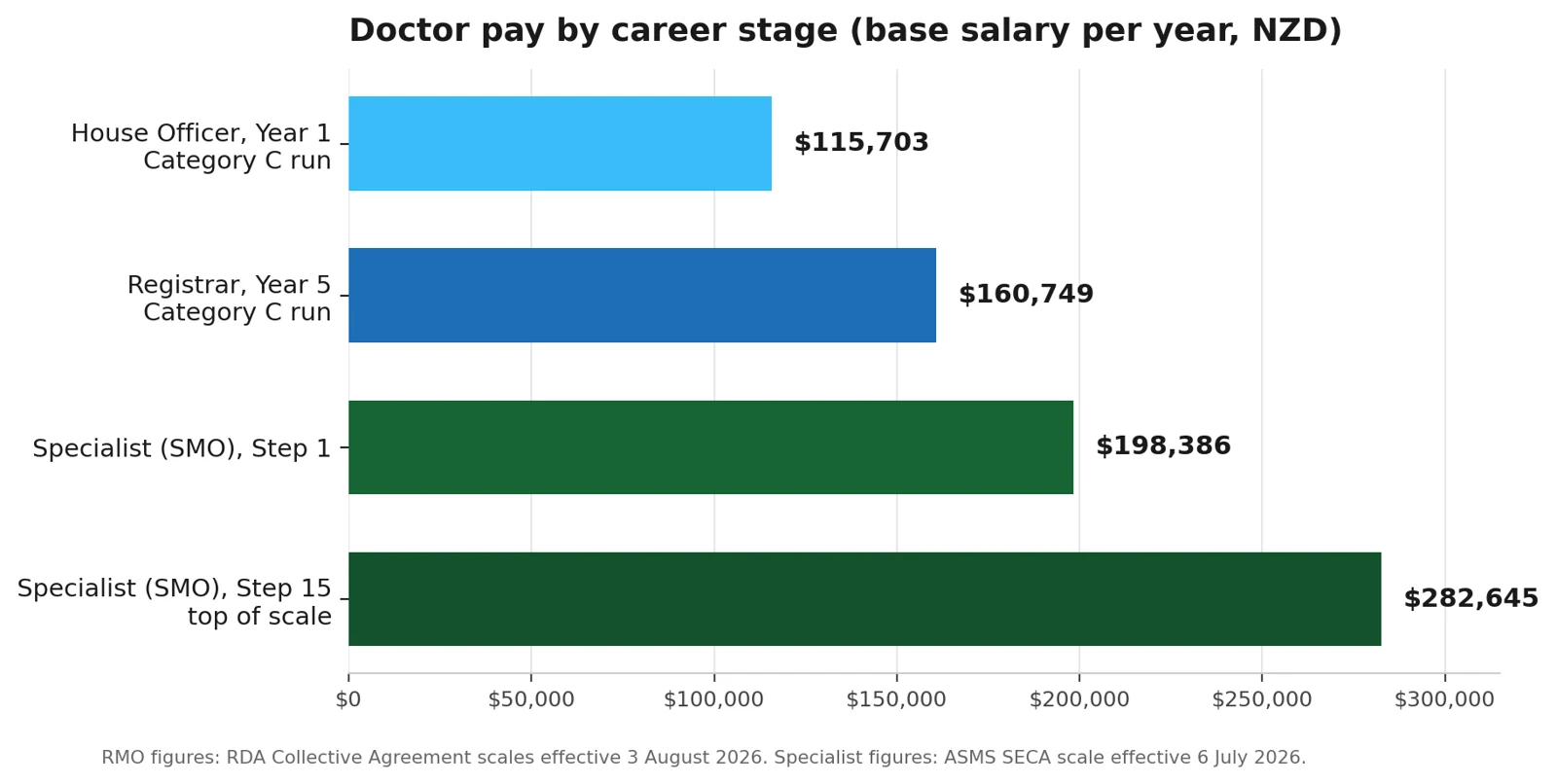
Pay by career stage
House officers: the first years
After graduating, doctors work as house officers while they complete prevocational training. Under the RDA Collective Agreement 2026–2028, a house officer’s salary is set by two things: their year of service (Year 1, 2 or 3) and the category of the run they are working. Runs are graded from Category F (an average of 40 to 44.9 hours a week) up to Category A (65 hours or more). Longer, heavier rosters pay considerably more.
House officer salaries, effective 3 August 2026 (RDA Collective Agreement)
| Run category | Average hours | Year 1 | Year 2 | Year 3 |
|---|---|---|---|---|
| F | 40–44.9 | $80,882 | $85,379 | $89,955 |
| E | 45–49.9 | $90,205 | $95,173 | $100,292 |
| D | 50–54.9 | $101,841 | $107,514 | $113,308 |
| C | 55–59.9 | $115,703 | $122,220 | $128,693 |
| B | 60–64.9 | $129,558 | $136,910 | $144,205 |
| A | 65+ | $145,727 | $154,020 | $162,381 |
Two things stand out from the table. First, the spread within a single year is huge. A Year 1 house officer on a Category A run earns nearly double what the same doctor earns on a Category F run, which is the agreement’s way of paying for nights, weekends and very long weeks inside the salary rather than by the hour. Second, the starting point is respectable by any standard. Even the lowest cell in the table sits above the starting salaries of most other public sector professions.
Registrars: training to be a specialist
Once a doctor enters a vocational training programme with one of the specialist colleges, they work as a registrar. Registrars are the backbone of hospital after hours care, and their scale runs for ten years, although progression works a little differently after Year 5 (more on that below). The first five years look like this.
Registrar salaries, effective 3 August 2026 (RDA Collective Agreement)
| Run category | Average hours | Year 1 | Year 2 | Year 3 | Year 4 | Year 5 |
|---|---|---|---|---|---|---|
| F | 40–44.9 | $95,209 | $99,698 | $104,149 | $108,626 | $113,065 |
| E | 45–49.9 | $105,029 | $110,044 | $115,126 | $120,007 | $125,083 |
| D | 50–54.9 | $118,691 | $124,363 | $130,013 | $135,821 | $141,373 |
| C | 55–59.9 | $134,830 | $141,446 | $147,778 | $154,376 | $160,749 |
| B | 60–64.9 | $151,097 | $158,400 | $165,778 | $172,953 | $180,255 |
| A | 65+ | $170,169 | $178,422 | $186,616 | $194,856 | $202,988 |
A registrar normally starts at Year 1 of this scale when first appointed, although directly relevant earlier service, including overseas experience, can be credited to place them higher. From there they move up one step each year. There is one important catch. A registrar does not progress beyond Year 5 unless they are in a training programme that leads to vocational registration. The rule is designed to push doctors into formal specialist training rather than letting them drift in registrar roles indefinitely. Passing Part I college exams also triggers an extra step, known as the exam step or higher qualification increment, although it cannot be paid before the doctor’s sixth year of postgraduate work.

Senior medical officers: the specialist scale
At the top of the hospital ladder sit the specialists: consultants who hold vocational registration with the Medical Council and carry ultimate responsibility for their patients. Their pay is set by the ASMS and Health New Zealand SECA for 2026–2027, which runs from 1 January 2026 to 31 January 2027. The specialist scale has 15 steps, and doctors advance one step a year, subject to satisfactory performance.
Medical and dental specialists scale, effective 6 July 2026 (ASMS SECA)
| Step | Salary | Step | Salary | Step | Salary |
|---|---|---|---|---|---|
| 1 | $198,386 | 6 | $228,479 | 11 | $258,571 |
| 2 | $204,405 | 7 | $234,498 | 12 | $264,590 |
| 3 | $210,423 | 8 | $240,516 | 13 | $270,608 |
| 4 | $216,441 | 9 | $246,534 | 14 | $276,626 |
| 5 | $222,460 | 10 | $252,553 | 15 | $282,645 |
The scale salary is calculated against the doctor’s agreed job size, so a specialist working part time receives the relevant proportion. On top of base salary, the agreement provides an availability allowance for doctors who are on call, worked out under district formulas in the agreement that take account of how often the doctor is called and how quickly they must attend. There are also provisions for professional development and an employer superannuation subsidy. A separate Fellows scale covers senior doctors working towards vocational registration, who move across to the specialist scale once they are registered.
Not every senior doctor is a vocationally registered specialist. Medical officers, experienced doctors who work at a senior level without holding vocational registration in that role, have their own 14 step scale in the same agreement, running from $152,694 at Step 1 to $222,476 at Step 14 (effective 6 July 2026).
How RMO pay actually works
RMO pay confuses people because it is not hourly. A house officer or registrar is paid an annual salary for a run, and each placement has a run description that sets out the roster, the clinical duties and the expected average hours. Those average hours determine the run’s category, and the category determines the salary. Nights, weekends and on call time inside the roster are already priced into that figure.
A few features of the system are worth knowing:
- Relievers get paid more. Doctors who work as relievers, covering gaps across different runs, are paid two categories above the majority category of the runs they cover, recognising that relief work is unpredictable.
- Emergency and intensive care runs are protected. Full rotating shift runs in areas such as emergency departments and intensive care are categorised at least two categories higher than the raw hours would suggest, and RMOs in those areas are paid at Category C as a minimum.
- Extra shifts are paid on top. When an RMO works additional duties beyond the run description, for example covering an absence, the work is paid at hourly rates set in the agreement and added to salary.
Additional duties hourly rates (RDA Collective Agreement 2026–2028)
| Grade | 8.00am–10.00pm | 10.00pm–8.00am |
|---|---|---|
| House Officer | $60.00 | $90.00 |
| Senior House Officer | $75.00 | $115.00 |
| Registrar | $85.00 | $130.00 |
| Senior Registrar | $120.00 | $180.00 |
- Rural work attracts an allowance. RMOs employed at listed rural hospitals, including Kaitaia, Thames, Taupō, Hāwera, Greymouth and Queenstown, receive an extra 5% of base salary.
- Superannuation is matched. Health New Zealand matches RMO contributions to KiwiSaver or an approved scheme dollar for dollar, up to 6% of gross salary.
Doctors covered by the STONZ agreement (1 March 2026 to 30 April 2028) have their own version of the scales, with the same additional duties rates. The RDA agreement also lifts its scales again on 2 August 2027, when, for example, a Year 1 house officer on a Category F run moves to $83,904.
What do GPs earn?
General practice is the part of doctor pay where there is no tidy official answer, and it is better to say that plainly than to invent one. Most GPs in New Zealand are not salaried hospital employees. They work in privately owned practices, either as independent contractors who keep a share of the fees their work generates, or as practice owners whose income is what is left after staff, rent and other costs are paid. There is no national GP pay scale, and neither Health New Zealand nor Tahatū publishes an official GP salary range.
What can be stated from official sources is narrower. Doctors training in general practice under the General Practice Education Programme (GPEP) are employed as registrars, and the RDA agreement sets their pay by experience: $124,904 for those with under five years of postgraduate experience, $132,517 at five to six years, and $139,545 at seven or more years (effective 3 August 2026). Once training is complete, a GP’s income depends on the practice, the contract and whether they hold an ownership stake, and it can fall well below or climb well above hospital specialist pay. For hospital specialists, Tahatū, the government’s careers service, puts the most common pay range for occupations such as anaesthetists, dermatologists and ophthalmologists at $206,000 to $247,000, which lines up with the middle steps of the ASMS scale above.
The training pathway: why the pay takes so long to peak
The long runway explains the shape of doctor pay. New Zealand has two medical schools, at the University of Otago and the University of Auckland, and the MBChB degree takes six years including the first year of health science study. Otago describes its degree as five years of medical school following Health Sciences First Year or a completed degree.
Graduation is not the finish line. Under the Medical Council of New Zealand’s prevocational training policy, the two years after graduation (PGY1 and PGY2) are a formal internship. PGY1 doctors hold provisional general registration and work a series of 13 week attachments. They can move to the general scope of practice after meeting the PGY1 requirements, and PGY2 completes the prevocational programme. Only then do most doctors settle into registrar roles and college training programmes, which take several more years depending on the specialty. Tahatū puts total training time for specialist occupations at 13 to 14 years. Put together, it is commonly 12 to 15 years from starting university to working as a fully qualified specialist, which is why the pay scales keep climbing for so long.
For context on how this compares with other public sector professions, a newly qualified registered nurse starts on $77,667 (see our Nurse Salary NZ guide), and the school teacher scale tops out at $105,686 (see Teacher Salary NZ). A first year house officer on a mid range Category C run already earns more than the top of the teacher scale. You can browse more guides like this in our Jobs & Education section.
Frequently asked questions
How much does a doctor earn in NZ?
It depends on the stage. Under the current collective agreements, hospital doctors earn from $80,882 as a first year house officer on the shortest hour runs through to $282,645 for a specialist at the top of the ASMS scale. Most established specialists sit somewhere between $200,000 and $280,000 in base salary.
What does a first year doctor earn in New Zealand?
A house officer in their first year after graduation earns between $80,882 and $145,727, depending on the category of their run. A typical mid range run (Category C, 55 to 59.9 average hours) pays $115,703.
Do junior doctors get paid during training?
Yes. From the first day of PGY1, doctors are salaried employees of Health New Zealand. There is no unpaid internship period in New Zealand.
How much do GPs earn in NZ?
There is no official figure. Most GPs are contractors or practice owners rather than salaried staff, so incomes vary with the practice and the arrangement. GPs in training (GPEP registrars) are paid $124,904 to $139,545 under the RDA agreement.
How long does it take to become a specialist in NZ?
Six years of medical school, two years of prevocational training, then several years of registrar work and college training. Tahatū gives 13 to 14 years of total training for specialist occupations such as cardiology and emergency medicine.
Sources
- NZ Resident Doctors’ Association and Health New Zealand | Te Whatu Ora Collective Agreement, 1 August 2026 to 30 September 2028 (salary scales at clause 8, additional duties at clause 11): https://static.info.content.health.nz/docs/health-pros/employment-agreements/RDA_collective_agreement_(1_August_2026_to_30_September_2028)-signed.pdf
- Specialty Trainees of New Zealand (STONZ) and Health New Zealand Resident Medical Officer Collective Agreement, 1 March 2026 to 30 April 2028: https://static.info.content.health.nz/docs/health-pros/employment-agreements/STONZ-Resident_medical_officer_collective_agreement_(1_March_2026_to_30_April_2028).pdf
- ASMS and Health New Zealand | Te Whatu Ora Senior Medical and Dental Officers Collective Agreement (SECA), 1 January 2026 to 31 January 2027 (salary scales at clause 12.4): https://asms.org.nz/wp-content/uploads/2026/06/2026-2027-ASMS-HNZ-SECA-signed.pdf
- Medical Council of New Zealand, Policy on prevocational medical training: https://www.mcnz.org.nz/assets/Policies/Policy-on-prevocational-medical-training.pdf
- University of Otago, Study Medicine at Otago (MB ChB structure): https://www.otago.ac.nz/healthsciences/students/professional/medicine
- Tahatū Career Navigator, Ophthalmologist occupation profile (specialist pay ranges and training durations): https://tahatu.govt.nz/work/explore-career-ideas/occupation/T00483-ophthalmologist
This article is general information only, based on the collective agreements named above as at October 2026. Base salaries are before tax and exclude allowances, additional duties payments and superannuation. Individual pay varies with run category, job size, part time arrangements and the agreement covering the role. It is not financial or career advice.