Student Visa Application Fee NZ: What It Costs and What You Need

If you plan to study in New Zealand for more than 3 months, the Fee Paying Student Visa is the visa most international students apply for. The application charge is only one part of what you pay, and it is not the biggest part. There is an application fee, an immigration levy on top, and, for most people applying from overseas, a separate visitor levy as well. This guide sets out each charge as Immigration New Zealand (INZ) and the immigration regulations publish them, then covers the money you must show for living costs, what INZ checks, and the visa conditions.
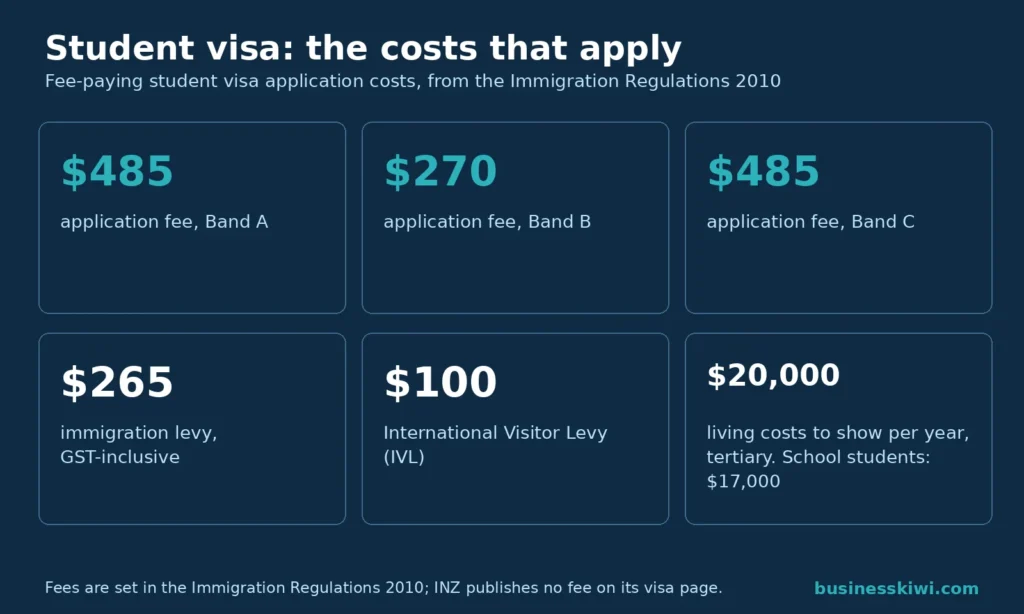
The application fee, broken down
The student visa application fee is set in the Immigration (Visa, Entry Permission, and Related Matters) Regulations 2010, and the amount depends on where you apply from:
Every student visa applicant also pays an immigration levy of NZD $265, charged per application. All three charges are inclusive of GST under the regulations.
Most people applying from outside New Zealand also pay the International Visitor Conservation and Tourism Levy, known as the IVL. INZ charges NZD $100, and it applies to most student visas, apart from the dependent child category. Travellers on Australian or New Zealand passports do not pay it, and neither do travellers on passports from many Pacific Island nations, or Australian resident visa holders.
Adding the parts together gives the realistic totals:
- Applying in New Zealand: $485 fee plus $265 levy is NZD $750.
- Applying from a Pacific country: $270 fee plus $265 levy is NZD $535, and many Pacific passport holders are exempt from the IVL.
- Applying from the rest of the world: $485 fee plus $265 levy plus $100 IVL is NZD $850.
There is no separate online and paper fee: the regulations set one fee per band, applications are made through Immigration Online, and you pay on submission.
Two cautions. Fees and levies are set by regulation and change from time to time; the student fee rose sharply in October 2024. Your total may also differ if a waiver applies: some countries have agreements under which their citizens pay no application fee in some cases, and refugees, claimants and protected people pay no fee or levy at all. Confirm your exact amount in INZ’s Fees, decision times and where to apply tool on immigration.govt.nz before you apply.
The visa fee is not your tuition fee
New applicants often mix these up. The $485 fee is the government’s charge for assessing your application. Your tuition fee is what your provider charges for the course, and INZ does not set it. This article does not quote tuition figures: they vary widely, and the figure that matters is the one in your offer of place.
INZ does require proof that the tuition side is sorted. Unless you are exempt, you must show you have paid the tuition fees for one course, or one year of study, whichever is shorter. Evidence can include a receipt or letter from your provider confirming payment, confirmation that you do not need to pay fees, or, in some cases, documents showing you have applied for a government loan in your home country for a bachelor degree or higher, with a provider letter confirming they expect to receive the fees.
If you apply from outside New Zealand, you can choose not to pay tuition until INZ approves your application in principle. That protects you if the visa is declined, but INZ cannot issue the visa until you evidence payment, so it slows things down.

The money you must show for living costs
The bigger test is showing you can support yourself while you study. INZ sets a minimum living costs amount, separate from tuition.
If your study is tertiary level, English language study, or other non-compulsory study, you must have:
- NZD $20,000 for each year of study, if you are studying for 1 year or more, or
- NZD $1,667 for each month, if your study is shorter than 1 year.
If you are in compulsory education, meaning school in Years 1 to 13, the amounts are lower: NZD $17,000 for each year, or NZD $1,417 for each month.
You also need to show you can leave at the end of your stay: a ticket out, or bank statements showing enough extra money to buy one.
Evidence that the money is real and available can include bank statements, proof that living costs are already paid (such as school homestay confirmation), scholarship evidence, education loan evidence including the loan sanction letter, fixed term deposit evidence, and a Financial Undertaking for a Student form from an acceptable guarantor.
If someone else is paying
A sponsor can take responsibility for your accommodation and living costs instead. A sponsor is an organisation, or an individual who is a family member or friend. You provide your sponsor’s sharing ID with your application, and the sponsor completes an online form and evidences that they can afford it, using documents such as bank statements, pay slips or an employment agreement. A guarantor is a third party who agrees, before you arrive, to support you financially. An individual guarantor must be a relative or friend, must complete the Financial Undertaking for a Student form, and must show the money is their own and not loaned.
Two tighter rules apply in some cases. Citizens of India, Sri Lanka, Bangladesh, Nepal or Bhutan applying from one of those countries can only be sponsored, or given a financial undertaking, by immediate family: a partner, parents, siblings, grandparents and parents-in-law. If you are in New Zealand applying for a further student visa, sponsorship is only possible if your first visa was sponsored, by the same sponsor.
What the fee covers, and what happens if you are declined
The fee pays for INZ to assess your application. It does not buy a visa, and it does not cover tuition, insurance, medical examinations or travel.
Refunds are the exception, not the rule. INZ gives refunds of application fees only in special circumstances. A refund may be possible where you paid a fee you did not need to pay, paid the wrong fee, or your application was not accepted and returned to you. You cannot get a refund if your application has been processed, even if it was declined, or if you withdraw after lodgement. The IVL is never refunded, even when an application is declined. In short, the money is spent whether or not the visa is granted, which is why getting the application right first time matters.
If you applied while in New Zealand and are declined, you may be able to ask INZ to reconsider. The request must arrive within 14 calendar days of the decision, you must still be in New Zealand holding a valid visa, and the reconsideration fee is NZD $220.
How long a decision takes
INZ publishes recent student visa wait times and updates them weekly. The figures cover the most common student visas, including this one, by provider type. In the recent period published when this guide was prepared, they were:
The average is the time by which half of applications were processed; the second figure is based on 80 percent, both in working days. Treat these as a snapshot, not a promise. Times swing with the student peak season, and INZ’s advice is to apply at least 3 months before your intended travel date, especially if you are applying from India, Nepal, Bangladesh, Sri Lanka or Pakistan, where volumes are high.

Who can apply, and what INZ checks
To be granted a Fee Paying Student Visa you must:
- have an offer of place from an approved education provider
- have enough money to pay your tuition fees, or have a scholarship
- be in good health and of good character
- have a genuine reason for coming to New Zealand
- have enough money to live on during your stay, or have an acceptable sponsor
- show you can leave New Zealand at the end of your stay
- have full medical and travel insurance for your stay
The offer of place must name the course, its duration, whether study is full-time or part-time, and, for courses longer than one academic year, the scheduled holiday dates. The provider must also declare that the course is appropriate to your expectations and that you have the English language ability and academic capability to pass it. Your provider must be a signatory to the Education (Pastoral Care of Tertiary and International Learners) Code of Practice 2021, the rulebook setting minimum standards for the care of international learners. Only Code signatories can enrol international students, and NZQA administers the Code for most providers.
Genuine intentions matter more than many applicants expect. INZ weighs everything you provide, what it knows about your personal circumstances, and anything you have previously given it. English language test results, such as IELTS or TOEFL, are not mandatory, but INZ says they can help where your course has English or academic requirements. Returning students also need evidence of performance, progress and attendance, with an explanation for any shortfall.
Health requirements
You must be in good health. Whether you need medical evidence depends on your length of stay and tuberculosis (TB) risk profile:
- Staying less than 6 months: you do not normally need a chest X-ray.
- Staying less than 12 months: you do not normally need a medical certificate.
- Staying more than 6 months: you must have a chest X-ray if you are a citizen of a country that does not have a low incidence of TB, or you have spent more than 3 months in the last 5 years in such a country.
X-ray and medical evidence must be less than 3 months old when INZ receives it. INZ notes that full fee-paying students do not usually need a medical certificate, but it can still ask for an X-ray or examination while processing your application.
Character requirements and police certificates
You must be of good character. Police certificates, less than 6 months old when you apply, are required if you are aged 17 or older and your total time in New Zealand will be 24 months or longer, including past time here. They must come from countries you are a citizen of, and countries you have spent more than 5 years in since turning 17. You are excused if you provided certificates on an earlier application within the last 36 months, or are under 20 and have held student visas continuously since turning 17. Include a required certificate with your application: INZ warns that applications without one can be declined or granted for a shorter period, and a receipt showing you merely applied is not accepted, except for Fiji, Hong Kong and Israel, which send certificates to INZ directly.
Insurance
Medical and travel insurance is compulsory for most students, from the start of your course until your visa expires, and holding it is a condition of your visa. The policy must meet the Code of Practice 2021 requirements and be acceptable to your provider; many providers arrange insurance for their students. PhD students are the exception: INZ states they do not need insurance. Either way, you or your sponsor pay for any health care you receive here.
How long the visa lasts
Your visa is normally issued for the period of study you have paid for. Pay for one year of a multi-year course and you can expect a visa of about that length, renewed as you continue. If your passport expires before your study ends, the visa ends at the passport expiry instead. The maximum term is 4 years, and your passport must be valid for at least 3 months after the date you plan to leave.
Work rights on a student visa
Many students plan to work part-time, and INZ’s current settings allow eligible students up to 25 hours a week while they study. The detail depends on your study, and your eVisa conditions are what count.
Tertiary students. You can work up to 25 hours a week if you are studying full-time towards a qualification at Level 4 or higher on the New Zealand Qualifications and Credentials Framework, or full-time for at least 2 years, or for at least 1 semester on an approved exchange scheme or Study Abroad programme. Training schemes and micro-credentials do not count, because they are not qualifications. Full-time work during scheduled breaks, and over the Christmas and New Year period, is allowed where your course runs for at least 1 academic year, is worth at least 120 credits, and has a minimum of 2 semesters over at least 8 months.
School students in Years 12 and 13. If you are 16 or older and in Year 12 or 13, you can work up to 25 hours a week in the school year, and full-time in the Christmas and New Year holiday between school years, with written permission from both your school and your parents or legal guardian. Permission, if given, must be for the full 25 hours; they cannot set a lower cap. Students aged 16 or 17 at a tertiary provider likewise need written permission from a parent or legal guardian and their provider. Students aged 15 or younger cannot work at all. Senior students are usually working towards NCEA qualifications at the same time; families weighing up part-time work often start with our guide to NZQA exams for the assessment load.
PhD and research masters students. If you are enrolled in a doctoral degree or a research masters programme at a New Zealand tertiary institution, there is no limit on your work hours. You must still keep studying full-time.
English language students. Work rights are narrower. You may work up to 25 hours a week if your course is full-time and at least 24 teaching weeks, improving your English is its main purpose, and you already hold an acceptable English test result no more than 2 years old, such as IELTS with an overall band score of 5.0. A full-time course of at least 14 consecutive weeks at a university, or at a provider NZQA has assessed as Category 1, can also qualify.
Practical experience. If your course requires practical work experience, INZ will normally grant conditions allowing you to complete it, where the requirement is approved and evidenced by your provider, and that time sits on top of your normal work hours. Two limits apply to everyone: you cannot be self-employed, so you must work for an employer under an employment agreement, and you cannot provide commercial sexual services or invest in that industry.
Young students and guardians
Very young students cannot come alone. A student aged under 10 who will not live in an NZQA-approved school hostel must be accompanied by a parent or legal guardian and live with that person while studying. Grandparents do not generally meet INZ’s definition of a legal guardian for this purpose. The guardian applies separately for a Guardian Visitor Visa.
Bringing family members
Your student visa covers you alone. A partner or children cannot be included in your application, and each family member needs their own visa. INZ offers a Dependent Child Student Visa, which lets children of holders of appropriate work or student visas study as domestic students at a primary or secondary school. Eligibility depends on your visa and your study, so check the detail on INZ’s website rather than assuming your children qualify.
After your course: the post-study work visa
Finishing your qualification is not necessarily the end of the road. Depending on what you studied and for how long, you may be able to apply for a Post-Study Work Visa to stay and work in New Zealand. INZ weighs your qualification and the length of your study, and a completed PhD, for example, can lead to a post-study visa of up to 3 years. That visa has its own charges: a fee of NZD $320 in New Zealand or from the rest of the world, NZD $270 from a Pacific country, plus a levy of NZD $1,350.
FAQs
How much is the student visa application fee for New Zealand?
The fee is NZD $485 if you apply in New Zealand or from most of the world, and NZD $270 if you apply from a Pacific country. Every applicant also pays an immigration levy of NZD $265, and most offshore applicants pay the NZD $100 IVL. The total government charge is therefore NZD $750 for an application made in New Zealand, and NZD $850 for most applications made from outside New Zealand and outside the Pacific. Confirm your exact total in INZ’s Fees, decision times and where to apply tool before you apply, because fees change and waivers apply to some passports.
Is the student visa fee refunded if my application is declined?
No, not once INZ has processed your application. Refunds are given only in special circumstances, for example if your application was not accepted and was returned to you, or you paid a fee you did not need to pay. The NZD $100 IVL is never refunded.
How much money do I need to show for living costs?
For tertiary, English language and other non-compulsory study, NZD $20,000 for each year of study, or NZD $1,667 per month for courses shorter than a year. For school students in Years 1 to 13, NZD $17,000 per year or NZD $1,417 per month. This is on top of tuition fees and your outward travel money.
How many hours can I work on a student visa?
Eligible students can work up to 25 hours a week during study, and full-time in scheduled breaks and over Christmas and New Year if their course meets the credit and semester rules. Years 12 and 13 students need written permission from their school and a parent or guardian. PhD and research masters students have no limit on work hours but must keep studying full-time. Students aged 15 or younger cannot work. Your eVisa conditions are the final word.
How long does a Fee Paying Student Visa last?
Normally for the period of study you have paid for, up to a maximum of 4 years. If your passport expires sooner, the visa ends when your passport does. Students on multi-year courses renew it as they pay for each further period.
Sources
- Immigration New Zealand, Fee Paying Student Visa: https://www.immigration.govt.nz/visas/fee-paying-student-visa/
- Immigration New Zealand, Working on a student visa: https://www.immigration.govt.nz/study/once-you-have-a-student-visa/working-on-a-student-visa/
- Immigration New Zealand, Student visa wait times: https://www.immigration.govt.nz/study/for-education-providers/data-and-processing-times-for-international-student-visas/student-visa-wait-times/
- Immigration New Zealand, Paying the International Visitor Levy: https://www.immigration.govt.nz/process-to-apply/applying-for-a-visa/fees-processing-times-and-refunds/paying-the-international-visitor-levy/
- Immigration New Zealand, How much visa applications cost and when to pay: https://www.immigration.govt.nz/process-to-apply/applying-for-a-visa/fees-processing-times-and-refunds/how-much-visa-applications-cost-and-when-to-pay/
- Immigration New Zealand, When you can get refunds on some visa application fees: https://www.immigration.govt.nz/process-to-apply/applying-for-a-visa/fees-processing-times-and-refunds/when-you-can-get-refunds-on-some-visa-application-fees/
- Immigration New Zealand, How to get a temporary visa decision reviewed: https://www.immigration.govt.nz/temporary-visa-decision-reviewed
- Immigration (Visa, Entry Permission, and Related Matters) Regulations 2010, Schedule 4 and Schedule 6, version as at 24 November 2025, legislation.govt.nz: https://legislation.govt.nz/secondary-legislation/pco-drafted/2010/241/en/latest.pdf
More visa guides, including work, visitor and residence visas, are in our Visa & Immigration hub.
Disclaimer
This article is general information about the Fee Paying Student Visa, based on Immigration New Zealand guidance and the immigration regulations published at the time of writing. It is not immigration advice for your situation. In New Zealand, immigration advice can only be given by a licensed immigration adviser or by a person who is exempt, such as a New Zealand practising lawyer. Fees and rules change, so confirm the current requirements and your exact fee on immigration.govt.nz before you apply.