Free Online Courses in NZ: What Is Actually Free, and What the Certificate Is Worth

Search for free online courses with certificates and you will be buried in offers within seconds. Some are genuinely free. Some are free until the final lesson, when the certificate turns out to cost money. A few are proper New Zealand qualifications that happen to carry no tuition fees at all, which is a very different thing from a weekend course with a PDF at the end.
This guide sorts the three apart. It covers what “free” means in each case, which New Zealand providers actually offer no-fees study online, and what the piece of paper you receive is worth when an employer, a training provider or NZQA looks at it.
The quick answer
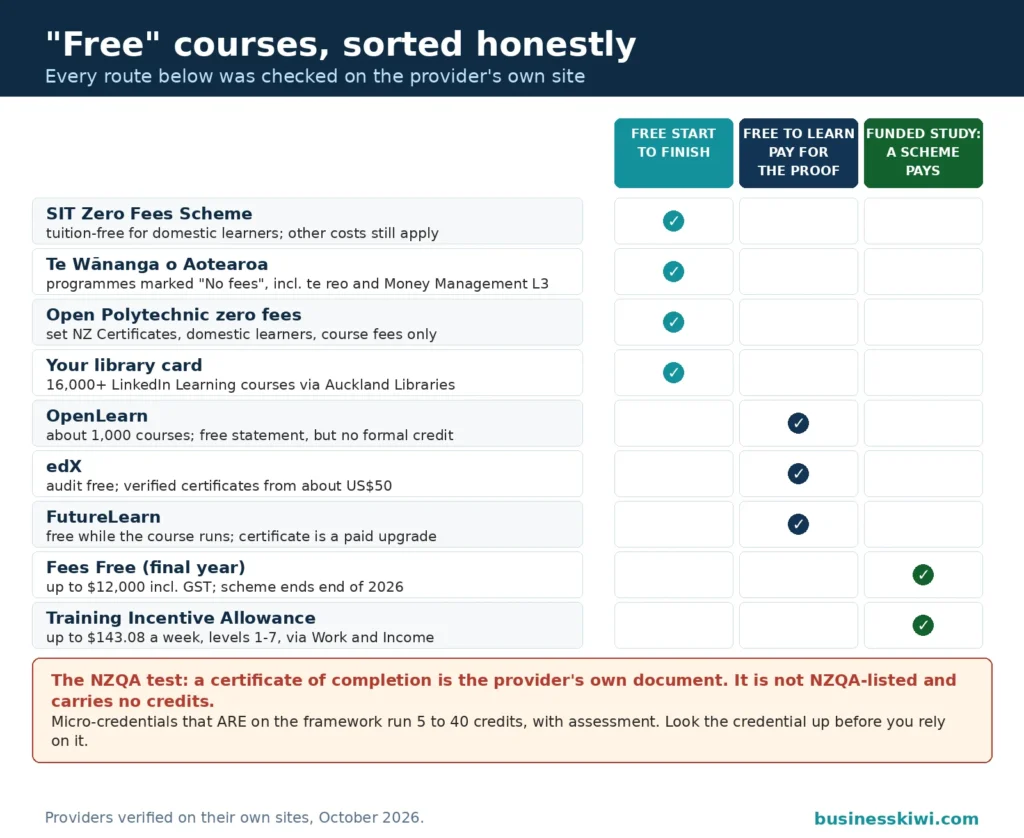
Genuinely free online courses do exist in New Zealand, and some of them lead to real qualifications. SIT’s Zero Fees Scheme covers tuition for domestic distance learners across whole NZQA approved programmes. Te Wānanga o Aotearoa runs a range of no-fees programmes, including te reo Māori courses online. Open Polytechnic regularly lists specific certificates at zero fees. Public libraries hand members free access to huge course libraries.
What you will rarely find is a free certificate that counts as a qualification. A certificate of completion is issued by whoever ran the course. It is not listed on the New Zealand Qualifications and Credentials Framework (NZQCF), it carries no credits, and no other provider has to recognise it. The free routes into real credentials run through funded study instead: zero-fees schemes, Fees Free in your final year, and allowances that cover your costs while you study a proper programme.
Three different things get called “free”
Most confusion in this area comes from one word doing three jobs.
Free to learn, from start to finish. The course costs nothing, and if anything is issued at the end, that costs nothing either. OpenLearn, run by The Open University, works this way: the courses are free and so is the statement of participation you can download afterwards. Library access to LinkedIn Learning also fits here, because your library pays so you do not.
Free to learn, pay for the proof. The big international platforms mostly use this model. You can watch the lessons and read the material for nothing, often for a limited time, but graded assessment and the certificate sit behind a paywall. There is nothing dishonest about it, as long as you know before you start. Plenty of people finish a “free” course and only then discover the certificate was the paid part.
Funded study, where someone else pays the fees. The qualification is a normal NZQA approved programme with a normal price tag, but a scheme pays it for you, or pays it back. SIT Zero Fees, Te Wānanga o Aotearoa no-fees programmes and the government’s Fees Free scheme all sit in this group. This is the only group where the certificate at the end is a real New Zealand qualification, because you were enrolled in one all along.
What a certificate actually means in New Zealand
New Zealand’s recognised qualifications and credentials sit on the NZQCF, the framework administered by NZQA. It has ten levels. Level 1 is the least complex, covering foundation learning. Levels 8 to 10 cover postgraduate study. School students meet the framework early: NCEA certificates sit at levels 1 to 3, and our NZQA exams guide explains how that side of the system works.
Size is measured in credits. One credit stands for about ten hours of learning, and a year of full-time study is usually 120 credits.
Credentials on the framework come in two main sizes:
- Qualifications. Certificates, diplomas and degrees listed on the NZQCF, delivered by accredited providers, with formal assessment. A New Zealand Certificate at level 4 from a polytechnic is a qualification, whoever paid the fees.
- Micro-credentials. Smaller stand-alone awards that NZQA has approved and listed on the NZQCF. NZQA’s rules make them 5 to 40 credits, at any level of the framework, with an assessment component, delivered by accredited education providers, and developed because there is evidence employers, industry or communities need them.
Now compare a certificate of completion. A provider designs a short course, you work through it, and the provider issues its own document saying you finished. No NZQA approval sits behind it, no credits attach to it, and it does not appear on the NZQCF. That does not make it useless. It may show an employer you bothered to learn something. But it is a receipt for attendance and effort, not a credential in the framework sense, and another institution is under no obligation to give you credit for it.
One practical test cuts through all of this. Search for the course or credential on NZQA’s framework listings. If it is there, with a level and a credit value, it is a recognised New Zealand credential. If it is not there, whatever the marketing says, you are looking at a certificate of completion.

New Zealand options that are genuinely free or zero fees
SIT Zero Fees: full qualifications, no tuition
The Southern Institute of Technology (SIT) runs the best known zero-fees arrangement in the country. On its own Study for Free page, SIT says the Zero Fees Scheme “enables tuition free education to domestic students based in Southland, Queenstown, and those studying by Distance Learning at all levels”. The distance learning part matters for this guide: SIT Online programmes carry no tuition fees for domestic students under the scheme, with terms and conditions applying.
These are NZQA approved programmes, from certificates through to master’s degrees, across areas like business, health, education, creative industries and trades theory. Finish one and you hold the same qualification as a student who paid full fees somewhere else. Read the scheme’s terms before enrolling, and budget for the costs tuition does not cover, such as your own computer, internet and any course materials.
Te Wānanga o Aotearoa: no-fees programmes, including te reo online
Te Wānanga o Aotearoa lists a large share of its programmes as “No fees” on its own site. Its online learning pages include Te Ara Reo Māori at levels 1, 2 and 3, studied part-time by e-learning, and Papa Reo, a beginner te reo programme delivered online over 12 months. The same online listings show business programmes marked no fees, including Smart Steps to Business and the Certificate in Money Management, both at level 3.
Availability depends on intake and location, and not everything at the wānanga is free: some programmes on the same pages are marked “Fees apply” or “Fees may apply”. Check the individual programme page before assuming. Where a programme is a New Zealand Certificate and shows no fees, that is a real qualification at no tuition cost.
Open Polytechnic: zero-fees offers on set certificates
Open Polytechnic, New Zealand’s main online polytechnic, runs zero-fees offers on selected qualifications. Its computing page promotes the New Zealand Certificate in Computing (Foundation User) at level 2 and the New Zealand Certificate in Computing (Intermediate User) at level 3 at zero fees, and a separate business page lists business certificates the same way, including Administration and Technology at levels 3 and 4.
The terms and conditions on the computing page are worth reading because they show how these offers usually work. The offer is for a limited time. It is for domestic learners who meet the entry requirements and have not already completed a similar or higher qualification. It covers course fees only: textbooks and other additional fees remain the student’s responsibility, and international students are not eligible. Treat these offers as genuine but time-boxed, and check the end date on the page.
Your public library card
The most underused free learning route in New Zealand sits in your wallet. Auckland Libraries states that members can use their library card to access over 16,000 free eLearning video courses and tutorials on LinkedIn Learning, covering technology, creative and business skills, and that no LinkedIn profile is needed: you log in with your library barcode and PIN. Membership is free for Auckland residents and ratepayers. Wellington City Libraries offers LinkedIn Learning through its eLibrary too, so check your own library’s website wherever you live.
Be clear about what this is. LinkedIn Learning is a commercial course library, and anything it records about your progress is its own record, not an NZQA credential. As a way to learn software, management skills or a new tool at no cost, though, it is hard to beat, and it costs you nothing beyond the time.
Funded routes into real qualifications
If what you actually want is a qualification and no bill, look at funding rather than free course sites.
Fees Free, final year. The government’s Fees Free scheme changed shape on 1 January 2025. It now covers fees for the final year of tertiary study, or the final two years of work-based learning, up to $12,000. Two catches matter. You pay your fees when you enrol and claim the payment back through myIR after you complete your first eligible qualification, so it does not remove the upfront cost. And the window is closing: the Fees Free website states you must start your final year on or after 1 January 2025 and complete your qualification or programme by 31 December 2026, and that Fees Free finishes at the end of 2026. Eligibility also turns on residency and on the qualification or programme meeting the scheme’s requirements, and the Fees Free site runs an eligibility checker for exactly this. If you are partway through a first qualification, check your position on feesfree.govt.nz soon rather than later, because a payment of up to $12,000 is worth planning your completion date around.
Training Incentive Allowance. If you receive support from Work and Income, the Training Incentive Allowance (TIA) can help with fees and study costs for courses at levels 1 to 7 on the framework, including tuition fees, books, childcare, equipment and transport. MSD’s published rates allow up to $143.08 for each week the assistance is payable, up to a maximum of $5,723.20 within a 52-week period, and it can be paid weekly, upfront, or as a mix. Note the interaction Work and Income flags on its own page: if you use TIA to pay study fees in your final year, you cannot also get Fees Free for those fees.
StudyLink, honestly labelled. A Student Loan is not free study. It is a loan, and StudyLink is blunt about the parallel product: Student Loan living costs have to be paid back, while the Student Allowance does not. The allowance is tested against income and circumstances. Neither turns a course into a freebie, but both are part of how most New Zealanders fund a real qualification, and the allowance in particular is money you keep.

International platforms, in a separate box where they belong
Overseas platforms can be excellent for learning. Just keep them mentally separate from the NZQA system, because nothing you earn there is a New Zealand qualification.
OpenLearn (The Open University, UK). Around 1,000 free courses, available immediately, with no start or end dates. Enrol and complete a course and you can download a free statement of participation; some courses also carry a digital badge, earned by passing the course quizzes. The Open University states plainly that its free courses do not carry any formal credit towards a qualification. This is the honest end of the market: free learning, free proof of completion, no credit promised.
edX. Founded by Harvard and MIT, edX lets you audit most courses free, which gives limited-time access to course materials. The paid verified track adds graded assessments and a verified certificate, and keeps your access open after the course ends. edX’s own pages put individual course certificates starting at around US$50, priced in US dollars, varying by course. Auditing alone earns no certificate.
FutureLearn. FutureLearn’s own explanation splits its short courses three ways. Free access lasts for the course’s duration. A paid course upgrade adds access for as long as the course exists on the platform, access to tests, and a Certificate of Achievement when you are eligible. Its Unlimited subscription bundles access to thousands of short courses with digital Certificates of Achievement. So on FutureLearn, learning can be free; the certificate is part of what you pay for.
How to judge a free course before you enrol
Five checks take about ten minutes and will save you most disappointments.
- Who is running it? Look for a real, identifiable provider. If you cannot find who is behind a site, close the tab.
- Is it on the NZQCF? Search NZQA’s framework listings for the qualification or micro-credential name. Listed, with a level and credits, means recognised. Not listed means certificate of completion, whatever the page claims.
- What exactly do you get at the end? Read for the words. “New Zealand Certificate in…” is a qualification title. “Certificate of completion”, “statement of participation” and “digital badge” are records of finishing, useful but different.
- Where is the paywall? Find out before you start whether assessment, the certificate, or even continued access costs money, and how much. Reputable platforms state this upfront, as edX and FutureLearn do.
- What will it cost you in time and extras? A free 40-credit certificate is still roughly 400 hours of learning. Zero-fees offers may exclude textbooks and other charges. A “free” course you never finish because it needed 10 hours a week is not free in any sense that matters.
What a completion certificate does and does not prove to an employer
Employers are not a single audience, but the logic is consistent. A completion certificate proves you finished something. It shows initiative and gives you something concrete to talk about in an interview, and for software skills an employer can simply test you, which makes the learning itself worth more than the document.
It does not prove assessed competence in the way a qualification does. Nobody independent checked your work against a national standard, because no national standard was involved. Where a job genuinely requires a credential, for licensing, safety or professional registration, only the listed qualification or approved micro-credential counts. Present completion certificates honestly on a CV, naming the provider and what the course covered, and they help you. Dress one up as a qualification and it will hurt you the moment anyone checks, because checking takes thirty seconds on the NZQA site.
Micro-credentials sit in a useful middle ground here. Because an approved micro-credential is listed on the NZQCF with a level and a credit value, an employer can look it up exactly as they would a qualification, and the assessment behind it was real. If you are choosing between a platform course and a listed micro-credential in the same subject, the micro-credential is the one that travels: other providers can see what it is worth, and it may count towards a larger qualification later.
Frequently asked questions
Are free online certificates recognised in NZ?
It depends which kind you mean. A certificate for an NZQA listed qualification, earned through a zero-fees scheme at a provider like SIT or Open Polytechnic, is recognised because the qualification is on the NZQCF, not because of how the fees were paid. A certificate of completion from an online platform is the provider’s own document. It is not listed on the framework, carries no credits, and no NZ employer or provider has to treat it as a credential.
Can I get a real qualification completely free?
Yes, in specific situations. Domestic distance learners can complete whole NZQA approved programmes tuition free under SIT’s Zero Fees Scheme. Te Wānanga o Aotearoa offers a range of no-fees programmes, including te reo Māori online. Open Polytechnic runs zero-fees offers on set certificates, for eligible domestic learners and for limited periods. Outside those schemes, “free qualification” claims usually turn out to mean free course content with a paid certificate.
Do free online courses give me credits towards a diploma or degree?
Only if the learning itself is a listed qualification or micro-credential, or part of one. Credits exist inside the NZQCF. Completing free courses on international platforms earns no NZ credits, and OpenLearn says outright that its free courses carry no formal credit towards a qualification. If credit matters to you, enrol in the credential, not just the content.
Is LinkedIn Learning through the library really free?
Yes, for library members. Auckland Libraries gives members access to over 16,000 LinkedIn Learning courses using just a library card number and PIN, and membership is free for Auckland residents and ratepayers. Other library services, including Wellington City Libraries, offer it as well. The learning is free; what you gain is skill and a record inside LinkedIn Learning, not an NZQA qualification.
What costs can still apply on a zero-fees course?
Tuition or course fees are what zero-fees schemes cover. Open Polytechnic’s offer terms state that textbooks and other additional fees stay with the student. Expect to provide your own device and internet connection for online study, and check each scheme’s terms for anything else, such as material costs for practical courses.
Sources
- NZQA, About micro-credentials, nzqa.govt.nz
- Fees Free, feesfree.govt.nz
- Tertiary Education Commission, Final-year Fees Free policy parameters, tec.govt.nz
- Southern Institute of Technology, Study for Free, sit.ac.nz
- Open Polytechnic, Zero Fees computing certificates and terms, openpolytechnic.ac.nz
- Te Wānanga o Aotearoa, Online learning programmes, twoa.ac.nz
- Auckland Libraries, Study help and online courses, aucklandlibraries.govt.nz
- Wellington City Libraries, Learn, wcl.govt.nz
- The Open University, Why study a free course on OpenLearn?, open.edu
- edX, About edX and How to audit a course on edX, edx.org
- FutureLearn, What is FutureLearn?, futurelearn.com
- StudyLink, Student Loan living costs, studylink.govt.nz
- Work and Income, Training Incentive Allowance, workandincome.govt.nz
Disclaimer
This article is general information about free and funded online study options in New Zealand. It is not personal education, careers or financial advice. Offers, terms and eligibility change, and zero-fees offers in particular can end at short notice, so confirm the details on the provider’s or agency’s own website before you enrol.
For more study and career guides, see our Jobs & Education hub.