How to Write an Invoice in NZ: What Must Be On It, GST Rules and a Worked Example

The short answer
Yes, you can invoice for free. Nothing in New Zealand law says an invoice has to come out of paid software, a subscription app or a printed invoice book. What the law cares about is the information on the document, not the tool you used to make it. A GST-registered seller has to give the buyer a set of details Inland Revenue calls taxable supply information, and those details can sit just as happily on a document you typed in a free word processor as on one generated by an accounting package.
This guide covers what has to be on an invoice, how the requirements change with the size of the sale, a complete worked example you can copy the layout from, and the practical side of actually getting paid.
An invoice and a tax invoice are not quite the same thing
Any seller can send an invoice. It is simply a request for payment that says who is asking, what the money is for and how much is owed. You do not need to be registered for GST to send one, and if you are not registered you must not charge GST or present the document as a tax invoice.
A tax invoice has historically been the GST version of that document: the invoice a registered seller issues so a registered buyer has the evidence needed to claim the GST back in their own return. If you are registered, the GST component of your price is money you collect on behalf of the Crown, and the paperwork is how Inland Revenue matches your sale against your customer’s claim. If you are weighing up whether to register, our GST registration guide walks through the threshold and the registration process.
Since 1 April 2023 the official language has shifted. Inland Revenue now talks about taxable supply information rather than a single document called a tax invoice. Debit notes and credit notes became supply correction information, and buyer-created tax invoices became buyer-created taxable supply information. The change is more than a rename. Under the old rules, one document had to carry everything. Now the required information can be spread across records you already keep, such as the invoice itself, a contract, a supplier agreement or a bank statement, as long as the full set exists and can be produced. Documents marked “tax invoice” are still perfectly acceptable, and an invoicing process that complied with the old rules complies with the new ones, so nobody had to reprint their templates in 2023. In practice, most small businesses still send one invoice containing everything, and that remains the simplest way to stay compliant.
What must be on it: the requirements scale with the amount
The detail Inland Revenue requires depends on the GST-inclusive value of the supply. There are three bands.
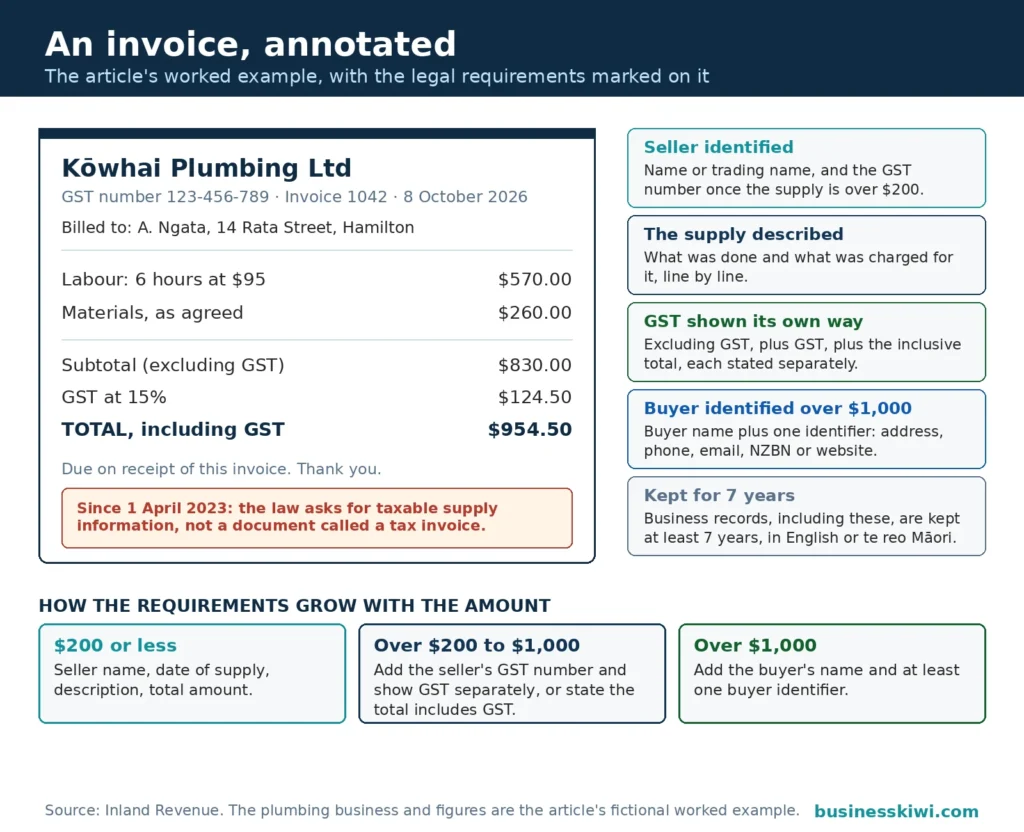
Supplies of $200 or less. The minimum is your name or trading name, the date of the invoice or the time of supply, a description of the goods or services, and the total amount charged. At this level you are not required to show your GST number or the buyer’s details. A till receipt or a short invoice can satisfy this band.
Supplies over $200 and up to $1,000. You add your GST number, and you must deal with the GST explicitly. You can either show the GST-exclusive amount, the GST amount and the GST-inclusive total as separate figures, or show the GST-inclusive total with a clear statement that it includes GST. Most invoices in this band show the full breakdown anyway, because customers ask for it.
Supplies over $1,000. Everything above, plus details of the buyer where the buyer is GST registered. That means the buyer’s name and at least one further identifier, which can be their postal address, phone number, email address, trading name, New Zealand Business Number (NZBN) or website address. The logic is straightforward: above $1,000 the buyer is likely claiming a meaningful GST credit, and Inland Revenue wants the transaction traceable to a named business.
A few practical points sit across all three bands:
- An invoice number is not on Inland Revenue’s legal checklist, but give every invoice a unique one anyway. business.govt.nz includes the invoice number, the date sent and the due date in its list of what an invoice should carry, and matching payments to invoices is painful without one.
- The description needs to identify what was actually supplied. “Services” on its own is weak; “drainage repair, 14 Kauri Street, 6 hours labour” is the sort of wording that supports a claim.
- If a GST-registered buyer asks for taxable supply information for a supply over $200, you must provide it within 28 days of the request, or by another date the two of you agree. In normal trading you send the invoice with the job, so this deadline mostly matters when paperwork has gone missing and a customer is rebuilding their records.
- If you are not GST registered, none of the GST bands apply to you. Send a plain invoice with your name, the date, a description and the amount, and do not add GST or a GST number you do not have.
A worked example
Here is a complete invoice from a fictional business. Kōwhai Plumbing Ltd is GST registered and has replaced a failed hot water cylinder at a rental property managed by a small property company. Because the total is under $1,000, the buyer’s details are good practice rather than a legal requirement at this value, but the full GST breakdown is required because the supply is over $200.
Tax invoice
Kōwhai Plumbing Ltd, GST number 123-456-789
Invoice number: 1042
Date: 12 May 2026
Billed to: Harbour Rentals Ltd
Payment due: 19 May 2026
Please pay to: Kōwhai Plumbing Ltd, 12-3456-0789012-00, reference 1042
The arithmetic: $570.00 plus $260.00 gives a GST-exclusive subtotal of $830.00. GST at 15 percent of $830.00 is $124.50, so the total the customer pays is $954.50. If you ever need to work backwards from a GST-inclusive figure, the GST content is three twenty-thirds of the total: $954.50 multiplied by 3 and divided by 23 is also $124.50. Quoting prices GST-inclusive to consumers and GST-exclusive to businesses is common, but whichever way you quote, the invoice itself should let the buyer see the GST amount or state clearly that GST is included.
Free ways to produce an invoice
Because the legal test is about content, the free options are genuinely fine:
- A word processor document. Type the invoice, save it as a PDF and email it. Keep your own copy filed by invoice number. This is what thousands of sole traders do.
- A spreadsheet. A simple template with formulas for the subtotal, GST and total removes most arithmetic slips. Save a blank master copy and a separate file for each invoice.
- The business.govt.nz invoice template. business.govt.nz publishes a template for businesses that do not use accounting software, covering the standard fields including the buyer’s reference, such as a purchase order number.
- Accounting software, if you already have it. Most packages generate invoices and some include invoicing in a free or entry tier, but tiers and pricing change often, so check the current offer rather than relying on anyone’s summary. You never need to buy software just to satisfy Inland Revenue.
- Pen and paper, in a pinch. Handwritten invoices are not prohibited. They are slow, hard to copy and easy to lose, which is why most people move on, but the information rules are the same.
Whatever you use, build one master layout with your business name, GST number if you have one, contact details and bank account number, then reuse it. Consistency helps your customers’ accounts staff as much as it helps you.
When to invoice, and payment terms
Send the invoice as soon as the work is finished. business.govt.nz makes the same point: the value of the job is freshest in the customer’s mind at that moment, and every week you sit on an invoice is a week added to when the money lands. For longer jobs, invoicing in stages, a deposit, progress payments and a final invoice, keeps cash moving and limits your exposure if a customer stalls.
The due date is a matter of agreement between you and your customer, not something tax law sets. Short terms such as 7 days from invoice are common for trades and services, and many larger organisations pay on fixed monthly cycles regardless of what your invoice says, which is worth knowing before you rely on the money. What matters legally is that the terms were agreed up front. State your terms when you quote, repeat the due date on the invoice itself, and you have a clear basis for following up. If your terms include late payment interest or fees, that needs to be in the agreement the customer accepted before the work started; an invoice sent afterwards cannot invent charges the customer never agreed to, so check your terms rather than assuming a right to add them.
When the buyer creates the invoice instead
In some industries the buyer is better placed to work out the price than the seller. Inland Revenue gives the example of an abattoir buying sheep from a farmer: the abattoir does the weighing, grading and pricing. A second pattern is the buyer who purchases the same thing from dozens of small suppliers, such as a food producer buying crops from many growers, and wants one consistent document instead of dozens of different invoice styles. In situations like that, the two parties can agree that the buyer provides the taxable supply information. This is buyer-created taxable supply information, the arrangement previously called a buyer-created tax invoice.
Since 1 April 2023 you no longer need Inland Revenue’s approval to do this. The conditions are that both parties are GST registered, you agree that only the buyer will provide the information, you record the reasons for the arrangement if it is not part of your normal terms of business, and you keep a copy. The buyer-created document must carry the standard taxable supply information, both parties’ GST numbers, and the GST added to the gross supply. Inland Revenue can invalidate an agreement where the parties have not complied with it or have not recorded the reasons when required. Arrangements approved before April 2023 can continue.
Mistakes, credit notes and corrections
Errors happen: a price is keyed in wrong, goods come back faulty, or a job is cancelled after invoicing. The fix under the current rules is supply correction information, the replacement term for debit notes and credit notes. If the amount charged needs to go down, the seller issues a credit note style correction identifying the original supply and the reduction in GST; if it needs to go up, a debit note style correction does the reverse. Both parties then reflect the correction in their GST returns so the seller’s output tax and the buyer’s claim stay consistent. The adjustment belongs in the return for the period in which the error came to light, not backdated into the original period. One exception worth knowing: where the only reason the price fell is a prompt payment discount the customer earned, a credit note is not required, although the return still has to reflect the reduced amount.
There is also a simpler point in the buyer’s favour: a customer who has claimed GST on your invoice can only hold that claim if the paperwork stacks up. If your invoice is wrong and you do nothing, the problem surfaces in their audit, not just yours, and it tends to surface at the worst possible time for the relationship.
Two habits keep this painless. First, never quietly edit or delete an invoice you have already sent and reissue it as though the original never existed; the correction document is the audit trail. Second, if you undercharged GST because you treated something as zero-rated or exempt when it was not, you still owe the tax on the supply, and the correction process is how you put it right. Voluntary disclosure to Inland Revenue before they find the error is generally treated more kindly than the alternative, and an accountant is worth the fee for anything beyond a small slip.

Getting paid, and what to do when payment is late
Most late payment is disorganisation rather than malice, and a tidy routine fixes most of it:
- Invoice immediately, to the right person. Confirm who approves payments and where invoices go before you finish the job, because an invoice sitting in the wrong inbox is not being processed at all.
- Watch the due date. A short, polite reminder a couple of business days after the due date, with the invoice attached again, resolves a large share of overdue accounts.
- Escalate in steps. business.govt.nz suggests a process along the lines of an email reminder shortly after the due date, then a phone call if there is no response within about a week. Keep notes of who owes what and how overdue it is.
- Stay polite early. Accidental late payers are usually future customers too. Save firmer language for accounts that have had several chances.
- If a genuine dispute sits underneath the non-payment, deal with the dispute. Customers who believe the work was defective will not pay until that is addressed, and a disputed invoice is a negotiation, not a debt collection problem.
If your agreed terms include interest on overdue accounts or recovery costs, you can apply them as the contract provides. If they do not, you cannot bolt them on after the fact, so the time to set late payment terms is in the quote or contract, before the work begins.
Records: keep everything for seven years
Inland Revenue requires business records, including taxable supply information and supply correction information, to be kept for at least 7 years. That covers records of all cash and electronic sales and purchases, invoices and receipts, bank statements, credit card records and statements, cash register or point of sale records, and cashbooks. Paper and electronic records are both acceptable, and a combination is fine. Records must be in English or te reo Māori unless Inland Revenue approves another language, and if you store records offshore, including in cloud services, the storage arrangement needs to meet Inland Revenue’s approval requirements. In practical terms: back up your invoice folder, make sure you can still open the files in a few years’ time, and do not let your only copy live inside a subscription account you might cancel.

E-invoicing: related, but not the same as emailing a PDF
E-invoicing comes up often enough to be worth a short note. Under the New Zealand framework, which uses the international Peppol network, an eInvoice is invoice data sent directly from the seller’s financial system to the buyer’s, even when the two businesses use different software. No PDF is generated and nothing is typed in by hand at the other end, which cuts errors and usually speeds up payment. Inland Revenue does not receive the information; it passes between the businesses. You need software that supports e-invoicing and your NZBN, the identifier that routes eInvoices to the right business. It is optional, and an ordinary emailed PDF invoice remains entirely valid, but for businesses invoicing each other regularly it is the direction official guidance is pointing.
FAQs
Do I need software to send an invoice?
No. Inland Revenue’s rules are about the information the invoice contains, not how you produced it. A document made in a free word processor or spreadsheet, saved as a PDF and emailed, meets the requirements as long as it carries the taxable supply information for the value of the sale.
What must be on a tax invoice?
It depends on the amount. For supplies of $200 or less: your name or trading name, the date, a description of what you supplied and the total charged. Over $200, add your GST number and either show the GST-exclusive amount, the GST and the total separately, or state that the total includes GST. Over $1,000, add the GST-registered buyer’s name and one identifier such as their address, email, phone number or NZBN.
Do I have to put the words “tax invoice” on it?
Not any more. Since 1 April 2023 the requirement is to provide taxable supply information, and there is no longer a requirement for the words “tax invoice” to appear. You can keep using them, and most businesses do, because buyers recognise the document instantly.
Can I charge GST if I am not registered?
No. Only GST-registered businesses charge GST. If you are not registered, send a plain invoice without GST and without a GST number. You must register once your turnover reaches $60,000 in a 12 month period, or if you expect it to in the next 12 months.
How long do I have to keep copies of my invoices?
At least 7 years, along with the rest of your business records. Electronic copies are acceptable, so a well organised folder of PDFs with a backup is enough.
Sources
- Inland Revenue, Taxable supply information for GST, ird.govt.nz
- Inland Revenue, How taxable supply information for GST works, ird.govt.nz
- Inland Revenue, Buyer-created taxable supply information, ird.govt.nz
- Inland Revenue, Electronic invoicing (eInvoicing), ird.govt.nz
- Inland Revenue, Record keeping, ird.govt.nz
- business.govt.nz, Getting paid on time, business.govt.nz
Disclaimer
This article is general information about invoicing and GST record requirements in New Zealand, based on official guidance published by Inland Revenue and business.govt.nz. It is not tax or legal advice for your specific situation. GST settings and thresholds can change, so check the current rules with Inland Revenue or a tax adviser before relying on them.
More guides for managing your business money are in our Finance hub.