Lockers NZ: Types, Materials, Prices and How to Choose
Buy lockers once and you will probably not think about them again for a decade or more. Buy the wrong ones and you will think about them every week: doors that jam, keys that vanish, damp sports gear slowly perfuming a changing room, a run of units that rocks because nobody anchored it. Lockers sit in schools, gyms, sports clubs, factories, offices and public buildings all over New Zealand, and the buying decision comes down to matching four things to your setting: the material, the configuration, the lock, and the way the supplier prices the job.
That last point matters more than most buyers expect. Some NZ suppliers publish a price for each locker on their website, so you can cost a project yourself. Others, including several of the biggest locker specialists, quote every job individually and publish no prices at all. This guide works through the types and materials first, then sets out the prices suppliers do publish, each with the model, the configuration and the date checked.
The short answer
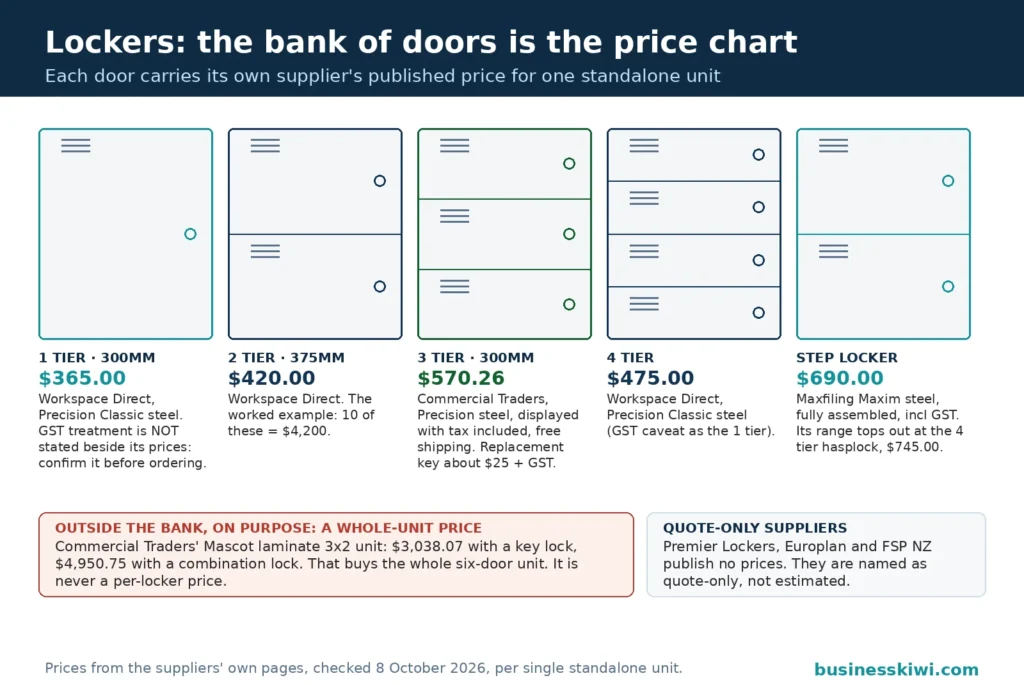
Powder-coated steel is the default locker for dry indoor areas, and the easiest to buy off the shelf. Published prices for a single standalone steel unit start at $365 for a one tier locker 300mm wide from Workspace Direct and run to $745 for a four tier unit 375mm wide with a hasplock from Maxfiling, whose prices include GST. HDPE plastic is the better answer anywhere wet, coastal or outdoors, and carries the longest warranties published by NZ suppliers: 15 years from FSP New Zealand for its OzLoka range, 20 years from Premier Lockers for its weather resistant HDPE range. Laminate is the office and front-of-house option, where finish matters more than surviving a hose-down. Premier Lockers, Europlan and FSP New Zealand all price by quotation, so a quote from them is a specification exercise, not a catalogue purchase. Whatever you buy, compare like with like: a price per unit means nothing until you know how many doors the unit holds, whether GST and freight are included, and which lock is fitted.
Lockers by setting
School lockers
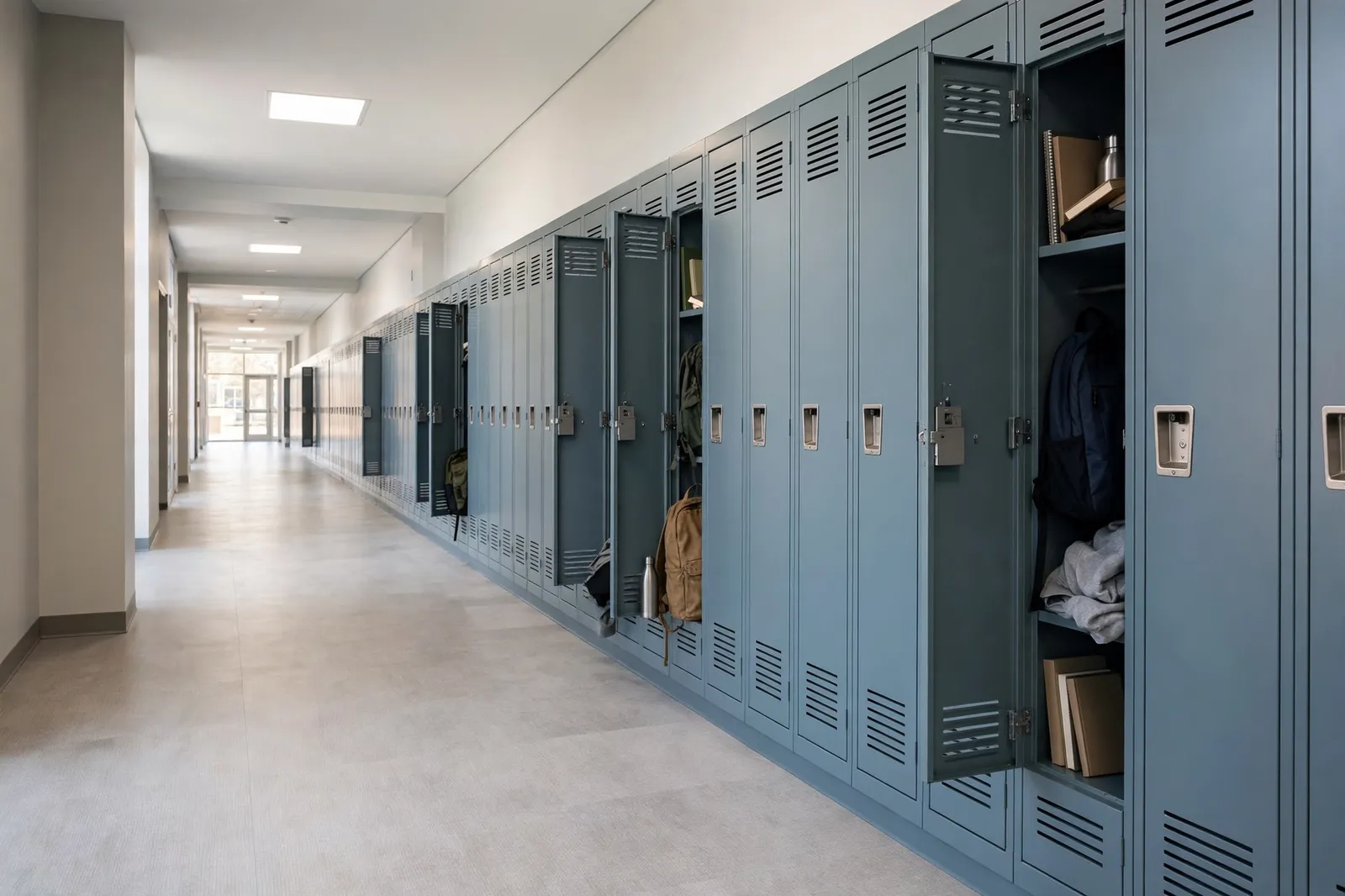
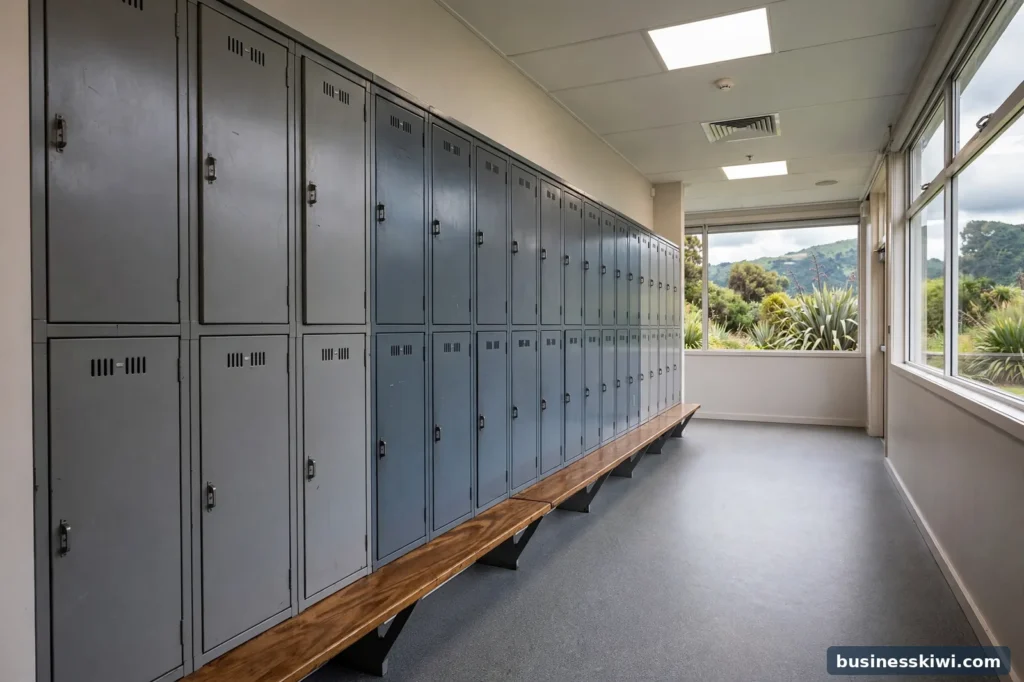
School lockers work harder than almost any others. They are opened and slammed hundreds of times a week, stuffed with bags, books, sports gear and the occasional forgotten lunch, and they are usually bought in long runs fitted to a fixed wall or corridor.
Maxfiling sells its Maxim steel lockers squarely at this market. The range comes in one, two, three and four tier versions plus a two tier step locker, in widths of 340mm and 375mm, and every unit arrives fully assembled. Maxfiling says the lockers can be configured in banks customised to the school or supplied as stand-alone units, which is how most school orders work in practice: a bank sized to the wall, not a row of separate purchases. FSP New Zealand aims its OzLoka A Series at schools too: rotationally moulded HDPE, 380mm wide and 450mm deep, a width FSP says takes a full-size backpack or a motorbike helmet, with smooth edges and corners for busy corridors. Graffiti comes off the surface with an alcohol-based solution, a detail any school caretaker will appreciate.
Placement is the part schools most often get wrong. Leave standing room in front of the run as well as the depth of the locker itself, because a corridor full of students opening doors at once needs more than the 450mm to 500mm the units occupy. If lockers are going outside or under a canopy, that is HDPE territory rather than steel, for the reasons in the materials section below.
Gym and sports lockers
Gym and club changing rooms have two problems schools do not: casual users who arrive without a lock or a key, and wet gear. For casual users, the standard answers are a padlatch, so members bring their own padlocks, or a coin operated lock. Premier Lockers offers a coin lock that works on a $1 coin in either coin return mode, where the user gets the coin back, or coin retain mode with a coin box, where the facility keeps it. Premier describes coin locks as suited to public or shared facilities such as gyms and aquatic centres.
Ventilation matters here. Steel lockers from Premier, Workspace Direct and Commercial Traders all carry ventilation louvres or perforations in the doors as standard, which helps damp gear dry out between visits. Bench seating is the other changing room staple: Premier’s range includes a locker seat and stand at 450mm high and island benches from 1000mm to 2400mm long, so users can sit to change shoes rather than blocking the walkway. For poolside and outdoor clubrooms, HDPE is again the safer material.
Workplace and staff lockers
Workplace lockers split into two jobs: personal storage for staff, and garment or uniform storage. Europlan’s Laundry Lockers are built for the second job. They are steel with a powder coated finish, 1800mm high, 375mm wide and 450mm deep, in a six or eight door layout, with a choice of camlock or latchlock, ventilation slots and a master key option, delivered assembled. Europlan sells them into factories, warehouses and hospitality, where uniforms need to be stored separately from personal gear.
For staff personal lockers, the lock decision drives most of the ongoing admin. Commercial Traders sets out the trade-off plainly on its locker pages. With a key lock you get two keys, so the staff member holds one and the manager keeps the spare; a replacement key can be reordered at around $25 plus GST including courier. With a latchlock, the user sets a combination on a padlock and there are no keys to manage at all, which Commercial Traders describes as possibly the easiest and most cost effective option over time.
End-of-trip and public lockers
End-of-trip facilities in offices and apartment buildings, and public lockers in places such as transport hubs and recreation centres, share one feature: the users are not known to the building the way staff are. That pushes buyers towards keyless locking. Digital combination and push button PIN locks need no keys and can be reprogrammed between users, and RFID locks work with the same swipe cards as the building’s access control. Charging is the other end-of-trip request that comes up constantly, and Premier lists GPO and USB charging among its locker accessories for exactly this reason. For paid public storage, the coin retain lock described above is the simple mechanical option.
Materials compared
Steel
Steel is the volume material and the one with the widest configuration range. Premier’s Steelco steel lockers come in 305mm and 380mm widths at 1830mm high and 475mm deep, in one, two, three, four, six, eight and twelve door versions plus a step door model. Doors are flush mounted and open 180 degrees, one and two door units include a hanging rail, shelves are rated at 20kg uniformly distributed load, and the warranty is 10 years. The Precision steel lockers sold by Workspace Direct and Commercial Traders are 1800mm high and 457mm deep in 300mm and 375mm widths, with one to four tiers and a two step version; Workspace Direct notes three point locking as standard on the single tier, and both suppliers publish a 10 year warranty. Steel’s limits are the obvious ones: standard powder coat makes it a dry indoor material, and doors can be dented in rough service.
Laminate and HPL
Laminate lockers swap the metal carcass for board construction and gain a furniture finish. Premier’s laminate locker has a carcass of 16mm E1 grade particle board and doors of 18mm MDF board, stands 1850mm high including a 100mm plinth, and is 400mm wide and 500mm deep in one, two, three and four door versions plus a step door. Key locking is standard, ventilation is by slits rather than louvres, shelves carry the same 20kg rating as the steel range, and the warranty is 10 years. Colours come from the Laminex and Polytec ranges, which is why laminate dominates in offices and end-of-trip facilities, anywhere the lockers are part of the interior design. The board construction makes it an indoor product: not the choice for wet changing rooms or outdoor runs.
The NZ-made entry in this category is the Mascot range sold by Commercial Traders: 18mm Melteca construction with a 25mm overlay top, steel hinges, Lehmann key locking with two keys per locker, adjustable feet behind a 100mm toe-kick, and units that arrive assembled.
Plastic (HDPE)
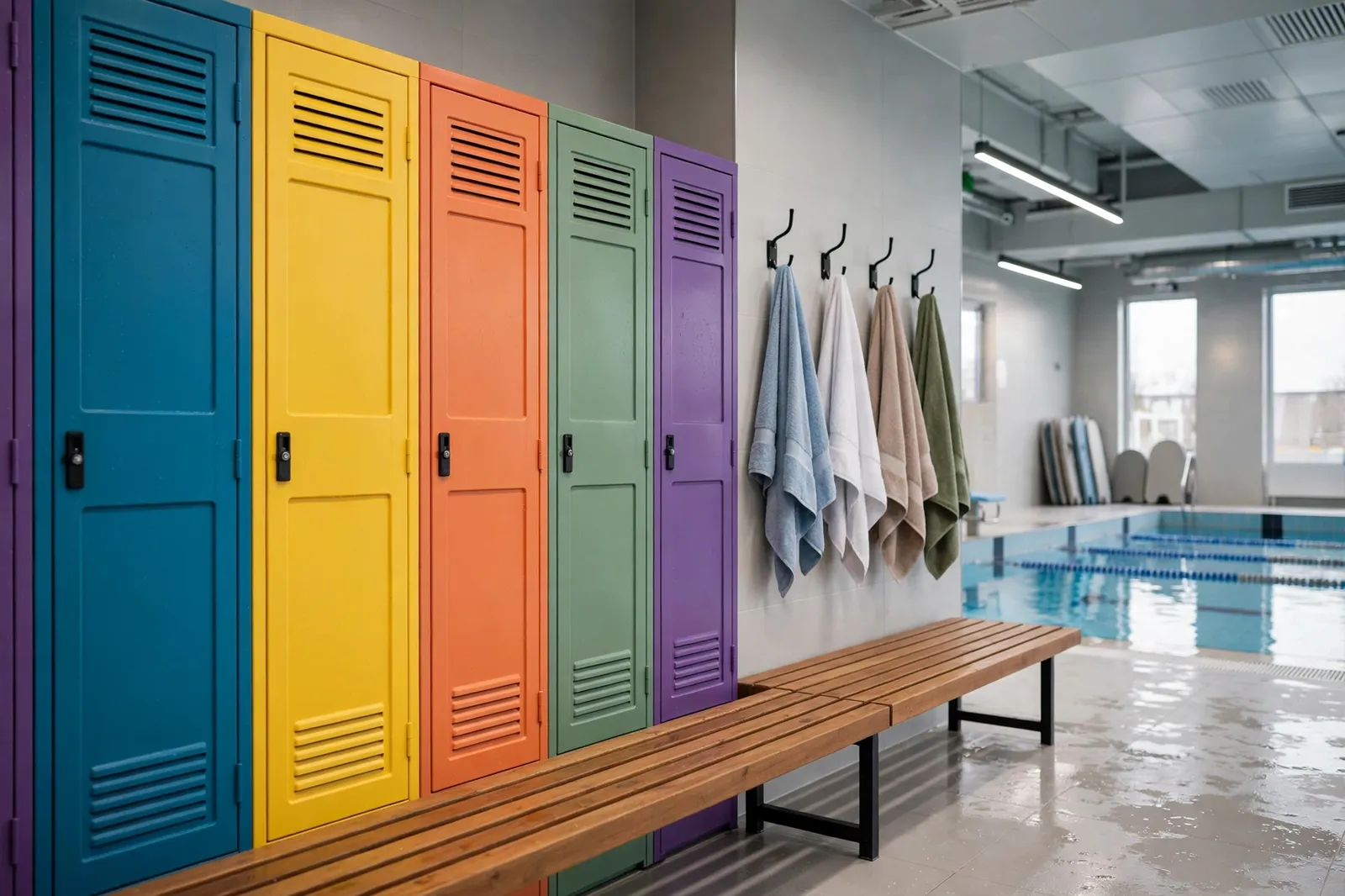
HDPE, high-density polyethylene, is the wet-area and outdoor material. FSP New Zealand rotationally moulds its OzLoka lockers in one piece, so there are no seams or welds, and lists the range as UV stable, corrosion resistant, weatherproof, graffiti resistant and cleanable with water and mild detergent. The A Series is 380mm wide and 450mm deep, comes fully assembled in 25 colours, and carries a 15 year warranty. Premier’s HDPE Weather Resistant Gen 1 range takes a different shape: stackable half height (910mm), third height (610mm) and quarter height (460mm) units, 388mm wide and 520mm deep, with a sealed door and a water strip that captures rain and drains it away. Premier rates the shelves at 25kg, recommends a padlatch, and warrants the range for 20 years, or 8 years for outdoor undercover use. One honest caveat from Premier’s own documentation: weather resistant is not waterproof if a unit ends up submerged, so site them out of flood-prone spots. HDPE also gives you solid colours rather than timber grains, if the finish matters.
Timber
Buyers sometimes ask for solid timber lockers, and the honest answer from the NZ ranges above is that the mainstream market does not really sell them. The timber look is delivered as laminate or melamine board: Premier’s laminate range in oak and beech-look finishes, and Commercial Traders’ Mascot units in Refined Oak and Classic Oak Melteca. Solid timber is a custom joinery commission rather than a catalogue locker, with pricing to match, so if a timber appearance is the goal, price the laminate version first.
Configurations and sizes
Locker dimensions across the NZ ranges cluster tightly. Heights run from 1800mm (Precision steel, Europlan laundry lockers) through 1830mm (Premier steel) to 1850mm including its plinth (Premier laminate), and depths from 450mm to 520mm. Widths are the real choice: 300mm or 305mm is the narrow standard, 340mm appears in Maxfiling’s Maxim range, and 375mm, 380mm or 400mm units give noticeably more room for bags and helmets.
Tiers decide how many people one unit serves. A one tier locker is a full height compartment with a hanging rail, right for uniforms, coats and long items. Two tier doubles the door count at the cost of hanging length. Three and four tier units suit bags, shoes and personal items in high-density settings such as schools and staff rooms, and Premier’s steel range keeps going, to six, eight and twelve door units for very small items. The step door is the hybrid: a tall compartment on one side for hanging, stacked smaller compartments on the other.
Two accessories change how a run behaves. Sloping tops stop dust collecting and stop users storing things on top of the lockers; Premier and Workspace Direct both list them, and FSP offers sloping hoods on the OzLoka range. Stands, plinths and bases lift units off the floor for cleaning access and wet floors: Premier offers stands up to 400mm high and an 80mm base on its HDPE range, and FSP offers kicker bases.
Locking options
Key locks are the standard fitting almost everywhere. They are simple and cheap, the cylinder can be replaced, and master key or keyed alike systems are available across Premier’s ranges, so a manager can open every door while users hold individual keys. The cost is administration: keys get lost, and every departure means recovering or replacing them.
Padlatches (hasp locks) put a loop or hasp on the door and the user supplies the padlock. Maxfiling prices its hasplock versions a few dollars above camlock versions of the same locker, and Commercial Traders supplies a combination padlock with its latchlock option. This is the lowest-admin system for gyms and public facilities, and the one Premier recommends for its outdoor HDPE range.
Combination locks, mechanical or digital, remove keys entirely. Premier’s spec sheets describe digital combination locks with programmable codes as suited to shared or high-turnover environments, with master key or master code override across the range.
Coin and token locks are the public facility option: a $1 coin in Premier’s case, returned to the user or retained by the facility depending on the mode fitted.
Digital, RFID and smart locks sit at the top. Push button and touch pad locks take a PIN, RFID locks open with a swipe card and can integrate with access control for audit tracking, and full smart locker systems add allocation and usage data. Budget for the difference in support life: Premier warrants its lockers for 10 to 20 years but its locks for 1 year, so locks are a consumable in a way the carcass is not.
What lockers cost in NZ
The prices below are the ones NZ suppliers publish on their own product pages, checked on 8 October 2026. Every price is for a single standalone unit unless the entry says otherwise. A unit is not a door: a four tier unit holds four lockers, and comparing a one tier price against a four tier price without that adjustment is the most common budgeting mistake in this category.
Three things to note about that table. First, GST treatment varies by supplier and is stated here exactly as each page presents it. Maxfiling shows both figures, a GST-inclusive headline price with the ex-GST amount underneath ($593.04 ex GST on the $682.00 locker). Commercial Traders displays its prices with tax included. Workspace Direct does not state the GST treatment beside its Precision prices, so confirm it before relying on the number in a budget. Second, lock choice moves the price: the Mascot unit above is $3,038.07 with standard key locking in the Snowdrift finish; the same unit with combination locks is listed at $4,950.75. Third, freight differs. Commercial Traders lists its steel lockers with free shipping; other suppliers charge freight or fold it into a quote.
A quick worked example, using only the figures above: ten of Workspace Direct’s two tier 375mm units give twenty staff lockers at $420.00 each, $4,200 in total before any bulk discount. Workspace Direct invites bulk order enquiries for special pricing and custom banking; published prices are single-unit prices, and larger runs are usually quoted.
Premier Lockers, Europlan and FSP New Zealand publish no prices for their ranges. Premier’s spec sheets show lead times instead, from stock items out to 10 to 12 weeks for some lock options, and Europlan’s product pages carry a request-a-quote button rather than a price. That does not make them dearer or cheaper than the published ranges; it means the price only exists once the configuration, lock, colour and quantity are fixed. Second-hand lockers also trade in NZ and can suit a club or workshop on a tight budget. Check the locks work, that keys or a master key come with the units, and the true width and depth before committing; used prices vary too much by condition to generalise.
Delivery and installation
How a locker arrives depends on the range. Maxfiling’s Maxim lockers, FSP’s OzLoka units, Europlan’s laundry lockers and Commercial Traders’ Mascot units all arrive fully assembled. Commercial Traders’ steel lockers are standalone units with a tool-less assembly design that can be joined with pot rivets in any quantity to form a bank. Fully assembled units are bulky, so check door widths and lift access on the delivery path before the truck is booked, not after.
On site, the essentials are level, plumb and fixed. Mascot units have adjustable feet behind the toe-kick for levelling, and Premier offers adjustable feet and stands across its ranges for uneven floors. Anchoring is a safety item, not a nicety: Premier sells a wall fixing kit or dynabolt option for its HDPE range and describes it as essential in preventing tipping. A tall, narrow, fully loaded run that is not fixed to a wall or floor is a hazard in a school or public space, so include fixings in the specification and the budget. Project suppliers fold delivery and installation into their quotation process, so get the delivery scope in writing either way.
Buying checks
- Measure the run, not just the wall. Total width is the unit width multiplied by the number of units, plus clearance for corner infills if you are fitting between walls. Then add the space in front: doors need to swing (Premier’s steel doors open 180 degrees, its laminate doors 90 degrees) and users need to stand there.
- Count doors, then compartments. Work out how many users need a locker at the busiest time, and choose tiers to match. One unit is not one locker.
- Match the material to the moisture. Dry indoor: steel or laminate. Wet, coastal, poolside or outdoor: HDPE, and check whether the warranty steps down for outdoor use, as Premier’s does.
- Decide the lock system before ordering. Locks are often factory fitted, and the cheap decision now (keys for a high-turnover gym) becomes the expensive admin later. Order spare keys and confirm the master key arrangement at the same time.
- Check ventilation. Louvres, perforations or slits matter anywhere damp clothing or sports gear will be stored.
- Confirm the full price in writing. GST treatment, freight, fixings, numbering and installation, plus the lead time. Some lock options in Premier’s range run to 10 to 12 weeks, which matters if the lockers are tied to a school term or a building opening.
Frequently asked questions
How much do lockers cost in NZ?
For a single steel unit bought online, published NZ prices run from $365.00 for a one tier Precision Classic locker 300mm wide at Workspace Direct to $745.00 for a four tier Maxim locker 375mm wide with a hasplock at Maxfiling, including GST. The large project suppliers, Premier Lockers, Europlan and FSP New Zealand, do not publish prices and quote per project. Prices here were checked on 8 October 2026.
What size locker does a school student need?
Width and depth matter more than height. A 340mm to 380mm wide unit at 450mm deep or more swallows a school bag comfortably; FSP sizes its 380mm wide OzLoka A Series to fit a full-size backpack or a motorbike helmet. Two and three tier configurations are the common school choice because they put more lockers on the same wall.
Are plastic lockers better than steel for a swimming pool or outdoor area?
For wet and outdoor sites, yes, on the suppliers’ own specifications. HDPE does not rust or corrode, Premier’s weather resistant range seals the door and drains rain away with a water strip, and warranties run to 15 years (OzLoka) and 20 years (Premier, stepping down to 8 years outdoors under cover). Standard powder-coated steel is a dry indoor product.
What is a step locker?
A step locker splits the unit into a tall compartment on one side, with a hanging rail for coats or uniforms, and smaller stacked compartments on the other. It suits workplaces and schools where one user needs both hanging space and secure small-item storage in a single footprint.
Should I choose key locks or padlock hasps?
Key locks suit allocated lockers for known users, especially with a master key system for managers. Hasps suit shared and casual use because the user brings their own padlock and there are no keys to administer. Commercial Traders’ guidance is that a key lock gives you a spare key to hold centrally, while a latchlock with a combination padlock is possibly the easiest and most cost effective option over time.
Do lockers arrive assembled?
Many NZ ranges do: Maxfiling, FSP New Zealand, Europlan’s laundry lockers and Commercial Traders’ Mascot laminate units are all supplied fully assembled. Some steel ranges use tool-less assembly and are joined on site into banks. Confirm the format before ordering, because assembled units need the access to match.
Do lockers need to be fixed to the wall?
For tall runs in schools, gyms and public spaces, yes. Suppliers sell fixing kits for the purpose; Premier describes its wall fixing kit or dynabolt option for HDPE lockers as essential in preventing tipping.
How long should lockers last?
Published warranties give a fair guide: 10 years on the steel and laminate ranges covered here, 15 years on OzLoka HDPE and 20 years on Premier’s weather resistant HDPE. Locks carry shorter warranties, 1 year in Premier’s lock range, so expect to replace locks before lockers.
This article is general information about buying lockers in New Zealand, based on suppliers’ published product information checked on 8 October 2026. Prices, specifications and lead times change, and nothing here is a recommendation of a particular product for your situation. Confirm the specification, the GST treatment and the delivered price with the supplier before ordering.
Sources
- Premier Lockers NZ, Steel Locker spec sheet, premier-lockers.co.nz
- Premier Lockers NZ, Laminate Locker spec sheet, premier-lockers.co.nz
- Premier Lockers NZ, HDPE Weather Resistant Locker Gen 1 spec sheet, premier-lockers.co.nz
- FSP New Zealand, Plastic Locker A Series (OzLoka), fspnewzealand.co.nz
- Workspace Direct, Precision Classic Steel Lockers, workspacedirect.co.nz
- Commercial Traders, Two Tier Lockers 300 Wide, commercialtraders.co.nz
- Commercial Traders, Three Tier Locker 300 Wide, commercialtraders.co.nz
- Commercial Traders, Three Tier Locker 375 Wide, commercialtraders.co.nz
- Commercial Traders, Mascot Lockers (3 x 2), commercialtraders.co.nz
- Maxfiling, School Lockers NZ (Maxim lockers), maxfiling.co.nz
- Europlan, Laundry Lockers, europlan.nz