Home Loans in New Zealand: Types, How They Work and How to Apply

Buying a home is the biggest financial commitment most New Zealanders ever make, and the loan that comes with it can run for decades. Yet it is often chosen in a hurry, squeezed between finding a property and signing an agreement. Understanding how home loans work before you start house hunting puts you in a stronger position: you will know what lenders look for, which structures suit you, and where the costs hide beyond the deposit.
This guide covers what a home loan is, the main types and structures offered in New Zealand, the Reserve Bank rules that shape how much you can borrow, the help available for first-home buyers, and the application process step by step. It deliberately does not list current interest rates, because rates change constantly and differ between lenders. For today’s rates, check our home loan rates guide, then confirm with lenders directly.
The short answer
A home loan is money borrowed from a bank or other lender to buy property, secured against that property. Most New Zealand home loans are repaid over 25 to 30 years, with payments covering interest and part of the amount borrowed. You can fix your interest rate for a set period, leave it floating, or split the loan between the two, and structures such as revolving credit and offset loans let your everyday money reduce the interest you pay. How much you can borrow depends on your deposit, your income and the Reserve Bank’s loan-to-value and debt-to-income rules. First-home buyers may qualify for a First Home Loan with a deposit as low as 5 percent, and KiwiSaver savings can usually be withdrawn to help.
What a home loan is
A home loan, also called a mortgage, is a loan secured by the property you buy. Security is the key idea. Because the lender can sell the property to recover its money if you stop paying, it will lend large amounts over long periods at lower rates than unsecured borrowing such as a personal loan or credit card.
Three terms come up constantly. The principal is the amount you borrow. Interest is the charge for borrowing it, calculated as a percentage of the balance still owing. The term is the time you have to repay the loan in full. Most lenders offer terms of up to 30 years, and 25 to 30 years is typical. A longer term means smaller repayments but more interest overall, because the balance stays higher for longer. At the start of a standard loan, most of each repayment goes towards interest, because the balance is at its largest. As it falls, a growing share of each payment chips away at the principal, which is why extra repayments early in the loan make such a difference.
Fixed, floating and split loans
With a fixed rate loan, the rate is locked in for an agreed period, usually from six months to five years. Repayments stay the same throughout, which makes budgeting straightforward. The trade-offs are flexibility and exit costs. Lenders usually limit how much extra you can repay without a charge, and ending the loan early, for example by selling or refinancing mid-term, can trigger a break fee.
With a floating rate loan, also called a variable rate loan, the rate can move up or down at any time. Floating rates generally follow movements in the Official Cash Rate set by the Reserve Bank, although the lender makes the final call on timing and size. In exchange for less predictability, floating loans are flexible: you can usually make extra repayments of any size, repay the whole loan, or restructure it without penalty.
A split loan divides your borrowing between fixed and floating portions. Many borrowers fix the larger part for certainty and keep a smaller part floating so they can make penalty-free extra repayments when money allows. Splitting is probably the most common arrangement in New Zealand, because it balances certainty against flexibility.
Table loans and reducing balance loans
A table loan is the standard structure and the one most borrowers have. You make the same regular repayment throughout the term, weekly, fortnightly or monthly. Each payment covers the interest due plus some principal, with the mix shifting towards principal as the balance falls. Because the payment never changes unless the rate does, table loans are easy to budget around.
A reducing balance loan, sometimes called a straight line loan, repays the same amount of principal with each payment, plus interest on the remaining balance. Because the balance falls steadily, the interest shrinks each period and so does the total payment. Repayments start higher than a table loan on the same amount and term, then drop. Fewer lenders promote this structure, but it can suit borrowers whose income is strong now and expected to ease later.
Revolving credit loans
A revolving credit loan works like a large overdraft secured against your home. You are approved up to a credit limit and can draw on it, repay it and draw on it again. There are no set repayments. You pay interest only on the balance you are actually using, calculated daily and charged monthly.
The usual way to run one is to pay your income into the account and spend from it, so money that would otherwise sit in a current account works against your debt every day. Kiwibank, which offers a revolving home loan, describes it as working like a big overdraft with an approved limit you can spend up to, with interest calculated daily.
Revolving credit can save serious interest, but it demands discipline. No fixed repayment forces the balance down, and the credit limit is always there to be spent. If the balance drifts back to the limit and stays there, you can pay interest for years without reducing what you owe. Lenders generally expect a decent equity buffer; Kiwibank notes that you will generally need 20 percent equity.
Offset loans
An offset loan keeps your savings in separate accounts but links them to your home loan for interest purposes. The balances in the linked accounts are subtracted from your loan balance when interest is calculated, so you pay interest only on the difference.
Kiwibank’s offset home loan gives a clear example: on a $50,000 offset loan with $20,000 in linked accounts, you pay the variable interest rate on $30,000 only. Kiwibank lets customers link up to eight everyday accounts, including accounts held by a spouse or partner, a parent or a child, and interest is calculated daily. Because the rate is variable, it can change at any time. The linked accounts earn no interest themselves, which is the swap you make. The difference from revolving credit is where the money sits: with revolving credit, your savings go into the loan account itself, while with an offset loan the accounts stay separate and only the interest calculation is linked.
Interest-only loans
With an interest-only loan, your repayments cover only the interest for an agreed period. The principal does not fall at all during that time. Lenders typically limit interest-only periods to between one and five years, after which the loan switches to principal and interest repayments, which are then noticeably higher because the full amount still has to be repaid over the remaining term.
Interest-only lending is now mostly used by property investors, and lenders apply strict criteria. Owner-occupiers will generally find it harder to get approved and may need a larger deposit. It can help short-term cash flow, but it costs more over the life of the loan, since you pay interest on the full amount for longer without owning any more of your home.
Construction loans
A construction loan is usually drawn down in stages, called progress payments, as the build reaches agreed milestones such as foundations, framing and lock-up. Interest is charged only on the amount drawn so far, and during the build repayments are often interest-only. Once the home is finished and the council has issued a Code Compliance Certificate, the loan normally converts to a standard home loan structure.
Lenders will want a fixed-price building contract, council consents and valuations of the land and the completed home before approving the loan. ANZ’s building and renovating handbook sets out the documents involved, including the sale and purchase agreement for the section, a valuation report, evidence of house insurance and the Code Compliance Certificate at the end. A turnkey contract is the main variation: you pay a deposit when you sign and the balance on completion, so there are no progress payments during the build.
Deposits, LVR and DTI: the rules behind how much you can borrow
Your deposit is the share of the purchase price you contribute yourself. The rest is the loan. Lenders and the Reserve Bank express this as a loan-to-value ratio, or LVR: the loan amount divided by the property’s value. A $600,000 home bought with a $120,000 deposit needs a $480,000 loan, an LVR of 80 percent.
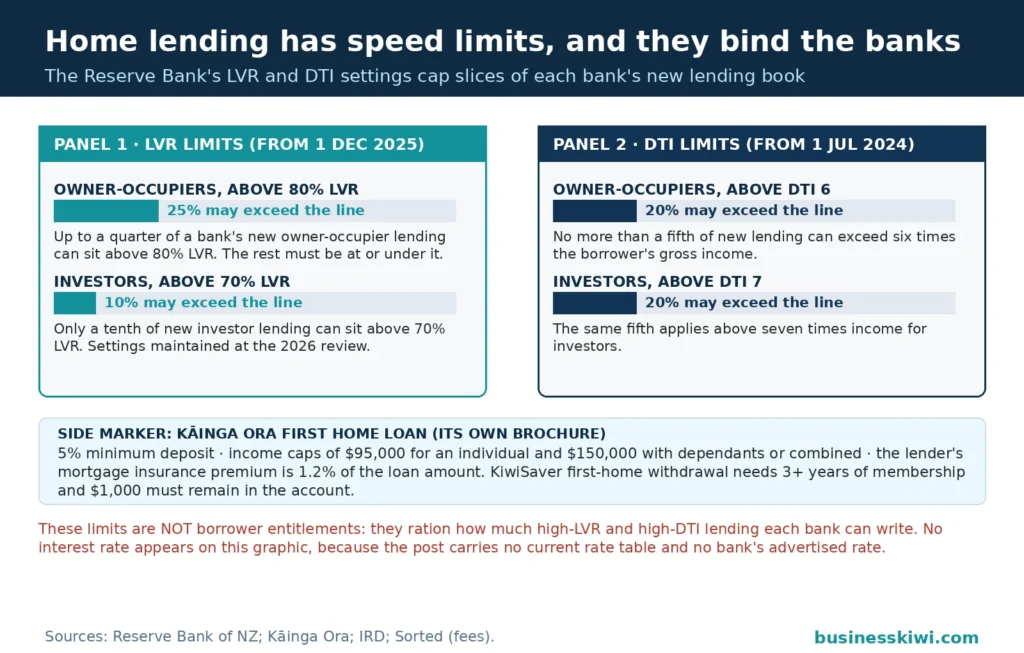
The Reserve Bank sets macroprudential rules limiting how much high-LVR lending banks can do. These are limits on banks’ overall lending, not personal bans, so one borrower can sometimes get a high-LVR loan while another cannot, depending on how much of its allowance a bank has used. Under the settings in force from 1 December 2025, and maintained in the Reserve Bank’s 2026 annual review, banks can make up to 25 percent of their new lending to owner-occupiers at an LVR above 80 percent. For investors, up to 10 percent of new lending can be at an LVR above 70 percent. In plain terms, a 20 percent deposit remains the standard expectation for an existing home to live in, and investors generally need 30 percent.
Since 1 July 2024, a second set of Reserve Bank rules has limited lending relative to income. The debt-to-income ratio, or DTI, is total debt divided by gross annual income. Banks may make no more than 20 percent of their new lending to owner-occupiers at a DTI above 6, and no more than 20 percent of new lending to investors at a DTI above 7. A household earning $120,000 with total debts of $720,000 sits right at a DTI of 6. Each bank also runs its own affordability assessment on top, testing whether you could still service the loan if rates rose.
Some lending sits outside these restrictions, including loans for new residential construction. Deposit size alone does not decide an application: income, existing debts (including credit card limits and student loans), living expenses and the property itself all feed in.

Help for first-home buyers: First Home Loan and KiwiSaver
The First Home Loan scheme exists for buyers who can afford repayments but struggle to save a full deposit. It is issued by selected banks and other lenders and underwritten by Kāinga Ora. The headline feature is the deposit: a minimum of 5 percent of the purchase price, instead of the more standard 20 percent.
To be eligible, Kāinga Ora’s First Home Loan brochure says you must be over 18, be a New Zealand citizen, permanent resident or resident visa holder, and be a first-home buyer (or a previous homeowner in a similar financial position, which Kāinga Ora assesses). Your before-tax income over the previous 12 months must be less than $95,000 for an individual buyer, $150,000 for an individual buyer with dependants, or $150,000 combined for multiple buyers. You must live in the home as your primary place of residence, must not currently own land, and must still meet the participating lender’s own criteria. Kāinga Ora charges a Lender’s Mortgage Insurance premium of 1.2 percent of the loan amount, charged to the lender, which you may have to reimburse; lenders may add their own application fee.
KiwiSaver is the other big lever. Inland Revenue’s guidance confirms that after at least three years of KiwiSaver membership, you may be able to withdraw your own contributions, your employer’s contributions, the government contribution, interest earned and any fee subsidies towards a first home. You must leave $1,000 in your account, and money transferred from an Australian complying superannuation scheme cannot be withdrawn. Many First Home Loan buyers combine the two, using a KiwiSaver withdrawal to build most of their 5 percent deposit. Apply through your provider, and start early: processing takes time and the money is usually needed by settlement.

The application process, step by step
Step 1: Work out your position. Before approaching a lender, pull together your deposit, income, regular expenses and existing debts. Lenders test affordability against their own criteria and a buffer rate, not just the rate on the day.
Step 2: Get pre-approval. A pre-approval (also called conditional approval) is a lender’s indication of how much it is willing to lend you, based on your income, deposit, expenses and credit history, and subject to conditions such as a satisfactory property. Kāinga Ora’s guidance describes pre-approval as confirming your eligibility and the lender’s criteria while you look, and notes it typically expires after a fixed period. Expect to provide photo ID, proof of address, and evidence of your deposit, household income and expenses. It is not a guarantee: the lender still assesses the specific property.
Step 3: Find a property and sign an agreement. You make an offer and sign a sale and purchase agreement, usually with a finance condition giving you time to turn pre-approval into full approval for that property. Your lawyer or conveyancer should review the agreement before it becomes unconditional.
Step 4: Valuation and conditions. The lender may require a registered valuation, especially for high-LVR lending, private sales or new builds. You also arrange house insurance, which lenders require from settlement, and your lawyer works through the remaining conditions.
Step 5: Full approval and loan documents. Once the lender is satisfied, it issues final approval and loan documents setting out the amount, structure, rate basis and repayment details. This is where you confirm your structure: fixed, floating, split, table, revolving, offset, or a combination.
Step 6: Settlement. On settlement day, your lawyer coordinates the flow of money: your deposit, any KiwiSaver withdrawal funds and the loan advance go to the seller’s lawyer, the title transfers to you, the lender registers its mortgage over the property, and you get the keys.
Costs beyond the deposit
The purchase price and deposit are only part of the cash you need.
- Legal fees. A lawyer or conveyancer handles the agreement, title and settlement. Fees vary by firm and complexity, so get a quote upfront.
- Valuation fees. If the lender requires a registered valuation, you usually pay. Sorted puts a typical valuation cost at $500 to $1,000.
- Loan application or establishment fees. Some lenders charge to set up the loan. Sorted describes these as usually up to $500, and a set-up fee of up to $500 can also apply to revolving credit facilities. Some lenders waive them, so ask.
- Low equity fees or premiums. Borrowing with a small deposit can attract extra cost: a low equity fee, or a margin added to your rate while your LVR is above 80 percent. Under the First Home Loan scheme, the cost is the 1.2 percent Lender’s Mortgage Insurance premium described above.
- Break fees. Not an upfront cost, but a real one if you end a fixed loan early. Check how your lender calculates them before fixing for a long term.
- Insurance and moving costs. House insurance is a lender requirement from settlement day, and contents insurance, moving and connection costs land at the same expensive moment.
Exact fees differ between lenders and change over time, so treat any figure here as indicative and confirm current charges on the lender’s own fee schedule before applying.
Repayments and how interest is calculated
Interest on a New Zealand home loan is calculated on the daily balance and charged regularly, usually monthly. That is why the balance matters so much, and why offset and revolving credit structures work: every dollar that reduces the balance, even briefly, reduces the interest charged.
To see the shape of the numbers, take a purely hypothetical example. Imagine a $400,000 table loan over 30 years at a hypothetical interest rate of 6 percent, fixed for the whole term (which real loans are not). The monthly repayment would be about $2,399, and over 30 years the total interest would come to roughly $463,000, more than the amount borrowed. That rate is illustrative only, not a current market rate. The example shows two things: the loan term has a huge effect on total cost, and extra repayments that cut the balance early save far more than their face value, because they remove interest from every remaining year. Repayment frequency also matters a little: paying fortnightly means 26 payments a year, the equivalent of 13 monthly payments rather than 12, which quietly accelerates the loan.
Lender or mortgage adviser?
You can apply to a lender directly, or use a mortgage adviser (often called a mortgage broker). A lender’s staff can advise only on that lender’s own products. An adviser can compare products across a range of lenders, helps with paperwork and negotiation, and often costs you nothing upfront.
Financial advice in New Zealand is regulated by the Financial Markets Authority (FMA). The FMA’s consumer guidance states that advisers must be licensed as a Financial Advice Provider, or work for a business that holds a licence, and must follow the Code of Professional Conduct for Financial Advice Services. Advisers must put your interests first and must tell you how they are paid: the FMA explains that advisers are generally paid either directly, through a fee you pay, or indirectly, through commission paid by the product provider when you take up a product. You can check an adviser on the Financial Service Providers Register, run by the Companies Office.
Going direct suits borrowers with simple needs who have done their own research. An adviser earns their keep when your situation is complicated, your income is irregular, or you want someone to shop across lenders for you. Either way, ask how the person in front of you is paid and which lenders they can actually offer.
Common mistakes to avoid
Borrowing the maximum because it is offered. Approval is a ceiling, not a target. Leave room for rate rises, repairs and life.
Forgetting the costs beyond the deposit. Legal fees, valuations, insurance and moving costs arrive together. Spending every dollar on the deposit can leave you in trouble before you move in.
Fixing for a long term without reading the break fee rules. Life changes: jobs move, relationships change, houses get sold. A long fixed term can be expensive to exit.
Skipping pre-approval. Making an unconditional offer without confirmed finance risks your deposit if the lender declines the property.
Ignoring the DTI effect of other debts. Car loans, personal loans and even credit card limits count against your borrowing capacity. Reducing them before applying can change the outcome.
Frequently asked questions
How much deposit do I need for a home loan in NZ?
For an existing home, a 20 percent deposit is the standard expectation under the Reserve Bank’s LVR restrictions, although banks can approve a limited share of lending above 80 percent LVR. First-home buyers who qualify for a First Home Loan may need as little as 5 percent.
What is the difference between a fixed and a floating rate?
A fixed rate is locked in for an agreed period, usually six months to five years, so repayments stay the same but extra repayments are limited and break fees can apply. A floating rate can move at any time, so repayments vary, but you can repay extra or in full without penalty. Many borrowers split their loan between the two.
How long can a home loan term be?
Most lenders offer terms of up to 30 years, and 25 to 30 years is typical. Shorter terms mean higher repayments but much less interest overall.
Can I use my KiwiSaver for a house deposit?
Yes, in most cases. Inland Revenue confirms that after at least three years in KiwiSaver you can withdraw your contributions, your employer’s contributions, the government contribution and returns earned, as long as you leave $1,000 in the account. Money transferred from an Australian complying superannuation scheme cannot be withdrawn.
What do LVR and DTI mean for my application?
LVR is your loan as a percentage of the property’s value. DTI is your total debt divided by your gross income. The Reserve Bank limits how much lending banks can do at high levels of each: currently up to 25 percent of new owner-occupier lending above 80 percent LVR, and no more than 20 percent above a DTI of 6. Banks apply their own criteria within those settings.
Do I need a mortgage adviser, or can I go straight to a bank?
Both routes are legitimate. A bank can only offer its own products. An adviser can compare several lenders and usually charges you nothing upfront, because they are commonly paid commission by the lender. The FMA requires advisers to be licensed and to disclose how they are paid, and you can check them on the Financial Service Providers Register.
What extra costs should I budget for besides the deposit?
Expect legal fees, a possible valuation fee (Sorted suggests $500 to $1,000 is typical), possible application or establishment fees, house insurance from settlement day, and moving costs. Small-deposit borrowing can also carry a low equity fee, a higher interest margin, or, under the First Home Loan scheme, a Lender’s Mortgage Insurance premium of 1.2 percent of the loan amount.
Is an interest-only loan a good idea?
It is a specialist tool, mainly used by investors. You pay no principal during the interest-only period, so the debt does not shrink and total interest costs are higher. Lenders apply strict criteria, periods are usually limited to one to five years, and repayments jump when the loan switches to principal and interest.
This article is general information only and is not financial advice. Home loan products, fees and lending criteria change over time and differ between lenders. Check current details with the lender, and consider advice from a licensed financial adviser about your own situation before making decisions.
Sources
- Reserve Bank of New Zealand, Reserve Bank confirms changes to LVR restrictions, rbnz.govt.nz
- Reserve Bank of New Zealand, Timeline for loan-to-value ratio restrictions, rbnz.govt.nz
- Sorted (Commission for Financial Capability), Types of mortgages in New Zealand, and how to choose, sorted.org.nz
- Kāinga Ora, First Home Loan brochure, kaingaora.govt.nz
- Inland Revenue, Getting my KiwiSaver savings for my first home, ird.govt.nz
- Kiwibank, Offset home loan, kiwibank.co.nz
- Kiwibank, Revolving home loan, kiwibank.co.nz
- Financial Markets Authority, Getting advice, fma.govt.nz
- ANZ, Building and renovating handbook, anz.co.nz