Halswell Residential College (HRC Te Otu Mātua): Enrolment, Programme and Student Life
Most New Zealand school profiles start with a zone map and a donation request. This one starts differently, because Halswell Residential College is not a school a family can simply choose off a list. It is a state special school in Christchurch that provides residential specialist schooling: a short, intensive live-in intervention for a small number of children and young people whose behavioural, social and learning needs are highly complex, and whose needs have not been met even with strong support in their local school and community.
The college is also known as HRC Te Otu Mātua, and its whānau name is Te Whānau o Ōtūmatua. It is one of only three residential specialist schools in the country. This profile explains who the school is for, how enrolment actually works (there is no home zone and no direct application by parents), what the programme and residential life look like, and what the official record says about the school’s size, leadership and oversight. Figures come from the Ministry of Education, the Education Review Office (ERO) and the college’s own published documents, checked in October 2026.
At a glance
- Official name: Halswell Residential College, also styled HRC Te Otu Mātua (Te Whānau o Ōtūmatua)
- Ministry of Education institution number: 522
- Type: State special school (not integrated), a residential specialist school, co-educational
- Location: 15 Nash Road, Aidanfield, Christchurch 8025
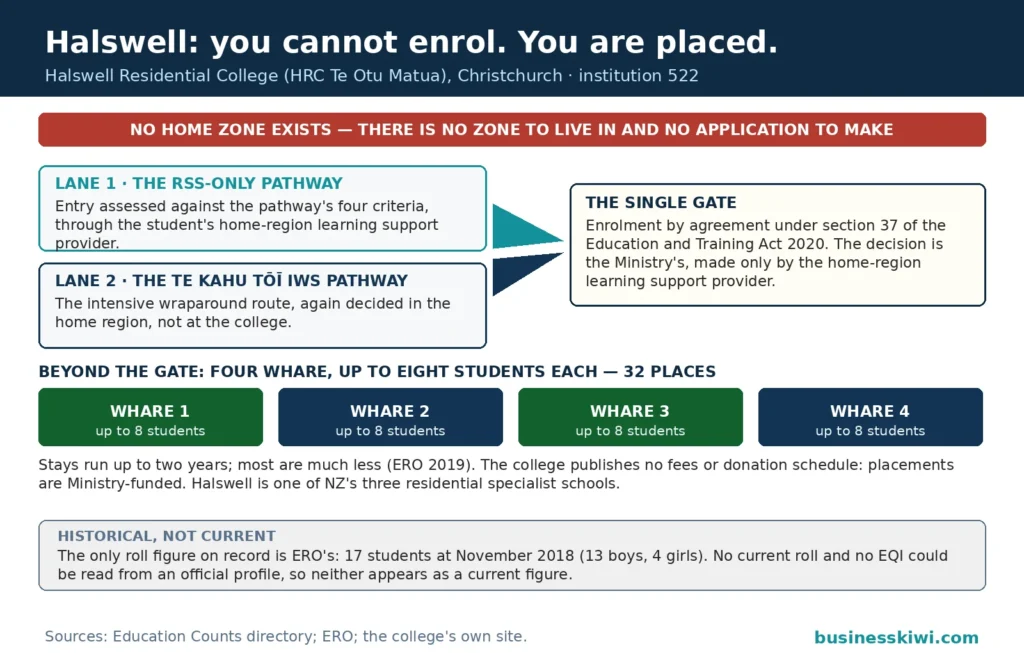
- Capacity: up to 32 students, living in four residential whare
- Who it serves: students aged 8 to 15 (Years 3 to 10) with highly complex behaviour, socialisation and/or learning needs, referred from anywhere in New Zealand
- Enrolment: by Ministry of Education application only, through a learning support provider in the student’s home region. There is no enrolment zone and families cannot apply directly
- Phone: 03 338 5089
What kind of school is this?
Residential specialist schools sit at the most intensive end of New Zealand’s learning support system. The Ministry of Education describes them as specialised settings that provide intensive 24/7 education and support for students with complex and challenging needs, combining learning, therapy and life skills development in one tailored environment. Students live on site in specialised accommodation as part of their educational programme, during term time.
There are three of them. Westbridge Residential School is in Auckland, Salisbury School is in Nelson and takes girls only, and Halswell Residential College is in Christchurch. Halswell and Westbridge are both co-educational.
Halswell’s own strategic plan describes its purpose plainly: a time-limited, targeted intervention for neurodiverse and/or intellectually impaired ākonga with complex needs, giving them skills and strategies so they can engage fully in their local education again. The presentations the college works with include autism spectrum disorder, intellectual impairments, specific learning disabilities, ADHD and the effects of trauma, along with similar presentations that may not have a formal diagnosis. The school’s motto, whakarangatirahia, means “be the best you can be”, and its stated values are manawa-roa (resilience), whanaungatanga (building relationships) and whaiwhakaaro (reflection).
The end goal matters here. A placement at Halswell is not a permanent school change. It is an intervention with a planned return built in, so that the young person transitions back to their whānau, their local school and their community with better tools for managing themselves and their learning.
Location and campus
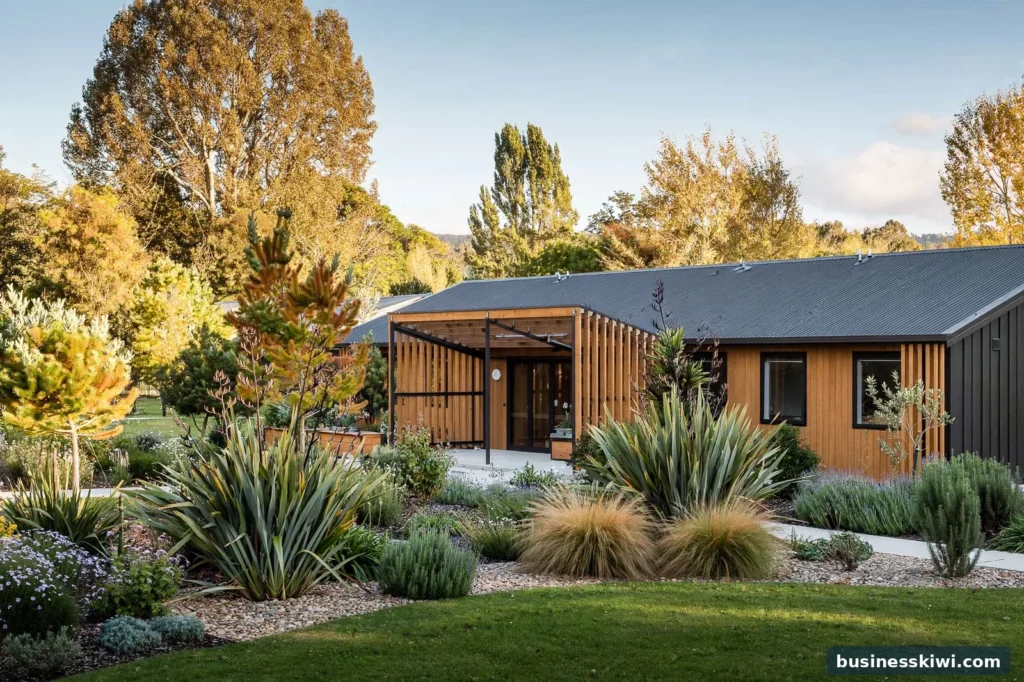
The college sits at 15 Nash Road in Aidanfield, on the Halswell side of Christchurch, in grounds its cultural narrative describes as a tranquil setting near the Huritini (Halswell) River system on the way to Te Waihora (Lake Ellesmere). The campus has two distinct parts: a day school with classrooms, and a separate residential area. The college points to that separation deliberately, because it keeps a clear line between being at school and being at home.
ERO’s January 2019 evaluation records that the residential houses were rebuilt on the original site after the 2014 review. There are four whare, each purpose-built for up to eight students, and each student has their own room. The houses were designed to feel home-like rather than institutional while still providing for safety and wellbeing, and they are licensed as the school hostel by the Ministry of Education. One whare, Whare Tauawa, provides a rich bicultural environment grounded in kaupapa and tikanga Māori. In the school’s current documents the whare include Huritini, Tauawa and Owaka, and the classrooms have names of their own, including Raumata, Te Puna Wai, Kawatea and Kaharoa.
Around the buildings, students have a swimming pool, a garden where ākonga plant vegetables, playgrounds and room for outdoor education. The school’s newsletters describe horse riding, skiing trips to Porters, fishing and Special Olympics events as part of ordinary school life.
Roll and student body
This is a very small school by design. Its maximum roll is 32 students, set by the four whare of eight. Actual numbers move around more than at an ordinary school, because students arrive and leave at staggered points through the year as individual placements begin and end, and most stay for well under the maximum period.
ERO’s 2019 report records the roll at the time of its November 2018 visit as 17 students: 13 boys and 4 girls, with 7 ākonga Māori, 9 Pākehā and 1 Pacific student. Only one of the 17 held Ongoing Resourcing Scheme (ORS) funding, a reminder that this cohort is defined by complex behaviour, social and learning needs rather than by ORS status. The college became fully co-educational in 2017, having previously been a boys’ school that could take a limited number of girls.
A current Education Counts roll figure is not quoted in this profile. The school’s Education Counts profile page could not be read in full when this article was researched, so no unverified number has been substituted, and no Equity Index figure is stated for the same reason. Families who need the current roll should check the school’s Education Counts listing or ask the school. Education Counts does publish the college’s school leaver qualification data: its NCEA Level 1 tables for 2022 to 2024 record no leavers at that level, which fits a cohort aged 8 to 15 whose success is measured against individual goals rather than senior qualifications, and who return to local schools for their senior years.
Enrolment: no zone, no direct application
Halswell Residential College has no home zone, no ballot and no out-of-zone application form of the kind used by ordinary state schools. Nobody enrols by filling in a school enrolment form. Instead, placement is a Ministry of Education decision, reached through one of two national pathways.
The first is the RSS-only pathway, for students who would benefit from a residential intervention but who do not need the Te Kahu Tōī Intensive Wraparound Service (IWS) in their home and community. The second is the IWS pathway itself, for students whose needs at home and in the community are also intensive. ERO’s 2019 report notes that students at that time were referred as part of the IWS, and the college’s strategic plan describes strong working relationships with referrers across both routes.
For the RSS-only pathway, the Ministry’s published criteria are specific. An application must meet all of the following:
- The young person is aged 8 to 15 years old (in Year 3 to 10).
- The young person has behaviour, social and/or learning needs that are highly complex and challenging (and may have associated intellectual difficulty) and requires support at school.
- Local learning support services have been considered or tried, but a residential intervention is believed to be the best way of meeting the young person’s needs.
- The young person does not need an intervention in the home or community, such as Te Kahu Tōī IWS, Oranga Tamariki services or the High and Complex Needs Unit.
Only the young person’s learning support provider in their home region can make the application. That might be a Resource Teacher: Learning and Behaviour (RTLB), a Ministry specialist, or a day specialist or fund-holder school. The provider works with parents, whānau and the team around the young person to prepare the application. They meet to decide whether an application should be made, which of the three schools would suit the young person best, and who will complete the paperwork. A risk assessment forms part of the application, and the Ministry is clear that an enrolment cannot be supported where a young person’s behaviour would place other students at risk.
The Ministry also stresses that an application takes time and is not a solution for a crisis situation. After applying, the learning support provider is contacted following the enrolment group’s meeting to discuss its recommendation. If the application is supported, the provider contacts the school to arrange the young person’s transition. Enrolment at a residential specialist school is by agreement under section 37 of the Education and Training Act 2020, between the student’s legal guardian and the Secretary for Education (or their delegate), and a parent or legal guardian must sign that specialist education agreement before the placement begins.
The college’s own newsletter gives a practical contact for families who are further along this road: its student coordinator handles enrolment questions and can arrange a visit. The bigger message for whānau, though, is that the first conversation is not with the school. It is with the learning support lead worker or provider already involved with your child, because that is who can start an application.
How long students stay, and what happens next
Placements are time-limited. ERO recorded in 2019 that students were resident for up to two years, with most staying significantly less than that. The college describes its programme as a short-term intervention, and everything in its design, from individual goal setting at entry to the daily sign-off on each ākonga’s achievements, is pointed at the return home.
Transition planning is part of the service rather than an afterthought. The Ministry confirms that students can and do transition back into state and state-integrated schools, and that the residential schools work with the Ministry, other professionals and the receiving school to manage that process carefully. Reintegration into mainstream schooling is written into staff roles at the college; its teaching position descriptions describe supporting students’ reintegration as a core purpose of the day school.
Families stay connected during the placement. Students live at the college during term time, and the school’s rhythm builds in travel days at term boundaries, when ākonga travel out at the end of term and travel back in at the start of the next. The college’s diary in its 2025 newsletter shows the pattern: a final assembly, a travel-out day on the Friday, and a travel-in day on the Monday term resumes. Most students are in regular contact with their family or whānau while they are away, ERO found, and whānau are partners in the individual planning rather than spectators.
The programme: a 24/7 curriculum
The college talks about its curriculum as a 24/7 one, and it means that literally. In its own summary document, the school splits the day into the five hours ākonga spend supported to be ready to learn in the classroom, and “the other 19 hours”, which include sleep, routines, meals and daily life, and which it treats as just as much a part of the intervention. Bedtime routines, morning preparation, making beds, tidying rooms and handing in cell phones are all described as learning, delivered through the purposeful use of daily life events.
In the day school, each ākonga has an individualised programme. The college’s local curriculum weaves together Te Mātaiaho (the refreshed national curriculum framework), its own HRC curriculum, and an approach it calls All About Me (AAM), developed in consultation with a Ministry psychologist. AAM uses psychological assessment to identify the social and self-management skills a student needs to build, and to measure growth in them. A system the school calls the Poutama Programme brings each student’s entry goals, residential curriculum goals and te reo goals together in one place, with staff signing off daily on each student’s achievement.
Literacy and numeracy teaching is structured and evidence based. The college’s annual reporting describes Better Start Literacy Approach work, Numicon hands-on maths, running records taken each term, and PAT assessments being introduced to capture achievement before and after enrolment. Progress is reported against each student’s own starting point: the college’s 2024 annual plan analysis recorded a group of ākonga making an average gain of one year in reading age across their placements. Because ākonga arrive with intellectual impairments or neurodiverse profiles, the college is blunt that standard academic measures used in ordinary schools do not, on their own, give a valid picture of its students’ progress; soft skills such as self-management, social skills and approach to learning carry much of the weight.
Layered over the academics is a therapeutic model. Staff are trained in the Daily Life Events framework and in the Three Pillars of Transforming Care, a trauma-informed approach. The college’s stated practice is relational: work alongside ākonga, doing things with them rather than for them or to them. Older students take part in a work experience programme, with placements such as a supervised role at a local dog daycare described in the school newsletter.
Residential life
Life in the whare is deliberately ordinary in structure, because ordinary routines are the teaching tool. Each day begins and ends with shared karakia, waiata and pepeha. Each whare has its own kaupapa; in whare Tauawa and whare Owaka, tikanga Māori is foundational, and both welcome rangatahi from any cultural background. Tuakana-teina relationships, where older or more settled students help newer ones, give ākonga leadership opportunities and support self-management.
Residential staff build close relationships with students and contribute detailed information about each young person’s growth to the school’s records. ERO found the houses appropriately staffed and well managed, with staff organising home and living skills learning inside the whare and supporting students into interests and sports in the wider community. The college’s philosophy of care, as ERO summarised it, asks everyone to contribute through “being a learner, being safe and showing respect”.
Staff and specialist support
A placement brings together more than classroom teachers. The college has a day school team (associate principal, team leader, teachers and teacher assistants for each classroom), residential staff in the whare, and a student coordinator who is the point of contact for enrolment questions and visits. Its strategic documents describe kaiako as highly effective specialists, with ongoing professional development in its curriculum, its trauma-informed models and the national Common Practice Model.
Around the school sits the wider learning support system. Specialist schools generally employ or draw on specialist teachers, speech language therapists, physiotherapists, occupational therapists and psychologists, as the Ministry’s specialist schools guidance describes, and at Halswell the All About Me approach was developed with a Ministry psychologist. For students on the IWS pathway, a wraparound team continues to be part of the picture, and residential staff work closely with IWS to align plans and approaches for individual students, as ERO recorded.
Governance and leadership
The college has been governed jointly with Westbridge Residential School. A Ministry-appointed board was established in 2014 to govern both schools, and the two schools’ combined board produced joint annual reports, including for 2024. The college’s 2025 newsletter is written partly by a Commissioner, Gabrielle Wall, who records that she was overseeing the governance of the college at that time, so families should confirm current arrangements on the school’s website or through the Ministry.
On the ground, leadership changed during 2025. Stephen Evans joined as Tumuaki (principal) from Term 4, 2025, following a period in which Jon Purdue was acting tumuaki. Before that, Janine Harrington was the college’s principal into early 2025, as the combined board’s annual report records.
Costs
The college publishes no fees, and no donation schedule appears in its official documents. That is consistent with how this provision works: placements are arranged through the Ministry of Education’s learning support pathways and funded as part of that system, rather than sold to families, and enrolment takes legal effect through the specialist education agreement described above. If a family is quoted any charge in connection with a residential specialist school placement, it would be sensible to check it with the Ministry’s regional office before paying anything, because no published fee from the college exists to check it against.
What ERO found
The most recent full ERO external evaluation of the college that could be read in full for this profile is the report dated 31 January 2019, following a review team visit in November 2018. ERO’s reporting approach has changed since then, so readers should check ero.govt.nz for the school’s current evaluation information as well.
In that 2019 evaluation, ERO found that all students were effectively supported to achieve personal equity and excellence, and that almost all were achieving the school’s valued outcomes. The school was judged very effective in accelerating learning, with most target students making accelerated progress. ERO described the 24/7 curriculum as highly responsive to students’ strengths, culture, needs and interests, and the processes behind it as highly effective, with strong leadership and a high-trust, caring culture. School information for 2018 showed most students met or exceeded targets in literacy and numeracy. For the hostel, ERO recorded that the four houses were licensed by the Ministry, appropriately staffed and well managed, and that most students were in regular contact with their family or whānau. The main next step ERO and school leaders identified was continuing to develop the new curriculum, including differentiated assessments.
The wider context: a model under national debate
Any honest profile of this school has to note that the future of residential specialist schooling has been debated nationally for several years. In its 2024-2025 strategic plan, the college records that it and the other residential schools were waiting to hear from the Ministry following a 2022 recommendation by the United Nations Committee on the Rights of Persons with Disabilities that New Zealand close residential institutions, a recommendation the government has not adopted as policy. Separately, in early 2026 the Ministry consulted on a proposal to close Westbridge Residential School in Auckland, the college’s sister school, after ERO concerns there. That consultation concerns Westbridge only; it is not a closure proposal for Halswell. What it does mean is that the national network these schools belong to is changing, and families considering a referral should ask the Ministry about the current position for each school at the time they apply.
Frequently asked questions
Can I enrol my child at Halswell Residential College directly?
No. Families cannot apply to the school themselves. An application can only be made by the young person’s learning support provider in their home region, such as an RTLB, a Ministry specialist, or a day specialist or fund-holder school. The first step is a conversation with the learning support lead worker already involved with your child.
Does Halswell Residential College have an enrolment zone?
No. There is no home zone, ballot or out-of-zone process. The college is a national provision and takes referred students from throughout New Zealand. Places are decided through the Ministry of Education’s residential specialist school pathways, not by address.
Who is Halswell Residential College for?
It is for students aged 8 to 15 (Years 3 to 10) whose behaviour, social and/or learning needs are highly complex and challenging, and who may also have an associated intellectual difficulty. The college works with neurodiverse ākonga and ākonga with intellectual impairments, including presentations such as ASD, specific learning disabilities, ADHD and trauma. Local learning support services must have been considered or tried first.
What is the difference between the RSS-only pathway and the IWS pathway?
The RSS-only pathway is for students who need the residential educational intervention but do not need intensive support in their home and community. Te Kahu Tōī, the Intensive Wraparound Service, is for students who need a high level of specialist support at home and in the community as well; those students can also be referred to a residential school as part of their wraparound plan.
How long do students stay at Halswell Residential College?
Placements are time-limited interventions, not permanent enrolments. ERO recorded stays of up to two years, with most students staying significantly less than that. The exact length is individual, and transition planning back to the student’s local school and community is part of the service from the start.
How many students attend Halswell Residential College?
The college can take up to 32 students, eight in each of its four residential whare. The actual roll is usually smaller and changes through the year as students start and finish placements. ERO recorded a roll of 17 at its November 2018 visit. This profile states no current roll figure, because the school’s Education Counts profile could not be read in full when researched; check Education Counts for the latest number.
What does it cost to attend Halswell Residential College?
The college publishes no fees and no donation schedule. Placements are arranged and funded through the Ministry of Education’s learning support pathways, and enrolment is completed through a specialist education agreement between the student’s legal guardian and the Secretary for Education. Families should not expect a tuition bill from the school.
Do students stay at the college during school holidays?
Students live at the college during term time. The school’s calendar builds in travel days at the end and start of each term, when ākonga travel home and then return. Students spend term breaks with their whānau, and most keep in regular contact with home during term as well.
This article is general information about Halswell Residential College drawn from official sources published by the Ministry of Education, the Education Review Office and the college itself. Enrolment in a residential specialist school is decided through Ministry of Education processes, and arrangements can change. Families should talk to their child’s learning support provider, the Ministry’s regional office, or the college directly for current information about a specific child.
Sources
- Ministry of Education, Specialist schools, education.govt.nz
- Ministry of Education, Enrolling at a residential specialist school via the RSS-only pathway, education.govt.nz
- Ministry of Education, Consultation on the possible closure of Westbridge Residential School: Frequently asked questions, education.govt.nz
- Education Counts, Halswell Residential College: NCEA Level 1, educationcounts.govt.nz
- Education Review Office, ERO External Evaluation: Halswell Residential College, Christchurch (January 2019), ero.govt.nz
- Halswell Residential College, Strategic Plan 2024-2025, otumatua.school.nz
- Halswell Residential College, Transforming Futures: Progress and Culture at HRC Te Otu Mātua, otumatua.school.nz
- Halswell Residential College, Newsletter Two 2025, otumatua.school.nz
- Combined Board of Halswell Residential College and Westbridge Residential School, Annual Report 2024, otumatua.school.nz
- Halswell Residential College, Te Whānau o Ōtūmatua (school homepage), otumatua.school.nz