Construction Management Courses NZ: Diplomas, Degrees and Where to Study

Construction managers and quantity surveyors are the people who keep building projects on time, on budget and built to the rules. If you want to move into that side of the industry, or get a qualification behind the experience you already have, New Zealand has a clear study ladder: a national Level 6 diploma, bachelor’s degrees in construction, and graduate and postgraduate options for people changing direction or stepping up.
This guide explains how those qualifications fit together, what entry to each one actually requires, what they cost at the providers that publish fees, and what the jobs at the end of them pay. All qualification details come from the New Zealand Qualifications Authority (NZQA) and the providers’ own course pages, checked in October 2026.
The qualification ladder, in plain terms
Almost everything in this guide sits on the New Zealand Qualifications and Credentials Framework (NZQCF), which has 10 levels. Level 1 is the least complex and levels 8 to 10 cover postgraduate study. The construction management pathway looks like this:
- Level 5: The New Zealand Certificate in Construction Trades Supervision is the usual stepping stone. It is aimed at people already working on site who are moving into supervisory roles.
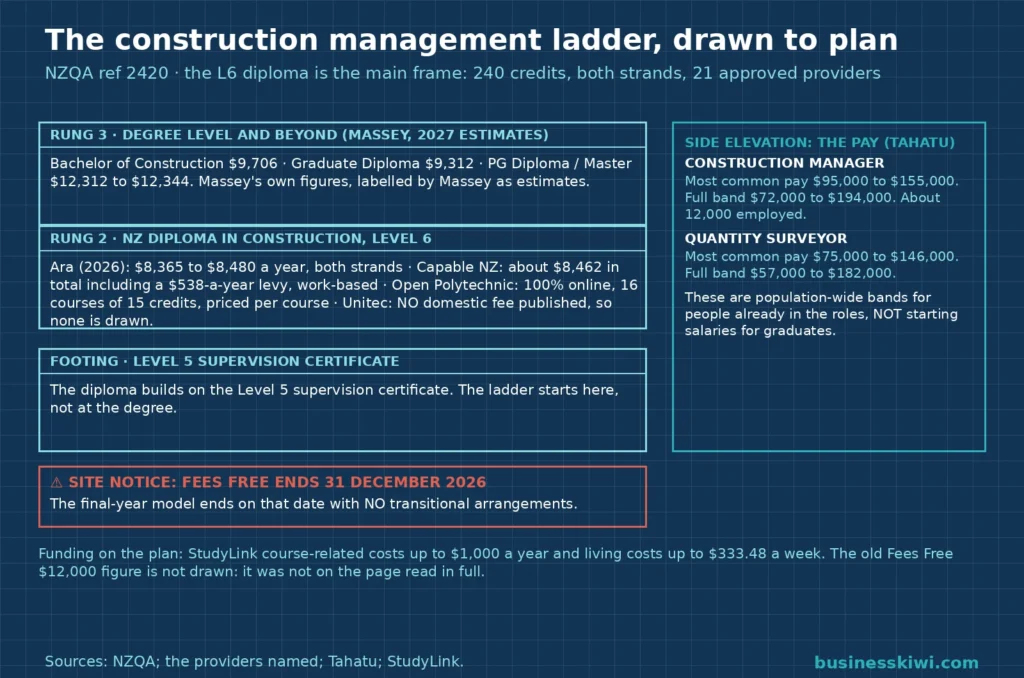
- Level 6: The New Zealand Diploma in Construction, with strands in Construction Management and Quantity Surveying, is the main sub-degree qualification. It is 240 credits, which is two years of full-time study.
- Level 7: Bachelor’s degrees in construction (360 credits, usually three years full-time) and graduate diplomas (120 credits, usually one year) sit here. Graduate diplomas are designed for people who already have a degree or substantial industry experience.
- Levels 8 and 9: Postgraduate diplomas, honours degrees and master’s degrees, for graduates who want senior, specialist or research-focused roles.
NZQA registers qualifications on the framework and quality assures many of them. University degrees are quality assured through the universities’ own academic processes under the same framework, so a qualification listed on the NZQF has been checked by NZQA, ITP Quality or the universities’ quality body before it can be offered.
The New Zealand Diploma in Construction (Level 6)
This is the qualification most people mean when they search for a diploma in construction. Its full title is the New Zealand Diploma in Construction (Level 6) with strands in Construction Management, and Quantity Surveying, and it is listed on the NZQF as qualification reference 2420. NZQA shows 21 education organisations approved to deliver it, so where you study it is a genuine choice.
NZQA’s stated purpose for the qualification is worth understanding before you enrol. It prepares graduates to assist with all stages of construction management or quantity surveying under the supervision of an experienced practitioner. In other words, it is deliberately pitched at assistant and junior level roles, and it also gives formal recognition to people already working in those jobs. The Construction Management strand covers managing site logistics and resources, setting up sites and site services, producing technical sketches, and applying leadership principles to site teams. The Quantity Surveying strand concentrates on feasibility information and preliminary estimates, measuring quantities and preparing schedules of quantities, and assembling tender submissions.
Graduates are expected to be able to administer and manage a construction contract, work inside New Zealand’s building legislation and regulatory frameworks, evaluate materials and finishes, apply structural principles to foundations, substructure, the building envelope and interiors, and monitor contract expenditure. NZQA lists the employment pathways as construction site manager, construction management assistant and construction project management assistant for the management strand, and quantity surveyor for the surveying strand. The diploma builds on the Level 5 supervision certificate and can lead on to higher-level qualifications in either field.
Unitec, Auckland
Unitec delivers the diploma at its Mt Albert campus in Auckland, with February and July starts and both full-time (two years) and part-time options. One practical detail sets it apart for working students: Unitec states that all courses in this programme are delivered in the evenings, so it is designed to fit around a full-time job. Unitec notes the qualification is recognised by the New Zealand Institute of Building, and that graduates can apply for a Licensed Building Practitioner (LBP) Site 2 licence. Diploma graduates can also transition into Unitec’s Bachelor of Construction, with cross-credits available, in majors covering construction management, construction economics and property development. Unitec’s programme page did not publish a domestic fee for the diploma when checked in October 2026, so ask Unitec for the current figure before budgeting.
Ara Institute of Canterbury, Christchurch
Ara offers both strands of the diploma from its Christchurch campus, full-time over two years or part-time. Most classes run in the late afternoon and evening as well as during the day, and full-time students get work experience components in the second year. Ara publishes its fees: the domestic fee for 2026 is $8,365 to $8,480 per year (checked October 2026). The Construction Management strand is recognised by the New Zealand Institute of Building (NZIOB), which gives graduates a pathway to professional membership and Chartered Building Professional status, and Ara says its management graduates are also eligible for LBP Site licence classes 1, 2 and 3. The Quantity Surveying strand is recognised and accredited by both the New Zealand Institute of Quantity Surveyors (NZIQS) and NZIOB, supporting progression to Registered Quantity Surveyor status.
Open Polytechnic, online anywhere
If campus study does not work for you, the Open Polytechnic of New Zealand delivers both strands of the diploma 100 percent online. You enrol course by course: the qualification is made up of 16 courses of 15 credits each, and you can study full-time or part-time, with up to six years to complete. Fees are charged per course, so the total cost varies with the courses you take rather than being a single annual figure. The Open Polytechnic notes that its construction qualifications were developed by the Building Construction Industry Training Organisation (BCITO) and meet current industry standards. When checked in October 2026 it was also running a limited-time offer of up to two zero-fee courses for eligible new enrolments in courses starting in August, September or October 2026, with terms and conditions attached.
Capable NZ, for experienced practitioners
Capable NZ, part of Otago Polytechnic, offers the same Level 6 diploma through a work-based model built for people who already know the job. It is aimed at professionals with five to seven years of practice experience, and instead of classes you are assessed largely through in-depth case studies that analyse your own work experience against the qualification’s requirements, with extra learning to fill any gaps. Capable NZ lists the domestic cost as approximately $8,462 in total, including a student services levy of $538 per year (checked October 2026). It takes about 10 months full-time or 18 to 20 months part-time, is delivered by distance, and has monthly intakes from February to November. For an experienced site manager with no paper qualification, this is often the fastest honest route to the diploma.

Bachelor’s degrees in construction
A degree goes further than the diploma in both depth and destination. Where the diploma prepares you to work under supervision, degrees are built to produce graduates who can run projects and progress to senior and professional roles, and they carry professional accreditation that matters for chartered pathways.
Massey University’s Bachelor of Construction (BConst) is a 360-credit, Level 7 degree, three years full-time, taught at the Auckland campus with distance and online options. It offers majors in Construction Management, Quantity Surveying and Design Management, and you can switch majors after the first year. Entry requires University Entrance, and Massey lists no specific subject prerequisites for the degree. Expect digital tools to run through the whole programme: computer aided drawing (CAD), building information modelling (BIM), and augmented and virtual reality are core skills in Massey’s construction courses. On accreditation, Massey’s Bachelor of Construction is accredited by the Royal Institution of Chartered Surveyors (RICS), and its quantity surveying specialisations are accredited by NZIQS for graduate membership, with the Quantity Surveying major also accredited by the Pacific Association of Quantity Surveyors (PAQS). Massey’s estimated domestic tuition fee for the Bachelor of Construction is $9,706 for a year of full-time study in 2027 (checked October 2026), and that estimate excludes non-tuition fees such as the student services fee.
Unitec also offers a Bachelor of Construction at its Mt Albert campus, with majors in Construction Management, Construction Economics and Property Development. Because Unitec’s diploma graduates can cross-credit into the degree, Unitec suits Auckland students who want to start with the diploma, work in the industry, and top up to a degree later without starting again.
Graduate diplomas and postgraduate study
If you already have a degree in another field, or years of industry experience, you do not need to start at diploma level. Unitec’s Graduate Diploma in Construction Project Management is a Level 7, 120-credit qualification taken full-time over one year, including two 2-week block courses per semester, with part-time options. It covers project management principles and practice, contract administration, procurement, and virtual design and construction using BIM. A previous qualification is not required for entry, but places are limited and Unitec gives preference to applicants with at least five years of industry experience or a relevant undergraduate degree.
Massey offers a Graduate Diploma in Construction and Facilities Management (120 credits, Auckland or distance), with an estimated domestic fee of $9,312 for a year of full-time study in 2027 (checked October 2026). Beyond that, Massey’s ladder continues to the Bachelor of Construction (Honours), the Postgraduate Diploma in Construction and the 180-credit Master of Construction, with specialisations that include Construction Project Management, Quantity Surveying, Construction Law, Digital Built Environment and Sustainable Built Environment. Massey describes its Construction Law master’s specialisation as the only one of its kind in New Zealand. Estimated domestic fees for 2027 are $12,312 to $12,344 per year of full-time study for both the Postgraduate Diploma in Construction and the Master of Construction (checked October 2026).
Entry requirements: what you actually need
For the Level 6 diploma, the pattern across providers is NCEA Level 2 including mathematics, plus literacy credits at NCEA Level 1. Ara asks for NCEA Level 2 including mathematics and NCEA Level 1 including literacy, or a relevant qualification at NZQF Level 4 or above, or a recognised equivalent. The Open Polytechnic asks for NCEA Level 2 including 12 credits in mathematics (excluding statistics) and at least 12 literacy credits at NCEA Level 1, or a relevant Level 4 or higher qualification, or equivalent knowledge and skills. If you are 20 or over and fall short on paper, do not rule yourself out: providers offer alternative or special admission where your work and life experience shows you are likely to succeed, and Ara explicitly considers applicants who can demonstrate equivalent skills gained through study, work or life experience.
Degrees need University Entrance, which is a higher bar than diploma entry. Graduate diplomas sit in between: Unitec’s requires no prior qualification on paper but is effectively gated by experience, while Capable NZ’s work-based diploma requires five to seven years of professional practice. English language requirements apply if English or te reo Māori is not your first language, typically IELTS (Academic) 6.0 with no band under 5.5 for the diploma. Always confirm the exact requirements on the provider’s page for the intake you are applying for, because they are set programme by programme.
What you will study
The diploma’s common core is the same wherever you study it, because providers are teaching to one national qualification. Expect construction technology for residential and then commercial buildings, materials and structural principles, building services, environmental and sustainable construction, law and construction contracts, procurement, programming, financial administration of contracts, and safety and wellbeing. Management strand students add planning and quality, site management and method statements. Quantity surveying students add deeper measurement, estimation and cost planning. Both strands are built to the same 240-credit structure, mixing Level 5 and Level 6 courses, so the first year builds foundations and the second year applies them to bigger, more commercial projects.
Degree study covers the same ground in more depth and adds research, professional practice and management theory, alongside the digital modelling skills employers increasingly expect. The thread through every level is contracts: how they are formed, administered, measured, varied and paid, within New Zealand legislation, codes of practice and standards.
Fees, student loans and Fees Free
Published domestic fees for the diploma cluster in a fairly tight band. Ara charges $8,365 to $8,480 per year for 2026, and Capable NZ’s work-based diploma is approximately $8,462 in total. Degree study at Massey is estimated at $9,706 per year for 2027, and Massey postgraduate construction qualifications are estimated at $12,312 to $12,344 per year. The Open Polytechnic charges per course, so your total depends on your enrolment pattern. Remember that published figures may exclude student services fees and course-related costs like safety gear for site visits, so budget a little beyond the headline number.
A student loan from StudyLink can cover compulsory course fees, up to $1,000 a year for course-related costs, and, for full-time students, living costs of up to $333.48 a week (figures checked October 2026). Part-time students are generally limited to fees only unless StudyLink classes them as full-time. Most of the programmes in this guide are approved courses at approved providers, which is what the loan requires.
Fees Free needs careful reading, because the scheme is ending. Under the current final-year Fees Free settings, first-time tertiary learners can have fees for the final year of their first qualification paid back after they complete it, but only if they start that final year on or after 1 January 2025 and complete the qualification by 31 December 2026. The Government has confirmed Fees Free ends on 31 December 2026 with no transitional arrangements. So a student starting a two-year diploma in 2027 should not count on Fees Free at all, while someone finishing an eligible qualification in 2026 should check their position on the Fees Free website and apply through myIR once they complete.
Studying while you work
Construction management is unusual among study areas in how well it tolerates a day job, and many students are already employed in the industry. Unitec delivers every course in its diploma in the evenings. Ara timetables most classes in the late afternoon and evening as well as during the day, and its programme is explicitly designed so you can drop to part-time study if you find relevant work before finishing. The Open Polytechnic’s fully online, course-by-course model exists for people fitting study around work and family. Capable NZ goes furthest: your workplace experience is the raw material of the qualification itself. Employers are often supportive because the content maps directly onto site work, and NZQA notes the diploma doubles as recognition of skills for people already in assistant construction manager and assistant quantity surveyor roles.
Diploma or degree: how to choose
Choose the Level 6 diploma if you want the quickest route into assistant construction manager, site manager or quantity surveyor work, if you are coming from the tools or a Level 4 or 5 qualification, or if you want to study part-time or online while working. It is cheaper in total, finishes in two years full-time, and can be cross-credited towards a degree later at providers like Unitec, so it does not close doors.
Choose a degree if you are starting tertiary study for the first time and can commit to three years, if you want the professional accreditation that supports chartered status through bodies such as RICS and NZIQS, or if your sights are set on senior project management, consultancy or commercial roles where a bachelor’s degree is the expected credential. Choose a graduate diploma if you already hold a degree or have five or more years of industry experience and want a one-year management qualification, and consider the work-based Capable NZ diploma if your experience is strong but your paper record is thin.

Jobs and pay at the end of it
Tahatū, the official careers website from the Tertiary Education Commission, profiles both destination roles. For construction managers, it puts the most common pay range at $95,000 to $155,000 a year before tax, with a lower figure of $72,000 and an upper figure of $194,000. Around 12,000 people work in the role, and Tahatū rates employment change as a strong increase. For quantity surveyors, the most common range is $75,000 to $146,000 a year, with a lower figure of $57,000 and an upper figure of $182,000, around 3,700 people employed, and employment increasing. These are population-wide figures across all experience levels, not starting salaries, and new graduates should expect to begin well below the top of the range and earn more as they take on bigger projects and responsibility.
Professional recognition builds as you work. Depending on your strand and provider, your qualification can support membership pathways with NZIOB (including Chartered Building Professional status), NZIQS registration as a quantity surveyor, RICS membership for Massey construction graduates, and LBP site licences for diploma graduates who meet the experience requirements.
Frequently asked questions
How long does a construction management diploma take in NZ?
The New Zealand Diploma in Construction (Level 6) is 240 credits, which takes two years full-time at campus-based providers such as Unitec and Ara. Part-time study takes longer. The work-based version through Capable NZ takes about 10 months full-time or 18 to 20 months part-time, because it assesses experience you already have rather than teaching every course from scratch.
Can I study construction management online in New Zealand?
Yes. The Open Polytechnic delivers both strands of the Level 6 diploma fully online, with enrolment course by course. Massey’s Bachelor of Construction and its postgraduate construction qualifications also offer distance and online study alongside the Auckland campus, and Capable NZ’s diploma is delivered by distance.
What qualifications do I need to enrol in a construction diploma?
Typically NCEA Level 2 including mathematics, and literacy credits at NCEA Level 1, or a relevant Level 4 or higher qualification, or equivalent experience. Applicants aged 20 and over can often gain special or alternative admission based on work and life experience. Degrees require University Entrance.
How much does a diploma in construction cost?
At providers that publish domestic fees, around $8,400 to $8,500 a year for campus-based study at Ara in 2026, and about $8,462 in total for Capable NZ’s work-based diploma, checked October 2026. The Open Polytechnic charges per course, so totals vary. Add student services fees and course-related costs on top.
Is a diploma enough to become a construction manager?
It is enough to start. NZQA designs the diploma to prepare graduates to assist with construction management under the supervision of an experienced practitioner, in roles such as construction management assistant, project management assistant and site manager. Running major projects independently usually comes later, with experience, and some people add a degree or graduate diploma as they progress.
What is the difference between construction management and quantity surveying?
Construction managers focus on delivering the build: programme, site logistics, resources, safety and quality. Quantity surveyors focus on the money: measuring quantities, estimating, cost planning, tenders and administering contract payments. The Level 6 diploma teaches a shared core first, then splits into the two strands.
Can I study construction management part-time while working full-time?
Yes, and many students do. Unitec runs its diploma courses in the evenings, Ara offers part-time study with late afternoon and evening classes, the Open Polytechnic is fully online, and Capable NZ’s model is built around your existing job. Check StudyLink rules if you need a student loan, because part-time students are usually limited to course fees.
This article is general information about construction management courses in New Zealand, based on official sources checked in October 2026. Fees, entry requirements and programme availability change, and this is not personal advice about your study or career. Confirm the current details with the provider and on the NZQA, StudyLink and Fees Free websites before you enrol.
Sources
- New Zealand Qualifications Authority, New Zealand Diploma in Construction (Level 6) with strands in Construction Management, and Quantity Surveying: Qualification Overview, nzqa.govt.nz
- Unitec Institute of Technology, New Zealand Diploma in Construction (Construction Management), unitec.ac.nz
- Unitec Institute of Technology, Graduate Diploma in Construction Project Management, unitec.ac.nz
- Ara Institute of Canterbury, New Zealand Diploma in Construction (Construction Management), ara.ac.nz
- Ara Institute of Canterbury, New Zealand Diploma in Construction (Quantity Surveying), ara.ac.nz
- Open Polytechnic of New Zealand, Construction and Trades Courses, openpolytechnic.ac.nz
- Open Polytechnic of New Zealand, New Zealand Diploma in Construction (Construction Management) qualification brochure, openpolytechnic.ac.nz
- Capable NZ (Otago Polytechnic), New Zealand Diploma in Construction (Level 6) (Construction Management), capable.nz
- Massey University, Study construction and built environment, massey.ac.nz
- Massey University, Tuition fees for domestic students, massey.ac.nz
- Tahatū Career Navigator, Construction manager, tahatu.govt.nz
- Tahatū Career Navigator, Quantity surveyor, tahatu.govt.nz
- StudyLink, Student Loan, studylink.govt.nz
- Fees Free, Final-year Fees Free, feesfree.govt.nz