Cosmetic Nurse Salary NZ: What Appearance Medicine Nurses Earn

Search for a cosmetic nurse salary in New Zealand and you will find confident numbers on job boards and recruitment sites. What you will not find is an official one. No government agency, professional body or collective agreement publishes a pay rate for cosmetic nurses, because appearance medicine sits outside the structures that set and record nursing pay for most of the profession.
That does not mean the question cannot be answered honestly. It means the answer has to be built from what is actually verifiable: the official pay band for registered nurses generally, the way cosmetic nurses are engaged by clinics, and the factors that push earnings in this niche up or down. This article sets out what the primary sources say, and is clear about where the published record stops.
If you want the full picture of hospital and community nursing pay, including the collective agreement steps, our guide to nurse salary in NZ covers registered nurse pay across the public system. This article stays inside the cosmetic niche.
What a cosmetic nurse actually does
A cosmetic nurse, also called an aesthetic nurse or cosmetic nurse injector, is a registered nurse who has moved into appearance medicine. The work centres on non-surgical treatments that change how skin and facial features look, rather than treating illness.
The New Zealand practice standards for aesthetic nursing, developed by registered nurses working in the field and published through the Cosmetic Appearance Nurses Network (CANN), describe the scope in detail. Day-to-day work includes:
- client consultations, skin and facial assessment, treatment planning and informed consent
- administering botulinum toxin A injections (the anti-wrinkle treatments sold under brand names such as Botox, Dysport and Xeomin)
- administering dermal fillers and related products
- laser and intense pulsed light (IPL) therapies, chemical peels, microneedling and platelet rich plasma treatments
- skin health and skincare advice, acne and pigmentation management, and removal of some benign skin lesions
- recognising and managing complications, from bruising and swelling through to rare emergencies such as vascular occlusion
Two features set the role apart from most nursing jobs. First, clients are almost always paying privately for elective treatment, so consultation, honest expectation-setting and ethical judgement about when not to treat are part of the clinical work. Second, many of the core treatments involve prescription medicines, which is why the regulatory frame matters so much in this field, and why it is covered in its own section below.
The honest position: there is no official cosmetic nurse salary
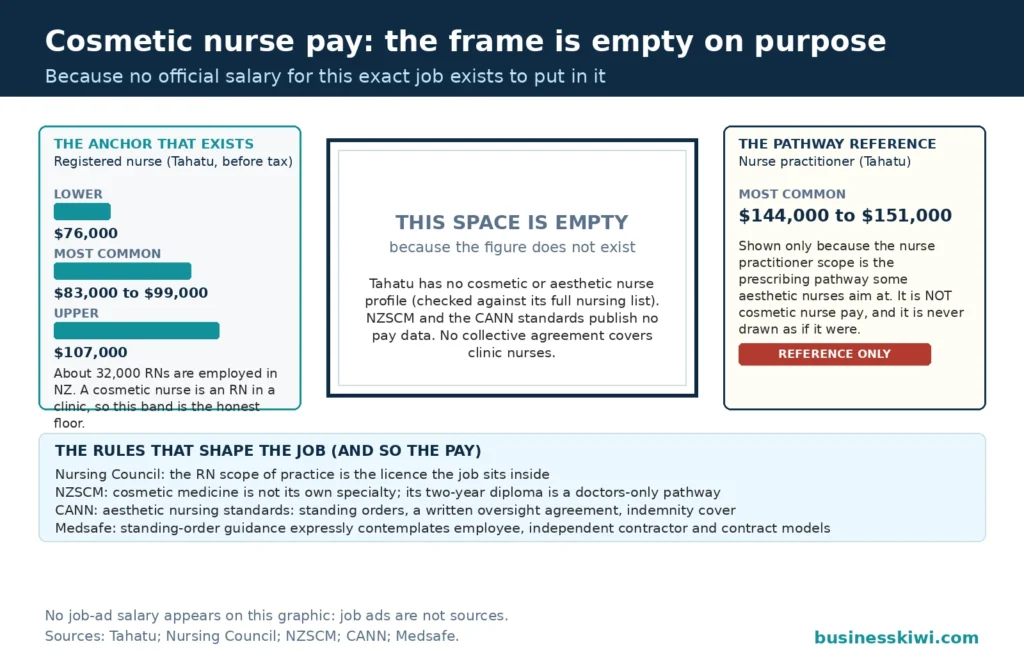
Start with what does not exist. Tahatū, the Tertiary Education Commission’s official careers website, profiles nursing occupations and publishes pay bands for them. Its nursing category includes registered nurse, enrolled nurse, clinical nurse specialist, nurse practitioner and midwife. There is no cosmetic nurse, aesthetic nurse or appearance medicine profile, and no cosmetic-specific pay band. The New Zealand Society of Cosmetic Medicine (NZSCM) publishes standards, training and regulatory guidance. It publishes no pay data. The CANN practice standards cover competence, oversight and professional practice in depth. They say nothing about salary.
There is also no collective agreement to fall back on. Hospital registered nurse pay is structured because a collective agreement between Health New Zealand and the NZNO sets stepped rates for a large public workforce. Cosmetic nurses work in private clinics, outside that agreement, so each role is priced individually by an employer, a contract, or the nurse’s own business. Nobody collects those figures into an official series.
Any single figure presented online as “the” cosmetic nurse salary has come from job advertisements, self-reported survey data or recruitment marketing. Those sources can be interesting, but they are not verified pay data, and this article does not use them.
The baseline: what registered nurses earn
The useful official anchor is the registered nurse occupation itself, because every cosmetic nurse is first a registered nurse. Tahatū puts registered nurse pay, before tax, at:
- lower band: $76,000 a year
- most common band: $83,000 to $99,000 a year
- upper band: $107,000 a year
Tahatū counts around 32,000 people employed as registered nurses in New Zealand, with employment change described as steady. Its training estimate for the occupation is three to five years, reflecting the bachelor degree plus postgraduate development many nurses complete.
Read those bands the way Tahatū presents them. They describe the whole registered nurse population across hospitals, primary care, aged care and private practice, not cosmetic clinics specifically. A cosmetic nurse’s earnings sit somewhere in relation to that population, shaped by the engagement model and the factors below. They are not a separate official statistic.
One more official reference point is worth noting. Tahatū’s most common band for nurse practitioners is $144,000 to $151,000 a year. Nurse practitioners are registered nurses with advanced education and prescribing authority, and a small number work in or support appearance medicine. That band shows where the top of the nursing pay structure sits for nurses who take the prescribing pathway, though it describes nurse practitioners across all settings.
How cosmetic nurses are engaged
Because there is no standard pay scale, the arrangement a cosmetic nurse works under matters as much as any hourly rate. Three models dominate, and each is visible in the primary sources for the field.
Employed by a clinic. Many cosmetic nurses are employees of a doctor-led practice or a clinic chain. Laser Clinics New Zealand, one of the larger chains, states on its own clinic pages that all cosmetic injectable treatments in its clinics are performed by registered nurses or doctors, and it emphasises structured education and training for its medical team. In an employed role, the clinic sets the pay, provides the products, premises and bookings, and carries the overheads. The nurse’s income is the most predictable of the three models, and the least exposed to quiet weeks.
Working under contract. Medsafe’s published guidance on standing orders notes that working under a standing order may form part of a person’s duties as an employee or as an independent contractor, or be governed by contract. That reflects real practice in appearance medicine, where experienced injectors sometimes contract to one or more clinics rather than holding a single employed role. Contracting can lift the headline rate, but the nurse carries more of the risk: unpaid gaps between bookings, their own tax and ACC arrangements, and often their own professional indemnity cover.
Running their own practice. The CANN standards are written for nurses in exactly this position as much as for employees. They require any aesthetic nurse, including one in their own clinic, to hold a current practising certificate, to work under a formal medical oversight agreement, and to hold professional indemnity and public liability insurance, with practice protocols covering emergencies and adverse events. A nurse who owns the clinic keeps the margin on treatments after product, premises, oversight and insurance costs. Earnings in this model vary the widest, because they depend on the client book the nurse has built and the costs of running the business.
What moves cosmetic nurse pay
With no official series to track, the honest way to explain cosmetic pay is through the factors that determine it in practice.
Experience and injecting skill. Appearance medicine rewards a built client book. A nurse in their first year of injecting, working under close supervision while building competence, is in a very different market position from an injector with several years of full books and a loyal repeat clientele. Clinics pay for booked-out diaries.
Breadth of treatments. A nurse competent across anti-wrinkle injections, fillers, laser and skin therapies can fill more of a clinic’s treatment menu than one limited to a single modality, and is harder to replace.
The engagement model. As set out above, employment trades some earning ceiling for security, contracting trades security for rate, and ownership trades both for business risk and the highest potential spread of outcomes.
Location and clinic type. A high-volume urban chain clinic, a doctor-led specialist practice and a small regional clinic operate on different volumes and price points, and pay follows those economics.
Hours. A large share of cosmetic nursing is part-time or sessional, fitted around clinic opening hours and client demand. Annual figures quoted for full-time roles do not translate directly to a nurse working three days a week, which is one more reason advertised numbers mislead.
Costs the nurse carries. In contract and ownership models, professional indemnity insurance, oversight arrangements, training and product costs come out before income. Comparing a contract rate with a salary without adjusting for those costs compares two different things.
The rules that shape the job, and the pay
Cosmetic nursing is regulated indirectly, and understanding that structure explains a lot about how the work and its rewards are organised.
New Zealand has no separate specialty registration for cosmetic medicine. NZSCM states the position plainly: cosmetic medicine is not its own specialty in New Zealand, and practice is regulated through each practitioner’s responsible authority. For a nurse, that authority is the Nursing Council of New Zealand.
The Nursing Council’s registered nurse scope of practice is broad, covering practice in a variety of settings, but it is not unlimited. Registered nurses are accountable for ensuring the care they provide is consistent with their education, their assessed competence and relevant legislation. Injecting cosmetic treatments is a form of expanded practice: the Council expects the nurse and the employer to identify the education, clinical supervision and assessment the role requires before the nurse takes it on. Only nurses who have completed the additional education the Council requires, and been authorised by the Council, may prescribe medicines.
That last point drives the working model. Botulinum toxin is a prescription medicine, and the standard arrangement is a standing order. Medsafe defines a standing order as a written instruction from a medical practitioner or dentist (nurse practitioners and prescribing optometrists can also issue them under the current regulations) authorising a specified class of people, such as registered nurses, to supply and administer specified prescription medicines without a prescription for each client. A standing order does not make the nurse a prescriber. It allows supply and administration within the terms the issuer sets.
The CANN standards describe what good looks like on top of that legal minimum. Oversight requires a written agreement between the nurse and a doctor who is vocationally registered, with recent experience in a related specialty such as cosmetic medicine, dermatology or plastic surgery, or who is a member of NZSCM, with a nurse practitioner also able to provide oversight. The agreement covers meeting frequency, review of clinical notes, back-up arrangements when the doctor is unavailable, and the specific standing orders, which the standards list as covering botulinum toxin A, adrenaline, hyalase (the enzyme used to dissolve filler in an emergency), stronger topical anaesthetics and some oral medicines. Formal case review sits alongside day-to-day access to advice.
For pay, the practical effect is this: a cosmetic nurse’s legal ability to do the highest-value part of the job depends on a structured relationship with a prescriber. Nurses who are organised, well documented and easy to oversee are more valuable to clinics, and nurses running their own practices must secure and maintain that oversight as a cost of doing business.
Training pathways into appearance medicine
Every route starts with registered nurse registration: a Nursing Council accredited bachelor degree in nursing (or the graduate-entry master’s route), registration in the registered nurse scope, and a current annual practising certificate.
Cosmetic-specific training is layered on top, and here the landscape needs care. The NZSCM Diploma in Cosmetic Medicine is New Zealand’s recognised advanced training pathway in this field, and NZSCM is explicit that it is a pathway for doctors: a two-year postgraduate diploma studied through workshops, peer support and clinical assessments. Nurses do not enter the NZSCM diploma. The doctors who complete it are, however, the same doctors who provide oversight and standing orders for nurses, which is why the diploma matters to a nurse’s working life even though it is not open to them.
For nurses themselves, the CANN standards set the expectation: rigorous, impartial, evidence-based practical training in each modality, led by an expert practitioner, with evidence of supervised practice, before administering botulinum toxin, fillers or laser and light therapies. In practice that training comes from a mix of sources: in-house programmes run by clinic chains for their own nurses, short courses and workshops (NZSCM’s practitioner events, for example, include sessions open to nurses), product company training, and ongoing continuing professional development. The Nursing Council requires 60 hours of professional development over three years to maintain a practising certificate, and the CANN standards add peer review and clinical audit with the oversight doctor on top of that.
There is no single accredited cosmetic nursing qualification in New Zealand, and no official body publishes what cosmetic training should cost. Course fees vary widely between providers, and any figure for training costs in this article would be a guess, so none is given. A nurse weighing up a course can test it against the CANN standard: is it evidence-based, is it led by an expert in the specialty, and does it include supervised practice?
A realistic day in the clinic
A cosmetic nurse’s diary looks different from a ward roster. The day is built from booked appointments, often 30 to 60 minutes, mixing consultations with treatments. Consultations involve a full medical history, including mental health history and previous cosmetic procedures, a facial assessment, clinical photography, a documented plan with costing, and informed consent. The CANN standards are specific about this, because clients must understand treatment process, aftercare, cost, side effects and the ongoing treatments needed to maintain a result before they agree to proceed.
Between clients there is the unglamorous core of safe practice: checking product batch numbers and expiry, documenting every administration, following up previous clients, and managing the occasional complication. Bruising and asymmetry are the common end. At the serious end, filler entering a blood vessel is an emergency the nurse must be trained and equipped to respond to, with hyalase on hand and a protocol for escalation. NZSCM also provides cosmetic adverse event support to practitioners, reflecting how seriously the field treats this side of the work.
Selling is part of the environment in a way it is not in public nursing, and the professional standards draw a firm line around it. Advertising by nurses must comply with the Medicines Act and professional codes: no financial inducements for referral, no time-limited discounts, no personal testimonials, and before-and-after photos must be genuine, unaltered and consented. A nurse who is uncomfortable with those boundaries will find the field difficult, because personal reputation and repeat bookings are the business.
Cosmetic nursing compared with hospital nursing
The comparison most nurses actually want is simple: will I earn more in a clinic than on the ward? The official data supports only a careful answer.
Hospital registered nurses sit inside Tahatū’s registered nurse bands, most commonly $83,000 to $99,000 a year, with the security of a collective agreement, penal rates for unsociable hours, and employer KiwiSaver and leave entitlements on top. Cosmetic nursing removes the penal rates and the shift work, and usually removes nights and weekends almost entirely, which is a large part of its appeal. In exchange, pay is individually negotiated, tied to bookings and clinic economics, and carries none of the collective agreement’s automatic progression.
Some experienced injectors with full books will earn above the registered nurse upper band of $107,000, particularly in contract or ownership models. Others, especially part-time and early-career clinic nurses, will earn within or below the general bands. Both statements are consistent with everything the primary sources publish, and no official figure exists to narrow it further. Anyone quoting you a precise average cosmetic nurse salary is working from data that is not official, and it is worth asking them where it came from.
Frequently asked questions
How much do cosmetic nurses earn in NZ?
There is no official cosmetic nurse salary. No agency or professional body publishes one. The official anchor is Tahatū’s registered nurse band: most commonly $83,000 to $99,000 a year before tax, with a lower band of $76,000 and an upper band of $107,000. Cosmetic nurses’ earnings vary around that population depending on experience, hours, location and whether they are employed, contracting or running their own practice.
Is cosmetic nursing covered by the nurses’ collective agreement?
No. The stepped pay rates in the Health New Zealand and NZNO collective agreement apply to nurses employed in the public hospital system. Cosmetic nurses work in private clinics, so their pay is set by their individual employment agreement, contract or business income.
Can a registered nurse give Botox injections in New Zealand?
Yes, within the rules. Botulinum toxin is a prescription medicine, so a registered nurse generally administers it under a standing order issued by an authorised prescriber, within a formal medical oversight arrangement, after completing appropriate training and being assessed as competent. Nurses who hold Nursing Council prescribing authorisation are an exception to the standing order model. Administering it without that framework is outside the rules, and disciplinary cases have turned on exactly that point.
What training do you need to become a cosmetic nurse?
First, registration as a registered nurse with a current practising certificate. After that, the professional standards for aesthetic nursing expect rigorous, evidence-based practical training with supervised practice in each treatment type, such as injectables or laser, before you perform it. There is no single accredited cosmetic nursing qualification in New Zealand, and the NZSCM Diploma in Cosmetic Medicine is open to doctors, not nurses.
Do cosmetic nurses need a doctor on site?
Not necessarily in the room, but they do need a formal oversight relationship. The aesthetic nursing standards require a written oversight agreement with a suitably experienced doctor (or nurse practitioner oversight), covering standing orders, case review, note auditing and back-up arrangements when the overseeing doctor is unavailable.
Can a cosmetic nurse open their own clinic?
Yes, nurses do run their own appearance medicine practices. Doing so means meeting the same professional requirements as any aesthetic nurse, including a practising certificate, a written medical oversight agreement for prescription medicines, professional indemnity and public liability insurance, and practice protocols for emergencies and adverse events, on top of the ordinary costs and obligations of running a business.
Do cosmetic nurses earn more than hospital nurses?
Some do and some do not, and there is no official figure that settles it. Experienced injectors with full client books, especially those contracting or owning a practice, can earn above the general registered nurse upper band. Early-career and part-time clinic nurses may earn within or below the general bands, without penal rates or collective agreement progression, but usually without nights and weekends either.
How are cosmetic nurses paid: salary, hourly or commission?
All three structures exist across the industry, in employed, contract and practice-ownership arrangements. No official source publishes the structure or rates, because pay is set in individual agreements. What can be verified is the model a role uses, and that is one of the first things to clarify in any job discussion, along with who pays for insurance, oversight, training and product.
This article is general information about cosmetic nurse pay and practice in New Zealand, based on official and professional-body sources. It is not career, financial or legal advice for your individual situation. Pay in private clinics is set by individual agreement, and regulatory requirements are set by the Nursing Council of New Zealand and the Medicines Act framework. Check current requirements with the Nursing Council and take advice before changing roles or setting up a practice.
Sources
- Tertiary Education Commission (Tahatū), Registered nurse, tahatu.govt.nz
- Tertiary Education Commission (Tahatū), Nursing, midwifery and personal care, tahatu.govt.nz
- Nursing Council of New Zealand, Registered nurse scope of practice, nursingcouncil.org.nz
- New Zealand Society of Cosmetic Medicine, Home, nzscm.co.nz
- New Zealand Society of Cosmetic Medicine, For All Practitioners, nzscm.co.nz
- Cosmetic Appearance Nurses Network, Professional Practice Standards and Scope of Practice for Aesthetic Nursing Practice in New Zealand, cann.co.nz
- Medsafe, New Standing Order Regulations will Provide Greater Consistency: media release and questions and answers, medsafe.govt.nz
- Laser Clinics New Zealand, Palmerston North clinic, laserclinicsnewzealand.co.nz