10kW Solar System NZ: Cost, Output and Whether It Fits Your Home
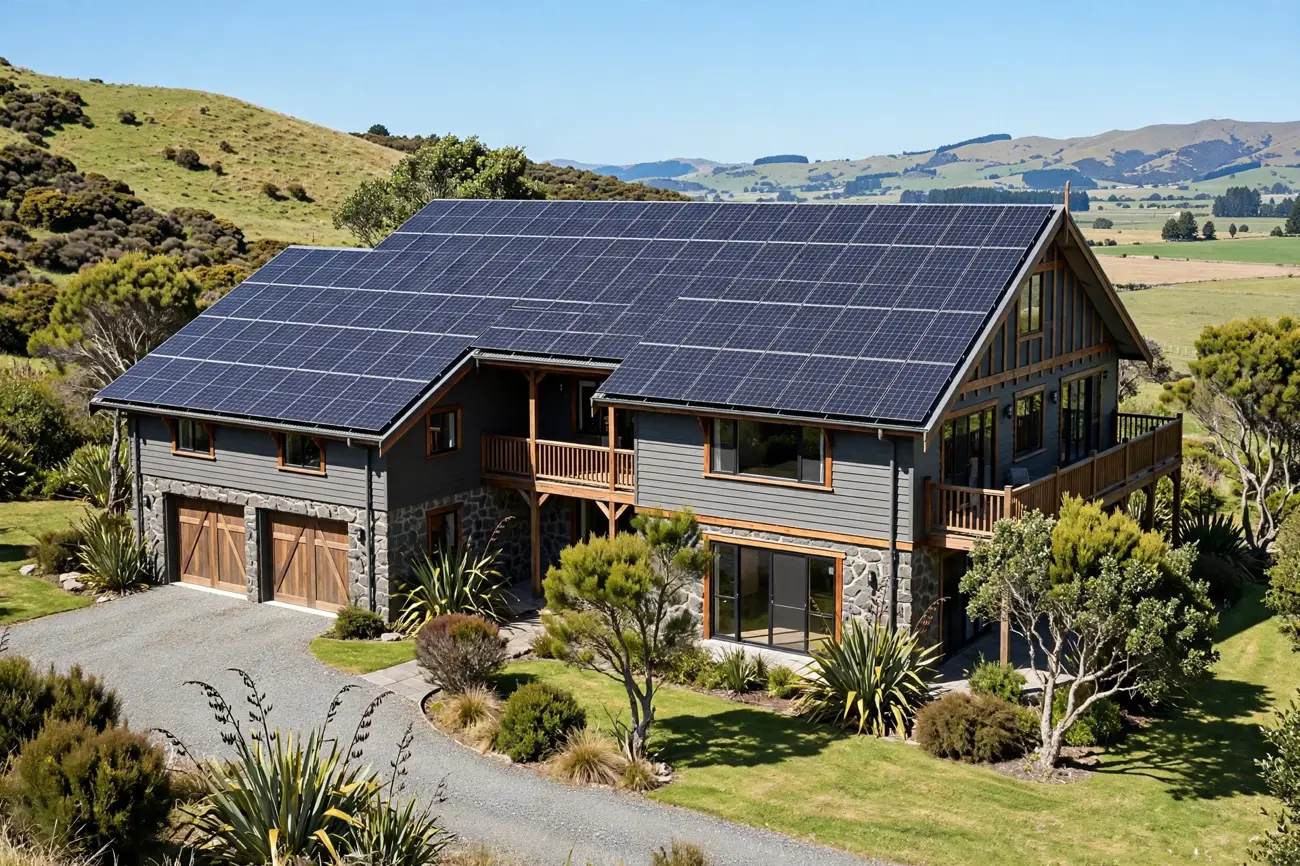
A 10kW solar system is the top end of residential solar in New Zealand. It is roughly double the size EECA treats as a typical medium system, and it will out-generate most households by a wide margin. For the right home, though, it is not excess at all. A large house with electric heating, a spa and an EV in the garage can soak up every unit a 10kW array produces, at a far lower price per kilowatt installed than a smaller system costs. This guide stays on the 10kW size specifically: what the number measures, how many panels and how much roof it takes, what it generates under New Zealand conditions, what installers are charging for it, how the network connection works at this size, and whether your household is one it genuinely suits. How solar works in general, and the wider buying process, sit in our solar panels guide; this page assumes that ground and goes deep on sizing.
What 10kW actually means
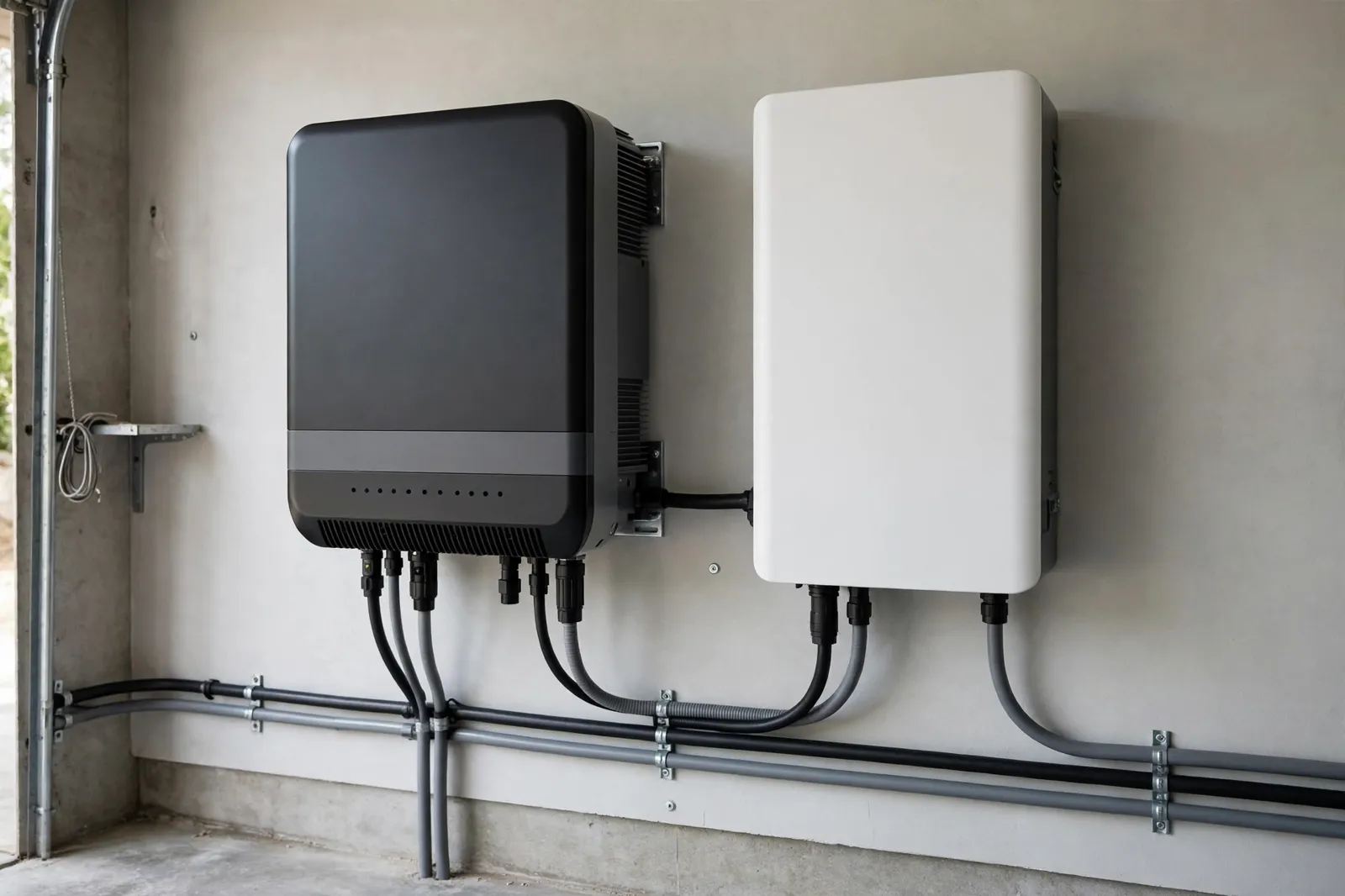
The 10kW figure describes the panels, not the inverter, and not what comes out of the wall. It is the combined direct current (DC) nameplate capacity of the array: add up the rated wattage of every panel and a 10kW system totals about 10,000 watts under standard test conditions. The inverter is a separate number. It converts DC to the alternating current (AC) your home uses, and it is often smaller than the array. EECA’s own worked profiles make the point: its rural Christchurch example pairs a 10kW system with a 9kW inverter, its Auckland profile runs a 5.5kW array through a 5kW inverter, and its Wellington profile pairs 3.5kW with a 3kW inverter. A slightly undersized inverter is normal design, not a shortcut: panels rarely produce at nameplate in real conditions, so a modest gap loses very little energy across a year.
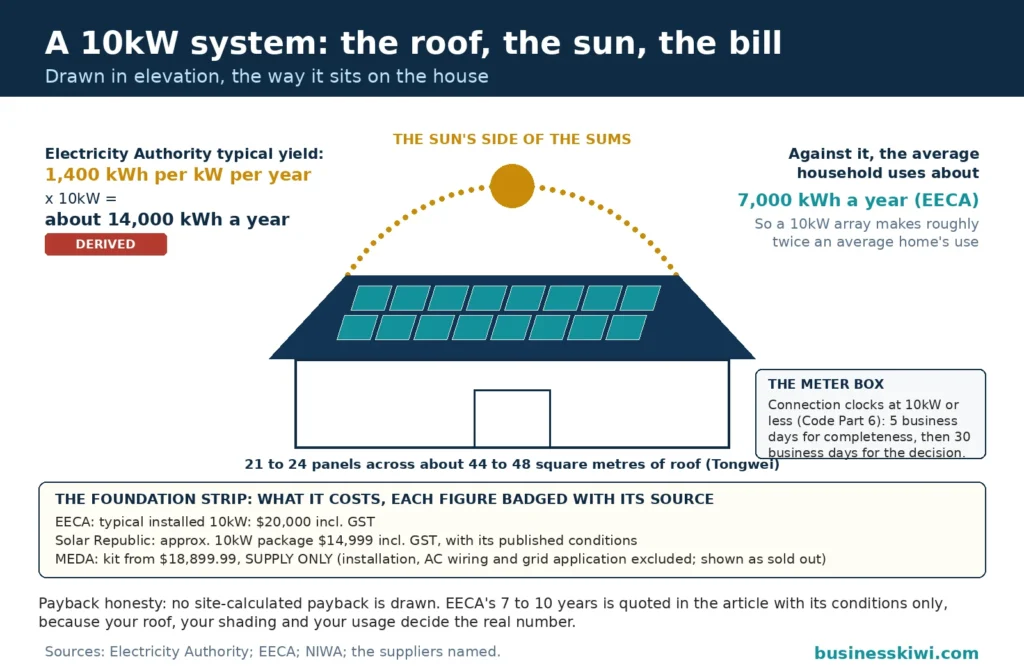
Panel counts follow from panel wattage, and current residential panels are powerful enough that a 10kW array is no longer a sea of glass. EECA’s published size guide uses 24 panels for its 10kW example, which works out at roughly 417 watts per panel (10,000 divided by 24). Panels sold in New Zealand now are commonly rated higher. One NZ supplier’s published kit uses Tongwei 475W panels: at 475 watts each, 21 panels total 9,975 watts, effectively a 10kW array, and 22 panels total 10,450 watts. Tongwei’s own module documentation lists its residential G12R-48 format at 1,762mm by 1,134mm, just under two square metres per panel. Solar Republic, an Auckland installer, sells an approximately 10kW package built from 22 panels and a 10kW inverter. Expect to see 21 to 24 panels described as a 10kW system when you compare quotes. All of them can be honest answers; what matters is the total DC wattage on the quote, not the rounded label.
Roof area is the physical constraint that follows. At just under two square metres per panel, 22 panels cover about 44 square metres and 24 panels about 48 square metres, and that is the panels alone. A real layout also needs working gaps, setbacks from ridges and edges, and clearance around chimneys, skylights and shading from trees or the neighbour’s roof. North-facing space is the most productive: EECA’s research notes that north-facing panels generate the most over the day, while east and west splits generate less overall but shift production toward morning and afternoon. A home with a large unshaded north roof, or generous east and west faces, can host 10kW comfortably. A villa with a chopped-up roof and a big pohutukawa to the north may not. If the array is split across faces, ask the installer to model each face separately rather than quoting one blended number.
One more distinction shapes everything about connection and export. The network cares about two figures other than the array’s DC size: the nameplate capacity of the generation as a whole, and the maximum export power, meaning how much the system may push back into the grid at once. A 10kW array behind a 9kW inverter cannot export more than the inverter allows, and the lines company can set the limit lower again. Generation, self-use and export are three different quantities, and a good quote treats them separately.
How much a 10kW system generates in New Zealand
Start with the most authoritative yield figure available. In its consultation paper on maximising the benefits of local generation, the Electricity Authority works on a typical New Zealand solar yield of 1,400 kWh per kW per year, illustrating it with a 7.92kW system generating 11,088 kWh a year (7.92 multiplied by 1,400). Applying that published input to a 10kW array is simple arithmetic: 10 multiplied by 1,400 gives about 14,000 kWh a year. That is a derived figure, not a promise, and your roof will land above or below it depending on location, orientation, tilt and shading.
Context makes the number meaningful. EECA puts average household use at about 7,000 kWh a year, costing roughly $2,600, so a 10kW system produces about twice what an average household uses. Against a genuinely high-use home the picture tightens: EECA’s rural Christchurch profile, a five-person household using 12,000 kWh a year with high use and an EV, is the household EECA itself pairs with a 10kW array. The annual total also hides the seasonal swing. NIWA records that New Zealand averages about 2,000 hours of bright sunshine a year, equivalent to roughly four kWh of solar energy per square metre per day on a horizontal surface, and its free SolarView tool estimates the solar energy available at a specific address for a given roof tilt and bearing. Summer days produce far more than the daily average implied by 14,000 kWh a year (about 38 kWh a day), and winter days far less, so a household using most of its power on winter evenings will still buy a good share of its electricity from the grid.
Location matters, but not always as people expect. EECA’s study of residential solar value, modelling almost 50,000 homes across four centres, found Queenstown had the best solar resource of the four, with Auckland second, Christchurch similar but slightly lower, and Wellington lowest because of its cloudier days. Latitude alone does not decide output. Nor can national figures describe your roof: two houses on the same street can differ materially because of orientation and shade, which is why serious quotes include a site-specific generation estimate.
Is 10kW the right size for your household?
EECA’s sizing advice is blunt: match the system to your normal usage, allow for future needs you are actually likely to add, and recognise that oversizing is not cost effective. The reason is how solar value works. Electricity you generate and use yourself displaces power you would otherwise buy. Electricity you cannot use when it is generated is exported, and exported power is worth less to you than power you never had to buy. The economics of a 10kW system therefore hinge less on the annual generation total and more on the overlap between generation and demand, hour by hour.
EECA’s research on the value of residential solar found that households which consume more electricity, particularly in the morning between 7am and 11am and during the day, see the best financial returns. Homes occupied during the day, home businesses, and households that can shift load into daylight hours all lift self-consumption. So do the big flexible loads. Heating water with a timer or diverter so the cylinder soaks up midday surplus is, in EECA’s research, a lower-cost way of storing solar energy in a cylinder you already own. Charging an EV at home during the day can significantly increase how much solar generation is used directly. Converting from gas to electric heating, cooking and hot water also raises the share of solar output the house can absorb. Heat pumps running through the day, a spa, a pool pump on a timer: these are the loads that turn a 10kW array from an exporter into a workhorse.
Now run the test in the other direction. A two-person household out at work all day, using 5,500 kWh a year like EECA’s Wellington profile, is matched by EECA with a 3.5kW system, not a 10kW one. Putting 10kW on that roof would generate roughly two and a half times the household’s annual use, most of it exported in the middle of the day when nobody is home. Extra panels are the cheapest part of a system per kilowatt, which is why oversizing is tempting, but cheap capacity you cannot use is still money spent earning the lowest-value return available. The households 10kW genuinely suits look like EECA’s own example: larger families, high annual use of 10,000 to 12,000 kWh or beyond, daytime occupancy or shiftable load, an EV charged at home, and all-electric heating and hot water. If your bills show usage well below that, the honest answer is usually a smaller system, and any installer who quotes you 10kW without asking about your usage pattern has told you something about the quote.
What a 10kW system costs in New Zealand
The official benchmark first. EECA publishes typical installed costs for standard installations, including GST, and its large system is exactly this size: a 10kW system with 24 panels at a typical cost of $20,000. Its smaller reference points are $8,500 for 3kW and $11,500 for 5kW, which shows the pattern to expect: the 10kW system costs well under double the 5kW price, because the fixed costs of design, installation, switchboard work and connection are spread over more capacity. EECA’s household profile with this size installed, the rural Christchurch home, came to $30,000, but that figure includes a 10kWh battery, so it is not a panels-only price.
Actual installer pricing published for this size sits below EECA’s typical figure at the time of writing, and the conditions attached matter as much as the headline. Solar Republic publishes an approximately 10kW package, 22 panels with a 10kW hybrid inverter, fully installed including GST at $14,999, reduced from $18,999. The conditions are printed on the same page: the price applies within 50km of the Auckland CBD, on single-storey homes with an iron roof pitched at no more than 25 degrees, and sites outside those conditions are quoted individually. Read it as a standard-install price rather than a guaranteed one. Two-storey access, a tile roof, a steep pitch, a switchboard upgrade or a long cable run can all move a real quote away from the package number.
Supply-only kits price differently again, and comparing them with installed packages is a category error. MEDA, a Bay of Plenty supplier, lists a hybrid kit built around a 10kW hybrid inverter and battery stack, with Tongwei 475W panels in 16, 24 or 30 panel configurations, starting from $18,899.99. That starting price buys the smallest panel and battery combination, the kit was listed as sold out when checked on 8 October 2026, and the page is explicit that installation, AC wiring, the grid connection application and export limit configuration are all left to your own electrician. A kit like this is not a cheaper version of an installed package, because the labour and compliance costs land on top.
Batteries change the total more than any other choice. EECA puts a battery add-on at typically $5,000 to $15,000 depending on type and capacity, and prices a large system with battery storage, a 10kW array with a 20kWh battery, at $40,000. On payback, this guide deliberately offers no number of its own, because a payback figure is only as honest as its self-consumption assumption, and that varies too much between households to generalise. EECA’s published position is a typical payback of 7 to 10 years where the household can use most of the electricity it generates, with average to high daytime use and electric heating and hot water. Treat that as the official benchmark with its conditions attached, and ask any installer quoting a faster payback to show the assumptions behind it. On finance, there is no government subsidy for solar power in New Zealand; some banks offer home energy lending, and it is worth checking current offers directly with your bank rather than relying on anyone’s summary of them, including this one.
Connecting a 10kW system to the network
A rooftop system that exports is distributed generation, and connecting it is a regulated process, not a courtesy. Part 6 of the Electricity Industry Participation Code, administered by the Electricity Authority, sets the framework, and a 10kW system sits right on its most important threshold. Applications for distributed generation with a nameplate capacity of 10kW or less in total follow a one-stage process under Part 1 of Schedule 6.1: apply to your lines company (the distributor) on its published form, provide the specified information, and pay the application fee if the distributor charges one. The Code gives the process a clock: the distributor must tell you within five business days whether your application is complete, and must decide a completed application within 30 business days. Distributors must also publish their forms, connection standards, fees and approved inverter lists. Go over 10kW of nameplate capacity and you leave that streamlined track for the longer two-stage process, one practical reason installers design carefully around this size. One subtlety worth raising with your installer: the threshold is nameplate capacity, so a quote with 24 panels of 475W is an 11.4kW array on paper even if the inverter is 10kW, and it needs to be clear which process the application will follow.
The export side of the rules changed materially in 2026. Under clause 6.3A of Part 6, inserted in May 2026, a distributor must not cap the nameplate capacity you may install under the small-scale processes, and any maximum export power threshold it sets must not be lower than 10kW unless a network study shows a lower limit is necessary for voltage, safety or network constraints locally, and that study is published. In plain terms, a blanket 5kW export cap is no longer the default for a compliant small system, though a genuine local constraint can still produce a lower limit at your address. Export limits exist for real reasons: too much power pushed into a quiet street at midday can lift voltage and overload equipment, and the Electricity Authority’s consultation work records that many distributors historically set a 5kW blanket limit that may not have reflected actual network capacity. The rules are moving toward limits based on the network in front of your house, not a national habit.
What this looks like in practice depends on your lines company, and two published examples show the range. Vector, the Auckland network, offers dynamic export connections for eligible single-phase customers from 11 May 2026, allowing export of up to 10kW, with the limit adjusted over the internet according to what the network can safely take at the time; eligibility requires an inverter compliant with AS/NZS 4777.2 that supports secure communications. Vector’s stated processing aim is 10 business days if your inverter is on its approved list, 30 if it is not, and after installation a Certificate of Compliance must be provided within 10 working days. Powerco, covering much of the central and lower North Island, charges no application fee for systems up to 10kW, has raised its single-phase export limit from 5kW to 10kW for approved inverters subject to available capacity, and publishes a list of transformers nearing capacity where export may be limited. Its process runs through your installer, finishing with the Certificate of Compliance once the system is live, plus the right meter arranged through your retailer. What varies is fees, timeframes and the export limit you are actually granted, so get the granted limit in writing before judging the system’s economics. An export limit caps what you can send out at any instant; it does not reduce what the array generates or what you can use in the house, but a tight limit on a big array means more midday surplus has nowhere to go unless you store it or shift load into it.
Pairing a 10kW system with a battery
A battery is the standard answer to the 10kW system’s structural problem, which is timing. The array peaks at midday; most households peak in the morning and evening. Storage moves midday surplus into the evening, lifting self-consumption without changing behaviour. EECA’s guidance on when a battery is likely to be worthwhile maps closely onto the 10kW case: high use outside daylight hours, a large system with surplus to capture, a desire for backup power (a stronger motive for rural households), or a goal of greater self-sufficiency. EECA is equally clear about the reverse cases. If most of your power is already used during the day, if usage is low, or if the fastest payback is the priority, a battery is unlikely to be cost effective, because batteries typically extend payback. EECA also observes that solar without a battery generally gives the best financial returns, and that adding storage later is a sensible path, which a battery-ready inverter makes straightforward.
Size the battery against the surplus, not the array: it should cover the generation your household cannot use during the day and the evening load you want to run from it. EECA’s own 10kW examples bracket the sensible range: its rural profile pairs the array with a 10kWh battery, and its large system with battery example pairs it with 20kWh. Storage also interacts with the network settings above: energy held in a battery is energy that does not hit an export limit at midday. The quote should show the battery as a separate line, so you can judge the panels on their own economics first.
Self-consumption, export and what the surplus is worth
Everything in this guide keeps returning to one ratio: how much of the generation you use yourself. Power used on site displaces a purchase at your retail rate. Power exported earns whatever your retailer’s buy-back arrangement pays, under the plan you are on, and those arrangements are a topic of their own; our solar buy-back rates guide covers how export pricing works and what to compare. A household using 7,000 kWh a year with a 10kW array generating around 14,000 kWh cannot self-consume most of its output without major load shifting or storage, no matter how the tariff is set. A household using 12,000 kWh with daytime load, an EV on a timer and a hot water diverter plausibly can. When an installer models returns for you, the self-consumption percentage is the assumption doing the heavy lifting, so ask for it explicitly, and be suspicious of modelling that has a working household at home all day when yours is not.
Frequently asked questions
How many panels is a 10kW solar system?
Usually 21 to 24 panels. EECA’s published 10kW example uses 24 panels, about 417 watts each. With the 475W panels some NZ suppliers now sell, 21 panels total 9,975 watts and 22 total 10,450 watts, so quotes describing 21, 22 or 24 panels as a 10kW system can all be accurate. Compare the total DC wattage on the quote rather than the rounded label.
How much electricity does a 10kW system generate in NZ?
Using the Electricity Authority’s typical New Zealand yield of 1,400 kWh per kW per year, a 10kW system generates about 14,000 kWh a year. That is derived arithmetic from the Authority’s published input, not a guarantee. Actual output depends on location, orientation, tilt and shading, and swings heavily by season.
How much roof space does a 10kW system need?
Plan on roughly 44 to 48 square metres of panel area, before gaps and access. Current residential panels measure about 1,762mm by 1,134mm, just under two square metres each. Setbacks from edges and ridges mean the usable roof face needs to be bigger than the panel total.
How much does a 10kW solar system cost in NZ?
EECA’s published typical installed cost for a 10kW system is $20,000 including GST for a standard installation. Published installer package pricing can be lower: one Auckland installer lists an approximately 10kW installed package at $14,999 including GST, subject to conditions including distance from the CBD, a single-storey home and an iron roof. Adding a battery typically adds $5,000 to $15,000 on EECA’s figures. Treat every published price as a starting point for a standard install; site conditions move real quotes.
Is 10kW too big for an average house?
For an average household, yes. EECA puts average household use at about 7,000 kWh a year, and a 10kW system generates roughly twice that, so most of its output would be exported rather than used. The size suits high-use homes: larger households using 10,000 to 12,000 kWh or more, people home during the day, an EV charged at home, and all-electric heating and hot water.
Do I need approval to connect a 10kW system?
Yes. Connecting generation that can export requires an application to your lines company under Part 6 of the Electricity Industry Participation Code. Systems with a nameplate capacity of 10kW or less use a one-stage process: your installer applies on the distributor’s form, the distributor must confirm within five business days whether the application is complete, and must decide a completed application within 30 business days. Your retailer arranges the correct meter.
Can a 10kW system export all its surplus to the grid?
Not necessarily. Since May 2026 the Code requires that any export threshold for small-scale applications be no lower than 10kW unless a published network study shows a lower limit is needed locally. Some networks offer dynamic limits of up to 10kW that flex with network conditions, and constrained parts of a network can still have lower limits. Your granted limit is confirmed through your application, so get it in writing.
Should I add a battery to a 10kW system?
It depends on your usage pattern rather than the array size. EECA’s guidance is that a battery is more likely to suit households with high use outside daylight hours, a large system with surplus to capture, or a need for backup power, and less likely to suit households that already use most of their power during the day or want the fastest payback. Adding storage later is a reasonable path if the system is battery-ready.
This article is general information only, based on official sources and installer pricing checked on 8 October 2026. Pricing, network rules and export settings change, and the right size depends on your usage, roof and network area. Get site-specific quotes, confirm the export limit your lines company will grant, and treat any payback estimate as only as reliable as its assumptions.
Sources
- Energy Efficiency and Conservation Authority, Breaking down home solar costs and savings, eeca.govt.nz
- Energy Efficiency and Conservation Authority, Planning the right home solar system for you, eeca.govt.nz
- Energy Efficiency and Conservation Authority, Understanding the value of residential solar in NZ, eeca.govt.nz
- Electricity Authority, Maximising benefits from local electricity generation, ea.govt.nz
- Electricity Authority, Electricity Industry Participation Code Part 6: Connection of distributed generation, ea.govt.nz
- NIWA, Solutions: Outlook for sunshine, niwa.co.nz
- Vector, Connect Power Generation: 10kW or less, vector.co.nz
- Powerco, Solar power for home and business, powerco.co.nz
- Solar Republic, All-in-One Home Solar Packages NZ, solarrepublic.co.nz
- MEDA, Hybrid Home Power Kit: Dyness Cygni 10kW + Battery, meda.co.nz
- Tongwei, White Paper of Tongwei PV Modules, en.tongwei.cn