Solar Hot Water NZ: How It Works, Costs and What You Save
Hot water is one of the biggest energy costs in a New Zealand home. EECA, the Energy Efficiency and Conservation Authority, puts water heating at about a third of an average household’s energy bill. That is why heating it with free sunshine is so appealing, and why solar hot water systems have been going onto Kiwi roofs since the 1970s.
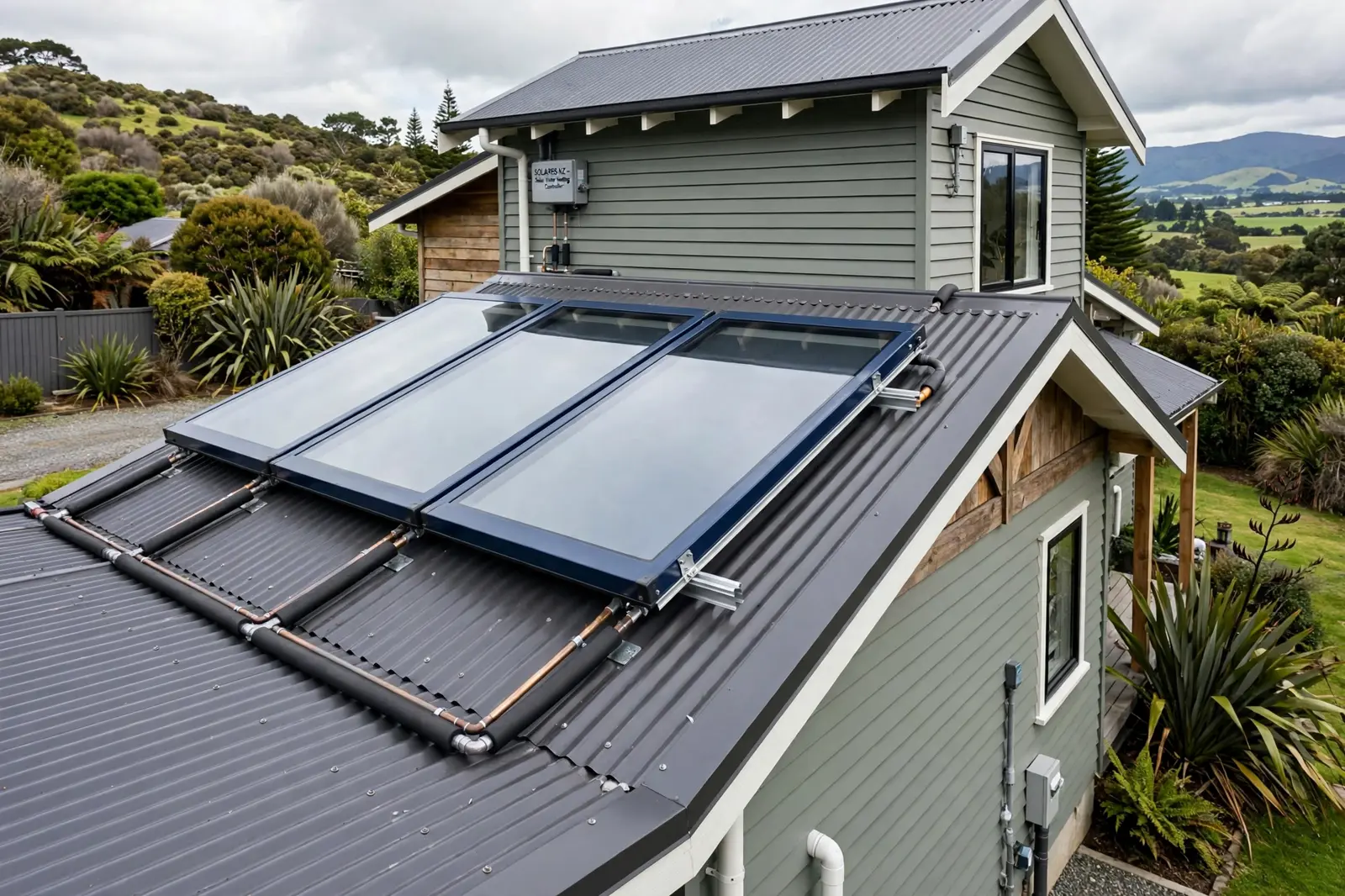
One confusion is worth clearing up first. The phrase “solar panels” covers two different technologies. Photovoltaic panels, usually called solar PV, turn sunlight into electricity. Solar thermal collectors, the subject of this article, turn sunlight directly into heat and transfer it into the water in your hot water cylinder. The industry calls them collectors, and you will also see them described as solar hot water panels.
New Zealand has plenty of the raw ingredient. NIWA, the National Institute of Water and Atmospheric Research, says the country receives about 2,000 hours of bright sunshine a year on average, equal to roughly four kilowatt-hours of solar energy landing on every square metre each day.
How a solar hot water system works
A solar hot water system has four main parts: collectors on the roof, a storage cylinder, a way of moving heat between the two, and a backup booster for when the sun does not deliver enough.
The collectors: flat plate and evacuated tube
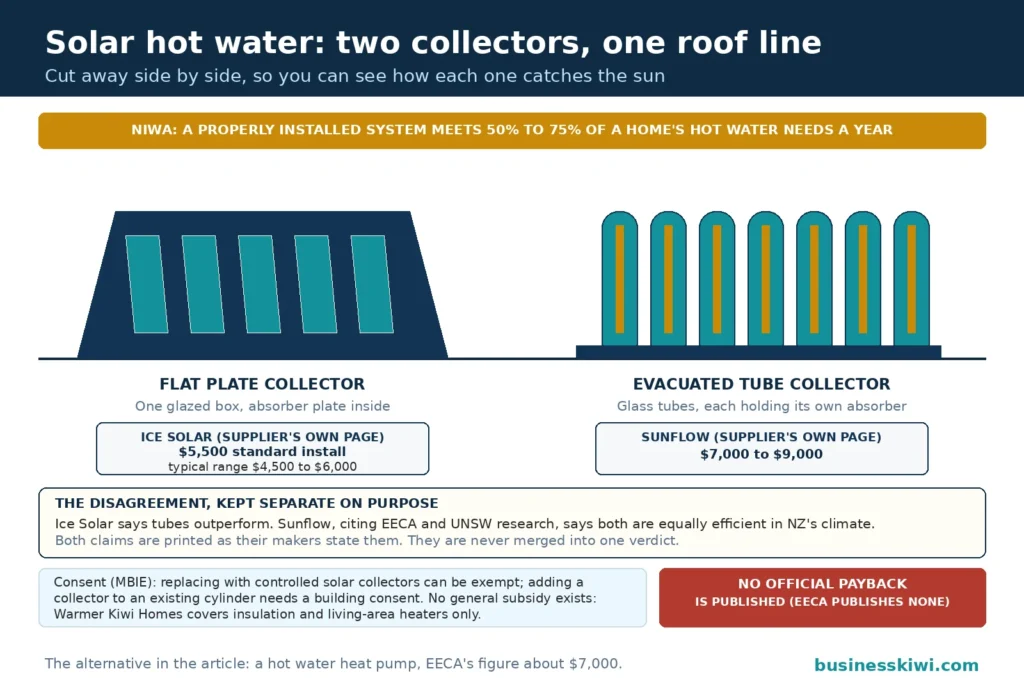
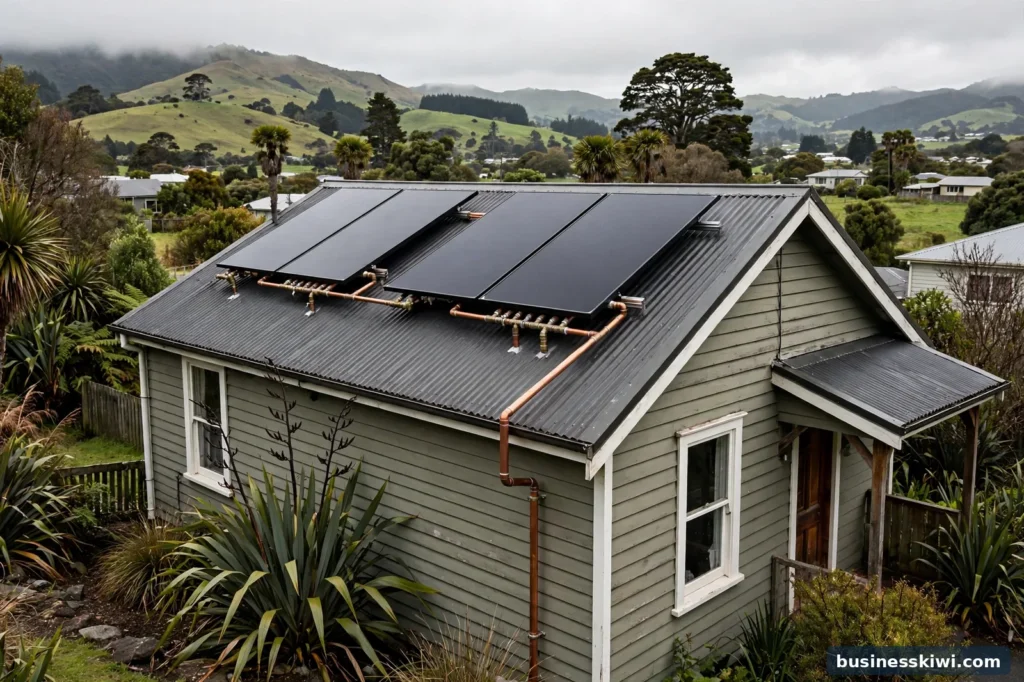
Flat plate collectors are the older design. Each panel is a shallow, insulated box with a dark absorber plate inside, pipes bonded to the plate, and a glass front. Sunlight passes through the glass, the plate heats up, and fluid in the pipes carries the heat away. The technology dates to the 1950s, and NZ supplier Sunflow points out that flat plate systems installed in the 1970s are still performing today.
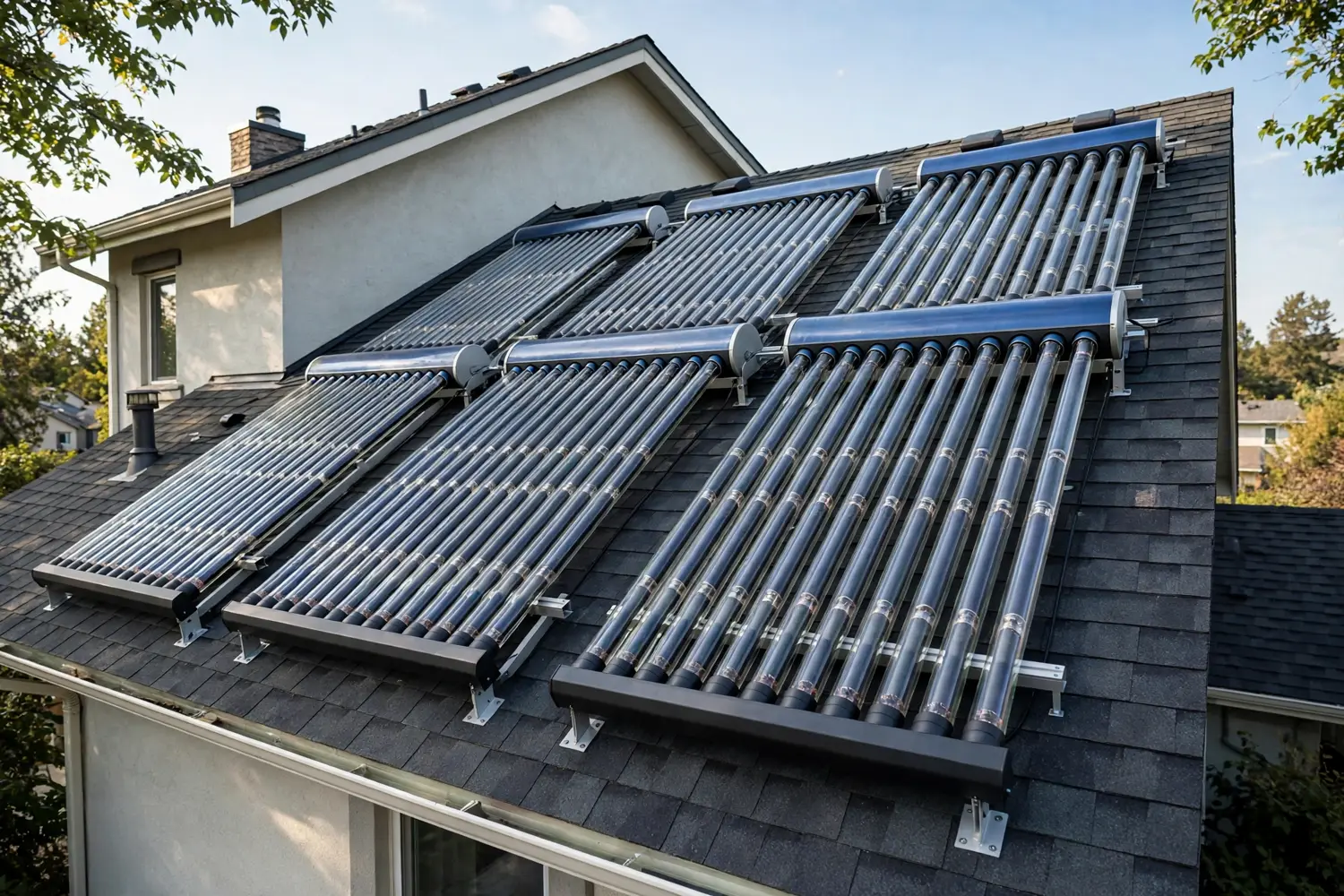
Evacuated tube collectors work differently. The collector is a row of glass tubes, each holding a vacuum that insulates like a thermos flask. A heat pipe inside each tube absorbs solar energy and transfers it to a manifold at the top, where the system’s fluid picks up the heat. Because the vacuum limits heat loss, tubes hold onto more heat in cold or windy weather. NZ supplier Ice Solar, which specialises in evacuated tubes, rates them as the stronger performer in cold, cloudy or overcast conditions.
Which design suits a given roof is contested: the two suppliers disagree, and their cases are set out side by side further down this page.
Getting the heat from roof to cylinder
In most modern installations the cylinder sits at ground level or inside the house, well below the collectors, so the heated fluid has to be moved. A small electric pump does that job, switched by an electronic controller. The controller compares the temperature in the collectors with the temperature in the cylinder and runs the pump only when the collectors are hotter. When the cylinder is fully hot, or the collectors cool down, the pump stops.
Some systems are direct, meaning the water that ends up in your taps circulates through the collectors. Others are closed circuit: a separate loop of fluid runs through the collectors and passes its heat to the cylinder water through a heat exchanger. Sunflow describes its systems this way, with a solar energy transfer fluid in a sealed loop. Closed circuits are the usual answer in frost-prone areas, because the loop fluid can be protected against freezing more easily than plain water.
The older alternative is a thermosiphon system, which needs no pump. The cylinder sits above the collectors, usually on the roof, and hot water rises into it naturally while cooler water sinks back down. MBIE’s Building Performance guidance notes a thermosiphon counts as an uncontrolled heat source for consenting purposes, because nothing limits how hot it can get. Roof-mounted cylinders have largely fallen out of favour, and BRANZ notes the compliance document G12/AS2 does not allow the storage tank to be roof-mounted under that path.
The storage cylinder
The cylinder in a solar system is usually larger than a standard electric cylinder, and that is deliberate. It has to store a sunny day’s worth of heat for that evening and the following morning, and carry the household through a dull day without leaning too hard on the booster. Solar cylinders are built with the solar heat exchanger or coil low in the tank, so incoming solar heat warms the cooler water at the bottom, while the booster element sits higher up.
Backup boosting: electric, gas and wetback
No solar system in New Zealand is sized to cover the worst week of winter on sunshine alone, so every practical system has a booster:
- An electric element in the upper part of the cylinder, controlled by a thermostat and often a timer.
- A gas booster, either a gas-heated section or a separate continuous flow unit that tops up water as it leaves the cylinder.
- A wetback, where water circulates through pipes at the back of a wood fire and returns to the cylinder. EECA describes wetback systems this way, and notes many wood and pellet fires can have one fitted.
The booster runs only when solar input has not kept the top of the cylinder hot enough: after a run of cloudy days, in midwinter, or when guests push hot water use past normal. Timers are often set so the booster does not cut in during the day and waste free solar gain, and instead tops up in the evening or overnight if still needed. There is also a health requirement in the background: water stored warm but not hot can grow Legionella bacteria, and Rinnai’s guide to solar hot water systems notes that New Zealand Building Code guidance requires hot water to be stored at a minimum of 60°C for Legionella control.
Flat plate or evacuated tube?
Because the two NZ suppliers quoted on this page sell competing technologies, their claims deserve to be read side by side rather than merged. Ice Solar’s case for evacuated tubes is better performance in cold, cloudy and overcast conditions, minimal overnight heat loss, a 10 year warranty, and the ability to retrofit onto an existing cylinder. Its case against flat plate is that output drops significantly in cold months, installation is more complex, and a closed-loop glycol system is often needed in frosty regions. Sunflow’s case for flat plate is longevity and simplicity: proven technology over decades, a 10 year limited warranty on its collectors, and closed circuit systems designed to withstand northern European winters. On efficiency, it argues the two types are equally efficient in New Zealand’s temperate climate, citing EECA and University of New South Wales research, so construction quality and durability matter more than collector type.
Sizing a system for your household
Sizing balances the collecting area on the roof against the storage volume in the cylinder, and both are driven by how much hot water the household uses. EECA makes the general point that the number of people in the house, the number of showers and baths, and whether the system also feeds the dishwasher or washing machine all affect the equipment size required.
The most concrete sizing guidance published by an NZ supplier comes from Sunflow. It says the number of people in the family determines the right size cylinder, and that a 300 litre cylinder will typically cater for an average family’s requirements. On the roof, a typical system includes about 4 square metres of collectors, with 5 square metres required for its larger collectors.
Two mistakes sit at either end of the scale. An undersized system leaves the booster doing so much work that the savings disappoint. An oversized one costs more than it needs to and, as Ice Solar itself notes, an oversized evacuated tube system can produce excess hot water that then has to be managed.
Solar hot water in New Zealand conditions
Sunshine: plenty, but not evenly spread
NIWA’s figures put the national average at about 2,000 sunshine hours a year, but the spread around that average matters. NIWA describes the northern South Island, around Nelson and Blenheim, as the sunniest region of New Zealand, averaging at least 2,300 sunshine hours a year. Southern and western areas receive less, and every region gets far less solar energy in winter than in summer, just when hot water demand peaks. A system that covers nearly all of a household’s hot water in January will cover much less of it in June, and the booster bridges that gap. For a specific address, NIWA’s free SolarView tool estimates the solar energy available at any location in New Zealand, allowing for roof tilt, bearing and shading from nearby trees and buildings.
Orientation, tilt and shade
BRANZ’s installation guidance is specific on positioning. Panels should face geographic north where possible, with a direction between north-north-east and north-north-west acceptable. The mounting angle should ideally match the latitude of the location: Wellington sits at latitude 41°S, so BRANZ gives 41 degrees to the horizontal as the ideal collector angle there, with a deviation of plus or minus 20 degrees acceptable. Sunflow gives a similar picture from the supplier side: north-facing is ideal but not critical, and its systems function well facing anywhere between north-east and north-west. Shade is the performance killer: BRANZ says panels should not be shaded by overhanging trees or taller neighbouring buildings, particularly during winter months, when the sun is low and shadows are long. A site assessment that only checks summer shade will overstate what the system delivers across the year.
Installation and building consent
Solar water heating is not a DIY job. BRANZ states that all plumbing work must be certified by a registered plumber and electrical work certified by a registered electrician, and MBIE’s consent guidance likewise names an authorised plumber as the legally required professional for water heater work. Specialist solar installers coordinate both trades.
The consent position depends on exactly what is being done, and MBIE’s Building Performance guidance on work that does not need a building consent sets it out:
- Replacing or repositioning an existing water heater with a system that includes controlled solar collectors can be done without a building consent, under exemption 38 of Schedule 1 of the Building Act 2004, as long as every heat source is controlled. A controlled heat source has controls or devices ensuring the water temperature in the tank goes no higher than 90°C.
- Adding a solar collector to an existing water storage heater is not covered by that exemption. MBIE states plainly that a building consent is required for that work, even if the existing heater has provision for a solar connection.
- A system connected to an uncontrolled heat source, such as a wetback on a solid fuel fire or a solar thermosiphon, also falls outside the exemption.
BRANZ’s installation guide makes the broader point that a building consent is required for a solar installation because the system is generally connected to a potable water supply, and it may also be required under Building Code clause B1 (Structure) because of the extra loading on the roof. Before installation, BRANZ says to confirm the roof area is adequate, the loading will not exceed what the roof structure can carry, and access exists for later maintenance. Collectors under the G12/AS2 compliance document must not exceed 22 kg per square metre. Because councils administer consenting, confirm the position for your specific job with your local council before work starts.
What solar hot water costs
There is no official price list for solar hot water, and EECA does not publish installed prices for solar thermal systems. The figures below are the ones NZ suppliers publish on their own websites.
Ice Solar lists an install cost of $5,500 for its solar thermal hot water system, based on a standard installation. On the same page it gives typical installed costs for its evacuated tube thermal systems of $4,500 to $6,000.
Sunflow puts its flat plate systems higher. Its FAQ page says a Sunflow solar system will typically cost between $7,000 and $9,000, depending on system location and site requirements.
Several things move a quote within and beyond those ranges: whether a new solar cylinder is needed or the system retrofits to an existing one, roof access and pitch, pipe run lengths, consent costs where a consent is required, and whether the booster is electric or gas. Treat the published figures as a starting range for budgeting, and get itemised quotes for your own roof.
What you save, and the payback question
This is where the solar industry has historically been most optimistic, so it is worth separating what official sources say from what sellers say.
The most useful official figure comes from NIWA: a properly installed and controlled solar water heating system will meet 50 to 75 per cent of a household’s hot water needs every year. Sunflow’s own claim is in the same territory, at 70 per cent and more of the average household’s hot water requirement. Ice Solar publishes no percentage, but describes solar thermal as delivering the biggest impact on power bills of the options it sells, because hot water is such a large share of household energy use.
Set against EECA’s figure that water heating is about a third of an average household’s energy bill, covering half to three quarters of that load is a real saving, but it is not half the power bill. The dollar value depends on what the system displaces: a household replacing straight electric resistance heating saves more per litre than one replacing gas, and EECA notes LPG is the most expensive water heating fuel, so LPG households have the most to gain.
On payback, honesty is required. No official source read for this article (EECA, NIWA, MBIE or BRANZ) publishes a dollar saving or payback period for solar hot water, and EECA no longer publishes a solar thermal savings calculator for households. Anyone quoting a precise payback is working from their own assumptions about your hot water use, your power price and the installed cost. The arithmetic is easy to test yourself: take the installed quote, estimate the share of your water heating cost the system will cover using the NIWA range, and divide one by the other.
The alternatives: solar PV and heat pump water heating
Solar thermal is no longer the only way to cut water heating costs with sunshine, and for many houses it is not the option EECA leads with. Its water heating options page frames the choice clearly: there are two ways to use solar energy for hot water. Solar thermal panels make heat. Solar PV panels make electricity, which can then run an electric water heater or a hot water heat pump, as well as everything else in the house. Households whose main goal is generating their own electricity should start with our solar panels guide, because PV economics are a separate question.
Solar PV with a standard cylinder
If a house already has, or is getting, solar PV panels for electricity, the hot water cylinder can soak up surplus generation that would otherwise be exported for very little. Rinnai’s guide to solar PV hot water systems describes the two main methods. A solar diverter monitors generation and household use, and sends excess solar electricity to the cylinder element instead of exporting it. A programmable timer is simpler: it schedules the cylinder to heat in the middle of the day, and Rinnai notes EECA’s modelling uses an example window of 11am to 3pm, when generation is typically highest. Either way, the cylinder acts as thermal storage, banking the day’s sunshine as hot water for the evening. What exported power earns you is set by solar buy-back rates, which our separate guide covers, and households weighing up a large PV array should read our 10kW solar system breakdown before sizing anything.
Ice Solar publishes typical installed costs that put the options in context, although as a thermal specialist it argues the thermal case: direct PV to a cylinder element at $10,000 to $11,500 installed, and a full grid-connected PV system at $12,000 to $22,000, against $4,500 to $6,000 for its evacuated tube thermal system. Thermal is a cheaper, single-purpose system. PV costs more and does far more than heat water.
Hot water heat pumps
The other serious alternative takes the sun out of the equation and pulls heat from the outdoor air instead. EECA calls hot water heat pumps the most efficient electric option, using around 60 to 75 per cent less electricity than a conventional electric hot water system, and says that while purchase and installation cost more than other systems, they are the cheapest option over time once running costs are counted. EECA puts the installed cost at around $7,000, the saving for an average household at around $284 a year, and the expected life at around 15 years.
The practical differences are these. A hot water heat pump works at night and in cloudy weather, needs no north-facing roof, and can often retrofit to an existing cylinder or replace it. It does need outdoor space for its unit, and it makes some noise. Solar thermal needs the right roof and delivers its best results in summer rather than winter, but its running costs once installed are little more than the pump’s electricity and whatever boosting is needed.
Grants and subsidies
There is no general government subsidy for solar hot water in New Zealand. EECA’s Warmer Kiwi Homes programme is the country’s main home energy grant scheme, and its published scope is insulation and efficient heaters for the living area: it covers 50 to 90 per cent of ceiling and underfloor insulation, and up to 90 per cent of the cost of an approved heat pump heater, capped at $3,450. Water heating of any kind, solar included, is not part of the programme, and the solar water heating grant schemes of earlier decades have ended. Anyone budgeting for a system should budget the full installed cost. For the wider picture on help with solar costs, see our guide to the government subsidy for solar power, which tracks what support exists for solar in New Zealand.
Looking after a solar hot water system
Solar thermal systems have few moving parts: a pump, a controller and valves are the main ones, alongside the cylinder itself. The hardware can last a long time. Sunflow says flat plate systems installed in the 1970s are still performing efficiently today, and offers a 10 year limited warranty on its collectors. Ice Solar likewise lists a 10 year warranty on its evacuated tube systems.
The maintenance that matters most is unglamorous. BRANZ’s installation guidance includes making sure access is available for roof and panel maintenance. Keeping trees trimmed so new shade does not creep across the collectors protects the performance the system was designed for, especially in winter. Collectors and pipework should be checked for leaks and damaged insulation, the pump and controller checked for correct operation, and the cylinder serviced as its manufacturer directs.
Frequently asked questions
How much does solar hot water cost in New Zealand?
Published supplier prices put a standard installation between about $4,500 and $9,000. Ice Solar lists $5,500 for its solar thermal system on a standard installation, with typical installed costs of $4,500 to $6,000 for its evacuated tube systems. Sunflow says its flat plate systems typically cost between $7,000 and $9,000 depending on location and site requirements.
How much of my hot water will solar actually cover?
NIWA says a properly installed and controlled system will meet 50 to 75 per cent of a household’s hot water needs over a year. Supplier claims sit in the same range, with Sunflow saying 70 per cent and more. Expect the share to be much higher in summer than in winter, with the booster covering the difference.
How much money will I save each year?
No official source publishes a standard dollar saving, because it depends on your hot water use, what fuel you are displacing and what you pay for it. EECA says water heating is about a third of an average household’s energy bill, so covering 50 to 75 per cent of that load is the right starting point for an estimate.
Do I need a building consent for solar hot water?
It depends on the job. MBIE’s Building Performance guidance says replacing or repositioning a water heater with a system that includes controlled solar collectors can be exempt from consent under Schedule 1 of the Building Act, but adding a solar collector to an existing water storage heater requires a building consent. A new installation will generally need one. Confirm with your council before work starts.
Which is better, flat plate or evacuated tube collectors?
The suppliers disagree, and both positions are on the record. Ice Solar argues evacuated tubes perform better in cold and cloudy conditions and lose less heat. Sunflow argues that in New Zealand’s temperate climate both types are equally efficient, citing EECA and University of New South Wales research, and that construction quality and durability matter more.
Will solar hot water work in winter, or in the South Island?
Yes, but it will contribute less. NIWA puts average sunshine at about 2,000 hours a year nationally, with the northern South Island the sunniest region at 2,300 hours or more, and solar energy is much weaker in winter everywhere. The booster covers the winter shortfall.
Can I add solar collectors to my existing hot water cylinder?
Sometimes. Ice Solar says its evacuated tube systems can be retrofitted onto an existing cylinder, saving the cost of a new one where the cylinder is suitable. Two cautions apply: the cylinder needs to be compatible and in good condition, and MBIE states that adding a solar collector to an existing water storage heater requires a building consent, even if the heater has provision for a solar connection.
Is there a government grant for solar hot water?
No. EECA’s Warmer Kiwi Homes programme, the main home energy grant scheme, funds insulation and efficient space heating only. It does not cover water heating, solar or otherwise, and the solar water heating grant schemes of earlier decades have ended. Budget for the full installed cost.
This article is general information about solar hot water systems in New Zealand, based on official sources and suppliers’ published figures at the time of writing. Prices, programmes and consent requirements change, and the right system for your home depends on your roof, your hot water use and your existing setup. Get itemised quotes from installers, and confirm consent requirements with your local council before committing.
Sources
- EECA, Compare common home water heating options, eeca.govt.nz
- EECA, Hot water heat pumps, eeca.govt.nz
- EECA, Warmer Kiwi Homes: insulation and heater grants, eeca.govt.nz
- MBIE Building Performance, Replacement or repositioning of water heater connected to controlled heat source, building.govt.nz
- BRANZ Build, Solar collector panel installation, buildmagazine.org.nz
- NIWA, Solutions: Outlook for sunshine, niwa.co.nz
- NIWA, Northern South Island climate summary, niwa.co.nz
- Ice Solar, Compare Solar, icesolar.co.nz
- Sunflow, Solar hot water FAQ, sunflow.co.nz
- Rinnai New Zealand, Understanding Solar PV Hot Water Systems: A Homeowner’s Guide, rinnai.co.nz