Disability Insurance in NZ: The Cover That Pays When Illness, Not Just Injury, Stops You Working

Most New Zealanders who cannot work for a long stretch are not stopped by an accident. They are stopped by illness: cancer, a stroke, a back condition that develops over years, a mental health condition that will not lift. That distinction matters more than any other in this corner of insurance, because the state scheme that pays weekly compensation, ACC, is built around accidents. If your inability to work comes from sickness rather than injury, ACC pays nothing, and the bills keep arriving on the same schedule they always did.
Disability insurance is the private cover that sits in that gap. It is not one product. It is a family of policies that pay out when disablement, from illness or injury, stops you working, and the products inside that family work quite differently from each other. One pays a single lump sum when disablement is total and permanent. Another pays a monthly benefit while you are disabled, for as long as the policy terms allow. Insurers name, bundle and define these products in their own ways, and the Financial Markets Authority warns plainly that policy definitions differ between providers, including the definition of permanent disability itself.
What disability insurance means in New Zealand
Search for disability insurance in New Zealand and you will mostly be offered two kinds of cover, sometimes sold separately and sometimes sitting inside a wider life insurance policy. The first is total and permanent disability cover, usually shortened to TPD. It pays a lump sum if you become totally and permanently disabled through illness or injury and, under the policy definition, will never work again. Fidelity Life describes its TPD cover as paying when a disability means you will not ever be able to perform your usual occupation or any other occupation, with the definition narrowed to your usual occupation only for some professional groups. Asteron Life sells three versions of the same idea, Own Occupation TPD, Any Occupation TPD and a Modified TPD, explained in the TPD section below.
The second kind pays an income rather than a lump sum. Insurers generally market this as income protection, and its mechanics are covered in the disability income section below: a monthly benefit, a waiting period before payments start, and a benefit period that caps how long payments can run. Sorted, the Retirement Commission’s personal finance service, describes disability insurance as cover that pays a lump sum for permanent disablement through sickness or accident, which reflects how the term is most often used in New Zealand, but the monthly-benefit products rest on the same underlying event: disablement that stops you earning.
Two practical points follow. First, there is no standard product called disability insurance that you can compare across insurers like for like, because each insurer defines disablement in its own wording. Second, TPD is frequently not a standalone purchase. Fidelity Life offers it either as a standalone policy or as an accelerated benefit taken from your life cover, meaning a TPD payout reduces the life cover amount by the same sum unless you buy the deducted amount back. Asteron Life offers the same two structures, with a buy back option on the accelerated version.
The ACC gap: accidents are covered, illness is not
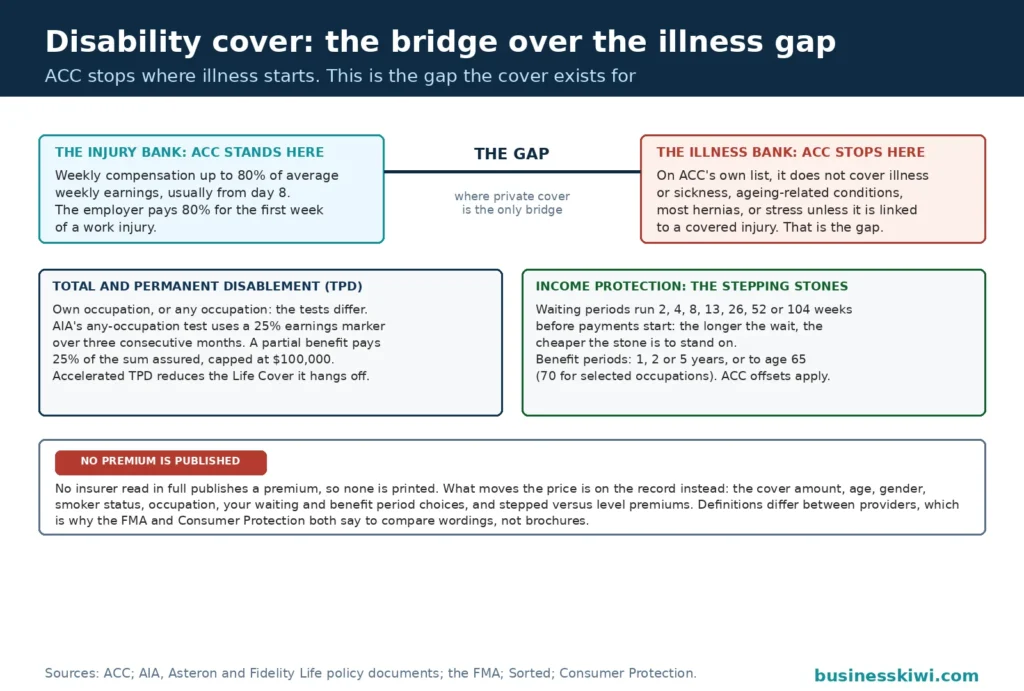
ACC is a no-fault scheme. Its own material states that everyone injured in an accident in New Zealand is covered, whether working, unemployed, retired or visiting, and that cover extends to physical injuries such as sprains, fractures and burns, to work-related gradual process conditions caused by work tasks or the work environment, to treatment injuries, and to serious injuries including spinal and traumatic brain injuries. For employees, ACC pays weekly compensation of up to 80 percent of average weekly earnings, usually from the eighth day after the injury. ACC does not pay the first week: for a work injury the employer must pay 80 percent of usual pay for that week, and for an injury outside work the first week is typically covered by sick leave or annual leave, or not covered at all.
The other side of the scheme is stated just as plainly on ACC’s own page about injuries it does not cover. ACC does not cover illness, sickness or contagious disease. It does not cover stress or emotional issues unless linked to a covered injury. It does not cover conditions related to ageing, such as arthritis, or most hernias, or injuries that happen over time unless an activity at work is causing them. Cover decisions are made under the Accident Compensation Act 2001.
Put those two pages together and the shape of the risk is clear. A fall from a ladder that breaks your back is an accident, and ACC responds with treatment support and weekly compensation at up to 80 percent of earnings. A degenerative spinal condition, a cancer diagnosis, multiple sclerosis or a depressive illness that leaves you unable to work is not an accident in the scheme’s terms, and ACC pays no weekly compensation at all. Disability insurance exists because of that boundary: every product described in this article covers illness as well as injury, and that single feature is the main thing your premiums buy.
Total and permanent disability cover explained
TPD is the blunt instrument in the family. It pays once, as a lump sum, when disablement is both total and permanent, and permanence is a high bar. The money is yours to use as you choose: insurers’ product material talks about clearing a mortgage, modifying a home for accessibility, paying for care the public system does not fund, or letting a partner take time off work to support you.
The definition decides everything, and definitions are insurer-specific. AIA’s policy wording for its Living TPD benefit sets out two occupational definitions. Under its any occupation definition, the life assured must be so incapacitated by illness or accident that, in AIA’s opinion after considering medical and other evidence, it is unlikely they will ever be able to work in any occupation or other gainful employment they are reasonably suited to by education, training or experience, where that work would pay more than 25 percent of their earnings over their last 12 months of work. The incapacity must have lasted three consecutive months without the person working at all. Under AIA’s own occupation definition, the test narrows to the occupation or business the person was in immediately before becoming incapacitated: they must be unlikely ever to resume that work, after the same three-month period. Both definitions also carry non-occupational routes, including the total and permanent loss of meaningful use of both feet, both hands or the sight in both eyes, or becoming totally and irreversibly unable to perform at least two activities of daily living without someone else’s physical help, and AIA’s wording excludes any condition the insurer has reasonable grounds to expect treatment could reverse or improve. Partial disablement sits below the full definition: AIA pays 25 percent of the sum assured, capped at $100,000, for the permanent loss of the entire use of one limb or the irrecoverable loss of sight in one eye, and Asteron Life similarly pays a partial amount for the loss of one limb or eye. These partial benefits are not universal, and their presence or absence is a genuine point of difference between policies.
Asteron Life’s structure shows how differently insurers package the same concept. Its Own Occupation TPD pays if your disability stops you returning to your most recent occupation. Its Any Occupation TPD pays if you cannot work in any job you are reasonably suited to by training, education or experience, or that would pay more than 25 percent of your previous 12 months earnings, the same 25 percent marker AIA uses. Its Modified TPD, aimed at people not in paid work, in very high risk occupations, or not eligible for the other two types, abandons occupation entirely and pays on permanent loss of the use of limbs or sight, inability to perform daily living activities, or loss of the ability to think or concentrate.
Own occupation definitions are easier to claim under than any occupation definitions, because being unable to do your own skilled job is a lower bar than being unable to do any job suited to your background. A surgeon who loses fine motor control may never operate again yet could still teach; an any occupation definition lets the insurer argue the teaching work defeats the claim. Fidelity Life notes a wrinkle many buyers miss: if you are not working, the definition of totally and permanently disabled changes, although cover remains available for people without paid jobs, such as homemakers, who are assessed differently. AIA adds that where own occupation cover is held and the life assured moves into full-time domestic duties, the own occupation benefit ceases and the any occupation benefit applies instead.

Disability income cover explained
Where TPD waits for permanence, disability income cover responds to disablement itself, temporary or long term. It pays a monthly benefit while you are unable to work because of illness or injury, and stops when you return to work, the benefit period runs out, or the cover term ends.
Three settings shape every policy of this type, and you choose all three when you buy. The first is the monthly amount. Fidelity Life states that up to 75 percent of your gross annual income can be covered under its income protection cover, paid monthly once a claim is approved. The second is the waiting period, the stretch between stopping work and the first payment. AIA’s income protection brochure lists waiting periods of 2, 4, 8, 13, 26, 52 or 104 weeks across its income protection options. A longer waiting period means you carry the early months yourself, out of savings, sick leave or a partner’s income. The third is the benefit period, how long payments can continue for a claim: AIA lists 1, 2 or 5 years, or through to age 65, with age 70 available for selected occupations.
How the monthly amount is calculated also varies. AIA offers agreed value cover, where payments are based on an amount agreed when the cover was taken out; indemnity cover, where payments are based on a proportion of your income at claim time; and a loss of earnings option that lets you choose at claim time whichever calculation is higher, which suits people whose income fluctuates. The distinction matters: an indemnity policy pays against the income you actually have when you claim, which may be lower than when you bought it.
The feature that surprises claimants most is the offset. AIA’s brochure states it directly: if you are receiving, or are entitled to receive, ACC payments and you hold its income protection cover, the ACC amount is deducted from your benefit payment, and its policy wording offsets the gross ACC entitlement amount in those circumstances, including where the entitlement exists but the payment is not being received. The brochure also says the monthly payment is reduced by other income replacement benefits you are entitled to, by income from being actively involved in a business, and by sick leave payments. The two income streams do not stack: if your disablement came from an accident, ACC’s weekly compensation counts first and the insurer tops up only to the insured level, if at all. Partial disability is handled inside these policies too: AIA pays a partial disability income benefit monthly in arrears, with a bridging payment when a claim moves from total to partial disability, and its wording waives the waiting period where the same or a related illness or injury disables you again within the policy’s terms.

How disability cover differs from income protection and trauma cover
The naming in this market invites confusion, so it is worth being precise. Income protection is the category name insurers use for the monthly-benefit products described above, and BusinessKiwi’s separate income protection guide covers that category in depth. Disability insurance, as the term is searched and sold in New Zealand, is the wider disability question: it takes in the monthly-benefit products and, distinctively, TPD, the lump sum that pays only when disablement is permanent. The two answer different problems. TPD money is typically aimed at the permanent reshaping of a household’s finances: debt cleared, a home adapted, a lifetime of reduced earning capacity partly compensated. Monthly disability income is aimed at keeping the household running month to month while work is impossible.
Trauma cover, sometimes called critical illness cover, works on yet another trigger. Fidelity Life describes it as paying a lump sum if you are diagnosed with a condition meeting the criteria in the policy document, from a defined list of more than 40 conditions including many cancers, heart attack, stroke, multiple sclerosis and major organ transplant. Sorted makes the same distinction: trauma cover pays for listed illnesses and injuries, while disability cover responds to permanent disablement. A trauma payment does not depend on whether you can work: you can receive it, recover, and return to your job. A TPD payment depends on almost nothing but work capacity, tested against permanence.
What affects the price
No insurer publishes a price list for disability cover, and there is no market average premium to quote. Premiums are calculated and quoted individually for each applicant, and any figure presented as typical has not come from an insurer’s own published material. What the official and insurer sources do support is an account of the factors that feed into that individual calculation.
Start with the settings you choose. The amount of cover is the largest single input: Fidelity Life notes that under its yearly renewable premium structure, the premium is recalculated each year based on factors including your age, gender, smoker status and your amount of cover. The waiting period and benefit period on a monthly-benefit policy define how much risk the insurer is carrying: a policy that starts paying after two weeks and can pay to age 65 exposes the insurer to far more than one that starts after 26 weeks and stops after two years.
Your occupation matters as well. Insurers set eligibility and terms partly by job type: AIA’s material limits some extended options, such as a benefit period to age 70, to selected occupations, and its entry ages differ for managerial roles. Asteron Life restricts its Own and Any Occupation TPD for people in very high risk occupations, directing them to Modified TPD instead. Your health matters because underwriting is individual, and the FMA notes that most premiums rise annually based on age or inflation.
Finally, the premium structure itself is a choice with long-term consequences. Fidelity Life offers yearly renewable premiums, which start lower and increase each year, or level term premiums, which start higher and stay fixed for the term. Asteron Life describes the same fork as stepped premiums, which start lower than level premiums but increase each year based on your age, and level premiums, which lock payments so they do not increase with age. A cheap first-year premium on a stepped structure is not evidence of a cheap policy; it is evidence of a price scheduled to climb for as long as you hold it, usually measured in decades.
Claims and definitions traps
Most disability insurance disputes are not about whether someone is unwell. They are about whether the wording is satisfied, and the wording is stricter than the marketing suggests.
The first is the definition of disablement itself. The FMA states that policies differ in when and how much they pay, that terms, conditions and exclusions apply, and that definitions of specific words differ between providers, giving permanent disability and employment as its examples. AIA’s wording shows what that means in practice: the TPD test is applied in the insurer’s opinion, on medical and other evidence the insurer finds satisfactory, against thresholds such as the 25 percent earnings marker, the three-month no-work period, and the exclusion of conditions the insurer reasonably expects treatment could reverse or improve. Two policies both labelled TPD can produce different answers on identical facts.
The second trap is disclosure. Consumer Protection’s insurance guidance is blunt: you must be honest and give complete, up-to-date and relevant information when you apply, when you renew, when you claim and when your circumstances change, and if incorrect or omitted information is material, meaning it would have affected the insurer’s decision to insure you or the premium charged, the insurer may refuse your claim or cancel the policy from its starting date. The FMA gives the same warning, and Sorted adds that pre-existing condition exclusions are very common in these policies. A condition you forgot to mention a decade ago can decide a claim today.
The third trap is assuming cover follows you unchanged through life. Fidelity Life notes that the TPD definition changes if you are not working, and AIA’s wording switches an own occupation benefit to an any occupation basis if the life assured moves into full-time domestic duties. A policy bought to protect a specific skilled occupation may quietly become a harder-to-claim policy after a career break or a move into caregiving, unless the schedule says otherwise.
The fourth trap is the offset, covered earlier: disability income benefits are reduced by ACC entitlements and other income replacement payments, including, under AIA’s wording, ACC entitlements you could have received but did not claim. Anyone budgeting on receiving the full insured monthly amount on top of ACC weekly compensation is budgeting on money the policy does not promise.
What to check before you buy
The FMA’s consumer guidance on insurance offers a practical checklist. Since 31 March 2025, insurers selling to consumers must hold a financial institution licence and publish a summary of their fair conduct programme, which sets out how they treat customers; the FMA suggests asking for it, and putting questions to the insurer in writing before committing, including how your premium is calculated and whether all applicable discounts have been applied.
Replacing existing cover deserves particular care, because disability cover is usually bought young and claimed old. The FMA warns that when you change policies or providers, a claim could be denied under the new policy that the old one would have accepted, that new qualifying periods and pre-existing condition exclusions can apply, and that a policy cheaper at first can cost more over the long term. Its practical advice is to keep the old policy running until the new one is fully in force. Consumer Protection adds that different companies call their products different things and levels of protection vary, so it pays to shop around, remembering that the exact terms sit in the policy document rather than the brochure.
If things go wrong, the route is the insurer first, then its dispute resolution scheme. The FMA notes that complaints can be made to the insurer or to the scheme it belongs to, and Consumer Protection explains that all retail financial service providers must belong to one of these free, independent schemes, which can investigate complaints about claim decisions when you and the provider cannot agree.
Frequently asked questions
Does ACC cover me if I cannot work because of illness?
No. ACC’s own material states that it does not cover illness or sickness, conditions related to ageing, or stress and emotional issues unless linked to a covered injury. ACC covers personal injury caused by accidents, and pays eligible employees weekly compensation of up to 80 percent of average weekly earnings, usually from the eighth day after injury. Illness-based inability to work is the gap disability insurance is designed to fill.
What is the difference between own occupation and any occupation TPD?
Under an own occupation definition, you can claim if disablement stops you returning to your own occupation. Under an any occupation definition, the insurer also tests whether you could work in any other occupation you are reasonably suited to by education, training or experience. AIA and Asteron Life both apply a marker under which work paying more than 25 percent of your previous earnings can count against an any occupation claim. Own occupation is the easier test to satisfy, and the definition in your schedule is the one that matters.
How long do disability income payments take to start?
Payments start after the waiting period you chose when you bought the policy. AIA’s income protection options list waiting periods of 2, 4, 8, 13, 26, 52 or 104 weeks. Nothing is payable during the waiting period, so the choice is about how many weeks of lost income you can carry yourself from savings, leave or other household income.
Will my disability income benefit be reduced if ACC is paying me?
Under AIA’s income protection wording and brochure, yes. ACC payments you receive, or are entitled to receive, are deducted from the monthly benefit, a mechanism called an offset. Other income replacement benefits, some business income and sick leave payments can also reduce the payment. The two sources of income are not designed to stack to more than the insured amount.
Can I get TPD cover if I am not in paid work?
Yes, in some forms. Fidelity Life says cover is available for people who are not paid for their work, such as homemakers, assessed differently, and notes the definition changes when you are not working. Asteron Life’s Modified TPD is designed for people not in paid employment and tests permanent loss of limb use or sight, inability to perform daily living activities, or loss of the ability to think or concentrate, rather than occupation.
What happens to my life cover if I claim TPD?
That depends on how the TPD was structured. As a standalone benefit, a TPD claim does not reduce your life cover. As an accelerated benefit, the TPD payment comes out of your life cover amount, reducing it by the same sum; Fidelity Life and Asteron Life both offer this structure, with an option to buy back the deducted amount. Your policy schedule shows which structure you hold.
Why is there no standard price for disability insurance?
Because insurers do not publish one. Premiums are quoted individually, based on the cover amount and settings you choose, your age, occupation, health and smoker status, and the premium structure, stepped or level. The FMA suggests asking the insurer in writing how your premium is calculated. Any figure presented as the typical cost of disability insurance has not come from an insurer’s published price list, because no such list exists in the sources read for this article.
Sources
- ACC, “Injuries we cover” and “Injuries we don’t cover”, acc.co.nz
- ACC, “Weekly compensation for employees”, acc.co.nz
- AIA New Zealand, AIA Living Personal Total Permanent Disablement Benefit policy wording, aia.co.nz
- AIA New Zealand, AIA Living Income Protection Insurance brochure, documents.aia.co.nz
- Asteron Life, Total and Permanent Disablement Cover brochure, asteronlife.co.nz
- Consumer Protection (MBIE), “Insurance”, consumerprotection.govt.nz
- Fidelity Life, “Total and permanent disability cover”, fidelitylife.co.nz
- Fidelity Life, “What type of life insurance might you need?”, fidelitylife.co.nz
- Financial Markets Authority, “Insurance”, fma.govt.nz
- Sorted (Retirement Commission), “Different types of insurance and what they protect”, sorted.org.nz
This article is general information only. It explains how disability insurance products are structured in New Zealand based on official and insurer sources, and it is not financial advice or a recommendation to buy, hold or replace any policy. Insurance definitions, terms and exclusions vary between providers and policies. Consider your own circumstances, read the policy wording for any product you are considering, and seek advice from a licensed financial adviser before making decisions about insurance cover.