Periodic Tenancy in NZ: Notice Periods, Your Rights and How to End One Under the Current Rules

A periodic tenancy is the open-ended form of renting in New Zealand. There is no finish date written into the agreement, and the tenancy simply rolls on until somebody gives proper written notice to end it. That flexibility suits a lot of people. It also means the notice rules matter more here than almost anywhere else in tenancy law, because notice is the only mechanism either side has for bringing the arrangement to an end. The Residential Tenancies Amendment Act 2024 took effect in stages through 2025, and its termination provisions, which apply from 30 January 2025, rewrote how periodic tenancies end. Landlords regained the ability to end a periodic tenancy without stating a reason. The notice period for tenants dropped back from 28 days to 21 days. The shorter landlord notice for specified grounds dropped from 63 days to 42 days. Any guide written before those changes will give you at least one of those numbers wrong.
Everything in this article reflects the current rules as published by Tenancy Services, the MBIE service that administers tenancy law, checked against section 51 of the Residential Tenancies Act 1986. Where the law used to say something different, that is flagged.
What a periodic tenancy is
Tenancy Services describes a periodic tenancy as an agreement with no end date. It starts when the landlord and tenant agree to that arrangement in the tenancy agreement, and it continues until either the tenant or the landlord gives the correct written notice to end it. Nothing about the tenancy expires on its own.
Many periodic tenancies did not start out that way. A large share began as fixed-term agreements that reached their end date without either party acting, at which point the law converts them automatically. We cover that conversion below, because it catches people out. A tenant who signed a 12-month agreement and simply stayed on is, in most cases, now a periodic tenant, with periodic notice rules applying, whether or not anyone ever said so out loud.
Periodic or fixed-term: the practical differences
A fixed-term tenancy runs for a set period stated in the agreement, commonly 12 months. Tenancy Services notes that a fixed term is more than 90 days, that there is no maximum length, and that the length and end date must appear in the agreement. Neither side can end it early by giving notice. Early exit is only possible where landlord and tenant both agree, or through a specific route the law allows, such as a Tribunal order in serious cases.
A fixed term of 90 days or less is a short fixed-term tenancy, and it behaves differently again: it does not automatically become periodic when it ends.
When an ordinary fixed term does end, three things can happen. The tenancy converts automatically into a periodic tenancy, which is the default. Or, during what Tenancy Services calls the effective period, either party gives written notice that they do not intend the tenancy to continue. That window opens 90 days before the expiry date and closes 21 days before it. No reason is required from either side, a change from the previous law, under which a landlord ending a fixed term at expiry had to rely on a specified ground. Or the parties agree on something else entirely, such as signing a fresh fixed term, and a tenant with a right of renewal in their agreement may exercise it.
Timing matters in that window. Notice given too early, before the 90-day mark, or too late, inside the final 21 days, does not stop the conversion. If the deadline passes quietly, the tenancy becomes periodic and the periodic rules in the rest of this article take over. One transition rule applies to older terms: for fixed-term tenancies that started on or after 11 February 2021 and expired on or before 30 April 2025, the previous law still applies to the ending of that term; for terms expiring on or after 1 May 2025, the current law applies.
Why the date matters: the January 2025 reset
Before 30 January 2025, a landlord could not end a periodic tenancy without a reason recognised by the Act. The grounds were listed, each with its own notice period: 63 days where the owner or a family member was moving in as their main home, and 90 days for selling, demolishing, or extensive renovations the tenant could not live through. Tenants had to give 28 days’ notice.
The Amendment Act swept that structure away for periodic tenancies and replaced it with the simpler framework described below. One transitional point from Tenancy Services matters for anyone holding an older notice: a termination notice issued before 30 January 2025 remains valid and cannot be swapped for a notice under the new periods by the party who gave it. A landlord who gave 63 days’ notice in mid-January 2025 cannot shorten it to 42 days because the law changed partway through.
Further changes followed on 20 March 2025, modernising how notices and documents can be given, including the use of an electronic address for service. Those service rules are covered below.

Day to day: rent increases and inspections
Because a periodic tenancy has no end date, the two recurring points of friction tend to be rent changes and access.
Rent can only go up once in any 12-month period. An increase cannot take effect within 12 months of the tenancy start date, and it cannot take effect within 12 months of the last increase. The landlord must give at least 60 days’ written notice of an increase, stating the new amount and the day it becomes payable. The notice can be served ahead of the 12-month anniversary, but the higher rent cannot bite before the 12 months are up. The law does not cap how much rent can rise by; it regulates the process, not the number. A tenant who believes the rent is well above market can negotiate first, with evidence, and then apply to the Tenancy Tribunal if the landlord will not move.
Inspections follow their own timetable. A landlord may inspect no more often than once every 4 weeks, at a time between 8am and 7pm, and must give the tenant at least 48 hours’ notice of the inspection. That notice cannot be given more than 14 days ahead. The tenant does not have to be home, although Tenancy Services suggests landlords ask whether the tenant wants to be there. General entry for other purposes, such as repairs, runs under separate notice rules, and a landlord who turns up unannounced outside the permitted grounds is interfering with the tenant’s quiet enjoyment, which the Act treats seriously.

How a tenant ends a periodic tenancy
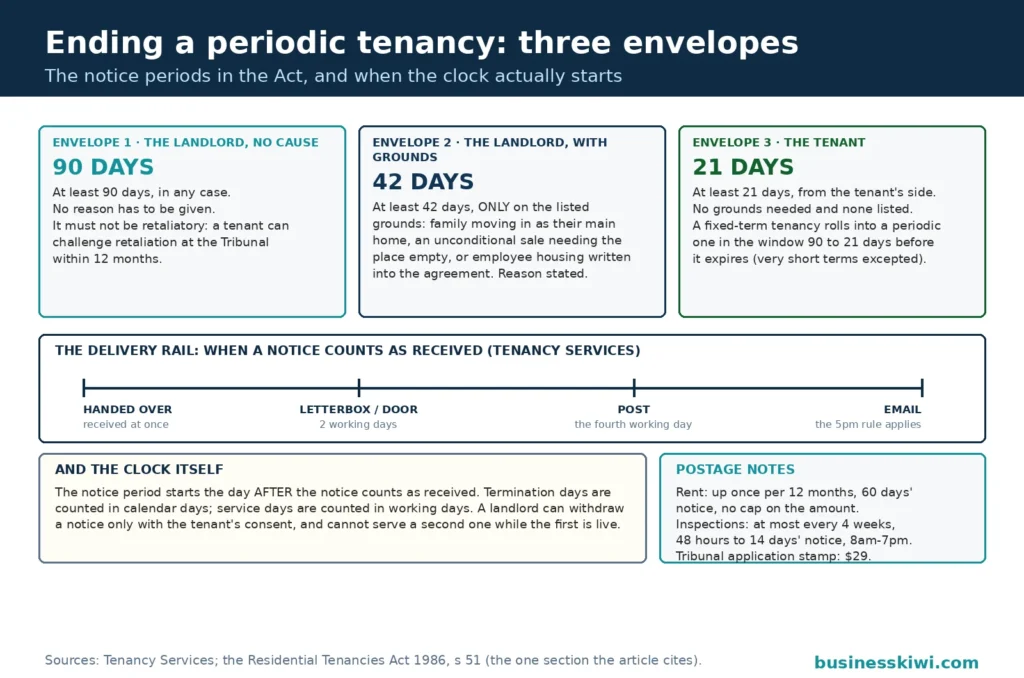
The tenant’s position is the simpler of the two, and it is set out in section 51(2A) of the Act. A tenant may end a periodic tenancy by giving at least 21 days’ written notice. No reason is needed, and the notice does not have to align with the rent cycle or the day of the week the tenancy began. Tenancy Services confirms notice can be given on any day, to end the tenancy on any day.
A few details from Tenancy Services deserve emphasis:
- The notice must be in writing, identify the property, state the date the tenancy will end, and be signed.
- A shorter period is possible only if the landlord agrees. Tenancy Services advises getting that agreement in writing.
- If the landlord has already given notice and the tenant wants to leave earlier than the landlord’s end date, the tenant must still give their own 21 days’ notice. The landlord’s notice does not cancel the tenant’s obligation.
- Where several tenants are named on the agreement, written notice from one of them ends the tenancy for all of them. That surprises flat groups regularly.
One special route sits outside the 21-day rule. A tenant, or their dependant, who experiences family violence during the tenancy can withdraw from it by giving at least 2 days’ written notice in the approved form, supported by qualifying evidence. There is no financial penalty and no need for the landlord’s agreement, and it applies to periodic and fixed-term tenancies alike.
How a landlord ends a periodic tenancy
The landlord’s position has two tiers, and keeping them separate matters, because using the wrong tier is one of the fastest ways to produce an invalid notice.
The 90-day notice: no reason required
Under section 51(1) of the Act, a landlord may end a periodic tenancy in any case by giving at least 90 days’ notice. No ground has to be stated, and the notice does not need to justify itself. This is the no-cause termination restored by the 2024 Amendment Act from 30 January 2025.
Two qualifications apply. The notice still has to meet the formal requirements: in writing, identifying the premises, stating the date the tenant must leave by, and signed. And it must not be retaliatory, a limit with real teeth, covered next.
The 42-day notice: specified grounds only
Section 51(2) allows a shorter notice of at least 42 days, but only where one of the listed grounds applies. As Tenancy Services publishes them, the grounds are:
- The owner, or a member of the owner’s family, needs the property as their main home. They must move in within 90 days of the tenancy ending and live there for at least 90 days.
- The property has been sold under an unconditional agreement for sale, and that agreement requires the seller to give the buyer vacant possession.
- The property is usually used for housing the landlord’s employees or contractors, or was bought for that purpose, that fact was clearly stated in the tenancy agreement, and the landlord now needs it for them. The Act also covers premises used for employees or contractors of a school board, where the landlord is the Crown.
If a landlord gives less than 90 days’ notice, the reason must be set out in the notice itself. That is a statutory requirement, not a courtesy. A 42-day notice that does not state its ground, or that relies on a ground the facts do not support, is exposed to challenge. Landlords relying on the family-occupancy ground should also expect the facts to be tested if the property is promptly re-let to strangers; a ground that was never genuine undermines the notice.
The retaliation limit
No-cause does not mean immune from scrutiny. It is unlawful for a landlord to give notice because the tenant exercised their rights, complained about the tenancy, or because an authorised body such as the Tenancy Services Compliance and Investigations Team became involved. Tenancy Services gives the obvious example: a tenant asks for maintenance and receives a termination notice instead of repairs.
A tenant who believes a notice is retaliatory can apply to the Tenancy Tribunal to have it declared retaliatory and an unlawful act. The application must be made within 12 months of the notice being issued. If it is made within 28 working days of the notice, the tenant can also ask for the notice to be cancelled. The 2025 changes extended the window for seeking exemplary damages to 12 months and clarified that the protection also bites where the trigger was Tenancy Services taking action, not only the tenant’s own complaint. Landlords with a genuine reason for ending a tenancy are well advised to keep records showing it, because the sequence of events is what the Tribunal will examine.
Other endings that run through the Tribunal
Not every ending is a simple notice. Tenancy Services lists several situations where the landlord’s path runs through the Tenancy Tribunal:
- Overdue rent. If, on 3 separate occasions within a 90-day period, rent that was due has stayed unpaid for at least 5 working days, and the landlord gave the tenant notice of the overdue rent on each of those 3 occasions, the landlord can apply to the Tribunal to end the tenancy.
- Anti-social behaviour. If the tenant behaves in an anti-social or unacceptable way on 3 separate occasions within a 90-day period, and the landlord gave notice of the behaviour on each occasion, the landlord can likewise apply to the Tribunal to end the tenancy.
- Physical assault. Where a tenant has physically assaulted the landlord, the owner, a member of their family, or the landlord’s agent, and Police have filed a charge over the assault, the landlord can give at least 14 days’ written notice in the approved form, with qualifying evidence of the charge.
The pattern of three documented notices in the rent and behaviour routes is deliberate: it gives the tenant warning and the landlord a paper trail.
Serving notice: the days nobody counts properly
More notices fail on arithmetic than on substance. A notice does not count from when it is written, or even when it is sent. It counts from when the law treats it as received, and the deemed receipt times differ by delivery method:
- Handed to the other person directly: received immediately.
- Left in the letterbox at the address for service, or clearly attached to the door: received 2 working days after delivery.
- Posted: received on the fourth working day after posting.
- Sent to the electronic address for service listed in the agreement before 5pm: received that day. Sent after 5pm: received the next working day.
The notice period then starts on the day after the notice is treated as received. Termination notice periods themselves are counted in calendar days, weekends and public holidays included. Service times, by contrast, are counted in working days, and some public and provincial holidays are not working days under the Act’s definition.
Tenancy Services’ own worked example shows the trap. A tenant who posts a 21-day notice on a Friday, in a week with no public holidays, is treated as having it received the following Thursday. The 21 days begin the next day, and the tenancy ends three weeks after that, later than the tenant probably assumed when they sealed the envelope. Around Christmas the drift is worse: a notice posted on 22 December may not be treated as received until 7 January.
Two practical consequences follow. Anyone giving notice should add the service time on top of the notice period, and keep proof of when and how the notice was sent. And anyone who receives a notice should check the maths before treating it as valid. If the parties disagree about receipt, Tenancy Services notes the landlord carries the burden of proving the notice was received earlier than the deemed times suggest.
Since March 2025, notices can also be served to an electronic address, such as an email address or messaging account, where that address has been provided as an address for service in the tenancy agreement. A physical address for service must still be provided as well.
When a notice is wrong, withdrawn or disputed
The Act is more forgiving of honest mistakes than most people expect.
Section 51(4) provides that no special form of words is required, and a notice is not invalid just because it fails to comply strictly with the formal requirements, provided it is in writing, the intention to end the tenancy on a particular date is clear, and the slip does not mislead the recipient or affect their interests unjustly. A notice with a minor defect is therefore not automatically worthless, although relying on that saving provision is a poor substitute for getting the notice right in the first place.
Where the problem is the length of the notice, perhaps because service took longer than expected or the end date was miscalculated, section 51(7) allows the party who gave it to issue a further notice varying the first one, bringing the period up to the required minimum. That can be done with the other party’s agreement, or, if agreement is refused, with the consent of the Tenancy Tribunal. The Tribunal will only consent where the error was inadvertent, the giver moved promptly to fix it once they realised, and varying the notice would not be unfair to the other side.
A notice can also be taken back. Under section 51(6), a party who has given an effective notice may revoke it before it expires, but only with the other party’s consent. Without that consent, the notice runs its course, and the same subsection prevents a party from giving a second termination notice while the first is still live. If the tenancy reaches the date in a valid notice, it ends on that date, and any disagreement about money owing or whether it has ended is a Tenancy Tribunal matter.
The Tenancy Tribunal route
Where talking fails, the Tenancy Tribunal is the forum Tenancy Services directs both sides to. Either a landlord or a tenant can apply. Applications are made online through Tenancy Services, using a RealMe login, and involve completing the form, attaching supporting documents such as the tenancy agreement and the notice itself, and paying the application fee.
The application fee published by Tenancy Services is $29. The applicant pays it. If the application succeeds, the Tribunal can order the other party to repay the fee, but the applicant has to ask for that in the application. Tenancy Services also notes that Work and Income may be able to help an applicant who is on a benefit with the fee.
Once an application is lodged, Tenancy Services will generally offer mediation, formalise a FastTrack resolution where the application suits it, or schedule a Tribunal hearing, and the parties receive a notice of hearing with the date, time and place. Mediation is often the fastest finish: a mediated agreement can deal with the fee as part of the settlement. The time limits noted earlier, particularly the 28 working days for asking that a retaliatory notice be cancelled, mean a tenant who sits on a notice can lose remedies that were available in the first month.
Mistakes that keep recurring
For tenants, the recurring errors are assuming the old 28-day period still applies, forgetting that service time sits on top of the 21 days, and agreeing a shorter notice period verbally, then finding it disputed. Tenants in shared houses also get caught by the rule that one named tenant’s notice ends the tenancy for everyone.
For landlords, the pattern is different: giving a 42-day notice without checking that the ground genuinely fits and is written into the notice, starting the 90-day count from the day the notice was posted rather than the day it is treated as received, and issuing notice hard on the heels of a repair request or a complaint, which hands the tenant a retaliation argument. Using a template downloaded before January 2025 is another reliable source of trouble, because the old templates were built for grounds and periods that no longer exist in that form.
On both sides, the most common mistake is treating the notice as a formality. It is the legal act that ends the tenancy.
Frequently asked questions
How much notice does a tenant have to give to end a periodic tenancy?
At least 21 days, in writing. That has been the rule since 30 January 2025; before that date it was 28 days. A shorter period is possible only if the landlord agrees, and any such agreement should be in writing. Remember that delivery time counts: a posted notice is treated as received on the fourth working day after posting, and the 21 days start the day after receipt.
Can a landlord end a periodic tenancy without giving a reason?
Yes. Since 30 January 2025 a landlord can end a periodic tenancy by giving at least 90 days’ written notice without stating any reason. The one firm limit is retaliation: a notice given because the tenant complained, exercised their rights, or prompted official involvement can be challenged at the Tribunal and declared retaliatory.
When can a landlord give 42 days’ notice instead of 90?
Only for the grounds section 51(2) of the Act lists: the owner or their family need the property as their main home, moving in within 90 days of the tenancy ending and staying at least 90 days; the property has been sold under an unconditional agreement requiring vacant possession; or the property is needed for the landlord’s employees or contractors, where that use was stated in the tenancy agreement. The reason must be written into the notice.
If my landlord gives me 90 days’ notice, can I leave earlier?
Yes, but you must give your own notice. Tenancy Services states that a tenant who wants to move out sooner than the landlord’s end date must still give the landlord at least 21 days’ written notice. Moving out without giving it can leave you liable for rent for the notice period.
Does the notice period start on the day I hand over the notice?
Not usually. The period starts the day after the notice is treated as received. Hand delivery counts as received immediately, so the clock starts the next day. A notice left in the letterbox is treated as received 2 working days later, and a posted notice on the fourth working day after posting, so the real end date can be later than a quick count suggests.
What happens when my fixed-term tenancy ends?
It converts automatically into a periodic tenancy unless either you or the landlord gives written notice during the effective period, which runs from 90 days before the expiry date down to 21 days before it, saying the tenancy is not to continue, or you both agree something else, such as a new fixed term. If it converts, the periodic notice rules in this article apply from then on.
My notice has the wrong end date on it. Is it worthless?
Not necessarily. Section 51(4) of the Act protects a notice whose intention is clear and whose defect does not mislead the other party. Where the notice period itself has come up short, section 51(7) lets the person who gave it issue a further notice correcting the first, either with the other party’s agreement or with the Tenancy Tribunal’s consent. Neither provision is a substitute for care, and disputed notices still end up before the Tribunal.
How much does it cost to apply to the Tenancy Tribunal?
Tenancy Services publishes an application fee of $29, paid by the person applying. If your application succeeds, the Tribunal can order the other party to repay the fee, provided you asked for that in your application. Tenancy Services notes Work and Income may be able to assist applicants on a benefit with the fee.
Sources
- Tenancy Services (MBIE), “Ending a periodic tenancy”, tenancy.govt.nz
- Tenancy Services (MBIE), “Giving notice to end a tenancy”, tenancy.govt.nz
- Tenancy Services (MBIE), “Serving notices”, tenancy.govt.nz
- Tenancy Services (MBIE), “Periodic or fixed-term tenancy”, tenancy.govt.nz
- Tenancy Services (MBIE), “Tenancy law changes”, tenancy.govt.nz
- Tenancy Services (MBIE), “Changes to tenancy terminations now in force”, 30 January 2025, tenancy.govt.nz
- Tenancy Services (MBIE), “Changes to how tenancies can end”, tenancy.govt.nz
- Tenancy Services (MBIE), “Rent increases and reductions”, tenancy.govt.nz
- Tenancy Services (MBIE), “Inspections”, tenancy.govt.nz
- Tenancy Services (MBIE), “How to apply to the Tenancy Tribunal”, tenancy.govt.nz
- Residential Tenancies Act 1986, section 51, legislation.govt.nz
This article is general information about periodic tenancies in New Zealand, based on guidance published by Tenancy Services and the Residential Tenancies Act 1986 as at the date of writing. It is not legal advice and does not account for the facts of any individual tenancy. Notice rules have changed more than once in recent years, so check the current position on tenancy.govt.nz, or get advice from Tenancy Services or a lawyer, before acting on a notice.