Line of Credit in NZ: How Business and Home Lending Lines Work, and the Risks

Plenty of borrowing is built around a fixed plan. You apply for a set amount, the money lands in your account, and you chip away at it with regular repayments until it is gone. A line of credit throws that plan out. Instead of a lump sum, the lender approves a limit. You draw what you need, when you need it, pay interest only on the amount you have actually used, and as you repay, the money becomes available to borrow again.
That revolving design is why lines of credit show up in two quite different corners of New Zealand lending. Businesses use them to ride out the gap between paying suppliers and getting paid themselves. Homeowners use them in the form of revolving credit home loans, where part of the mortgage works like a very large overdraft secured against the house. The mechanics are cousins, but the risks, the costs and the fine print differ, and it pays to keep the two separate in your mind.
This guide works through how each type operates in New Zealand, using what the banks themselves publish about their own products, then looks at the costs, the traps, and how lenders decide who gets one.
What a line of credit actually is
A line of credit is a pre-approved borrowing limit attached to an account. Three features define it.
First, access is flexible. Once the facility is set up, you do not apply again each time you borrow. Westpac describes its Business Revolve Account as a flexible line of credit linked to your everyday banking, where you can access and repay funds as needed, within your approved limit, without submitting a new application each time. ANZ says much the same of its Business Flexible Facility: you can draw down, repay and redraw funds at any time, within your credit limit.
Second, interest is charged on what you use, not on the whole limit. If your limit is $80,000 and you have drawn $25,000, interest accrues on the $25,000. Every bank page referenced in this guide makes that point, because it is the core selling point of the product. ANZ notes that for its business facility, interest is calculated daily on the outstanding amount only.
Third, there is usually no fixed repayment schedule. Unlike a term loan, where repayments are set from day one, a line of credit generally lets you repay at your own pace, provided you stay within the limit and meet any conditions. That freedom is both the attraction and, as we will see, the danger.
Rates on these facilities are almost always floating, meaning they move with the market rather than being locked in. Westpac states that its Business Revolve Account carries a floating interest rate that may increase or decrease in line with the market, and ASB says its Orbit revolving home loan is variable (floating) rate only.
Business lines of credit
For a business, a line of credit is working capital on tap. Cash flow in most small businesses is lumpy: wages and rent go out on fixed dates, while customers pay on their own schedule. A revolving facility bridges those timing gaps, and covers seasonal swings. Westpac pitches its Business Revolve Account squarely at that problem, saying it supports cashflow through seasonal changes and gives breathing room for day-to-day needs, whether that is an unexpected cost or gearing up for a new season.
The banks sell these facilities under their own names. ANZ’s Business Flexible Facility is a revolving line of credit that works through a current account, accessible online, by phone, by EFTPOS, at ATMs or in a branch. Westpac’s Business Revolve Account is accessed through digital banking at any time. The shapes differ slightly, but the underlying product is the same: an approved limit, draw and redraw as you like, interest only on the balance you are using.
Security is often the price of a business line
The detail that surprises many applicants is security. ANZ’s Business Flexible Facility is not an unsecured product. ANZ states that it uses your home or other residential property as security, and that a first registered mortgage over the property is required. In exchange, ANZ says borrowers get lower interest rates than they would with unsecured business lending, precisely because the credit is secured against the property.
Westpac takes a broader position on its Business Revolve Account: depending on the amount, you might need to provide security such as residential property, commercial property or business assets. Westpac makes a similar point on its business overdraft page. Either way, the message for business owners is plain. A cheap-looking revolving facility may be cheap because your house is standing behind it. If the business cannot repay, the property is exposed, and that should be understood before signing, not discovered afterwards.
Who a business line suits
A revolving facility fits a business with an established trading pattern and a genuine timing problem: stock to buy before a busy period, invoices that land 30 or 60 days after the work is done, or seasonal income that arrives in lumps. It is a poor fit for covering ongoing losses, because there is no repayment structure forcing the balance down, and a facility that sits permanently at its limit is really just expensive long-term debt wearing a flexible costume. Businesses that need a defined amount for a defined asset, such as a vehicle or a machine, are usually better served by a business loan with set repayments, where the debt is guaranteed to reduce over the term.
Business facilities are also for business purposes only. Westpac notes that its business lending products are only available for business and/or investment purposes, not for personal, domestic or household purposes.
The home version: revolving credit and equity-style facilities
The same revolving idea exists in home lending, where it is usually called a revolving credit home loan. Kiwibank describes its Revolving Home Loan as a flexible revolving credit facility that works like a big overdraft. You are approved to borrow up to a credit limit, and you can spend up to that amount, using a Visa Debit or Eftpos card on the account or transferring money to your everyday account.
ANZ’s Flexible Home Loan works the same way: a revolving credit facility on your everyday transactional account, a bit like an overdraft, in ANZ’s own words. You can pay money in whenever you like and redraw it if you need to. ASB’s Orbit home loan follows the pattern too, a set credit limit on a transaction account style loan, with interest calculated and accrued daily and charged monthly.
The strategy these products are built around is simple to describe and harder to live. Because interest is calculated daily on the outstanding balance, money sitting in the account reduces the interest you pay. So borrowers have their income paid straight into the facility and let their spending flow out of it, keeping the average balance as low as possible. Kiwibank explains it exactly that way: the more money in your revolving credit account, the less interest you pay. Some borrowers also run spending through a credit card and sweep the card balance from the facility each month, a tactic Kiwibank mentions, though it piles one credit product on top of another and needs care.
Two features separate the home version from a standard mortgage:
- No set repayments. Kiwibank is blunt about this: unlike term loans, there are no set repayments on a revolving loan, and you do not pay it down as such; you only pay interest on what you have used. ANZ says the same of its Flexible Home Loan.
- Equity requirements. Kiwibank notes that you will generally require 20 percent equity to get a revolving loan.
Most borrowers do not put their whole mortgage on revolving credit. Kiwibank points out that you can put some of your mortgage on a revolving loan and the rest on other loan types, such as fixed, variable or offset loans. That split structure, part fixed for certainty and part revolving for flexibility, is the common real-world setup. Sorted, the consumer guidance service run by the Commission for Financial Capability, describes revolving credit mortgages the same way: they work like a giant overdraft, your pay goes into the account, bills go out, and interest is charged on the daily balance.
There is also a variant worth knowing about. ASB’s Orbit FastTrack, now closed to new applications, had a credit limit that reduced regularly over the loan term, so the amount you could redraw shrank fortnightly or monthly. Sorted notes that some revolving credit mortgages have reducing limits for the same reason: to make sure the debt actually gets paid off rather than simply revolving forever.

Line of credit vs term loan vs overdraft vs revolving credit mortgage
These products overlap enough to confuse anyone. The table below sets out the differences, based on how the banks and Sorted describe each product.
Some of these distinctions deserve a word of explanation. An overdraft and a business line of credit are close relatives, and Westpac treats them as neighbouring products: its overdraft is a safety net linked to your everyday business account that lets you access funds above your available balance up to an agreed limit. The practical difference is mostly one of scale and structure. Overdrafts tend to be smaller, day-to-day buffers; facilities like ANZ’s Business Flexible Facility and Westpac’s Business Revolve Account are larger, purpose-built revolving lines, sometimes secured by a mortgage. A term loan sits at the other end of the spectrum: ASB describes its table loan structure as regular payments spread evenly over the full term, part interest and part principal, which is the discipline a line of credit deliberately lacks. And the revolving credit mortgage is simply the line of credit idea applied to home lending, with your house as security and, usually, a much bigger limit.
What it costs
The cost of a line of credit has two parts: interest on what you draw, and fees for having the facility at all.
Interest
Interest is calculated daily on the outstanding balance and generally charged monthly. ASB says interest on its Orbit home loan balance is calculated and accrued daily and charged monthly; Kiwibank says the same of its revolving home loan; ANZ calculates debit interest daily on the outstanding amount for its business facility.
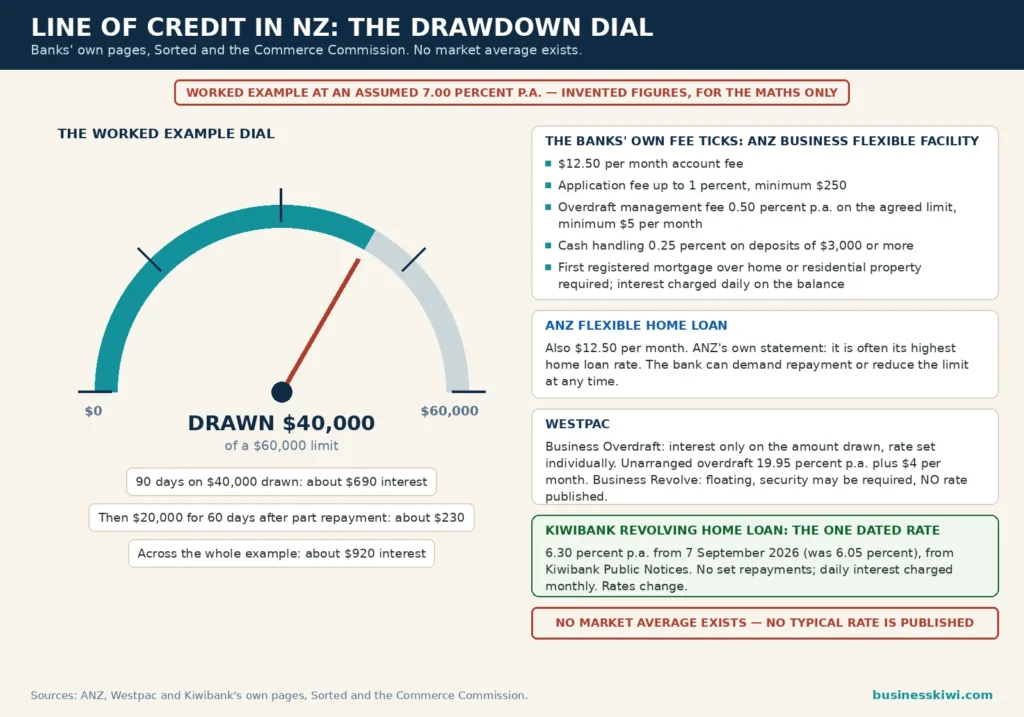
Rates vary by bank and by product, and they change over time. To give one current, published example: Kiwibank’s public notices set the interest rate on its Revolving Home Loan at 6.30 percent per annum from 7 September 2026 for new loans (6.05 percent before that change). That is Kiwibank’s rate for that product, not a market figure, and it will move again. ANZ notes that its Flexible Home Loan often has the highest interest rate of its home loan types, while offering the most flexibility. That trade-off, a higher rate in exchange for total flexibility, is typical of revolving products.
For business facilities, banks often do not publish a single rate at all. Westpac states that its business overdraft interest rate is variable and set individually, based on the business’s credit profile and risk assessment, and is confirmed when you apply. Westpac’s Business Revolve page likewise publishes no rate figure. If a bank’s page shows no rate, assume the price is negotiated case by case, because that is what the banks themselves say.
Worked example (illustration only)
To see how daily interest on a drawn balance works, take an invented example. Say a business has a $60,000 facility and draws $40,000 to buy stock. Assume an interest rate of 7.00 percent per annum. That rate is assumed purely for this illustration; it is not any bank’s actual pricing.
Interest accrues only on the $40,000 drawn, not the full $60,000 limit. Over 90 days, the interest would be roughly $40,000 × 7.00% × 90 ÷ 365, which comes to about $690. If the business repaid $20,000 after 30 days when a big invoice was paid, interest for the remaining 60 days would accrue on $20,000 only, adding roughly $230. Total interest for the quarter: approximately $920, on money the business had use of throughout. The lesson of the arithmetic is that the timing of repayments matters as much as the rate, because every day a dollar sits repaid is a day it costs nothing.
Fees
Facility fees are where published detail exists, so they are worth reading closely. For ANZ’s Business Flexible Facility, ANZ publishes a monthly account fee of $12.50, no charge for automated or manual transactions, and an application fee of up to 1 percent of the loan amount with a minimum of $250. The fee with real teeth is the monthly overdraft management fee: 0.50 percent per annum, calculated and charged monthly as a percentage of the highest agreed flexi limit during that month, with a minimum of $5 a month. On a $60,000 limit, that fee works out to about $25 a month, or $300 a year, and it is charged on the limit whether you draw a cent or not. ANZ also charges a cash handling fee of 0.25 percent on cash deposits of $3,000 and over per business processing day.
ANZ charges the same $12.50 monthly account fee on its Flexible Home Loan. Kiwibank’s revolving home loan page directs borrowers to its fees schedule rather than listing amounts, and Sorted warns more generally that application fees on revolving credit mortgages can be up to $500, with possible transaction fees on the account. Westpac’s business overdraft carries a line of credit charge and an establishment fee, with amounts set out in its fees brochure. And one Westpac figure deserves highlighting: if you overdraw a business account with no arranged limit, the interest rate on the overdrawn amount is 19.95 percent per annum, plus an unarranged overdraft fee of $4 per month. An arranged facility costs money. An unarranged one costs far more.
Risks and traps
A line of credit is the easiest form of borrowing to misuse, because nothing in the product forces you to repay. The banks say this themselves. Kiwibank warns that if a revolving loan is not managed well, the loan balance won’t get paid off, and that you should only opt for one if you are confident in your budgeting skills and won’t be tempted to max out the credit limit on unnecessary spending. ASB says much the same of Orbit: if you aren’t confident in budgeting or actively managing your finances, the loan is not suitable for you. Sorted’s verdict is blunt: revolving credit requires serious discipline, and without fixed repayments there is no forcing mechanism to pay the mortgage down.
Beyond discipline, watch for these traps:
- The limit is not permanent. ANZ states that although its Flexible Home Loan has no maximum loan term, the bank can ask you to repay it or reduce your credit limit at any time. Business facilities are likewise reviewed; Westpac says its overdraft limits are reviewed regularly to make sure they are working for the business. A line you rely on can shrink at review time, usually at the worst possible moment.
- Your home may be the security. This bears repeating for business borrowers. ANZ’s Business Flexible Facility requires a first registered mortgage over your home or other residential property. Sorted makes the same point for homeowners: if you fall behind with payments, you risk your home.
- Rates float. Every facility discussed here is on a variable rate. When market rates rise, your cost rises with them, on the whole drawn balance, immediately.
- Fees run even when the facility doesn’t. Limit-based fees, like ANZ’s overdraft management fee, are charged on the approved limit, not on what you use. A large, mostly idle facility is not free insurance.
- Spending creep. Because the account looks and behaves like a transaction account, borrowed money and your own money blur together. Sorted warns against treating your home like an ATM: every withdrawal adds to the mortgage balance and the interest cost.
- Cheap money, long tail. Sorted also cautions that borrowing extra on a mortgage at a lower rate still costs more in the long run if the extra debt is spread across the whole mortgage term instead of being paid off quickly.
How lenders assess applications
For business facilities, expect the bank to want your business financials and to look hard at trading history and cash flow. Westpac lists what you need for a business overdraft: a Westpac business transaction account, your NZBN (New Zealand Business Number), and your business financials. ANZ offers a digital application route, goBiz, which can pull your financial details from MYOB or Xero into the application if you use those systems and meet its criteria; otherwise you deal with a business specialist. ANZ also notes, sensibly, that good financial management makes it easier to get lending approved and may earn a lower interest rate.
For home lending lines, equity is the first hurdle: Kiwibank’s general requirement of 20 percent equity for a revolving loan is an example. The bank will also assess whether your income supports the limit, because the limit is what you could owe, not just what you plan to draw today.
For personal and domestic borrowing, there is a legal layer on top of the bank’s own criteria. Under the Credit Contracts and Consumer Finance Act 2003 (CCCFA), lenders must follow the lender responsibility principles. As the Commerce Commission explains, these require lenders to make reasonable enquiries before entering into a loan, so they can be satisfied that the credit will meet the borrower’s needs and that the borrower will be able to make the payments without suffering substantial hardship. Lenders must also make sure loan documents are clear enough for borrowers to make informed decisions, and must publicly display their interest rates, fees and standard contract terms. In practice, that is why applications involve thorough questions and evidence about income and expenses, and why an approval can take longer than applicants expect. Business-purpose lending sits outside the consumer credit rules, which is one reason business facilities hinge more heavily on financial statements, security and the bank’s own credit assessment.
Frequently asked questions
What is the difference between a line of credit and an overdraft?
They work in a similar way, and the line can be blurry. An overdraft is attached to a transaction account and lets you spend past a zero balance up to an agreed limit; Westpac describes its business overdraft as a safety net of exactly that kind. A business line of credit or revolving facility is usually a larger, stand-alone arrangement with its own limit and fees, and it may be secured against property. Both charge interest only on the amount used.
Do I pay interest on the whole limit or only on what I use?
Only on what you use. Every bank referenced here calculates interest on the drawn or outstanding balance, usually daily. However, some fees are charged on the limit itself. ANZ’s Business Flexible Facility, for example, charges its monthly overdraft management fee as a percentage of the agreed flexi limit, whether or not you have drawn anything.
Can a bank reduce or cancel my line of credit?
Yes. ANZ states openly that it can ask you to repay its Flexible Home Loan or reduce the credit limit at any time, and business facilities are reviewed regularly. A line of credit is not a guaranteed permanent source of funds, so it should not be the only thing standing between your business and a cash shortfall.
Is a line of credit cheaper than a business loan?
Not necessarily. Interest only accrues on the drawn balance, which can make a line of credit cheap for short, occasional use. But the interest rate is usually higher than a secured term loan rate, facility fees apply even when you are not using it, and without set repayments the balance can linger for years. ANZ notes its business facility’s rates are lower than unsecured business lending because the facility is secured against residential property, which is a trade-off, not a free lunch.
Can I use a revolving credit home loan to renovate?
Yes, that is one of its common uses. Kiwibank gives the example of a $100,000 revolving loan for renovations: spend $20,000 and you pay interest on $20,000; spend another $30,000 and you pay interest on $50,000. The catch is discipline. The renovation debt has no repayment schedule, so it only gets cleared if you actively pay it down.
Does a business line of credit put my house at risk?
It can. ANZ’s Business Flexible Facility requires a first registered mortgage over your home or other residential property as security. Westpac says security such as residential property, commercial property or business assets may be required for its Business Revolve Account, depending on the amount. Always check what security you are offering before you sign.
How much equity do I need for a revolving home loan?
Kiwibank says you will generally require 20 percent equity to get a revolving loan. Other banks apply their own lending criteria, so treat that figure as one bank’s published requirement rather than an industry rule.
What happens if I go over my limit or overdraw without a facility?
Expect it to be expensive. Westpac’s business overdraft page states that going overdrawn without an arranged limit attracts interest at 19.95 percent per annum on the overdrawn amount, plus an unarranged overdraft fee of $4 per month, and transactions may be declined or reversed if there are insufficient funds. Arrange the facility before you need it.
Sources
- ANZ, Business Flexible Facility: https://www.anz.co.nz/business/lending/flexible-facility/
- ANZ, Flexible Mortgage (Flexible Home Loan): https://www.anz.co.nz/personal/home-loans-mortgages/loan-types/flexible/
- Westpac NZ, Business Revolve Account: https://www.westpac.co.nz/agribusiness/westpac-business-revolve-account/
- Westpac NZ, Business overdraft: https://www.westpac.co.nz/business/loans-and-finance/business-overdraft/
- Kiwibank, Revolving home loan: https://www.kiwibank.co.nz/personal-banking/home-loans/loan-options/revolving-credit-home-loan/
- Kiwibank, Public notices (revolving home loan rate change, September 2026): https://www.kiwibank.co.nz/about-us/governance/public-notices/
- ASB, Shaping your loan payments (Orbit home loan): https://www.asb.co.nz/home-loans-mortgages/shaping-your-loan-payments.html
- Sorted (Commission for Financial Capability), Types of mortgages in New Zealand: https://sorted.org.nz/guides/home-buying/mortgage-types
- Commerce Commission, Law change creates new climate for borrowing (lender responsibility principles): https://www.comcom.govt.nz/news-and-media/news-and-events/2015/law-change-creates-new-climate-for-borrowing/
This article is general information only and is not financial advice. Interest rates, fees and product features change, and the figures quoted here are those published by the relevant banks at the time of writing, so check the current rate and fee schedule with the lender before applying. Whether a line of credit suits your business or your home loan depends on your own circumstances, and you should seek advice from a qualified financial adviser or your bank before making a decision.