NZ Resume Examples: What a Strong CV Looks Like, Section by Section

Most CV advice tells you what to include. It is much less helpful on the question that actually stops people mid-sentence: what does a good version of this part look like when it is written down? A personal statement can be three lines long and still say nothing. A work history bullet can describe a busy job and still leave an employer shrugging.
This article takes a different approach. It walks through a complete example CV for a fictional New Zealand job seeker, section by section, showing a weak version and a stronger version side by side so you can see exactly what changed and why it works better. The guidance underneath the examples comes from New Zealand’s official careers sources, mainly Tahatū Career Navigator (the Tertiary Education Commission’s careers service, formerly careers.govt.nz) and the Job Hunters’ Toolkit produced for job seekers. Everything about the example person is invented. The advice is not.
One quick note on words. In New Zealand, CV and resume mean the same document. Tahatū describes a CV as a written record of your education, training, achievements, skills and work experience, and employers here use the two terms interchangeably. This article mostly says CV, because that is the term the official guidance uses.
What NZ employers expect a CV to contain
Before the examples, it helps to know the shape employers are scanning for. Tahatū’s guidance and the templates in the Job Hunters’ Toolkit point to the same core sections:
- Your name and contact details
- A personal statement or objective, pitched at the job you are applying for
- Your skills, usually split into technical skills (specific to a job, such as a driver licence or cash handling) and personal skills (the transferable ones, such as communication and teamwork)
- Your work history, most recent job first, with tasks, duties and achievements under each role
- Any work and volunteer experience, which matters a lot if your paid history is short
- Your education and training, including qualifications and relevant courses
- Achievements and awards, and interests where they show a skill an employer wants
- Referees, with their names, roles, organisations and contact details
Two things sit behind that list. The first is speed. Tahatū is blunt about it: an employer may have a pile of CVs for one job and very little time, so your CV has to show quickly and clearly how you match what they asked for. The second is that a computer may read your CV before a person does. Tahatū explains that many applications pass through an applicant tracking system (ATS), software that searches CVs and cover letters and ranks them. That is why the official advice keeps coming back to using the words from the job advertisement itself, including the job title, the industry name, the key skills listed and any tools or software mentioned.
There is also a choice of structure. If you have a solid work history, a work-focused CV that leads with employment makes sense. If you are a school leaver, returning after a gap, or changing direction, Tahatū recommends a skills-focused CV, which puts your skills up front and draws evidence from study, volunteering, sport, whānau and community activities as well as paid work. The examples below use a work-focused layout, because that is what most experienced job seekers need, but the writing lessons apply to both.
The worked example: meet Jess
Jess Walker is fictional. She is 26, lives in Hamilton, and has spent four years working in warehousing and retail. She is applying for a role as a storeperson and dispatch coordinator with a building supplies company. The advertisement asks for a full driver licence, forklift experience, confidence with inventory systems, accuracy under pressure and good communication with drivers and customers.
Below is her CV, taken apart piece by piece. Each section shows the draft most people write first, then the version that does the job properly.
Contact details and heading
This part is simple, and the official advice is mostly about not getting it wrong. The Job Hunters’ Toolkit checklist ends with a reminder to double-check every contact detail, yours and your referees’, because a wrong digit in a phone number quietly ends applications. Jess’s heading is just her name, suburb and city, phone number and a professional email address. No photo: Tahatū says not to use images in a CV, and the toolkit says the same.
The personal statement
Weak version:
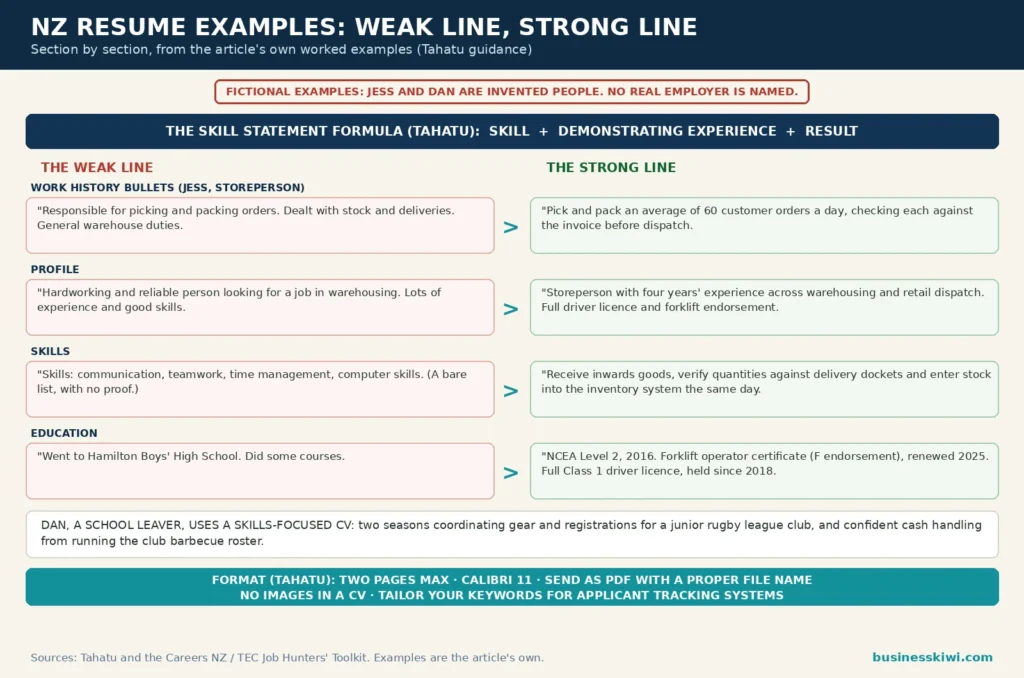
I am a hardworking and reliable person looking for a job in warehousing. I have lots of experience and good skills. I am a team player who works hard and would like a job where I can grow.
There is nothing false in that. There is also nothing in it that could not be pasted into an application for almost any job in the country, which is exactly the problem. It names no skill the employer asked for, gives no evidence, and spends its three lines on claims (hardworking, reliable) that every applicant makes.
Stronger version:
Storeperson with four years’ experience across warehousing and retail dispatch. Holds a full driver licence and forklift endorsement, with daily experience picking, packing and checking stock in a computerised inventory system. Known for accurate orders and calm problem-solving when deliveries run late. Looking to bring dispatch and stock control experience to a full-time coordinator role.
The rewrite is the same length but does real work. It leads with the job identity, matches three of the advertisement’s specific requirements in the first two sentences, and turns the vague claims into things an employer can picture. Tahatū advises exactly this kind of tailoring: you may need to change the wording of your personal statement for each application so it reflects the job in front of you. The statement is not a description of you in general. It is an argument for this job.
Work history: duties versus evidence
Under each job, most people list what the role involved. Employers already know what a storeperson does. What they cannot know, unless you tell them, is how well you did it and what changed because you were there.
Weak bullets, from Jess’s current warehouse role:
- Responsible for picking and packing orders
- Dealt with stock and deliveries
- Helped customers and drivers
- General warehouse duties
Stronger bullets for the same job:
- Pick and pack an average of 60 customer orders a day, checking each against the invoice before dispatch
- Receive inwards goods, verify quantities against delivery dockets and enter stock into the inventory system the same day
- Reorganised the fast-moving product shelves with two workmates, cutting average pick time on common lines and reducing wrong-item returns
- Train new casual staff on the scanner guns and safe manual handling during busy periods
- Hold a clean safety record across two years in the role, including weekly forklift pre-start checks
The difference is not flair. It is information. The strong version names tasks precisely, adds scale where Jess honestly can (orders per day), and shows outcomes. Tahatū’s skills guidance makes the underlying point well: where possible, include amounts or outcomes that show the impact of what you did. Notice also what the strong version avoids. Jess does not claim figures she could not back up in an interview, and she does not inflate her job title. Accuracy matters, and the toolkit is clear that a CV should be accurate above all else, because employers check.
Order matters here too. Work history runs most recent first, and the bullets under your current or latest role deserve the most effort, because that is where an employer’s eye lands.
Skills: a list is not evidence
A bare skills list is the weakest section in most CVs:
Skills: communication, teamwork, time management, computer skills, forklift, problem solving.
Every applicant in New Zealand could write that list, and most do. Tahatū’s “Know your skills” guidance suggests a better unit of writing altogether: the skill statement. A skill statement names the skill the employer wants, gives the experience that demonstrates it, and finishes with the result. Written that way, a skills section (especially in a skills-focused CV) looks like this:
Organisation. Planned the weekly dispatch roster for a team of six around delivery deadlines and staff leave, reorganising loads when trucks were delayed. Kept late dispatches rare across the summer peak period.
Communication. First point of contact for delivery drivers and trade customers collecting orders. Explained delays, offered alternatives and followed up by phone, which reduced repeat complaint calls to the branch.
Accuracy. Checked outgoing orders against invoices as a final step before loading, catching picking errors before they left the yard and cutting the branch’s re-delivery trips.
Three things are worth noticing. First, each statement could only have been written by someone who has actually done this work. Second, the skills chosen are the ones in the advertisement, reordered to the top, which is precisely what Tahatū recommends when it says to re-order your skills list so the leading entries match the job. Third, technical skills (forklift endorsement, inventory software, driver licence) sit comfortably in the work history and statement where they are used, while the skills section carries the personal skills with proof attached.
Education and training
Weak version:
Went to Hamilton Boys’ High School. Did some courses.
Stronger version:
NCEA Level 2, Hamilton secondary school, 2016
Forklift operator certificate (F endorsement), industry training provider, renewed 2025
Full Class 1 driver licence, held since 2018
First aid certificate, completed 2024
Education sections fail in two directions: too vague, as above, or padded with every certificate since childhood. The toolkit template asks for the school or institute, the qualification, the location and the period of study, and that is the right level of detail. Lead with the most relevant or most recent training rather than strict chronology if your qualifications are old but your licences are current and job-critical. For school leavers, Tahatū’s skills-focused approach lets subjects, awards and school responsibilities carry more weight, because there is less work history to draw on. For someone like Jess, four years into working life, education becomes the shortest section on the page, and that is fine.
Referees
Jess finishes with two referees:
Referees
Mark Thompson, Warehouse Supervisor, building products distribution company, Hamilton. Phone and email supplied.
Aroha Ngata, Store Manager, retail chain, Hamilton. Phone and email supplied.
In a real CV those phone numbers and email addresses would be written out in full, and that is the point worth making. The toolkit template collects each referee’s name, job title, organisation, phone and email, and its checklist reminds you to check those details are current. Two practical rules follow from the official guidance and plain courtesy: ask each referee before you list them, and pick people who have actually seen you work. A recent supervisor is worth more than a family friend, though the toolkit does allow for a character referee, such as a coach, tutor or community leader, when a work referee is not available, which is a lifeline for school leavers and people returning to work.
You will sometimes see “referees available on request” on CVs. Listing real referees with contact details, as the official templates do, is the more straightforward approach and saves the employer a step.
Achievements and interests
Jess adds a short closing section:
Achievements and interests
Employee of the month, March 2025, for keeping dispatch running during a stocktake backlog.
Volunteer marshal and gear coordinator for a junior football club, 2023 to present.
Keen tramper and member of a local tramping club.
This section earns its place only when each line works. The toolkit template puts achievements and awards in their own section, and it suggests including interests that show you have the skills an employer is looking for. Jess’s football role is not decoration: organising gear and people for junior sport is organisation and reliability evidence, the same skills her skill statements claim. An interest that shows nothing relevant, or a long list of hobbies, is better cut to keep the CV within two pages.
A second, shorter example: the skills-focused CV
Not everyone has Jess’s work history to draw on. Consider Dan, a fictional 17-year-old school leaver in Rotorua applying for an entry-level retail job. He has no paid employment, so a work-focused CV would be mostly empty space. Following Tahatū’s advice for school leavers, he uses a skills-focused CV instead. His personal statement reads:
Recent school leaver with NCEA Level 2, looking for a first role in retail. Two seasons coordinating gear and registrations for a junior rugby league club, regular volunteer at school working bees, and confident handling cash from running the club barbecue roster. Reliable, quick to learn and comfortable talking with people of all ages.
His skills section carries the weight, using the same statement structure as Jess’s:
Teamwork and reliability. Turned up to every scheduled training and game across two seasons as gear coordinator for an under-12 rugby league team, organising uniforms, water bottles and the barbecue roster so coaches could focus on the team.
Cash handling. Ran the club barbecue stall on home game days, taking cash and EFTPOS payments, balancing the float at the end of the day and banking takings with the club treasurer.
Everything Dan claims is true within the fiction, and none of it comes from a job. That is the point of the format. Tahatū’s skills guidance is explicit that skills come from study, hobbies, whānau activities, sports teams, cultural groups and community involvement, not only paid work. The writing job is the same as in a work-focused CV: name the skill, show where you used it, and say what resulted.

Length and format: what the official guidance says
Tahatū’s formatting advice is refreshingly specific. Keep your CV to two pages if you can. Use simple wording, short sentences and short paragraphs. Use bullet points to list information rather than burying it in prose. Use a plain black font, Tahatū gives Calibri 11 as an example, with larger bold headings and plenty of white space. Do not use images.
The Job Hunters’ Toolkit tidy-up checklist adds the ATS angle. Put all your text in the main body of the document and remove text boxes, because tracking software may not read them. Use clear subheadings for each section. Write acronyms out in full first with the shortened form in brackets. Avoid infographics and diagrams for the same reason: the software cannot read the information in them, and if the information only exists inside a picture, it effectively does not exist.
Two final mechanics from Tahatū. Send your CV as a PDF unless the employer asks for a Word document. And name the file properly, using your first and last name and the word CV, so it can be found in a downloads folder full of documents called “CV final version 2”.
Tailoring: the step that makes the examples work
Every improvement in the worked example above came from one habit: writing for a specific advertisement instead of for jobs in general. Tahatū puts it as an instruction, not a suggestion. Update your CV for each job application, using information and keywords from the job ad, so employers can see your skills and experience match their requirements.
In practice that means three passes over a master CV you keep on file. First, read the advertisement closely and mark the skills, tools and requirements it names. Second, adjust: reword your personal statement, move the matching skills to the top, and choose work history bullets that speak to this employer’s needs, which may mean swapping a bullet about one duty for a bullet about another you also genuinely did. Third, check the keywords. Because an ATS may rank your application, the job title, industry name, key skills and named software from the advertisement should appear in your CV where they truthfully apply. Tahatū also advises keeping formatting simple and consistent so the system can read the document at all.
Here is what one of those passes looks like in miniature. Jess’s advertisement asks for someone who can “work accurately under pressure during peak periods”. Her master CV has this bullet under her retail role: “Helped with end-of-day cash-up and restocking shelves.” For this application she brings a different true bullet from the same job to the front of that section instead: “Completed end-of-day cash-up and reconciled the till within a small tolerance across the Christmas peak, while restocking the highest-turnover shelves before close.” Nothing was invented. The experience was always there; the tailoring pass simply chose the version of it that answers the sentence in the advertisement, in something close to the advertisement’s own language.
Tailoring is not fabrication. Every statement still has to be true and defensible at interview. What changes is emphasis, order and wording, and that is usually enough.
Common mistakes official guidance warns about
The checklists in the official sources name a consistent set of errors. None of them are exotic, which is why they are worth listing:
- Spelling and grammar mistakes. The toolkit puts a thorough spelling and grammar check at the top of its tidy-up list, and Tahatū adds a second pair of eyes: proofread carefully and ask someone else to check it too.
- Wrong contact details. A single transposed digit in your phone number, or an out-of-date referee, can silently end an application.
- Photos and images. Both Tahatū and the toolkit say to leave them out. In New Zealand CVs they are not expected, and they can break ATS reading.
- Walls of text. Long paragraphs where bullet points belong make a busy reader give up. Shorten sentences and break information into lists.
- Sending the same CV everywhere. Tahatū’s guidance to update your CV for each application exists because a generic CV reads as generic.
- Text boxes, tables and graphics carrying key information. If the ATS cannot read it, it does not count.
- Claims you cannot support. The toolkit stresses accuracy throughout. A CV that oversells collapses at the reference check or the interview.
Frequently asked questions
Should I call it a CV or a resume in New Zealand?
Either. The terms are used interchangeably by NZ employers, and Tahatū uses CV as its main term while noting it is sometimes called a resume. Use whichever word the job advertisement uses, and you will match the employer’s language automatically.
How long should my CV be?
Tahatū’s advice is to keep it to two pages if you can. If your history is short, one strong page beats two padded ones. If you have decades of experience, the two-page discipline still helps you cut the oldest and least relevant material.
Do I need a personal statement?
The official templates include one, and it is worth the three lines if you tailor it. Written for the specific job, naming the skills that job asks for, it does the work of a summary and a signal that this application was prepared for this employer. Written generically, it is wasted space.
Should I include a photo on my CV?
No. Tahatū says not to use images, and the Job Hunters’ Toolkit checklist says to remove images and photos. New Zealand employers do not expect one.
What if I have little or no work experience?
Use a skills-focused CV, as Tahatū recommends for school leavers and people with gaps. Build skill statements from study, volunteering, sport, cultural groups, community work and whānau responsibilities, which are all legitimate evidence of skills like communication, organisation and teamwork.
Should I list referees or write “available on request”?
The official templates list referees in full: name, job title, organisation, phone and email. Ask your referees first, check their details are current, and prefer people who have seen you work. A character referee such as a coach or tutor is acceptable when a work referee is not available.
What file format should I send?
Send a PDF unless the employer asks for a Word document, and name the file with your first and last name plus CV, following Tahatū’s example format. That way your CV is identifiable the moment it lands in an employer’s inbox or downloads folder.
Can I use AI or a CV builder to write my CV?
Yes, with care. Tahatū notes that AI tools and CV builders can produce a good draft, but they work best when you check, personalise and edit the results, and it suggests comparing the output against its own templates and examples to keep a New Zealand style. The facts, examples and achievements still have to be yours and true.
Sources
- Tahatū Career Navigator, “How to write a CV”: https://tahatu.govt.nz/work/applying-for-a-job/how-to-write-a-cv
- Tahatū Career Navigator, “Know your skills”: https://tahatu.govt.nz/get-inspired/discovering-who-you-are/know-your-skills
- Careers NZ / Tertiary Education Commission, Job Hunters’ Toolkit, “How to write a CV” (step-by-step guide): https://api.careers.govt.nz/assets/Uploads/how-to-write-a-CV.pdf
- Work and Income, “CVs and cover letters”: https://www.workandincome.govt.nz/work/get-ready-to-work/cvs-and-cover-letters/index.html
- Wellington Careers and Employment, Te Herenga Waka Victoria University of Wellington, “Preparing a CV”: https://www.wgtn.ac.nz/careers/employment/jobs/applications/cv
This article is general information about preparing a CV for the New Zealand job market. The example job seeker, employers and achievements shown are fictional and included only to demonstrate writing techniques. Guidance reflects New Zealand official careers sources at the time of writing, and individual employers may ask for different formats or information, so always follow the instructions in the job advertisement you are applying for.