Foundation Courses in NZ: Bridging Programmes, Entry Requirements and What They Cost

Leaving school without University Entrance is not the end of the road. Neither is a rank score that falls a few points short, a decade away from the classroom, or a career you want to leave behind. New Zealand has a well established set of foundation and bridging programmes designed for exactly these situations, run by the universities and polytechnics themselves.
The terminology takes a little untangling. Providers use foundation, bridging, preparation and pathways in overlapping ways, and there is no single national programme called a foundation course. A university might offer a Certificate in Foundation Studies, a Tertiary Foundation Certificate or a Certificate of University Preparation. A polytechnic is more likely to offer a New Zealand Certificate in Foundation Skills or a New Zealand Certificate in Study and Employment Pathways. Underneath the names, the purpose is the same: build the academic skills, subject knowledge and confidence you need, then move into the diploma or degree you actually want.
What foundation and bridging programmes actually are
A foundation or bridging programme is a short, structured qualification that sits before degree level study. Instead of jumping straight into first year papers, you spend a semester or a year learning how tertiary study works: academic writing, research, referencing, numeracy, and the subject basics your intended degree assumes you already have. Classes are usually smaller and more supported than a first year lecture hall.
Two broad families exist. University foundation programmes are tied to a particular university and feed into its degrees; Auckland, AUT, Waikato, Massey, Victoria University of Wellington, Canterbury, Otago and Lincoln all describe preparation or foundation routes on their own pages. Polytechnic certificates are broader, preparing you for a range of certificates, diplomas and degrees at that polytechnic, often with employment focused skills alongside academic preparation. Bridging is sometimes used more narrowly, for a shorter top up that fills a specific gap, as with Otago Polytechnic’s Health Bridging Certificate. Elsewhere the words are used almost interchangeably. The name matters less than three questions: what level it is, what it leads into, and whether the programme you want next accepts it.
The NZQA levels involved
Every qualification in this space sits on the New Zealand Qualifications and Credentials Framework, administered by NZQA. NZQA describes the first three levels as foundational skills. At Level 1, learners hold basic skills and knowledge and can carry out simple tasks in a highly structured context; NZQA gives the Certificate in Foundation Skills as its Level 1 example, covering basic literacy, numeracy and communication. Level 2 involves basic factual or operational knowledge, with tasks done under some supervision, and NCEA Level 2 sits at this level. At Level 3, learners can perform a variety of tasks independently or with limited supervision, and NCEA Level 3 sits here too.
In practice, most foundation and bridging certificates for tertiary entry are pitched at Levels 2, 3 and 4. Otago Polytechnic explains the ladder plainly: its pathway programmes run from Level 2 to Level 4, a Level 2 certificate builds introductory knowledge and skills including literacy and numeracy basics, and certificates at Levels 3 and 4 start to focus learning in a specific field and expect more self management. Completing a Level 3 or 4 certificate does not give you a degree level qualification. It gives you a recognised way to meet the entry requirements for one.
Not every foundation certificate is itself a university entrance qualification. Lincoln states openly that its Pathway Certificate (Foundation) is not a university entrance qualification in itself; it progresses you to a further pathway diploma, and then to a degree. Unitec makes a similar point, noting that its Level 3 certificate is not equivalent to NCEA Level 3, even though it opens doors to higher level programmes. Always check what the specific certificate does for the programme you want next.
Who these programmes suit
The audiences overlap, but providers describe them consistently.
School leavers short of University Entrance are the classic group. Canterbury and Waikato both describe their preparation certificates as designed for students who do not meet University Entrance. Auckland’s Tertiary Foundation Certificate (TFC) goes further: Auckland describes TFC as a University Entrance equivalent qualification and an alternative way to meet rank score requirements, aimed at students who left school without UE or without the rank score their degree needed.
People who have UE but the wrong subjects, or not quite enough of them, are a second group. Canterbury’s Diploma in University Studies is aimed at students who have just missed University Entrance and want to study foundational 100 level courses towards a degree with extra support. Otago describes its pathway diplomas in Arts, Commerce and Science the same way, as qualifications for students who have only just missed university entrance requirements, enabling direct progression into the second year of a relevant bachelor’s degree.
Career changers and adults returning to study form a third group, and providers are explicit about welcoming them. Waikato lists students returning to study after time away from school among the people its preparation certificate is for, and Auckland notes that some TFC students chose the programme to change their study or career path, or to try something new. Years out of education are not a barrier in this part of the system; they are one of the reasons the programmes exist.
International students are a fourth group, on separate, fee paying programmes. Several universities run foundation studies programmes specifically for international students who do not meet entry requirements, delivered with pathway partners. Victoria University of Wellington states that its Foundation Studies programme helps international students prepare for undergraduate study, and Canterbury’s Certificate in Foundation Studies is described as replacing the final year of high school for its international intake. These carry international fees and English language entry requirements, covered below.
University foundation programmes
Each university designs its own programme, so treat these as illustrations of the range, not a league table. Fees and entry settings change, and the figures quoted are the ones each institution publishes for the intake stated.
Auckland’s Tertiary Foundation Certificate is a full time programme over two semesters, with eight courses to pass. Its Tai Tokerau page explains that completing TFC with the required subjects and grades offers guaranteed entry to all degrees in the faculties of Arts and Education, Business, Law and Science, with further faculties listed from 2027. TFC is only available to New Zealand citizens or permanent residents, and you need to have finished Year 13, or be the equivalent age or older. Attendance is compulsory, most courses have a final examination worth around 40 to 50 percent of the course mark, and Auckland recommends limiting paid work to ten hours a week.
Waikato’s Certificate of University Preparation is shorter and sharper: a one trimester, 60 point programme taught in Hamilton, with a Trimester A option in Tauranga, and intakes in March, July and November. A full time student takes four papers, two compulsory (Academic Essentials and Foundations of Critical Thought) and two electives from areas such as arts, business, health, mathematics and science. Waikato puts the workload at up to 17 hours of class and around 20 hours of self directed study a week, with part time study available by approval. Completing it gives you University Entrance and direct entry into a wide range of bachelor’s degrees at Waikato.
Massey’s Certificate in Foundation Studies takes a pathways approach. It requires eight courses: four compulsory core courses covering academic language and writing, foundations of tertiary learning, strategies for undergraduate success and critical academic skills, plus four elective pathway courses. Full time at four courses per semester it takes one year; part time it takes two. Pathway sets are published for Business, Humanities and Social Sciences, Science, Health and Creative Arts, and the core courses run at Auckland, Manawatū and Wellington as well as by distance.
AUT’s Certificate in Foundation Studies is issued by UP Education on behalf of Auckland University of Technology, at three speeds: Standard over one year, Fast-Track over eight or nine months, and Accelerated over four or five months. Its page lists the entry point as students currently studying at Year 12 (NCEA Level 2) or an equivalent, with a Foundation Connect option below that. Progression to an AUT degree requires completing all credits, meeting set minimum marks in the English and core subjects, and achieving 50 percent or higher in all optional subjects.
Victoria University of Wellington’s Foundation Studies programme, delivered by UP Education, is aimed at international students. The university says it offers successful students guaranteed entry into its undergraduate programmes, runs for six, eight to nine, or twelve months depending on academic background and English level, and has four intakes a year. Applicants receive a conditional degree offer alongside their foundation offer.
Canterbury separates its domestic and international routes. Domestically it offers the Certificate in University Preparation for those without UE, a Summer Headstart for students who have UE and want a subject refresh, and the Diploma in University Studies for those who just missed UE. For international students, its Certificate in Foundation Studies runs over eight months and two trimesters, delivered by UC International College, and pathways into any of Canterbury’s bachelor’s degrees.
Otago describes its Foundation Studies Certificate as a university entrance qualification for students who want a supportive preparation year before the first year of a bachelor’s degree, run through its Pathway and English Language Centre.
Lincoln’s Pathway Certificate (Foundation) is a half year, full time, 60 credit programme on the Lincoln campus, covering academic writing, mathematics and statistics, and science or environment, through two compulsory courses and two electives. Lincoln is upfront that it is not a university entrance qualification in itself; it progresses you to the First-Year Pathway Diploma, then to a degree.
Polytechnic foundation and bridging certificates
Polytechnic programmes tend to start lower, cost less, and connect to a wider mix of work and study outcomes. They suit you if your goal is a diploma, a trade or health programme, or a degree at the same institution, or if you need to rebuild basic skills first.
Unitec’s New Zealand Certificate in Study and Employment Pathways (Level 3) is a 60 credit programme, worth 0.5 EFTS, studied full time for 16 weeks or part time, at the Waitākere and Mt Albert campuses with February and July starts. You pass four courses of 15 credits each. Unitec offers six pathways within the certificate, including an Engineering and Construction pathway and a General pathway spanning areas from business and computing to early childhood education and social work. On completion you can apply for higher level programmes across a long published list, from architecture and engineering to nursing, medical imaging and the trades. Entry involves a skills review session, with short quizzes in reading, writing and maths, so the team can place you correctly.
Ara structures its offer as a ladder. Its Level 3 certificates build the skills and entry requirements needed for Level 4 study at Ara, and its Level 4 certificates then prepare you for named diplomas and degrees. The Level 4 Engineering Pathway is a 60 credit, 19 week full time programme (part time up to two years) covering skills for academic study, engineering maths and engineering physics, preparing students for the New Zealand Diploma in Engineering in its civil, electrical, mechanical and electronic forms, and then on to the Bachelor of Engineering in the corresponding fields. Its Level 4 Open Pathway prepares students for programmes including the Bachelor of Architectural Studies, Bachelor of Applied Management, Bachelor of Social Work and Bachelor of Sustainability and Outdoor Education.
Otago Polytechnic explains its pathway range as Levels 2 to 4, including a Level 2 foundation skills certificate at its Dunedin campus and a work focused Level 3 certificate that builds employability skills such as CV and interview preparation. Its Health Bridging Certificate combines the Level 3 certificate in semester one with the Level 4 certificate in semester two, across one year full time or two years part time, in Dunedin or online with compulsory block courses. Completion may help you meet the academic entry requirements for programmes such as the New Zealand Diploma in Enrolled Nursing, the Bachelor of Nursing, the Bachelor of Midwifery, the Bachelor of Occupational Therapy, the Bachelor of Social Services and the Bachelor of Applied Science, but high demand means it does not automatically guarantee a place, and those programmes have non academic entry requirements too.
Toi Ohomai offers a New Zealand Certificate in Foundation Skills (Level 2) in Rotorua and Tauranga: 60 credits, one semester full time, classes Monday to Thursday. It covers identity and culture, research, literacy and numeracy skills, teamwork, and study and job pathways, and Toi Ohomai says past graduates have gone on to further study including nursing, engineering and carpentry.
Entry requirements as published
There is no single entry standard, because the programmes start at different levels.
At the bottom of the ladder, entry can be completely open. Toi Ohomai’s Level 2 certificate has open entry with no minimum academic requirements, although domestic applicants for whom English is not their first language may need to show language competency. Otago Polytechnic’s Health Bridging Certificate is also open entry, with international students individually assessed.
Mid ladder programmes ask for NCEA evidence. Ara’s Level 4 certificates require 40 credits at NCEA Level 2, including 10 Level 1 literacy credits and 10 Level 1 mathematics credits, with a strength in algebra for the Engineering and Construction and ICT pathways; the alternative is Ara’s own Level 3 certificate. Statistics and probability credits do not count towards that mathematics requirement. Ara also allows alternative entry where you can demonstrate equivalent skills gained through study, work or life experience.
University preparation programmes pitch entry around the UE gap itself. Waikato’s certificate is for students without University Entrance, students returning after time away, and those needing extra preparation. Auckland’s TFC adds citizenship or permanent residency and completed Year 13 (or equivalent age).
English language requirements apply where a programme is designed for international students, and sometimes more widely. Canterbury’s international foundation certificate requires the equivalent of IELTS 5.5 with no band below 5.0. Ara’s Level 4 Engineering Pathway requires an overall IELTS 5.5 Academic, and Ara warns that some of its degrees then require 6.5 or 7.0. Otago Polytechnic’s health bridging programme requires applicants whose first language is not English to provide New Zealand University Entrance or an overall Academic IELTS 5.0 with no band below 5.0, or acceptable alternative evidence.
Age settings appear in places too: Unitec notes a Youth Guarantee route on its Level 3 page for 16 to 19 year olds who did not achieve NCEA Level 2 at school. The detail varies enough that checking the exact programme page before you apply is not optional.
How pathways into degrees and diplomas work
A pathway is a promise with conditions, and the conditions are published. Three patterns cover most programmes.
The first is entrance equivalence. Auckland describes TFC as a University Entrance equivalent, Waikato says completing its preparation certificate means you gain University Entrance, and Otago describes its Foundation Studies Certificate as a university entrance qualification. You still need the required subjects and grades for the degree you want.
The second is guaranteed or direct entry to the partner institution’s degrees. Waikato describes direct entry into a wide range of its bachelor’s degrees. Victoria University of Wellington describes guaranteed entry for successful foundation students, with a conditional degree offer issued alongside the foundation offer. AUT publishes grade thresholds in the certificate itself. Canterbury says completers can apply for one of its bachelor’s degrees, a softer formulation worth noticing.
The third is step up entry within a polytechnic. Ara’s Level 3 leads to Level 4, and Level 4 leads to named diplomas and degrees. Otago Polytechnic’s health bridging completion may help you meet academic entry requirements, without guaranteeing a place. Lincoln’s foundation certificate leads to its First-Year Pathway Diploma rather than directly to a degree. Choose a programme whose published next step is the qualification you actually want, ideally at the institution where you want to study it, because pathway recognition is strongest within the provider that designed it.

Fees and funding
Fees vary widely because the programmes do different jobs. A domestic polytechnic certificate, a domestic university preparation semester and an international foundation year are three different products. The figures below are as each provider publishes them for the intake or year stated. Check the current fee on the programme page before you enrol.
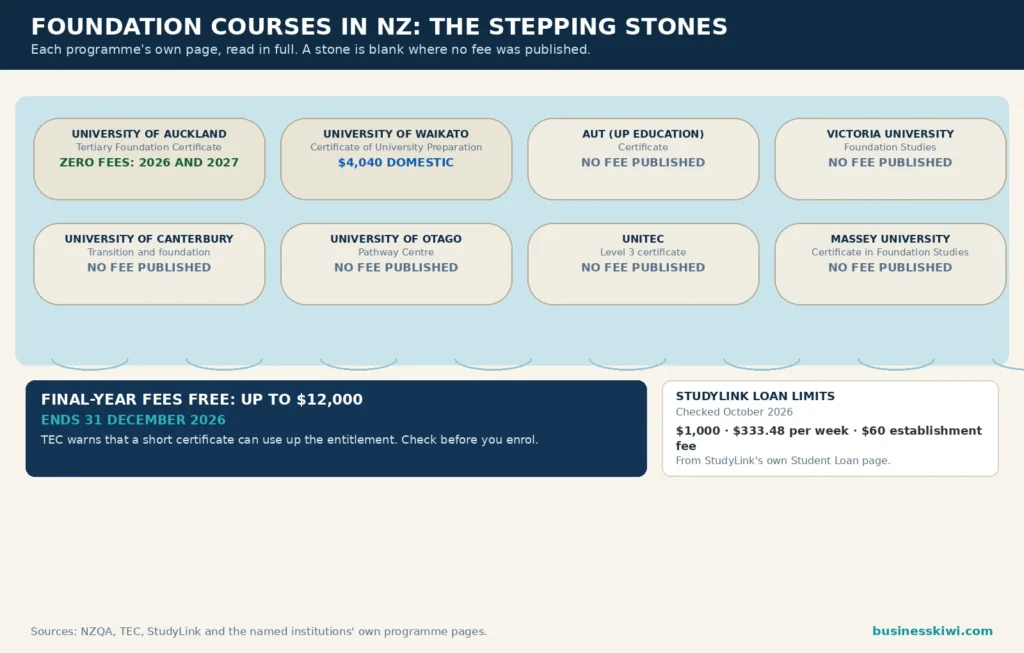
At Auckland, TFC courses incur zero fees in 2026, and Auckland’s Tai Tokerau page confirms zero fees again for 2027, with students retaining their full Fees Free eligibility for degree level studies. That is a specific, published position for that programme, not a sector wide rule.
Waikato’s page lists domestic fees of $4,040 for the one semester full time programme and international fees of $14,746, presented as per year figures. Lincoln’s fee estimate for 2027 is $3,359 domestic and $17,500 international for its 60 credit pathway certificate, and Lincoln notes the figures are estimates that may vary.
In the polytechnics, Ara publishes domestic fees for 2026 of $4,102 to $4,200 per year for its Level 4 Engineering Pathway, plus an indicative student services fee of $392.50 per year. Otago Polytechnic lists its Health Bridging Certificate at an approximate domestic tuition fee of $8,924 for the full qualification ($4,296 for Level 3 and $4,628 for Level 4), with international fees of $27,600, and notes the fees are approximate and exclude additional and living costs. Toi Ohomai lists no tuition fee for domestic students on its Level 2 certificate.
Funding support runs through StudyLink, and eligibility depends on you and the course. StudyLink’s own Student Loan page says a student loan can help pay for course fees, study materials and weekly living costs, and that you must meet residency criteria and be studying an approved course with an approved provider. For most people the residency test is New Zealand citizenship, or being ordinarily resident with at least three years living in New Zealand and at least three years holding a residence class visa. If you study full time, StudyLink publishes that you can borrow for compulsory course fees, course related costs up to $1,000, and living costs up to $333.48 a week, with a one off establishment fee of $60 added to your loan. Those are the figures on StudyLink’s page when checked in October 2026; check the current figures before relying on them. Part time students are more limited, students aged 55 or older can borrow only for compulsory course fees, and courses running more than a year require a fresh application each year.
A student allowance is different money: it helps with living costs and does not need to be repaid. Massey’s StudyLink guidance summarises the settings as requiring you to be a domestic student aged 18 to 65 and studying full time, with some part time and under 18 students also able to qualify, and parents’ income taken into account if you are under 24 and do not have children. Auckland’s TFC pages note eligible TFC students can apply for an allowance and living costs support through StudyLink. Whether you qualify is a StudyLink decision, so check with StudyLink directly.
Fees Free needs careful reading, because the settings have changed. The Tertiary Education Commission’s published guidance on final year Fees Free says the scheme now rewards completion: you may be able to get Fees Free if you complete your first eligible qualification or programme in 2025 or 2026, covering fees for the final year of study up to $12,000. You pay your fees when you enrol, using a student loan if you need one, and apply through Inland Revenue in myIR after completing, within 12 months. The government has confirmed Fees Free ends on 31 December 2026, and learners who complete after 2026 will not be eligible. The TEC also warns that some shorter qualifications, like certificates, completed before a degree or diploma may use your Fees Free entitlement, so check with your provider whether a short first certificate is eligible and what claiming would mean for a later degree. Auckland’s published TFC position, that students retain their full Fees Free eligibility for degree studies, shows programme specific arrangements exist.
Choosing a programme
Start with the destination, not the starting point. Name the diploma or degree you want, then work backwards to programmes whose published pathway leads there. A foundation certificate designed for one university’s degrees is the strongest preparation for that university. A polytechnic Level 3 or 4 certificate is the strongest preparation for that polytechnic’s diplomas and degrees.
Check the level against your current credits. If you left school with little or no NCEA, an open entry Level 2 programme may be the honest starting point; these programmes are built for second chances. If you have solid NCEA Level 2 credits but missed UE, a university preparation certificate or a Level 4 polytechnic pathway will usually move you faster. If you only just missed UE, ask about diploma style routes into degree level courses with support, of the kind Canterbury and Otago describe.
Look hard at delivery and workload. Some programmes are on campus only, some blend online learning with block courses, and Massey offers its foundation core by distance. Waikato’s estimate of up to 17 hours of class plus around 20 hours of self directed study, and Otago Polytechnic’s expectation of around 40 hours a week for its full time health bridging programme, tell you these are real commitments, and Auckland advises keeping paid work near ten hours a week during TFC. Part time versions exist at Waikato, Unitec, Ara and Otago Polytechnic, but they take longer, and funding rules can treat part time study differently.
Compare the full cost, not the headline fee, and check your StudyLink position early, because loan and allowance applications take time. Short free online courses can help you test your readiness for academic writing or maths before you commit. If you are weighing up engineering courses later in your pathway, a Level 4 engineering pathway certificate gives you the maths and physics grounding first, a safer sequence than discovering the gap inside a diploma.
Frequently asked questions
What is the difference between a foundation course and a bridging course in NZ?
Providers use the terms loosely. Foundation usually describes a fuller preparation programme, often a semester or a year, that builds broad academic skills before degree or diploma study. Bridging often describes a shorter or more targeted programme that fills a specific gap, such as Otago Polytechnic’s health bridging route into nursing and related degrees. Judge any programme by its level, content and published next step, not its label.
Will a foundation certificate give me University Entrance?
Some do and some do not. Auckland describes TFC as a University Entrance equivalent, Waikato says its preparation certificate gives you University Entrance, and Otago describes its Foundation Studies Certificate as a university entrance qualification. Lincoln, by contrast, states its pathway certificate is not a university entrance qualification in itself, and Unitec states its Level 3 certificate is not equivalent to NCEA Level 3. Check the exact wording for your programme.
How long do foundation and bridging programmes take?
Published durations in this guide range from 16 weeks full time for Unitec’s Level 3 certificate and 19 weeks for Ara’s Level 4 certificates, through one trimester at Waikato, half a year at Lincoln, eight months for Canterbury’s international foundation certificate, and a full year for Massey’s foundation certificate studied full time and Otago Polytechnic’s health bridging route. Part time study extends each of these, in some cases to two years.
What do foundation courses cost in NZ?
There is no single price. Published domestic figures in this guide include zero fees for Auckland’s Tertiary Foundation Certificate in 2026 and 2027, no tuition fee for domestic students on Toi Ohomai’s Level 2 certificate, $3,359 as Lincoln’s 2027 domestic estimate, $4,040 listed by Waikato, $4,102 to $4,200 for 2026 on Ara’s Level 4 Engineering Pathway, and approximately $8,924 across both levels of Otago Polytechnic’s health bridging certificate. International programmes cost considerably more. Fees change each year, so confirm the current fee for your intake.
Can I get a student loan or student allowance for a foundation course?
Possibly, if you meet StudyLink’s criteria and the course is an approved course with an approved provider. Full time students can borrow for compulsory fees, course related costs and living costs within published limits. An allowance may also be available if you meet its conditions, which in the usual case include being a domestic student aged 18 to 65 studying full time. Eligibility is individual, so check with StudyLink before you enrol.
Does completing a foundation programme guarantee me a place in a degree?
It depends on the programme. Victoria University of Wellington describes guaranteed entry for successful foundation students, and Auckland describes guaranteed entry to specified faculties for TFC graduates with the required subjects and grades. AUT publishes grade thresholds you must meet to progress. Otago Polytechnic, by contrast, says health bridging completion may help you meet academic entry requirements but does not guarantee a place in high demand health degrees. Read the progression wording for your exact programme.
I left school years ago with no qualifications. Where do I start?
Start with an open entry programme at the right level. Toi Ohomai’s Level 2 certificate has open entry and no minimum academic requirements, Otago Polytechnic’s health bridging certificate is open entry, and Ara allows alternative entry to its Level 4 certificates where you can show equivalent skills from work or life experience. Providers also run skills reviews and adviser conversations to place you correctly, so you do not need to guess your starting level alone.
Will a foundation certificate use up my Fees Free entitlement?
It might. The Tertiary Education Commission warns that some shorter qualifications, like certificates, completed before a degree or diploma may use your Fees Free entitlement, and final year Fees Free ends on 31 December 2026, applying only to first eligible qualifications completed in 2025 or 2026. Some programmes carry their own published position; Auckland states TFC students retain their full Fees Free eligibility for degree studies. Ask your provider before you complete the programme.
Sources
- NZQA, Understanding the New Zealand Qualifications and Credentials Framework: https://www2.nzqa.govt.nz/about-us/news/understanding-the-new-zealand-qualifications-and-credentials-framework/
- Tertiary Education Commission, Communications pack for TEOs, final-year Fees Free: https://www.tec.govt.nz/funding/fund-finder/final-year-fees-free/communications-pack-for-teos
- StudyLink, Student Loan: https://STUDYLINK.GOVT.NZ/products/a-z-products/student-loan/index.html
- University of Auckland, TFC fees, examinations and regulations: https://www.auckland.ac.nz/en/study/study-options/undergraduate-study-options/preparation-and-foundation-programmes/tertiary-foundation-certificate/tfc-fees-examinations-and-regulations.html
- University of Auckland, TFC Tai Tokerau: https://www.auckland.ac.nz/en/study/study-options/undergraduate-study-options/preparation-and-foundation-programmes/tertiary-foundation-certificate/tfc-taitokerau.html
- University of Waikato, Certificate of University Preparation: https://www.waikato.ac.nz/study/qualifications/certificate-of-university-preparation/
- Massey University, Certificate in Foundation Studies: https://www.massey.ac.nz/study/all-qualifications-and-degrees/certificate-in-foundation-studies-SCFNS/
- Massey University, StudyLink student loans and allowances: https://www.massey.ac.nz/study/fees-and-funding/studylink-student-loans-and-allowances/
- AUT Certificate in Foundation Studies (UP Education, on behalf of AUT): https://aut.up.education/certificate-in-foundation-studies/
- Victoria University of Wellington, Foundation Studies (International): https://www.wgtn.ac.nz/international/study-options/foundation-studies
- University of Canterbury, Transition programmes: https://canterbury.ac.nz/study/other-study-options/transition-programmes
- University of Canterbury, Foundation studies certificate: https://www.canterbury.ac.nz/study/other-study-options/transition-programmes/pathways-for-international-students/certificate-in-foundation-studies
- University of Otago, Pathway and English Language Centre, About us: https://www.otago.ac.nz/uolcfy/about
- Lincoln University, Pathway Certificate (Foundation): https://www.lincoln.ac.nz/study/study-programmes/programme-search/pathway-certificate-foundation/
- Unitec, New Zealand Certificate in Study and Employment Pathways (Level 3): https://www.unitec.ac.nz/career-and-study-options/foundation-and-bridging-education/new-zealand-certificate-in-study-and-career-preparation-level/
- Ara Institute of Canterbury, New Zealand Certificate in Study and Employment (Level 4) Engineering Pathway: https://www.ara.ac.nz/products/programme/nz2860-epc-new-zealand-certificate-in-study-and-employment-level-4-engineering-pathway/
- Otago Polytechnic, Pathways: https://www.op.ac.nz/study/pathways
- Otago Polytechnic, Health Bridging Certificate (Level 3 and 4): https://www.op.ac.nz/programmes/nzqa/health-bridging-certificate-level-3-and-4
- Toi Ohomai Institute of Technology, New Zealand Certificate in Foundation Skills (Level 2): https://toiohomai.ac.nz/study/course/new-zealand-certificate-foundation-skills-level-2
This article is general information about foundation and bridging study options in New Zealand. It is not personalised education, careers or financial advice. Programme names, entry requirements, fees and funding settings change, and providers publish the current settings for each intake. Check the programme page for the institution you are considering, confirm your funding position with StudyLink, and talk to the provider’s student advisers before you enrol.