Plastic Tubing in NZ: Materials, Sizes, Uses and What to Check Before You Buy
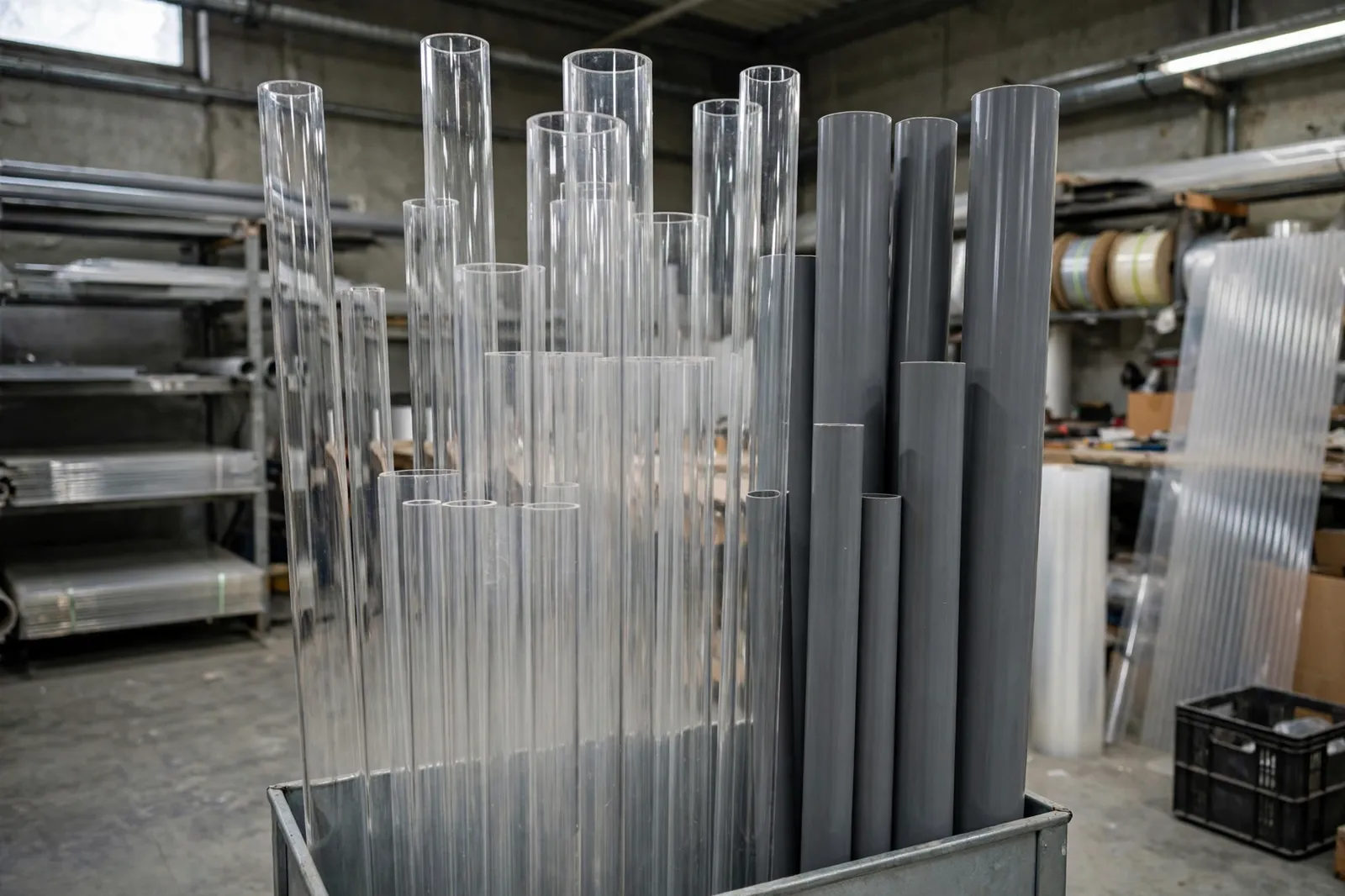
Search for a plastic tube in New Zealand and the results pull in several directions at once. One listing is a crystal clear tube for a shop display. The next is a grey engineering tube a machinist will turn into a spacer or pump part. Further down sits a white pressure pipe rated for a water supply, and in the mix there is usually a coil of soft hose that has almost nothing in common with any of them.
Hard plastic tubing is a rigid, hollow profile that holds its shape without support. Suppliers sell it as a stock shape, alongside rod and sheet, to be cut, machined, glued or welded into something else. Flexible hose and flexible pneumatic tubing are different products, chosen for routing rather than for structure or appearance.
With rigid tube you choose a material, an outside diameter, an inside diameter and a wall thickness. With a plumbing pipe you also choose a pressure rating and a manufacturing standard. This guide works through the main materials, sizing, joining, uses and buying in New Zealand, using what NZ suppliers publish about their own ranges.
Rigid tube, pipe, rod and hose: getting the names straight
A tube is hollow, with an outside dimension, an inside dimension and a wall. A rod is solid. LEP Engineering Plastics lists acrylic rod and acrylic tube as separate products with separate size ranges, and Cambrian Plastics does the same. If something needs to carry liquid, pass a cable through or act as a display cylinder, you want tube. If it needs to be a solid handle or bar, you want rod.
Pipe is a tube with a job and a rating. Plumbing pipe is made to a standard, carries a pressure class where it is a pressure pipe, and belongs to a system of matching fittings. Marley, which manufactures in New Zealand, describes its white Series 1 water supply pipe as unplasticised PVC made to AS/NZS 1477:2006, with stated pressure ratings and jointing that varies by size. A clear acrylic tube is not a pipe in that sense, however similar it looks.
Hose is soft, usually sold by the coil or by the metre off a reel, and is not expected to hold a straight line or carry a load. LEP says tube and profiles in various shapes and forms are available on request, but round tube dominates the published NZ ranges and is where most buyers should start.
The main materials
Match the material to the environment first and to appearance second.
PVC and uPVC
PVC is the workhorse. LEP describes it as a rigid plastic, usually grey, with very high resistance to many chemicals including concentrated acids, alkalis and alcohols, good mechanical strength and easy machining. It can be milled, turned, drilled and tapped, moisture absorption is low at 0.2 percent, and it has good electrical insulating properties. LEP gives a temperature range of minus 15 to plus 60 degrees Celsius, tube from 50 mm to 160 mm, and a standard tube length of 2000 mm.
Dotmar puts numbers beside those claims in its comparison of HDPE, polypropylene and PVC stock shapes. PVC is the stronger, stiffer and heavier of the three there, with tensile strength of 55 MPa, tensile modulus of 3000 MPa, specific gravity of 1.44 so it sinks in water, and the lowest thermal conductivity of the three at 0.16 W/(m.K). Dotmar also records PVC as highly resistant on flammability at UL94 V0, grey as the stocked colour, and long term allowable temperature of minus 20 to 60 degrees Celsius in that comparison.
Supply Services, a NZ engineering plastics supplier, explains that rigid PVC is also known as unplasticised PVC, or uPVC, meaning no plasticisers have been added and the material is hard and rigid rather than soft and flexible. Marley makes the same point about its uPVC pipe. Supply Services carries limited stock of rigid PVC tube, gives a general range of 5 mm inside diameter to 230 mm outside diameter, and describes rigid PVC as easy to weld, bond and machine, used for pumps, valve bodies, manifolds, tanks, spacers and insulators.
Two limits matter. Dotmar’s comparison marks PVC stock shape as not suitable for food contact and not suitable for drinking water in the context it covers, while Marley’s purpose made uPVC water pipe is a different, standardised product made for that use. The two are not interchangeable. Dotmar also records PVC as not UV resistant there, so outdoor use needs a grade or system made for it.
For joining, LEP notes that rigid PVC is solvent cementable, that the same solvent cement used for PVC plumbing works on rigid PVC components, and that it can also be bonded to other materials with a general purpose epoxy resin.
HDPE and the polyethylene family
HDPE is high density polyethylene. In Dotmar’s comparison it has specific gravity of 0.96, so it floats, tensile strength of 24 MPa and stiffness of 1000 MPa, well below PVC on both. What it gives back is toughness in wet and chemical environments and a wider cold range, with long term allowable temperature of minus 50 to 80 degrees Celsius and moderate wear resistance. Dotmar records HDPE as suitable for food contact, and its pipe grade Polystone PG100 as suitable for drinking water.
LEP’s HDPE page is sheet focused, itself a buying signal, but its properties explain where polyethylene tube and pipe turn up. LEP describes HDPE as having excellent chemical resistance, very low moisture absorption, a low coefficient of friction, good wear properties, very high impact strength and suitability for food contact, across minus 100 to plus 80 degrees Celsius on that page. Its family guide adds that PE300 grade is more rigid than polypropylene, is often used as liners in chemical plants and tanks, and has a working range of minus 40 to plus 80 degrees Celsius there.
Polyethylene is a ladder, not a single material. As molecular weight rises through HDPE and HMWPE to UHMWPE, wear, impact and stress cracking resistance improve. Expect questions about grade for wear parts, and a move to purpose made polyethylene pipe and fittings for water. HDPE is less stiff than PVC, moves more with temperature, and is not solvent cemented the way PVC is. Dotmar describes all three stock shapes as weldable, thermoformable and machinable.
Acrylic (PMMA)
Acrylic is the clear tube most people picture first. LEP gives its chemical name as polymethyl methacrylate, notes the trade names Perspex and Plexiglas, and describes its standout characteristic as transparency comparable to glass. It lists tube from 5 mm to 200 mm with a standard length of 2000 mm, rod from 3 mm to 125 mm, and a temperature range of minus 30 to plus 80 degrees Celsius.
Cambrian Plastics publishes the most detailed clear acrylic tube range read for this guide, in lengths of 1000 mm and 2000 mm, with a maximum of two metres in one run, and in diameter pairings running from very small tubes up to 200 mm by 190 mm. Pairings named there include 10 mm by 6 mm, 12 mm by 8 mm, 25 mm by 19 mm, 25 mm by 21 mm, 30 mm by 20 mm, 50 mm by 40 mm, 100 mm by 90 mm and 100 mm by 94 mm. At the small end this is a lighting and model making material. At the large end it becomes a display cylinder, guard or vessel component.
LEP lists good weather resistance, high optical transparency, low moisture absorption, good insulating properties, solvent cementability and high scratch resistance for acrylic, with uses including signage and displays, sight glasses, feed hoppers, machine guards and decorative fittings. It says acrylic tubing is used extensively in small feed hoppers and as sight glasses for liquid storage tanks where chemical compatibility is maintained, resists most detergents, cleaning agents, food oils and lubricants, can be heat formed, and is readily glued with an acrylic solvent cement.
PSP Limited gives panel properties of density 1.19 g/cm3, light transmission of 92 percent for clear, service temperature of 80 degrees Celsius, and forming temperature of 160 to 175 degrees Celsius for its general purpose cast acrylic. Mulford Plastics’ NZ flyer for impact modified extruded acrylic gives the same density and light transmission, tensile strength of 55 MPa, flexural strength of 85 MPa, service temperature of 70 degrees Celsius and Vicat softening temperature of 98 degrees Celsius, and describes that product as up to ten times as tough as conventional acrylic while remaining lightweight, weather resistant and easy to fabricate.
Standard clear acrylic gives the cleanest look. Impact modified acrylic trades a little purity for toughness. Neither is a pressure pipe. Keep acrylic for visibility, display, guards, hoppers and sight glasses, and check chemical compatibility first.
Polycarbonate
Polycarbonate is the clear material for impact risk. LEP describes it as transparent with high light permeability and minimal water absorption, so it stays dimensionally stable in damp conditions. It calls it hard and dimensionally rigid with remarkable impact strength, describes it as virtually unbreakable, and notes it is self extinguishing and flame resistant, retains its properties as low as minus 60 degrees Celsius, can be heat or cold formed, and is solvent cementable. LEP also describes it as physiologically inert and suitable for the food sector, with uses including covers, housings, machine guards, safety glazing and electrical insulators.
A gap is worth stating. The LEP polycarbonate page read in full lists rod and sheet, not a tube range. Bay Plastic Fabrication in Tauranga lists acrylic and polycarbonate tube and rod among its materials, in full sheets or cut to size. Confirm the exact tube sizes held rather than assuming the rod and tube ranges match.
ABS
ABS is acrylonitrile butadiene styrene. LEP describes it as an easily machined, soft cream coloured plastic with a low melting point of 120 degrees Celsius, a temperature range of minus 15 to plus 60 degrees Celsius, and excellent impact strength. It can be turned, bored, drilled, sheared and routed, is easily thermoformed, reproduces mould detail well, is solvent cementable, welds easily, and has good resistance to many salt solutions, alkalis, mineral acids and oils.
ABS tube is a fabrication and prototyping material more than a display material. It is opaque, machines cleanly, and suits housings, formed parts and models where toughness matters more than clarity. Bay Plastic lists ABS among its fabrication materials and Supply Services includes it in its engineering range. Tube dimensions need confirming for the grade wanted.
Polypropylene and other engineering tubes
Polypropylene sits beside HDPE and PVC in Dotmar’s comparison, with tensile strength above 30 MPa, stiffness of 1500 MPa, specific gravity of 0.91, long term allowable temperature of 0 to 100 degrees Celsius, good ozone resistance, and suitability for food contact, with drinking water suitability limited to the non UV grade there. It suits chemical and food related fabrication where its temperature range helps.
Beyond those materials, engineering suppliers hold tube as a machining blank as much as a finished product. LEP’s range spans more than 30 types of industrial plastic, including nylon, acetal, PETP, PEEK, PTFE and UHMWPE, with tube and profiles available on request. A nylon or UHMWPE tube is often bought so a machinist can finish a bush, roller or wear part to an exact size.
Forms: round, square, rectangular, and the rod distinction
Round tube is the default. It is what Cambrian lists in depth for clear acrylic and what LEP lists for acrylic and PVC, and it suits anything that flows, rotates, telescopes or needs a clean cylindrical look.
Square and rectangular tube exist, but NZ evidence read here is thinner. The clearest everyday example is the rectangular downpipe profile in uPVC rainwater systems, where a flat sided profile sits better against a wall. Marley’s range includes rectangular downpipes alongside its round RP80 and RP65 downpipes. For display work, treat square or rectangular clear tube as a confirm first product and ask what profile, dimensions, wall and length the supplier actually holds.
Rod deserves a second mention because the mistake is common. If a project needs a solid clear bar for a handle or support, rod is correct and tube will disappoint. If it needs to pass light, liquid, cable or another component through the middle, only tube will do. Check the product name, not just the diameter. Twin wall and corrugated profiles belong mainly to roofing, drainage and ducting, and are not a substitute for smooth bore rigid tube.
Sizing: outside diameter, inside diameter and wall thickness
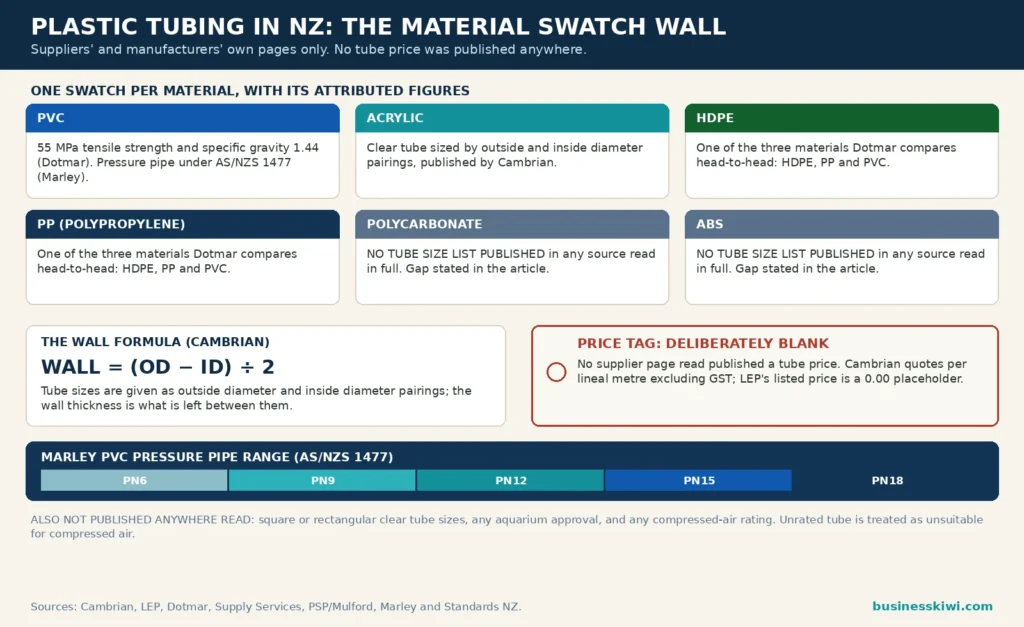
Three numbers describe a round tube: outside diameter (OD), inside diameter (ID) and wall thickness. Any two determine the third. Cambrian gives the formula: outside minus inside, divided by two, because the wall appears on both sides. A 10 mm by 6 mm tube has a 2 mm wall, a 25 mm by 19 mm tube a 3 mm wall, and a 50 mm by 40 mm tube a 5 mm wall.
Two tubes can share an outside diameter and behave differently. Cambrian lists both 25 mm by 19 mm and 25 mm by 21 mm, walls of 3 mm and 2 mm on the same outside diameter. The thicker wall is stiffer and heavier, and leaves a smaller bore.
Pipe sizing uses distinct language. Marley sizes water supply pipes in DN, nominal diameter, across ranges such as 15 DN to 375 DN for Series 1 uPVC, and separates Series 1 metric pipes from Series 2 pipes in imperial measurements with increased outside diameter sizing to join to steel pipes. A DN number is a system size tied to compatible fittings, not a promise that a vernier will read exactly that number outside the pipe. Mixing a DN pipe with a display tube of similar diameter, or a fitting from another series, is a reliable way to build a leak.
Length is the fourth dimension. Cambrian offers clear acrylic tube in 1000 mm and 2000 mm, with a maximum of two metres in one run. LEP gives a standard tube length of 2000 mm for its acrylic and PVC tube. Decide whether you need a full length, a cut length or several identical cut lengths, because that choice affects price, freight and waste. Tolerance matters too. PSP publishes a gauge tolerance of plus or minus 8 percent for its cast acrylic sheet, a reminder that plastics carry manufacturing tolerance. For a tube that must fit another component, measure actual stock or ask for the tolerance in writing.
Cutting, joining and working rigid tube
Cambrian offers clear acrylic tube cut to size, with a stated lead time of 24 to 72 hours depending on workload and quantity. LEP offers rod, sheet and tube cut to size, backed by machine shops in Auckland and Christchurch. Bay Plastic offers precision cutting including laser cutting, alongside bending and bonding. Where accuracy matters, order cut lengths from the supplier and keep home cutting for rough sizing.
Joining depends on material. PVC is solvent cementable, and LEP is explicit that plumbing solvent cement works on rigid PVC components as well as pipe. Acrylic is readily glued with an acrylic solvent cement, and LEP also describes polycarbonate as solvent cementable. ABS is solvent cementable and welds easily. Those methods support neat, permanent joints for fabrication, guards, tanks and display work. They do not turn a fabricated joint into a pressure rated pipe joint. For pipe systems, Marley’s jointing is system specific, with rubber ring joints and solvent joints in stated size bands. Use the joint the system specifies.
Welding and machining broaden the options. Dotmar describes HDPE, polypropylene and PVC stock shapes as weldable, thermoformable and machinable. Supply Services offers CAD and CNC machining to turn stock into finished parts.
Bending needs cooled expectations. Acrylic can be heat formed, and PSP gives a forming temperature of 160 to 175 degrees Celsius for its cast acrylic sheet, with a minimum cold bending radius of 330 times the sheet thickness for that sheet product. Those figures are not a tube bending recipe, but they show that cold bending acrylic is severely limited and real bends need controlled heat and practice, or a fabricated joint instead. LEP says polycarbonate can be heat or cold formed. Even then, a tight bend in a hollow tube risks flattening or thinning the wall. Straight lengths joined with purpose made bends usually look better and last longer.
Heat has a second consequence. LEP gives plus 60 degrees Celsius as the top of its PVC and ABS ranges, PSP gives 80 degrees for its cast acrylic, and Mulford gives 70 degrees for its impact modified acrylic. Check the published limit for the exact product before placing tube beside a motor, lamp or hot process.
Where rigid tube is used
Plumbing and drainage are the most regulated uses. Marley’s uPVC water supply pipe is made to AS/NZS 1477:2006 in Series 1 and Series 2, with pressure ratings including PN6, PN9, PN12 and PN15 for the white Series 1 range, and PN12, PN16 and PN18 for the blue Series 2 range. Its modified PVC ranges are made to AS/NZS 4765:2017. Standards New Zealand records that the AS/NZS 3500 plumbing and drainage series sets out design and installation requirements in New Zealand and Australia, and that the 2018 editions remained in force as a means of complying with Building Code clauses E1, G12 and G13 at the time of its 2021 update. Building plumbing and drainage are standards based, system based and, for most sanitary work, licensed trade work. Do not substitute display tube or unrated profile because the diameter looks close.
Rural work follows the same system logic at larger sizes. Marley’s Agriduct culvert pipe is a uPVC culvert product for gateway crossings, piping open drains and other farm uses, solvent socketed for all sizes, in diameters listed from 100 mm to 375 mm, able to use large diameter uPVC Stormline fittings, with ground cover of 500 mm where there is no traffic load and light stock movement, and 700 mm under traffic loads and heavy movement, as stated on Marley’s page.
Aquariums, displays and lighting are the natural home of clear tube. Cambrian names stabilisers, buffers, lighting and point of sale displays among the uses for its clear acrylic tube, and notes demand including use with LED strip lighting and for making light sabres. LEP adds sight glasses and feed hoppers. For an aquarium build, confirm that the specific acrylic, cement and sealant suit the livestock and water involved. None of the pages read publishes an aquarium safety approval for a named tube, so do not treat clear as a synonym for aquarium safe.
Pneumatics needs a careful boundary. Compressed air work normally uses flexible pneumatic tubing and rated fittings, not clear display tube, and none of the tube pages read publishes a compressed air rating for those tubes. The only pressure ratings in the sources read are Marley’s PN ratings for water supply pipes, and a water rating is not an invitation to use that pipe for air. Treat any unrated rigid tube as unsuitable for compressed air, however strong it feels.
DIY and prototyping sit comfortably with rigid tube if the material choice is honest. Bay Plastic’s prototyping service develops working prototypes before production runs, for one off pieces or larger batches, using precision cutting, bending and bonding. LEP offers custom engineered parts alongside its stock shapes. Acrylic suits a prototype that must look finished, polycarbonate or ABS one that must survive handling, and PVC or a polyolefin one that needs chemical resistance.

Buying plastic tubing in NZ: lengths, cut to size, delivery and prices
The NZ market splits into three routes. Clear display tube is sold most like a retail product, with named sizes and per metre pricing language. Engineering tube is sold most like a trade stock shape, with ranges, grades and quotes. Plumbing pipe is sold as a system through merchants, with fittings, ratings and standards attached.
Cambrian is the clearest example of the first route. It states that prices for its clear acrylic tube are excluding GST and per lineal metre, that tube is available cut to size, that the maximum length in one run is two metres, and that cutting takes 24 to 72 hours depending on workload and quantity.
LEP represents the second route. It publishes ranges and standard lengths, offers rod, sheet and tube cut to size, and holds manufacturing capacity in Auckland and Christchurch. Supply Services holds uPVC stock ready for cutting and shipping, offers cut to size plastics with CAD and CNC services, and imports special sizes with regular shipments. Dotmar positions itself around stock holding, machining and custom manufacturing. On this route price is normally a quote, because grade, diameter pairing, length, machining and quantity all move it.
Bay Plastic illustrates the fabrication route. It supplies acrylic and polycarbonate tube and rod, couriers panels anywhere in New Zealand with sheets up to 1800 mm by standard courier and larger sheets by Mainfreight, and dispatches cut orders usually within a few working days of payment. Those delivery details are published for its panels, so confirm how a long tube will be freighted before ordering.
Prices need an honest paragraph. None of the NZ supplier pages read in full published a readable dollar price for a named rigid tube. Cambrian publishes the basis, per lineal metre excluding GST, without the individual variant figures being readable in the page text retrieved. The other suppliers publish ranges and services without tube prices on the pages read. Merchant prices for Marley pipe seen during research were not used, because a retailer’s listing is not the manufacturer’s published price. This guide therefore gives no average, typical or per metre price. It can give the checklist that controls a quote: material and grade, OD and ID, wall, length and number of cuts, machining, quantity, and freight.
Before ordering, confirm the material by its full name, and OD, ID and wall as three numbers. Confirm full length or cut length, the jointing method, and that fittings and cements are from a compatible range. Confirm temperature and chemical environment against the manufacturer’s limits for that exact product, and for plumbing or pressure use, the standard, rating and who is allowed to install it.
Frequently asked questions
What is the difference between plastic tube and plastic pipe?
A tube is a hollow stock shape sold by material and dimensions. A pipe is a tube made to a standard for a system, with compatible fittings and, for pressure pipe, a published pressure rating. Marley’s uPVC water supply pipe made to AS/NZS 1477 is pipe. A clear acrylic display tube is tube, even if the diameters look similar.
How do I work out the wall thickness of a plastic tube?
Subtract the inside diameter from the outside diameter and divide by two, the formula Cambrian publishes. A 50 mm outside by 40 mm inside tube has a 5 mm wall. Check both diameters, because the same outside diameter can be sold with different walls.
Can I use clear acrylic tube for plumbing or compressed air?
No. The acrylic tube pages read publish display, lighting, sight glass and hopper uses, with no plumbing standard and no pressure rating. Plumbing needs a rated pipe system, and compressed air needs a product its manufacturer publishes for that duty.
What is the longest clear acrylic tube I can buy in NZ?
Cambrian states a maximum of two metres in one run, offered in 1000 mm and 2000 mm lengths. LEP gives a standard acrylic tube length of 2000 mm. Longer clear runs will normally need joining or a fabricated solution.
Which is stronger, acrylic tube or polycarbonate tube?
They are strong in different ways. Acrylic offers high optical clarity and high scratch resistance. Polycarbonate offers remarkable impact strength and is described by LEP as virtually unbreakable. Choose acrylic for appearance, polycarbonate where knocks and safety are the concern.
Can rigid PVC tube be glued?
Yes. LEP states that rigid PVC is solvent cementable and that the solvent cement used for PVC plumbing is effective on rigid PVC components, and that it can also be bonded to other substrates with a general purpose epoxy resin. For a pressure pipe system, use the joint type and fittings the manufacturer specifies.
Why do suppliers quote some tubes and list others by the metre?
Display tube in standard sizes suits per metre pricing, the model Cambrian publishes, excluding GST. Engineering tube varies by grade, diameter pairing, machining and quantity, so suppliers such as LEP and Supply Services work by quote. Plumbing pipe is priced as a system product through merchants.
Is uPVC different from PVC tube?
uPVC is unplasticised PVC. Supply Services explains that no plasticisers are added, so the material is hard and rigid rather than soft and flexible. Marley uses uPVC for its standardised water supply pipes. Only the pipe carries the pipe standard and rating.
Sources
- Cambrian Plastics, Acrylic Tube (Clear): https://cambrianplastics.co.nz/product/acrylic-tube/
- LEP Engineering Plastics, Acrylic PMMA Tube: https://lep.co.nz/shop/industrial-plastics-rod-sheet-tube/acrylic-tube/
- LEP Engineering Plastics, PVC Rods (PVC tube availability and properties): https://lep.co.nz/shop/industrial-plastics-rod-sheet-tube/rods/pvc-rods/
- LEP Engineering Plastics, ABS: https://lep.co.nz/materials-plastics-selection-guide/abs/
- LEP Engineering Plastics, Polycarbonate Sheets (polycarbonate properties): https://lep.co.nz/shop/industrial-plastics-rod-sheet-tube/sheets/polycarbonate-sheets/
- LEP Engineering Plastics, HDPE Sheet (HDPE properties): https://lep.co.nz/shop/industrial-plastics-rod-sheet-tube/sheets/hdpe-sheet/
- LEP Engineering Plastics, Polyethylene: The Difference Between UHMWPE, HMWPE, HDPE and LDPE: https://lep.co.nz/polyethylene-the-difference-between-uhmwpe-hmwpe-hdpe-ldpe/
- LEP Engineering Plastics, About Us (rod, sheet and tube cut to size): https://lep.co.nz/about-us/
- Dotmar, HDPE vs PP vs PVC: https://www.dotmar.co.nz/insights/educational/HDPE-vs-PP-vs-PVC
- Supply Services, Engineering Plastic Rod and Rigid PVC Sheet Supplier NZ: https://www.supplyservices.co.nz/pvc-rod-sheet-supplier/
- PSP Limited, General Purpose Cast Acrylic: https://psp.co.nz/cdn/shop/files/General_Purpose_Cast_Acrylic.pdf?v=3330756781592840985
- Mulford Plastics, Impact Modified Extruded Acrylic product flyer NZ: https://www.mulfordplastics.co.nz/media/bncp20jr/impact-modified-acrylic-product-flyer-nz.pdf
- Bay Plastic Fabrication, Cut to Size Plastic and Perspex, Tauranga: https://www.bayplastic.co.nz
- Marley New Zealand, PVC Water Supply: https://marley.co.nz/products/plumbing-civil/water-supply/pvc-water-supply/
- Marley New Zealand, Agriduct Culvert Pipe: https://marley.co.nz/products/rural/agriduct-culvert-pipe/
- Standards New Zealand, Plumbing and drainage joint standards get an overhaul: https://www.standards.govt.nz/news-and-updates/plumbing-and-drainage-joint-standards-get-an-overhaul
This article is general information about rigid plastic tubing materials, sizes and buying in New Zealand. It is not engineering, plumbing or building advice for a specific project. Product ranges, sizes and services change, so confirm dimensions, ratings, standards and suitability with the manufacturer or supplier for the exact product before ordering, and use a licensed plumber or drainlayer where the law or the Building Code requires one.