Commercial Building Insurance in NZ: Cover, Rebuild Values and the Traps That Catch Owners Out

Own a commercial building and it is probably the largest single asset on your balance sheet. A workshop in Hamilton, a block of shops in Invercargill, a small warehouse you lease to a manufacturer: each one carries the same basic exposure. Fire, storm damage or a burst pipe can turn an income-producing asset into a demolition problem in a single night. Commercial building insurance is the contract that decides whether that night ends the investment or merely interrupts it.
It is also a contract owners routinely misunderstand. The Insurance Council of New Zealand (ICNZ) points out that a policy has two parts: the schedule, which records what you have insured and for how much, and the wording, which sets out what is covered and what is not. Most expensive mistakes happen before any claim is made: insuring for the wrong amount, assuming the government scheme behind house insurance also sits behind commercial cover, or failing to tell the insurer something that later gives it grounds to walk away. This guide works through how the cover is put together in New Zealand, what the insurers’ own documents say, and where owners get caught.
What commercial building insurance is
Commercial building insurance is the part of a business insurance package that protects the physical asset: the building structure and the fixed parts the owner is responsible for. In the New Zealand market the building cover is usually written as a material damage policy. NZI describes its commercial property cover as a Material Damage policy paying the repair or replacement cost of a business’s physical assets on accidental loss or damage. AMI puts its building cover the same way: its Business Assets product includes Material Damage cover for buildings you own, alongside contents, stock and equipment at your premises.
The building rarely sits in a policy on its own. Insurers sell commercial cover as sections an owner picks from, and the building section is one item on a longer menu. Vero’s BusinessPlan, for example, lets a business choose from business vehicles, material damage, business interruption, broadform liability, employers liability, statutory liability and machinery breakdown. NZI likewise treats business interruption as its own cover sitting alongside material damage, and Ando sells commercial property within a wider business range running from liability to marine and transit. The liability sections in these packages, the covers most owners know as public liability insurance, respond when a business is legally required to pay compensation for personal injury or property damage. Where the building cover ends and the neighbouring sections begin matters at claim time, because building damage is one claim problem and the income lost while it is repaired is a different one, handled by business interruption cover, not the building section.
Two consequences follow. The sum insured you set for the building is the ceiling on what the building section can pay, whatever the wider package costs. And the exclusions in the material damage wording apply even if another section would have responded. Reading the package as a single blob is how gaps stay hidden until a loss exposes them.
How it differs from house insurance
Owners who arrive at commercial cover from insuring their own home bring three assumptions with them, and all three are unsafe.
The first is that a government scheme stands behind the policy. For a house, a private fire policy carries EQCover, the Natural Hazards Commission Toka Tū Ake scheme that covers residential buildings against natural hazards. Commercial premises are outside that scheme. The Commission’s own published explanation of mixed use buildings is blunt: the non-residential parts of a building are not insured by EQC, and insurance and repair costs for commercial areas are a matter for the owner, the body corporate and their insurer. A purely commercial building has no EQCover layer at all: whatever natural disaster protection it has must come from its own commercial policy.
The second assumption is that the insurer sets the value. Under a sum insured policy the owner chooses the figure, and ICNZ is explicit that the responsibility sits with the owner. Set it too low and the shortfall is yours; set it too high and you pay for cover that will never be paid out.
The third assumption is that you buy it the way you buy house insurance. Much of the commercial market does not work that way. ICNZ notes that some insurers only sell through brokers, and both Vero and Ando state that their business policies are arranged through brokers or advisers rather than sold direct.
What the cover responds to
Material damage cover is built around accidental loss or damage to insured property at the premises. NZI describes its policy as covering the cost of repairing or replacing the business’s physical assets, including the premises a fixed location business owns. AMI frames its cover the same way: loss or damage at your premises to buildings you own, contents, stock and equipment.
The events owners most often ask about sit inside that accidental damage frame, and the insurers’ own documents fill in detail around the edges. Vero’s BusinessPlan wording, for instance, extends its material damage section to the reasonable costs of protecting your property when a neighbouring property is on fire, and to demolishing or removing undamaged parts where that is needed to reinstate the damaged property. The same insurer’s product page lists cover for assets and stock in transit, and theft from locked vehicles, among its material damage features. These are examples from one insurer’s documents, not a market standard, and they show why the wording, not the brochure, is the document that counts.
Natural disaster damage is dealt with expressly in commercial wordings rather than left to a government scheme: Vero’s wording treats it as its own defined category, and parts of the policy that lift other limits specifically do not apply to it. What a policy does with earthquake, flood and storm risk is a wording question, settled by reading your own policy rather than assuming it mirrors a house policy.
Some losses that look like building problems are handled elsewhere in the package. Machinery breakdown is the clearest example: Vero’s material damage section excludes it as a cause, then responds through a separate machinery breakdown cover. Building damage and plant breakdown are different sections with different conditions, and an owner who assumes the building policy quietly covers both has misread the structure.
What it does not cover
The exclusions are where commercial building cover is won and lost. Insurance responds to sudden, accidental events. It is not a maintenance contract, and it does not pay to put right problems the building already had.
Vero’s BusinessPlan material damage section does not insure the cost of putting right faulty workmanship, faulty design or faulty materials. It does not insure damage from a building’s failure to keep moisture out, the weathertightness failure behind the leaky building era. Damage from mould, mildew and rot is excluded, as is normal settlement, shrinkage and expansion. Consequential losses such as penalties, delays and loss of market sit outside the section, and unexplained disappearance, or shortages revealed only by an inventory, are not covered either. The policy’s general exclusions, applying across every section, include terrorism and war. Note the contrast inside the same insurer: Vero’s corporate property team lists terrorism among the covers that can be included for large organisations. What a standard package excludes can sometimes be bought back deliberately, but only if someone asks.
Two of these exclusions deserve emphasis because they generate disputes out of proportion to their length. The first is gradual damage. A pipe that bursts is an event. A pipe that weeps into a wall cavity for two years is a process, and by the time it is discovered the cause is a maintenance failure and the claim argument starts. ICNZ publishes a consumer guide on gradual damage precisely because the distinction is so commonly misunderstood. The second is defects. If a loss traces back to how the building was designed or built, the cost of fixing the defect itself is the owner’s problem, however the argument about resulting damage plays out.
There is also a conduct layer. Vero’s wording requires the owner to keep insured property safe and protected, and to maintain protective devices, including sprinkler systems and alarms, in an operational condition. An owner who lets the alarm contract lapse or leaves a sprinkler system impaired is in breach of a policy obligation, and that can matter as much as the cause of the fire.
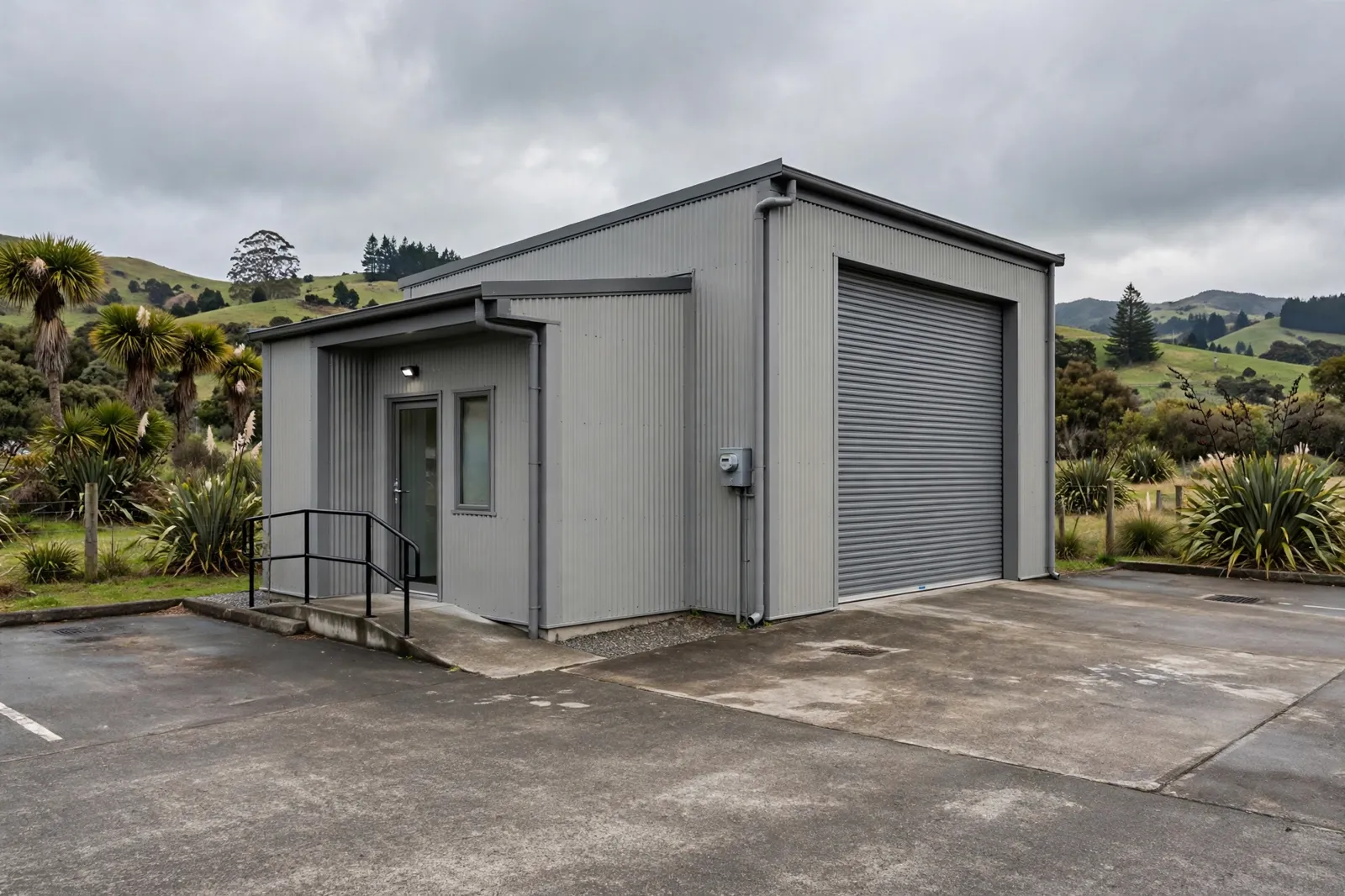
The sum insured problem
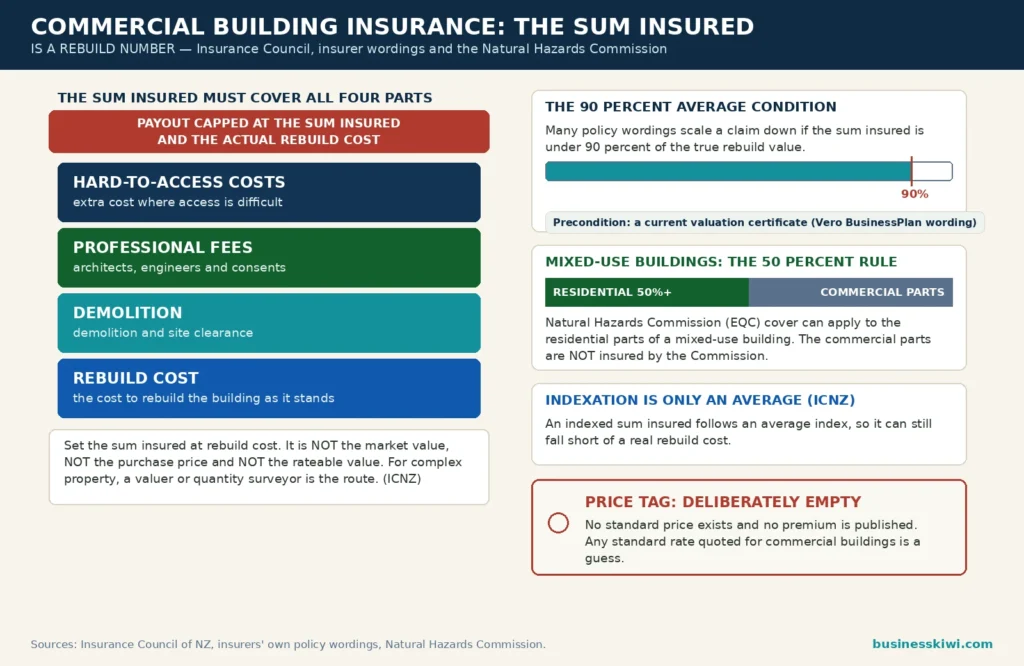
If commercial building insurance has a single point of failure, this is it. The sum insured is the maximum the insurer will pay, and it has to be built up from what a rebuild would actually cost. ICNZ’s guidance starts with what the figure is not: it should not be based on the property’s market value or its rateable value. Market value includes the land, which does not burn down, and reflects what a buyer pays for location and income, neither of which a builder charges for. Rateable value is set for a different purpose entirely.
What belongs in the number is the full cost of putting the building back. ICNZ’s insurance health check tells owners to set the figure at rebuild cost and to allow for more than bricks and labour: demolition, professional fees, and the extra costs of a hard to access site. For a commercial building the professional fees are heavier than for a house, and they come out of the same sum insured as the construction work.
Getting to a defensible figure is the owner’s job. ICNZ suggests an insurer’s online calculator for straightforward property, and a valuer or quantity surveyor’s replacement valuation for more complex property. Commercial buildings are almost always the complex case, with fire systems, lifts and compliance requirements a generic calculator cannot see. Vero’s BusinessPlan wording shows how seriously insurers take the point: it provides for the owner to supply a certificate setting out the property’s reinstatement estimates, and the sum to be insured is not to be less than the certificate amount unless the insurer agrees in writing to a lesser figure.
The same wording’s average condition shows why the paperwork matters. Where Vero has advised a policy is subject to a condition of average and the certificate has not been provided, if the sum insured at the time of damage is less than 90 percent of the cost of reinstating the whole item, the owner is treated as an insurer for the difference and bears a rateable proportion of the loss. In plain terms, underinsurance does not just cap a total loss payment: on a policy written that way it shrinks partial claims too, in proportion to the gap. A burst pipe claim on a building insured at two thirds of its rebuild cost can be paid at roughly two thirds, even though the repair bill is far below the sum insured.
The opposite error is less dangerous but still wasteful, and ICNZ names it too. Set the figure too high and you pay too much premium, because the insurer is not required to pay more than the actual cost of rebuilding. There is no windfall in an inflated figure, just an inflated bill.
The quieter risk is drift. ICNZ lists the common causes of a sum insured falling behind: assets upgraded and never added, more assets on site than when the policy was taken out, and renewal indexation that is only an average figure rather than a measure of your building. Construction costs do not move at the average. The health check advice is to review sums insured at renewal, when you change insurers and whenever the property changes, treating it as a valuation task, not a paperwork one.
What insurers want to know about your building
Commercial cover is underwritten, not simply sold, and it starts with a duty many owners underestimate. ICNZ puts it plainly: you must disclose all material information when you take out the policy, when you renew it and when your circumstances change, and non-disclosure can lead to a claim being refused, the policy cancelled or payments reduced. Vero’s wording defines material information as anything that might influence the insurer’s decision on whether to insure you, on what terms and at what premium, and requires owners to advise the insurer of all of it before the policy starts and before each renewal or variation. Failing to do so entitles the insurer to avoid the policy.
Expect the assessment to be physical as well as documentary. NZI runs risk consulting and electrical review teams for its commercial customers, using thermographic inspection of wiring and switchboards to find electrical faults before they become fires. Vero likewise describes a risk management service whose specialists carry out risk surveys and arrange site visits. An insurer sending engineers to look at your switchboard is telling you what it prices: the building’s systems, its fire protection, how it is run.
The obligations continue after the policy is in place. Vero’s wording requires the owner to notify the insurer immediately of any change in circumstances that may increase the risk, and warns that if the change is not notified, loss happening after it may not be insured at all. A change of tenant into a higher hazard trade, a building left empty, storage of flammable material that was not there at inception: these are the changes the clause is aimed at, and exactly the ones owners forget to mention.
Landlords carry a further, specific set of expectations. Vero’s wording makes its cover for damage caused by unlawful substances, including methamphetamine contamination, conditional on what it calls the landlord’s obligations: taking reasonable care in selecting tenants by obtaining satisfactory references, inspecting the property inside and out at least every six months and at every change of tenancy, and keeping a written record of each inspection that can be produced on request. An owner who cannot produce inspection records may find a contamination claim fails on the conditions rather than the damage.
Landlord or owner-occupier: the angles differ
The building section responds to the physical damage in much the same way whoever owns the building. What differs is the income wrapped around it, and that difference decides which other sections of the package matter.
For a landlord, the income at risk is rent. NZI describes its business interruption cover as protecting against loss of revenue, profit or rental income resulting from loss or damage insured under a material damage policy, and notes it can extend to payroll, redundancy pay, additional operating costs and claim preparation costs. Vero’s interruption section likewise includes loss of rent receivable as an item of cover, and its material damage section carries a loss of rent extension for residential units within a commercial package. The details differ by product, but the structure does not: rent is insured on the interruption side of the package, not the building side, and a landlord who has insured the building but not the rent has covered the asset and left the income exposed.
For an owner-occupier, the exposure runs the other way. The building and the business inside it fail together, so the interruption claim is about trading revenue and the extra cost of operating from somewhere else while the rebuild happens. Owner-occupiers also blur a boundary landlords keep clean: the fitout. Tenant improvements, landlord’s fixtures and the building’s services need to be allocated between the building sum insured and the contents and fitout sums insured, because an item left out of both lists is an item nobody has insured.
Mixed use buildings add one more wrinkle. Under the approach the Natural Hazards Commission publishes, if dwellings make up 50 percent or more of a mixed use building’s floor area, the whole building is treated as residential for EQCover purposes. Below that threshold, cover applies to the dwellings only, and the commercial parts are a matter for the building’s own insurer. A small block with two flats over a café sits close to that line, and which side it falls on changes what the commercial policy has to do.
Claims: what happens and what to keep
The claims conditions in an insurer’s wording bind from the first hour of a loss. Vero’s wording sets the pattern. As soon as you are aware of an event likely to result in a claim, you must notify the insurer immediately, report suspected burglary, theft, arson or intentional damage to the Police, and take prompt steps to minimise the loss and prevent further damage. You must not dispose of or abandon property you intend to claim for, or start repairs without the insurer’s permission unless the work is necessary to prevent further loss. You must not admit responsibility, or make any admission, offer or promise that could prejudice the insurer’s ability to defend or settle a claim. The insurer can require a completed claim form, free access to assess the damage, any information it reasonably requests, and a statutory declaration verifying the loss if it asks for one. The excess is your contribution, payable to the insurer or the repairer.
Documentation is the part owners control in advance. ICNZ advises keeping policy documents somewhere safe: the schedule is the record of what the insurer thinks your building is. A schedule that still describes last decade’s fitout or last decade’s tenant is a dispute waiting for a fire. Owners who keep a current reinstatement valuation, photographs of the building and its plant, fire system and electrical maintenance records, and the inspection records their wording requires are doing the unglamorous work that makes a large claim straightforward.
If a claim decision goes against you, the wording provides the first escalation path: Vero’s conditions direct an unhappy policyholder to the adviser or broker, then to the insurer’s own review process. ICNZ adds the wider frame: its member insurers must comply with the Fair Insurance Code, which sets standards for dealing with customers and handling complaints, so a dispute is not simply the insurer’s word against yours.
Choosing cover, price and advice
There is no standard price for insuring a commercial building, and any quoted average or typical cost should be treated with suspicion. Each building is assessed on its own facts and quoted individually. Vero’s corporate property page states the position from the insurer’s side: cover is subject to the underwriting criteria applying at the time, and excesses, terms, conditions, limits and exclusions all apply and are found in the wording. Two similar buildings on the same street can be priced very differently for construction, fire protection, tenancy and claims history, none of which shows in a headline figure.
That makes comparing policies a wording task. ICNZ’s renewal guidance makes the general point that the cheapest policy is not always the best, and that cover levels, sums insured and excesses all need weighing against the premium. For a building owner the practical version is to compare what each insurer will pay to reinstate your building, what it excludes and what conditions it attaches, treating the premium as the last number to look at, not the first.
Many owners will not deal with the insurer directly anyway, and the advice market they use instead is regulated. The Financial Markets Authority (FMA) explains that advisers must be licensed by the FMA as Financial Advice Providers or work under a licence held by an approved business, and must follow the Code of Professional Conduct for Financial Advice Services, which sets standards of conduct, client care, competence, knowledge and skill. Advisers must put client interests first and tell you how they are paid. Payment is either direct, a fee you pay, or indirect, a commission from the insurer whose product you take, and some advisers also receive ongoing trail commission for as long as the relationship lasts. The FMA’s warning is worth taking at face value: where an adviser is paid by commission, you may be offered a limited choice from only one provider, so ask how the adviser is paid and have the costs clearly written down.
For a building owner, good advice earns its keep in the places this guide has concentrated on: a defensible reinstatement figure rather than a guess, the exclusions read before the loss rather than after it, and a package where the building, the rent or revenue and public liability insurance are each doing the job the owner thinks they are doing. The policy wording remains the final authority, and anyone advising on the building should be working from it.
Frequently asked questions
Is commercial building insurance the same thing as business insurance?
No. Business insurance is the wider package. Commercial building insurance is its material damage section, the part that pays to repair or replace the building itself after accidental loss or damage. The same package usually offers separate sections for business interruption, liability, vehicles and machinery breakdown, each with its own conditions and exclusions.
Does EQCover cover my commercial building?
No. EQCover, run by the Natural Hazards Commission Toka Tū Ake, is a residential scheme. The Commission states that the non-residential parts of a building are not insured by EQC, and that repair costs for commercial areas are a matter for the owner and their own insurer. In a mixed use building, if dwellings make up 50 percent or more of the floor area the whole building counts as residential for EQCover; below that, only the dwellings have it.
How should I set the sum insured for a commercial building?
Set it at rebuild cost, not at market value or rateable value. ICNZ advises allowing for demolition, professional fees and difficult site access on top of construction. For a complex commercial building, ICNZ suggests a replacement valuation from a valuer or quantity surveyor rather than an online calculator, and reviewing the figure at every renewal and whenever the building changes.
What happens if my sum insured is too low?
On a total loss, the insurer pays no more than the sum insured, and the gap between that figure and the real rebuild cost is yours to fund. It can also affect smaller claims. Vero’s BusinessPlan wording contains an average condition under which, where it applies and no valuation certificate has been provided, a sum insured below 90 percent of the reinstatement cost means the owner bears a rateable proportion of any loss, including partial losses.
Does commercial building insurance cover wear and tear or gradual damage?
No. Material damage cover responds to accidental loss or damage, not to deterioration. Insurers’ wordings exclude wear and tear and gradual causes, and Vero’s excludes the cost of putting right faulty workmanship, design or materials, damage from moisture penetration where the building has failed to keep water out, and damage from mould and rot. A sudden burst pipe and a pipe that has leaked undetected for two years are treated very differently.
I lease my building to tenants. What should I watch for?
Your income exposure is the rent, which is insured under business interruption cover as loss of rental income or loss of rent receivable, not under the building section. Check that it is in your package. Also check your wording’s landlord conditions: Vero’s, for example, makes cover for unlawful substance contamination conditional on careful tenant selection, documented inspections at least every six months and at each change of tenancy, and written inspection records you can produce on request.
Why is there no standard price for commercial building insurance?
Because there is no standard commercial building. Insurers assess and quote each building individually against their underwriting criteria: the building itself, its fire protection, how it is used and who occupies it. Premiums are an output of that assessment, not a published rate, so averages quoted by anyone other than an insurer pricing your building are no guide to what you will pay.
Do I need a broker or adviser to arrange commercial building insurance?
Often, yes, because much of the market works that way. ICNZ notes that some insurers only sell through brokers, and Vero and Ando both arrange their business cover through brokers or advisers. Advisers must be licensed by the FMA or work under a licence, follow the Code of Professional Conduct, and tell you how they are paid, whether by a fee from you or a commission from the insurer.
Sources
- Insurance Council of New Zealand (ICNZ), Insurance Health Check: https://www.icnz.org.nz/individuals/insurance-health-check/
- Insurance Council of New Zealand (ICNZ), House and Contents Insurance: Sum Insured Explained: https://www.icnz.org.nz/individuals/house-contents/
- Insurance Council of New Zealand (ICNZ), Consumer Guides: https://icnz.org.nz/?p=432
- NZI, Commercial Property Insurance: https://www.nzi.co.nz/business-cover/property-insurance
- Vero, BusinessPlan product page: http://vero.co.nz/business-insurance/business-plan.html
- Vero, Corporate Property Insurance: https://www.vero.co.nz/business-insurance/corporate-property-insurance.html
- Vero, BusinessPlan Policy Wording (2020), introduction, material damage and business interruption sections and general conditions: https://www.vero.co.nz/documents/business/businessplan-policy-wording-2020.pdf
- AMI, Business Assets Insurance: https://www.ami.co.nz/business/assets
- Ando, Business Insurance: https://www.ando.co.nz/business-insurance/
- Financial Markets Authority (FMA), Getting Advice: https://www.fma.govt.nz/consumer/getting-advice/
- Natural Hazards Commission Toka Tū Ake, EQC Media Response on Multi-User Buildings: https://www.naturalhazards.govt.nz/news/eqc-media-response-on-multi-user-buildings/
This article is general information about commercial building insurance in New Zealand and is not financial advice or a recommendation of any insurer, policy or adviser. Cover, exclusions, conditions and sums insured vary between insurers and between individual policies, and the policy wording and schedule for a specific building are the documents that govern any claim. Figures and policy features described here are drawn from the official sources listed above as published at the time of writing and may change. Building owners should read their own policy wording, keep their sum insured under review with professional valuation help where needed, and get advice from a licensed financial adviser or insurance broker about their own circumstances.