One Tree Hill Community Kindergarten: Hours, Sessions and What Parents Need to Know
One Tree Hill Community Kindergarten has been part of the Greenlane and One Tree Hill community for more than 70 years. It operates from Massey Reserve at 21 Massey Avenue in Greenlane, Auckland, a short walk from Cornwall Park and the slopes of Maungakiekie, and it runs as a community kindergarten governed by the families who use it rather than by a company or a national chain. For parents comparing early learning options in this part of Auckland, the practical questions are usually the same: what sessions can a child actually attend, who will be teaching them, what did the Education Review Office find, and what will it cost?
This profile pulls those answers together from the official record. The details come from the kindergarten’s own website and from the Education Review Office (ERO) institution page for the service, which carries its most recent Akarangi quality evaluation. Where a figure parents often ask about is not published by either source, this article says so rather than guessing. One example up front: the kindergarten does not publish a fee schedule on its website, so no fees are quoted here, and the section on costs below explains what to ask the office instead.
One Tree Hill Community Kindergarten at a glance
Two figures are missing from that table because neither source publishes them. The kindergarten’s Equity Index (EQI) rating does not appear on its own website or in the ERO material read for this profile, so it is not stated here. Fees are in the same position, and the gap is covered in its own section below.
A community kindergarten run by its families
The first thing to understand about One Tree Hill Community Kindergarten is how it is owned and run. It is a community kindergarten, governed by a committee of parents and teachers, and its own website describes a supportive committee of parents working in partnership with the Head Teacher and staff. There is no head office, no franchise and no association office setting the programme from elsewhere. The families whose children attend are the same community that keeps the kindergarten running, and that shows up in the way decisions are made and in the expectations placed on parents to be involved.
ERO’s account of the service, from its 2021 Akarangi evaluation, describes the same structure from the outside: a service governed by a committee of parents and teachers, with conditions that foster staff retention and a committee that supports effective leadership. Reviewers found that children’s learning and wellbeing were the primary considerations in the service’s decision making, and that the kindergarten had well established relationships with its community.
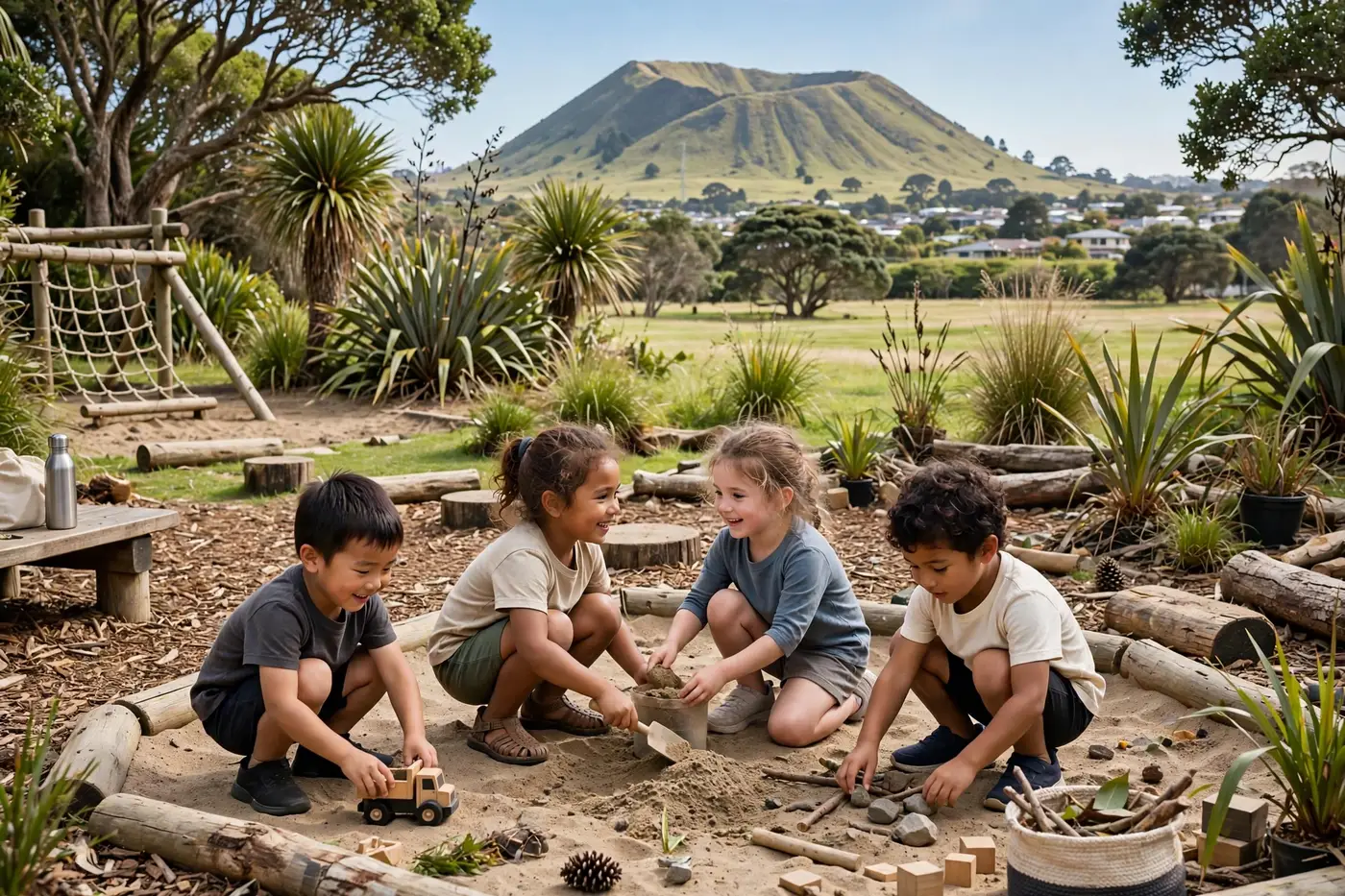
The kindergarten says it has been serving its community for over 70 years, which makes it one of the longer established early learning services in this part of Auckland. Longevity on that scale usually reflects a settled local role. ERO noted that many enrolments come from the local community, and the kindergarten sits in a part of Greenlane where families from One Tree Hill, Oranga, Ellerslie, Epsom, Royal Oak and Onehunga can all reach it within a few minutes. Its setting does some of the work for it: a large indoor space and an extensive outdoor play area on a reserve, in the shadow of Maungakiekie, with Cornwall Park next door.
One naming point is worth clearing up for parents searching online. The service is widely known simply as One Tree Hill Kindergarten, and some directories shorten it to that. Its full official name, recorded by ERO against service number 20125, is One Tree Hill Community Kindergarten, and that is the name the kindergarten itself uses on its website and signage. The shorter and longer names refer to the same service at the same address.
ERO’s institution listing classifies the service type as an education and care service, even though it operates, and is known locally, as a kindergarten. That is a licensing category rather than a description of the experience. What a child gets day to day is a sessional kindergarten programme in school terms, run by qualified teachers, which is what the rest of this profile describes.
Philosophy: belonging first, then learning
The kindergarten’s philosophy statement is built around a single Māori concept: whanaungatanga, the building of relationships and a sense of belonging. The kindergarten says its culture embodies that spirit, and that it values its partnerships with parents and the wider community. Its starting belief is that children learn best once they have built secure relationships, with their kaiako (teachers) and with each other. Everything else in the philosophy follows from that foundation.
From there, the emphasis is on children directing their own learning. The kindergarten works to provide an environment where children develop a love of learning and exploration, and it encourages perseverance and resilience by offering experiences with genuine challenge, and the chance to revisit an experience to deepen the learning. Children are supported to set their own tasks and goals, which the kindergarten sees as fostering self directed learners who also contribute to each other’s learning, a concept it names as ako. Accomplishments along each child’s individual learning journey are celebrated, which the kindergarten links to self confidence and self esteem.
The philosophy also acknowledges Te Tiriti o Waitangi and the diversity of the community the kindergarten serves. It talks about modelling respect for other people and for the environment, instilling manaakitanga (caring and hospitality), and celebrating children’s individuality and creativity as a way of building self worth and empowerment.
For parents, the practical reading is that this is a relationship led, play based kindergarten rather than a school readiness programme with an academic timetable. The faith element found in some Auckland kindergartens is absent here; the values base is community, belonging and care. Families who want their child known well by a small, stable team, and who are comfortable contributing to a parent governed service, are the families this philosophy is written for.

The programme: Te Whāriki with room to follow the child
Like every licensed early learning service in New Zealand, the kindergarten works from Te Whāriki, the national early childhood curriculum. Its curriculum statement says teachers regularly provide a wide range of experiences and that children are able to choose where they will participate. Those choices are deliberate: the kindergarten uses them to support children to set their own tasks and goals, building the disposition to be a self directed learner that its philosophy describes.
Planning is responsive rather than fixed in advance. The kindergarten describes a cycle in which teachers notice, recognise and respond to children’s learning and interests, leading to co-construction between children and teachers. Much of the planning is spontaneous, deliberately, so teachers can capture what it calls teachable moments as they arise. Teachers aim to stay flexible, encourage children to learn from their own curiosity and enthusiasm, and then challenge them a step further.
ERO’s evaluators saw that approach in action during their 2021 visit. They described a play based curriculum that responds to each child’s individual interests and needs, a wide range of resources and equipment, and an environment that encourages exploration and nurtures curiosity and creativity. They noted the spacious indoor and outdoor areas, which enable individual, small group and large group activities, and a teaching team that role models positive, nurturing relationships. Families who spoke with ERO said they held the service in high regard and particularly valued the trusting relationships they had with teachers.
Each child’s learning is documented in two ways. Every child has a printed portfolio that records their learning journey, kindergarten trips, events and contributions from their families. Parents can read it at any time, and when a child leaves, the portfolio is presented to them to keep. Alongside the printed record, the kindergarten offers an online portfolio through Storypark, so families can follow learning as it happens rather than waiting for a folder to come home.
The everyday practicalities are simple and worth knowing before you start. For morning tea, families provide a small container of pre-cut fruit for their child, and the kindergarten also provides crackers and Marmite, and at times baking done with the children. Children bring a named packed lunch and a water bottle from home. The kindergarten is nut free, and it supports families managing other allergies as well.
When children move on, they scatter across the local primaries. The kindergarten names the main schools its children feed into as Cornwall Park, Ellerslie, Oranga, Royal Oak and St Marys. That spread reflects its catchment across several suburbs, and it means new entrants arrive at those schools with kindergarten friends heading in several directions rather than one single pipeline.
Hours, sessions and term dates
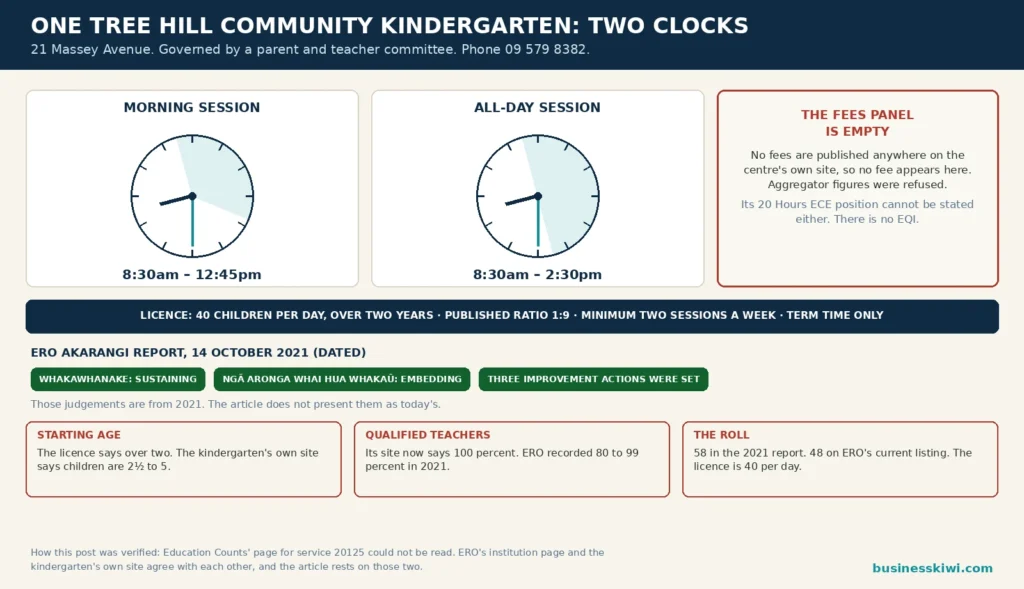
The kindergarten keeps classic kindergarten hours. It is open Monday to Friday in school terms, with two session shapes on offer. Morning sessions run from 8:30am to 12:45pm. All day sessions run from 8:30am to 2:30pm. There is no early drop off or late pickup window published, and no holiday programme: when the school holidays arrive, the kindergarten closes, along with the public holidays that fall inside term time.
To help children settle, make friends and become familiar with the routines, the kindergarten requires every child to be enrolled for a minimum of two mornings or days a week. A single weekly session is not an option. Parents building a pattern usually combine mornings and all day sessions across the week up to the five day maximum, keeping in mind the kindergarten’s published ages: it says it offers education for children from two and a half to five years old, even though its licence covers children over the age of two. That difference is worth checking with the office if your child is a young two year old, because the licence position and the kindergarten’s own stated starting age do not line up exactly.
For 2026, the kindergarten’s published term dates are:
The office hours are 8:00am to 3:00pm, Monday to Friday, which is the window for phone calls, enrolment enquiries and visits. The kindergarten can be reached on 09 579 8382 or at info@othkindy.co.nz.
The session structure has one cost and planning implication parents sometimes miss. Because the longest day on offer is six hours, and morning sessions are four and a quarter hours, a child’s total weekly hours are modest compared with a full day childcare centre. Families who need care beyond 2:30pm, or during the school holidays, will need a separate arrangement for those hours, because the kindergarten does not provide them.
Fees and 20 Hours ECE: what is published, and what is not
This is the section where the official record runs out, and this profile says so plainly rather than borrowing numbers from elsewhere.
The kindergarten does not publish a fee schedule, a session charge or an hourly rate anywhere on its own website, at least not on the pages read in full for this profile. No dollar figure for attending One Tree Hill Community Kindergarten is therefore stated in this article. Fee figures for this kindergarten do circulate on third party directory and childcare listing sites, but those are not the kindergarten’s own published prices, they are not verified against the service, and none of them is used here. If cost is a deciding factor for your family, ask the office for the current session charges in writing before you enrol, and ask how they are applied across morning and all day sessions.
The same caution applies to 20 Hours ECE, the government scheme that funds up to 20 hours a week of early childhood education for three, four and five year olds. The kindergarten’s own website does not state whether it offers the scheme or how it applies funded hours to its session patterns. The Ministry of Education’s Education Counts profile for the service records the position, and parents can check it there or simply ask the office to confirm, for their child’s exact pattern of mornings and days, which hours are funded and which are charged. Given the session lengths here, the answer matters: an all day session is six hours, and no child can be funded for more than six hours in a single day under the scheme, so a five day all day pattern and a five morning pattern sit quite differently against a 20 hour weekly entitlement.
What can be said from the published record is the shape of the commitment. Enrolment is a minimum of two sessions a week, sessions run in term time only, and the service is community governed, which in practice means charges, fundraising and committee decisions sit close to the parent community rather than with a distant owner. None of that adds up to a dollar figure, and this profile will not invent one. The questions to put to the office are set out in the enrolment section below.
What ERO found in its Akarangi evaluation
The most recent ERO evaluation available for this service is an Akarangi quality evaluation, with the review team on site in August 2021 and the report dated 14 October 2021. Akarangi is ERO’s current framework for early childhood services. It judges how well a service’s learning and organisational conditions support equitable and excellent outcomes for all children, using the outcome indicators and domains set out below. Akarangi judgements are made on a scale that runs through Whakawhanake (sustaining), Whakaū (embedding) and earlier stages of development.
ERO’s judgements for One Tree Hill Community Kindergarten were:
In narrative terms, ERO found children learning in an environment of respect and inclusiveness, where their cultures, languages and identities are celebrated and promoted. Teachers know their children well, and the report describes a cohesive team culture in which service leaders and teachers collaborate and keep children’s learning and wellbeing at the centre of decision making. Reviewers noted that teachers use te reo Māori regularly when interacting with children and are demonstrably committed to developing their knowledge of Te Tiriti o Waitangi, supported by professional learning and development. Governance came through as a strength: the executive committee and service leaders had created conditions that foster staff retention, and the committee supported effective leadership, systems and processes aimed at positive and equitable outcomes, including opportunities for teachers to take leadership roles matched to their strengths.
The report was not all strengths. ERO found that systems and processes for planning and evaluation could be strengthened through more robust gathering and documenting of evidence, including monitoring the impact of practices on children’s learning outcomes over time. Three improvement actions were recorded for the service’s quality improvement planning: strengthen internal evaluation by gathering evidence from a wide range of sources and monitoring the effectiveness of changes; support teachers to clearly document programme planning and records of children’s learning over time; and strengthen learning focused partnerships with families and the community.
The figures attached to that 2021 report belong to their moment. ERO recorded a service roll of 58 children at the time, with an ethnic composition of NZ European and Pākehā 28, other Asian 9, Chinese 7, other ethnic groups 6, other European 5 and Māori 3. ERO’s current institution listing for the service shows a total roll of 48, which is the more recent figure, although rolls at a sessional kindergarten move across the year as children start and leave for school. The licensed maximum has been consistent: 40 children at any one time, all over the age of two.
One further figure from the 2021 report deserves a note because it differs from what the kindergarten currently publishes. ERO recorded that between 80 and 99 percent of the teaching team were qualified teachers. The kindergarten’s own website now states that 100 percent of its teachers are qualified. Both statements are recorded here with their sources and dates: the ERO figure describes the team as it was in 2021, the website figure is the kindergarten’s current claim, and the team page discussed below shows why parents may want to ask about the mix directly.
Earlier ERO reports for the service date from May 2018 and October 2014, under the previous review framework.
The team
The kindergarten’s website publishes a team page with individual profiles, which is more than many services provide, and the picture it gives is of an unusually settled team. The Head Teacher is Jenni, who joined One Tree Hill Kindergarten in 2006 and has worked in early childhood for over 30 years, including day care work mainly with under twos and nannying in Canada and England before she settled here. In a sector where turnover is a common parent complaint, a head teacher approaching two decades at one kindergarten is a genuine feature of this service.
Alongside her, the published teaching team includes Catherine, who trained as a kindergarten teacher at Auckland Teachers College, graduating with a diploma in 1986, and has taught at the kindergarten since 2003 after previously being Head Teacher at Cuthbert Kindergarten in Onehunga. Alison joined the team in August 2014, after graduating from the University of Auckland in 2013 and relieving in different centres; she brings over twenty years of work with children across England, Scotland and New Zealand. Eudy retrained into early childhood after a commerce degree, gaining a Diploma of Teaching (ECE) in 2001, and has more than ten years of early childhood experience locally and overseas. Shayna started at the kindergarten in 2016 and has around ten years as an early childhood educator in the local community. Esther, whose family migrated from the Philippines, is completing a Bachelor of Early Childhood Education at AUT University, studying towards graduation at the end of 2026. The team is rounded out by Eulalia, the administrator, whose background spans nannying, volunteering in early childhood settings overseas and the travel industry, and Elizabeth, a kindy assistant who joined in 2024 and whose own children attended the kindergarten.
Parents reading that list alongside the qualification figures will notice the honest wrinkle. The kindergarten describes its teaching team as 100 percent qualified, and most of the named teachers hold long standing qualifications and registration. At the same time, one teacher is still completing her degree and the team includes a kindy assistant and an administrator who are not counted as teachers. ERO’s framework counts qualified teachers as a proportion of the teaching team, which is how its 2021 figure of 80 to 99 percent arises. The practical point for parents is not to litigate the percentage but to understand the mix: a core of very experienced, fully qualified kindergarten teachers, supported by assistants and a teacher in training, with a published teacher to child ratio of 1:9 against a licence of 40 children a day.
ERO’s 2021 description of the staffing structure differs slightly from today’s team page: at that time, two qualified teachers shared the head teacher role, supporting a team of four qualified teachers and two unqualified staff. The kindergarten’s current website presents a single Head Teacher. Services reorganise over five years, and the current position is the website’s; the ERO description is included here so parents are not confused if they read the older report first.
Enrolling: what to do next
The kindergarten does not publish an enrolment form or a step by step enrolment process on its website, so the first move is a conversation. Phone the office on 09 579 8382 during office hours, 8:00am to 3:00pm Monday to Friday, or email info@othkindy.co.nz, and arrange a visit. Seeing a session in progress, particularly a morning session at full roll, will tell you more about the feel of the place than any profile can.
A few questions are worth asking on that visit. Ask about places for your preferred pattern of days, remembering the two session minimum and that attendance is capped at 40 children a day. Ask for the current session charges in writing, and how 20 Hours ECE applies to your child’s pattern if your child is three or older, including what a morning and an all day session each cost after any funding is applied. Ask about the starting age for your child, given the gap between the licence, which covers children over two, and the kindergarten’s stated age range of two and a half to five. Ask how the waiting list works if your preferred days are full, and what happens at the end of the kindergarten day and in the school holidays if your family needs care beyond 2:30pm or outside term time, because the kindergarten does not cover those hours. And because this is a parent governed kindergarten, ask what the committee expects of families, from working bees to fundraising to committee roles. That involvement is part of the deal at a community kindergarten, and families who go in expecting it tend to get the most from the service.
Frequently asked questions
Where is One Tree Hill Community Kindergarten?
It is at 21 Massey Avenue in Greenlane, Auckland, on Massey Reserve near Cornwall Park. The Ministry of Education service number is 20125, the phone number is 09 579 8382 and the email is info@othkindy.co.nz.
What ages does One Tree Hill Community Kindergarten take?
The service is licensed for 40 children over the age of two, with no children under two. The kindergarten’s own website says it offers education for children aged two and a half to five years, so check the current starting age with the office if your child has just turned two.
What are the session times?
Morning sessions run from 8:30am to 12:45pm and all day sessions from 8:30am to 2:30pm, Monday to Friday in school terms. Children must be enrolled for at least two mornings or days a week. The kindergarten closes for public holidays and for the school holidays.
How much does One Tree Hill Community Kindergarten cost?
The kindergarten does not publish its fees on its own website, so no figure is quoted here. Fee figures shown on third party listing sites are not the kindergarten’s own published prices. Ask the office for the current session charges in writing, and how they apply to your child’s pattern of sessions.
Does it offer 20 Hours ECE?
The kindergarten’s own website does not say. The Ministry of Education’s Education Counts profile for the service records its 20 Hours ECE status, and the office can confirm how funded hours would apply to your child’s sessions. No child can be funded for more than six hours in a single day under the scheme.
What did ERO say about One Tree Hill Community Kindergarten?
ERO’s Akarangi quality evaluation, dated 14 October 2021, judged the service at Whakawhanake (sustaining) for outcomes for learners and for four of its five domains, with evaluation for improvement judged at Whakaū (embedding). ERO found a respectful, inclusive environment, a play based curriculum and strong governance, and set three improvement actions around internal evaluation, documenting children’s learning and learning focused partnerships with whānau.
How many children attend, and what is the ratio?
The licence allows 40 children per day. ERO’s current institution listing shows a total roll of 48, and its 2021 report recorded a roll of 58 at that time. The kindergarten publishes a teacher to child ratio of 1:9.
How do I enrol my child?
Contact the office on 09 579 8382 or info@othkindy.co.nz, arrange a visit, and talk through your preferred days and your child’s starting age. Ask about availability, because sessions are popular and the daily cap is 40 children, and ask what the parent committee expects of enrolled families.
Sources
- One Tree Hill Community Kindergarten, Home: https://www.onetreehillkindy.org.nz/
- One Tree Hill Community Kindergarten, Parent Info: https://www.onetreehillkindy.org.nz/parent-info
- One Tree Hill Community Kindergarten, Our Philosophy: https://www.onetreehillkindy.org.nz/our-philosophy
- One Tree Hill Community Kindergarten, Contact: https://www.onetreehillkindy.org.nz/contact
- One Tree Hill Community Kindergarten, Meet the Team: https://www.onetreehillkindy.org.nz/meet-the-team
- Education Review Office, One Tree Hill Community Kindergarten institution page and Akarangi Quality Evaluation Report, 14 October 2021: https://ero.govt.nz/institution/20125/one-tree-hill-community-kindergarten
This article is general information about One Tree Hill Community Kindergarten, drawn from the official sources listed above at the time of writing. Fees, hours, term dates, staffing and ERO findings change over time, and ERO reports reflect the service as it was when the review team visited. Confirm the details that matter to your family directly with the kindergarten before making enrolment decisions.