Digital Marketing Auckland: NZ Guide, Requirements & Practical Information

The short answer: digital marketing in Auckland means the same core channels as anywhere in New Zealand: search, social, email and your own website. What changes in Auckland is the competition. It is the country’s biggest market, so ads cost attention, local search matters suburb by suburb, and the rules are the NZ ones: consent before marketing emails under the spam law, ads clearly identifiable under the Advertising Standards Code, and customer data handled under the Privacy Act 2020.
Ask an Auckland business owner where their customers come from and most will say some version of the same thing: Google, word of mouth, and social media, in some order. Digital marketing is the work of being found, chosen and remembered in those places. This guide explains what the channels actually are, how the Auckland market shapes them, the New Zealand rules that apply, how agencies and freelancers charge, and the questions to ask before you pay anyone. It is written for Auckland businesses, and nearly all of it holds for the rest of New Zealand too.
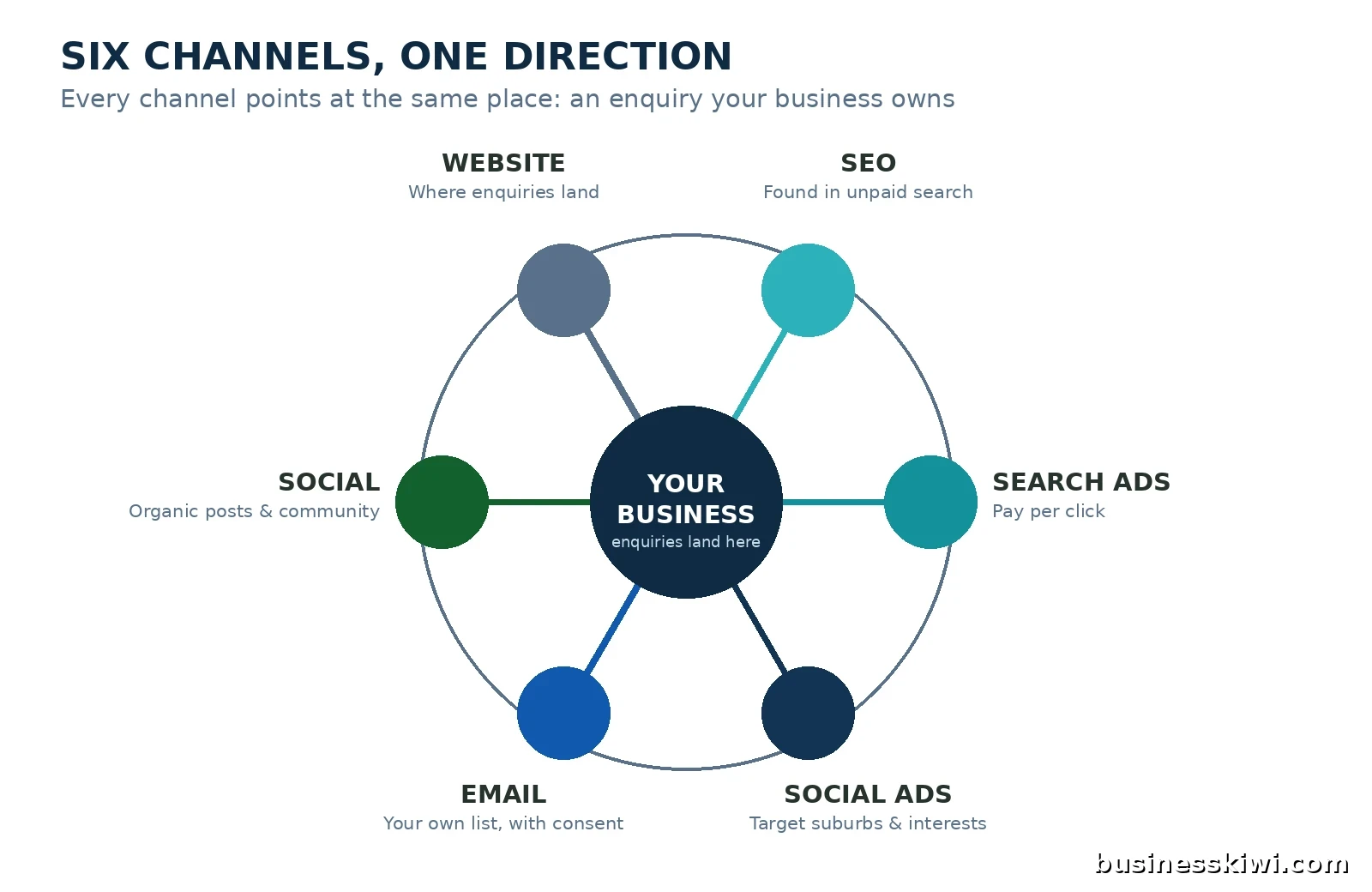
The channels, in plain English
Every channel eventually lands on your website or your phone number, which is why the website is listed as a channel in its own right. An ad can rent attention. Only your own site and your own customer list are assets you actually hold.
The Auckland difference
Auckland is home to about a third of New Zealand’s population and its largest concentration of businesses. For a service business, that cuts both ways. The demand is there: more people searching for plumbers, dentists, builders, lawyers, cafes and clinics than anywhere else in the country. So is the supply. In many trades there are dozens of competitors inside a few suburbs, all bidding on the same searches and appearing in the same map results.
Auckland is also one of the most culturally diverse cities in the world, with large Māori, Pasifika and Asian communities. For many businesses that diversity is a marketing fact, not a footnote: the language of your ads, the faces in your photos and the channels you choose either include those customers or quietly exclude them.
Two consequences follow. First, Auckland marketing is local at suburb level. A customer in Howick does not want a plumber from Henderson, and search engines know it. Your Google Business Profile, your suburb pages and your reviews effectively compete suburb by suburb, not citywide. Second, paid clicks in competitive Auckland categories can get expensive quickly, because auctions reward whoever values the customer most. Businesses that know their numbers, what a new customer is worth and what they can pay to win one, outlast businesses that simply boost posts and hope.
Start with search: SEO and your Google presence
For most Auckland service businesses, search is where high-intent customers appear. Someone searching “emergency plumber Albany” is not browsing. Two pieces of work matter.
Your Google Business Profile is the free listing that feeds the map results, showing your hours, reviews, photos and contact buttons. Claim it, keep it accurate, and treat reviews as an ongoing job: ask for them, reply to them. For multi-suburb businesses, the profile anchors your local presence.
SEO on your website is the slower compounding asset: pages that genuinely answer what your customers search, organised so each service and location has its own clear home. One intent per page. Thin pages stuffed with suburb names and no real content are the pattern search engines have learned to ignore, and the pattern that gets sites in trouble. Our guide to local SEO for New Zealand businesses goes deep on this layer, suburb pages, reviews and citations included.
Paid advertising: search ads and social ads
Paid ads buy speed. The mechanics are similar across Google and the social platforms: you set a budget, choose who should see the ad, and the platform runs an auction among advertisers who want that person’s attention.
Search ads appear when someone searches. You bid on the search terms that signal buying intent, and you generally pay when the ad is clicked. Geographic targeting lets an Auckland business show ads only within its service area, down to a radius around the workshop or named suburbs.
Social ads appear in feeds. Targeting is by demographics, interests and location rather than by what someone typed, which makes social better for creating demand: showing the kitchen renovation to homeowners in the right suburbs before they know they want it.
The discipline that separates profitable ads from expensive ones is measurement. Judge ads on enquiries and sales, not clicks. A cheap click that never calls is expensive. An Auckland business should also insist that ad accounts are created under its own ownership, a point returned to in the agency section, because the history and data inside those accounts are valuable and they should never walk away with a provider.
For the organic side of social, posting cadence, community management and whether a business even needs it, our article on running a business without social media covers the honest pros and cons.

Email marketing, and the spam law you must follow
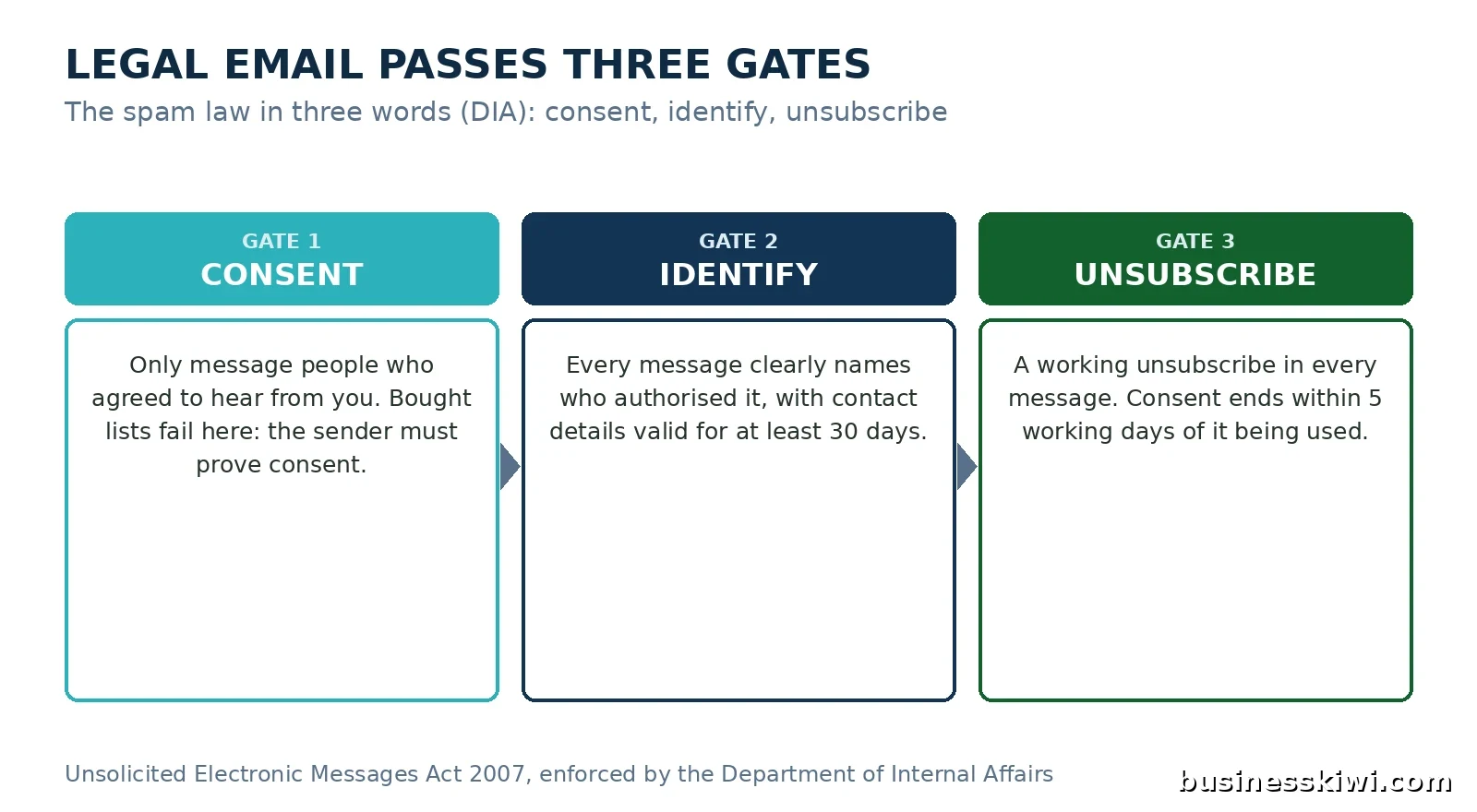
Email is the cheapest channel to run and the one with the clearest law around it. The Unsolicited Electronic Messages Act 2007, enforced by the Department of Internal Affairs, sets three duties the DIA summarises as consent, identify and unsubscribe.
Consent. You may only send commercial emails and texts to people who have consented, and if consent is ever questioned, the sender has to prove it. Consent can be express, such as ticking a box or signing up, or inferred from an existing business relationship where the messages relate to that relationship. Buying address lists is a trap: the people on them never consented to hear from you, and using address-harvesting software or harvested lists is prohibited outright.
Identify. Every commercial message must clearly and accurately identify who authorised it, with contact information that stays valid for at least 30 days after the message is sent.
Unsubscribe. Every message must include a working unsubscribe facility. When someone uses it, their consent is treated as withdrawn 5 working days later at the latest, so your sending system needs to honour unsubscribes inside that window.
Alongside the spam law, the Privacy Act 2020 governs the customer data behind your list. Collect only what you need, use people’s information for the purposes it was collected for, keep it secure, and expect that people can ask what you hold about them and have it corrected. A marketing list built in breach of those principles is a liability wearing a disguise.
The advertising rules that cover everything
On top of the email law, two frameworks cover all NZ advertising, digital included.
The Advertising Standards Code, administered by the Advertising Standards Authority, requires advertisements to be clearly identifiable as ads, truthful, and not misleading. That identification duty is the one digital marketers trip over most: paid or gifted influencer posts are advertising and must be disclosed clearly as ads, on every post, in a way followers can actually see. The ASA runs a free public complaints process and can require an ad to be taken down or changed. The Fair Trading Act sits behind the code with legal force: misleading claims in trade, including on your website and in your ads, are unlawful.
Platform policies add a third layer. Google and Meta each ban categories of misleading or restricted advertising, and an account strike can cost an Auckland business its main enquiry channel overnight. Whoever runs your ads should be able to explain the rules for your category, especially if you work in health, finance, alcohol or housing, where extra restrictions apply.
Agency, freelancer or in-house?
Auckland has agencies of every size, a deep freelancer pool, and plenty of businesses that keep marketing in-house. The right answer depends on how much work there is and how much of it is strategy versus doing.
An agency suits a business spending seriously on ads or needing several skills at once: strategy, copy, design, ad management, SEO. You are buying a team and their accumulated pattern recognition across clients. The Auckland agency market is competitive, which helps on price and makes references easy to check.
A freelancer or contractor suits a business that knows what it wants done: ad management, content, SEO fixes. Cheaper than an agency, narrower in coverage, and the quality variance is wider, so the work itself and past clients matter more than the pitch.
In-house suits businesses with steady volume: a marketing coordinator running content, social and email, with specialists bought in for projects. Scope the role properly before you hire: a coordinator executes, a strategist directs, and confusing the two is how businesses end up with lots of activity and no direction. Whoever you choose, four contract points protect you:
• Own your accounts. The Google Ads account, Analytics, Business Profile, social accounts and domain must be registered to your business, with providers given access, not ownership. If the relationship ends, your history and data stay.
• Agree reporting in writing. A monthly report showing spend, enquiries and cost per enquiry, in plain language, is a reasonable minimum.
• Watch lock-ins and exit terms. Long contracts with heavy exit fees shift all the risk to you. Shorter terms keep a provider earning the renewal.
• Know what is ad spend and what is fees. Your budget splits into money paid to the platforms and money paid to the provider. Any quote that blurs the two is hiding something.
How pricing works
There is no official price list for digital marketing, and anyone quoting one number for every business is guessing. Pricing follows a few standard models.
Monthly retainers buy an agreed block of ongoing work, common for SEO, content and ad management. Percentage of ad spend is common for ad management at higher budgets. Hourly and project rates suit one-off work such as a website rebuild or a tracking setup. On top of provider fees, ad spend is paid to the platforms themselves, usually from your own account so you can see every dollar.
The comparison that matters is total cost against tracked results: cost per enquiry and cost per sale in your business, not the fee in isolation. A cheaper provider who cannot show you where enquiries came from is the expensive option wearing a discount.
Measuring what works
You do not need a data team. You need three habits. Use the platforms’ own free measurement tools, Google Analytics and Search Console, properly set up so enquiries are recorded as conversions rather than page views. Review one page a month: spend by channel, enquiries by channel, and what you will change next month because of it. And ask every new customer how they found you, then check the answer against the data. Auckland businesses that do just those three things usually discover that one or two channels do most of the work, and the rest of the budget redeploys itself.

A sensible first 90 days
If you are starting from a standing start, sequence beats intensity. This order works for most Auckland service businesses.
Days 1 to 30: foundations. Claim and complete your Google Business Profile. Fix the website basics: services pages that match how customers search, a phone number and enquiry form that work on a phone, and tracking set up so enquiries are recorded. Sort out who owns every account and put the passwords in the business’s name.
Days 31 to 60: one paid channel. Launch a single paid channel matched to intent: search ads if people actively search for what you sell, social ads if they need to discover it. Small budget, tight geography, weekly checks. Kill what does not produce enquiries.
Days 61 to 90: retention and review. Start the email list properly, with consent captured at every counter, invoice and booking, and send the first genuinely useful message. Then hold the first monthly review: spend by channel, enquiries by channel, and one decision about what changes next.
Frequently asked questions
How much should an Auckland business spend on digital marketing?
There is no standard figure, and no official benchmark to quote. Work backwards from value: what a new customer is worth to you, how many enquiries your ads need to produce, and test with a budget you can afford to learn from before scaling what proves itself.
Do I need an Auckland agency, or can my provider be anywhere?
The work itself is remote, so a provider anywhere in NZ, or beyond, can do it. What matters is that they understand NZ search behaviour, NZ consumer law and your market. Local providers add meeting convenience and suburb-level knowledge, which some businesses value enough to pay for.
Is SEO or Google Ads better for a local service business?
They do different jobs. Ads deliver enquiries now and stop when the budget stops. SEO builds slower and keeps working. Most established Auckland service businesses end up with both: ads for immediate flow, SEO and their Business Profile for the compounding base.
Can I email my existing customers without asking first?
Only within the spam law’s limits. Commercial messages need consent, which can be inferred from an existing relationship where the message relates to that relationship, and every message still needs sender identification and a working unsubscribe. When in doubt, treat consent as something you must be able to show, because the law puts the proof on the sender.
Do influencer posts about my business need to say they are ads?
Yes. Paid or gifted promotion is advertising under the Advertising Standards Code and must be clearly identifiable as an ad on every post. That duty sits with you as the advertiser as well as the influencer.
Who should own the Google Ads account, us or our agency?
You should. Have the account created under your business, pay the platform from your own payment method, and give the agency manager access. Account history, data and audiences are business assets.
How long before digital marketing shows results?
Ads can produce enquiries within days of a correct setup. SEO and content are measured in months. Anyone promising page-one rankings or a fixed number of leads by a fixed date is selling certainty the platforms themselves do not offer.
The bottom line
Digital marketing in Auckland rewards the businesses that treat it as a system: a website and Business Profile built to be found, one or two paid channels run against tracked enquiries, an email list built on real consent, and every rule, spam law, advertising code and Privacy Act, respected because they are also what keeps the accounts alive. Buy help if you need it, but own your accounts, read the monthly numbers, and never let the fee blur into the ad spend.
For more practical guides for NZ businesses, browse our business guides.