Print Online NZ: What You Can Order, How Long It Takes and How to Get It Right

Printing online in NZ means uploading your file, choosing paper and quantity on a printer’s website, and having the finished job couriered to your door. Total time is printing time plus delivery time. NZ Post targets up to 3 working days nationwide for standard parcels, and rural addresses take longer. Buy from a New Zealand business and the Consumer Guarantees Act covers you if the job arrives wrong.
Almost any printing job can be ordered from a laptop now. Business cards, wedding invitations, photo books, signage for the shop, a run of menus for the cafe. The choice is no longer whether to print online, but which kind of online printer to use, how long to allow, and how to make sure what arrives matches what you saw on screen. This guide covers the landscape for New Zealand buyers: what is on offer, who sells it, realistic timeframes, and your rights when a job goes wrong.
What you can print online
The range is wider than most people expect. If it is printed on paper, card, vinyl or fabric, someone will sell it online.
Everyday documents. Reports, manuals, booklets, training material, thesis and dissertation binding, and plain document printing by the page. Useful when the office printer cannot handle volume, colour or binding.
Business basics. Business cards, letterheads, flyers, brochures, presentation folders, stickers and product labels. These are the highest-volume online print products, and the prices reflect it.
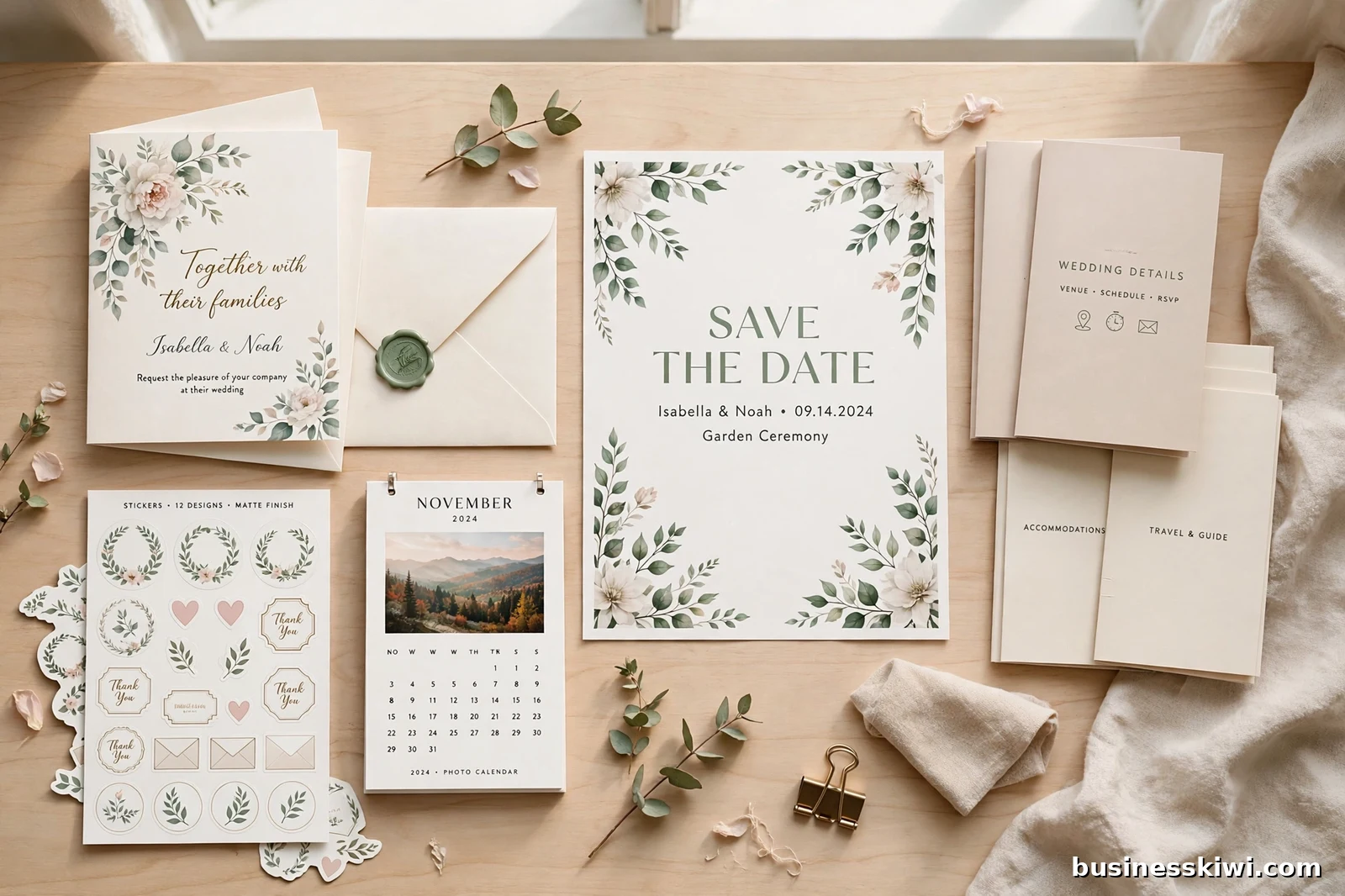
Marketing and events. Posters, pull-up banners, signage, flags, invitations, menus, table talkers, and event programmes. Turnaround matters more here than almost anywhere else, because the event date does not move.
Photos and gifts. Photo prints, enlargements, canvas prints, framed prints, calendars and photo books. Quality varies a lot between sellers, which makes the proofing advice later in this guide worth reading.
Books and publishing. Short-run books, family history books, cookbooks and annual reports, printed in small quantities that would once have been uneconomic.
The three kinds of online printer
Online printers selling to New Zealand fall into three groups. They differ in where your job is printed, how fast it reaches you, and how easy problems are to fix.
New Zealand online printers are local print companies that take orders through a website instead of a counter. Your file is printed here, support is in your time zone, and if the job is wrong, NZ consumer law applies in full. For anything with a hard deadline, this is usually the safest group.
Global platforms run New Zealand storefronts but may print some products offshore. Prices on standard items can be sharp. Read the delivery estimate carefully, because an order can look local while the parcel starts its journey in another country.
Design-tool services let you design in the browser, then order the print of that design in the same place. They are convenient for cards, invitations and simple marketing pieces. The print itself is produced by partner printers, and quality control sits with the platform.
One warning applies across all three groups. A web address with NZ in it does not make the seller a New Zealand business. Consumer Protection makes exactly this point in its online shopping guidance. Before paying, check for a real business name, a contact address, and clear delivery timeframes. If a problem ends up in front of the Disputes Tribunal, a local seller is far easier to deal with.
Choosing a printer: checks before you pay
Five minutes of checking tells you most of what you need about an online printer.
Can you tell who they are? A genuine business shows its legal name, a physical address and a working contact method. A contact form alone, with no name or address behind it, is a reason to walk away. For a New Zealand business, the details should match what you would find on the Companies Office register.
Is the price complete? Prices shown to New Zealand consumers must include GST, and delivery should be quoted before you hand over card details, not revealed at the last step. If a site shows a very low headline price, check what the cart total looks like with your actual quantity and address.
Do they check files, or just print them? Some printers run a human or automated pre-flight check and flag low resolution images or missing bleed before printing. Others print whatever arrives. For anything beyond a simple reprint of a proven file, the checking service is worth more than a small saving.
What happens if the job is wrong? Look for a stated reprint or refund policy before you order, not after. Printers who stand behind their work say so on the site. Silence on the subject is information too.
Can you order a sample? Many printers sell sample packs of their paper stocks for a few dollars, sometimes refundable against an order. For cards, invitations and signage you will hand to other people, feeling the actual stock first removes most of the guesswork.
How long printing online really takes
Every online print order has two clocks running. The first is production time: how long the printer takes to print, finish and pack your job. The second is delivery time: how long the courier network takes after dispatch. The date that matters to you is the two added together.
Printers quote production time at checkout. Some quote the combined time instead, and the two are easy to confuse. If a wedding, market day or product launch depends on the parcel, confirm which one you are looking at before you pay.
For the delivery leg, NZ Post publishes delivery targets for its network. Courier services target the next working day. Standard parcels target up to 3 working days nationwide. Two cautions come straight from NZ Post. The targets are guides, not guarantees. And delivery to rural and remote addresses takes longer, with public holidays affecting timing as well. Other courier companies run their own networks and targets, but the pattern is the same: allow extra days outside the main centres.
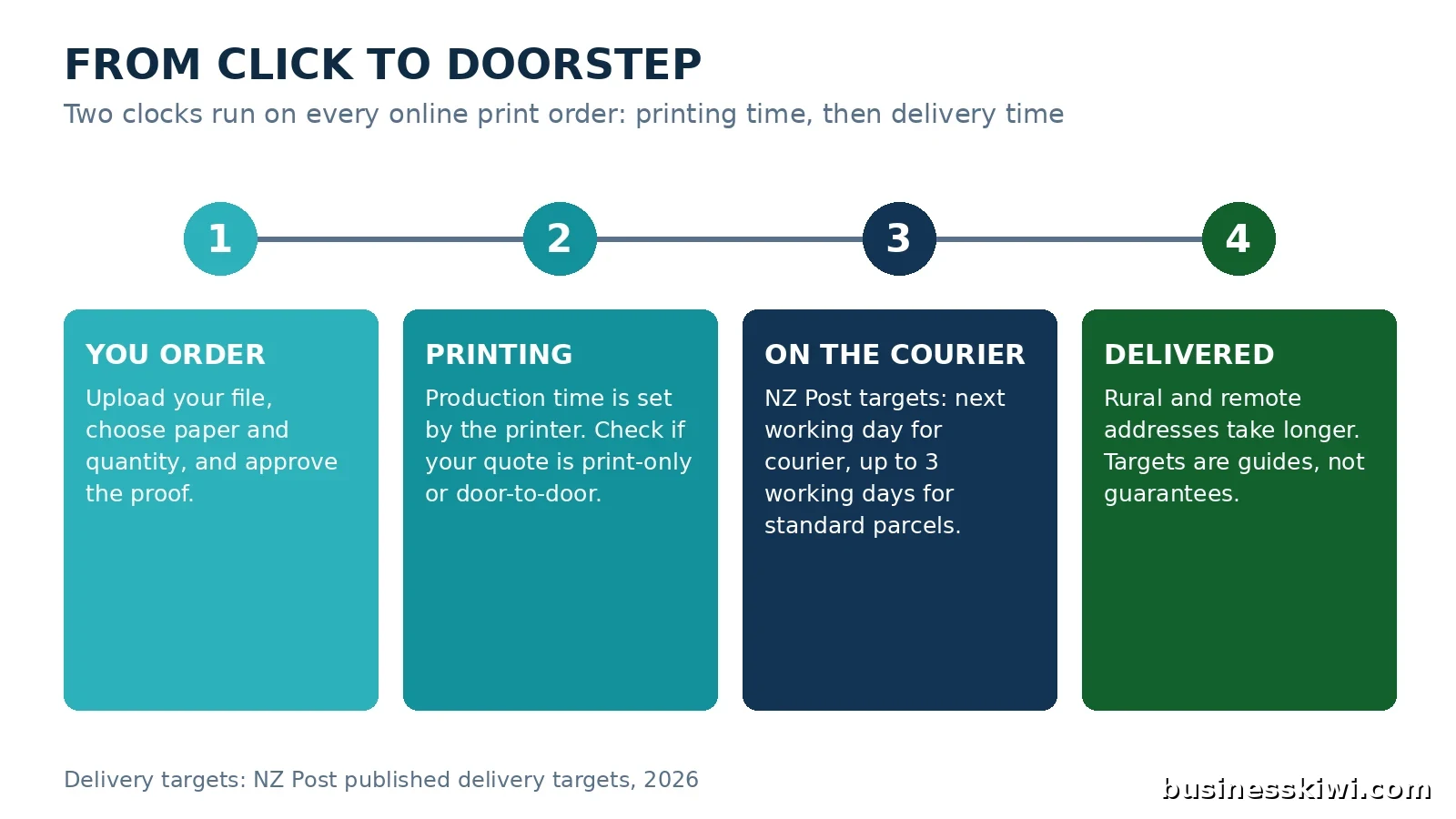
Work backwards from your deadline. If invitations must be posted out by the 20th, and printing takes 3 working days with up to 3 more for delivery, the file should be final and ordered by about the 12th, with a spare day or two for the unexpected. Printers also sell express production for a fee. Paying for speed at the printing end does not speed up the courier, so check both halves before relying on it.
Our companion guide to postage costs in NZ covers what sending parcels around the country costs if you are posting printed material on to customers or guests.
What it costs, in brief
Online print pricing follows a few reliable patterns. Quantity is the biggest lever: the cost per piece falls steeply as the run grows, because most of the work sits in setting the job up. Paper and card weight, colour printing on one or both sides, finishing such as laminating or folding, and production speed all move the price. Delivery is usually charged on top, and free-delivery thresholds are worth checking before you split an order.
That is the short version. The full breakdown of what drives a print quote, and how to compare two quotes fairly, sits in our guide to online printing in NZ.
Getting the quality right
Most disappointing print jobs are not printing failures. They are expectation failures, and they are preventable.
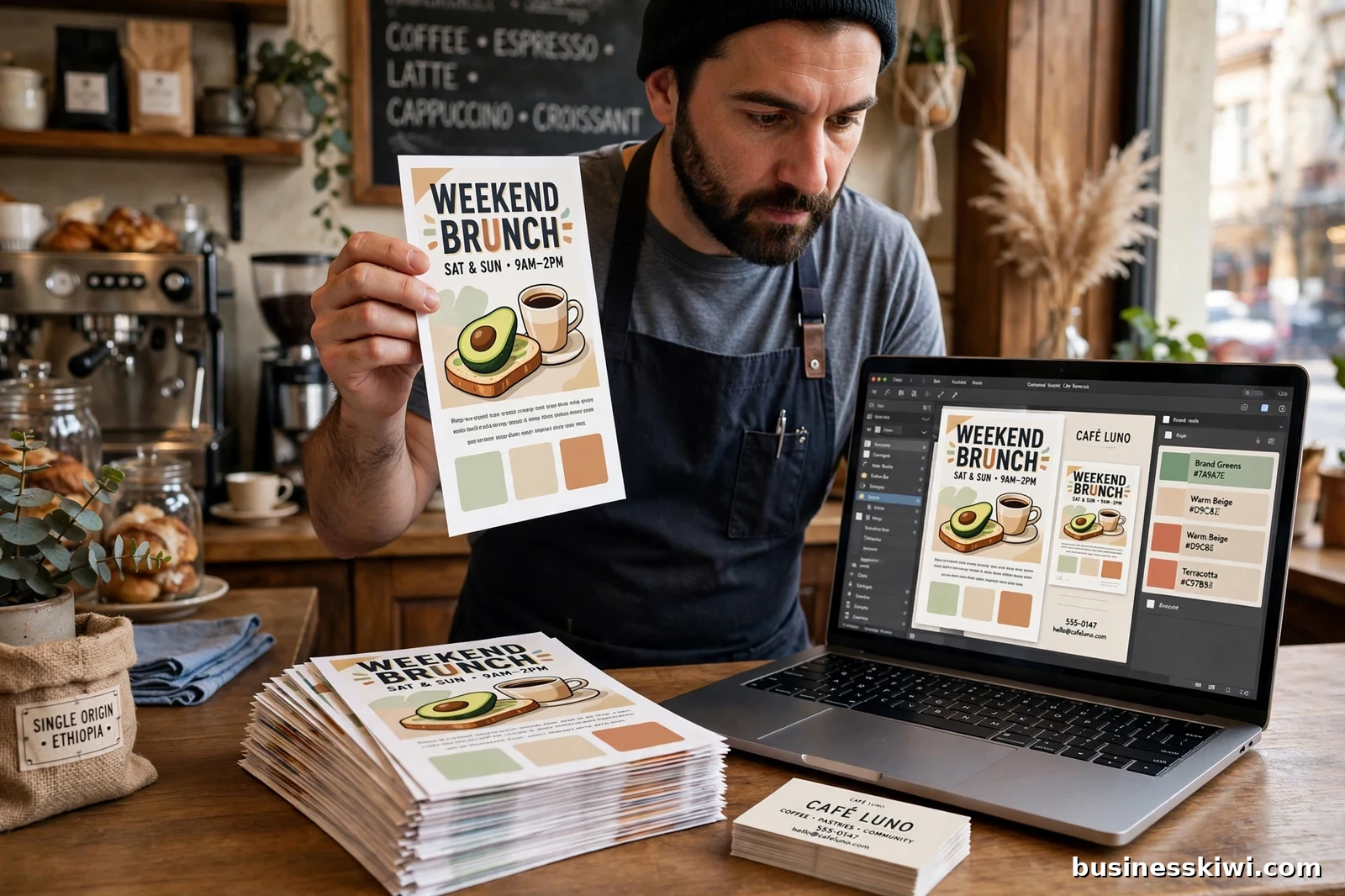
Approve a proof. Reputable online printers show a digital proof before printing, and some offer a printed proof for a fee. Check the proof at full size, not as a thumbnail. Look at names, dates, phone numbers and prices character by character. Once you approve the proof, errors in it are usually your cost to reprint.
Expect colour to shift. Screens display colour in RGB. Presses print in CMYK, a smaller range of colours. Bright screen blues and greens often print slightly duller than they look on a monitor. Rich, simple colours survive the trip best. If exact colour matters, such as brand colours on signage, ask the printer about a printed proof before the full run.
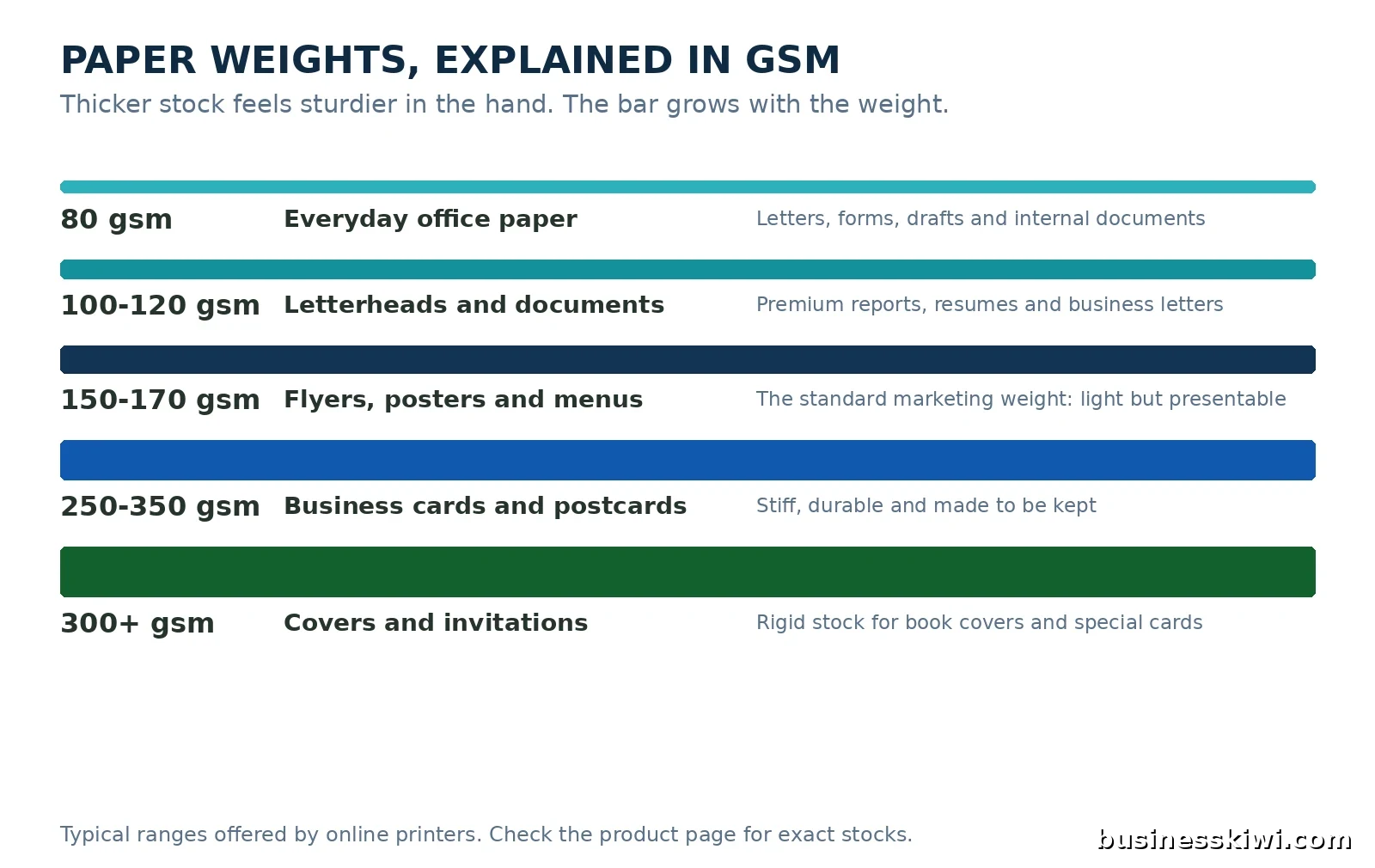
Choose paper by weight. Paper and card weight is measured in grams per square metre, written as gsm. Higher numbers mean thicker, stiffer stock. The ladder below shows the bands most online printers offer.
Match the file to the product. Photos for print need higher resolution than photos for a screen, and artwork that runs to the edge of the page needs bleed so nothing important is trimmed. Each printer publishes its own file setup guide. The detailed walkthrough of file preparation, sizes and formats is in the online printing guide linked above, so this post does not repeat it.
If the job arrives wrong: your rights
Start where Consumer Protection says to start. Contact the seller, explain the problem clearly, and give them a reasonable chance to fix it. For print, the fix is normally a reprint or a refund. Keep your order confirmation, the file you sent, the proof you approved, messages with the seller and the tracking details. Photograph damaged parcels and damaged printing before you throw packaging away. Those photos make responsibility much easier to establish.
If you bought from a business selling in New Zealand, the Consumer Guarantees Act gives you solid ground. Printed goods must be of acceptable quality, fit for their purpose, and match their description and the proof you were shown. Where the seller arranged the delivery, the seller is responsible for the goods arriving in acceptable condition and on time. The Fair Trading Act also bans misleading claims, which covers delivery promises and print quality claims made on the product page.
Offshore sellers are the weak spot. Your NZ consumer rights are hard to enforce across a border, and you are usually left with the platform’s own dispute process or a card chargeback through your bank. That is not a reason to never buy offshore. It is a reason to keep offshore orders to standard products where a problem is an annoyance, not a disaster.
Ordering print for a business
Businesses order print differently from households, and the good online printers are set up for it. Saved templates and stored artwork make reordering a two-minute job and keep branding consistent across staff and branches. GST receipts and monthly invoicing matter to your accounts, and New Zealand printers issue proper tax invoices as a matter of course.
Consistency is the quiet benefit. When the Auckland office and the Dunedin branch both order from the same printer and the same saved file, the cards match. When three people order from three different sites, they do not. If your business hands printed material to customers every week, standardising on one printer with saved files is worth more than chasing the cheapest quote on each order.
Volume changes the conversation too. Once a business is ordering regularly, many NZ printers will quote contract pricing or assign an account contact. Ask. The website price is the starting point for a relationship, not always the final one.
Print online, local print shop, or print on demand?
These three options solve different problems. A local print shop wins when you need to see and feel paper stocks in person, match a colour exactly, or collect a small job the same day. Printing online wins on price for standard products, on range, and on ordering at whatever hour suits you.
Print on demand is a different model again. Nothing is printed until a customer buys it, and the printer ships straight to that customer. It exists for people selling their own designs on shirts, mugs and prints rather than buying printing for themselves. If that is the side of the fence you are on, our print on demand guide explains how the model works in NZ.
Mistakes that waste money
✓ Ordering to the deadline with no spare days for delivery or a reprint.
✓ Approving a proof on a phone screen at thumbnail size.
✓ Assuming an NZ-looking website means the printing happens in New Zealand.
✓ Forgetting that rural delivery adds days to every estimate.
✓ Splitting an order across two sellers and paying two delivery fees.
✓ Choosing the thinnest card to save a few dollars on business cards people will judge you by.
Frequently asked questions
Is it cheaper to print online or at a local print shop?
For standard products in reasonable quantities, online printing is usually cheaper, because online printers batch many jobs together. A local shop can be better value for one-off jobs, same-day work, or anything where you need advice and a physical look at the stock first.
How long does online printing take in NZ?
Add the printer’s production time to delivery. NZ Post targets the next working day for courier and up to 3 working days nationwide for standard parcels, and those targets are guides rather than guarantees. Rural addresses take longer. A typical standard order lands somewhere between 3 and 7 working days all up, depending on the product and where it is printed.
What file format do online printers want?
PDF is the standard across the industry, usually with fonts embedded and images at print resolution. Each printer publishes its own setup guide with sizes and bleed. Our online printing guide walks through file preparation in detail.
What does gsm mean when choosing paper?
Grams per square metre. It describes the weight of the paper or card, and in practice how thick and stiff it feels. Around 80 gsm is everyday office paper, 150 to 170 gsm suits flyers and posters, and 250 to 350 gsm is business card territory.
Can I get a refund if my printing arrives with a mistake in it?
It depends whose mistake it is. If the printer produced something that does not match the proof you approved, a NZ business must fix it under the Consumer Guarantees Act, normally with a reprint or refund. If the error was in the file or proof you approved, the cost of fixing it usually falls on you.
Is it safe to order printing from an overseas website?
Plenty of people do it without problems, but your protections are weaker. NZ consumer law is hard to enforce offshore, so you rely on the platform’s dispute process. Keep offshore orders to standard items, and use NZ printers for deadline work.
Can I print just one copy of something?
Yes. Digital printing makes single copies and tiny runs practical, which is why photo books, one-off posters and short-run books are sold online at all. The per-piece price is higher than a long run, but there is no minimum order problem for most consumer products.
The bottom line
Printing online works well in New Zealand when you treat it as two purchases: a printing job and a delivery. Choose the provider type that matches how much the job matters, add production and delivery times together honestly, approve the proof like it is the final product, and keep an NZ business behind anything with a deadline. Do those four things and what arrives in the courier bag will almost always be what you expected.
For more practical guides for NZ businesses and households, browse our business guides.