Print on Demand in NZ: How It Works, What It Costs and How to Start
The quick answer
Print on demand is a way to sell printed products, such as t-shirts, hoodies, mugs, posters and phone cases, without holding any stock. You create the design and list the product in an online store. Nothing is printed until a customer orders. At that point a print on demand platform passes the order to a print provider, which prints your design on a blank product, packs it and ships it straight to your customer under your brand. You set the retail price, the platform takes its production and shipping costs out of that price, and the difference is yours. For a New Zealand seller the model works, but two local facts shape it: most platforms print offshore, so where your customers live matters, and the moment you sell regularly you are in trade, with the same tax, GST and consumer law duties as any other NZ business.
How print on demand works
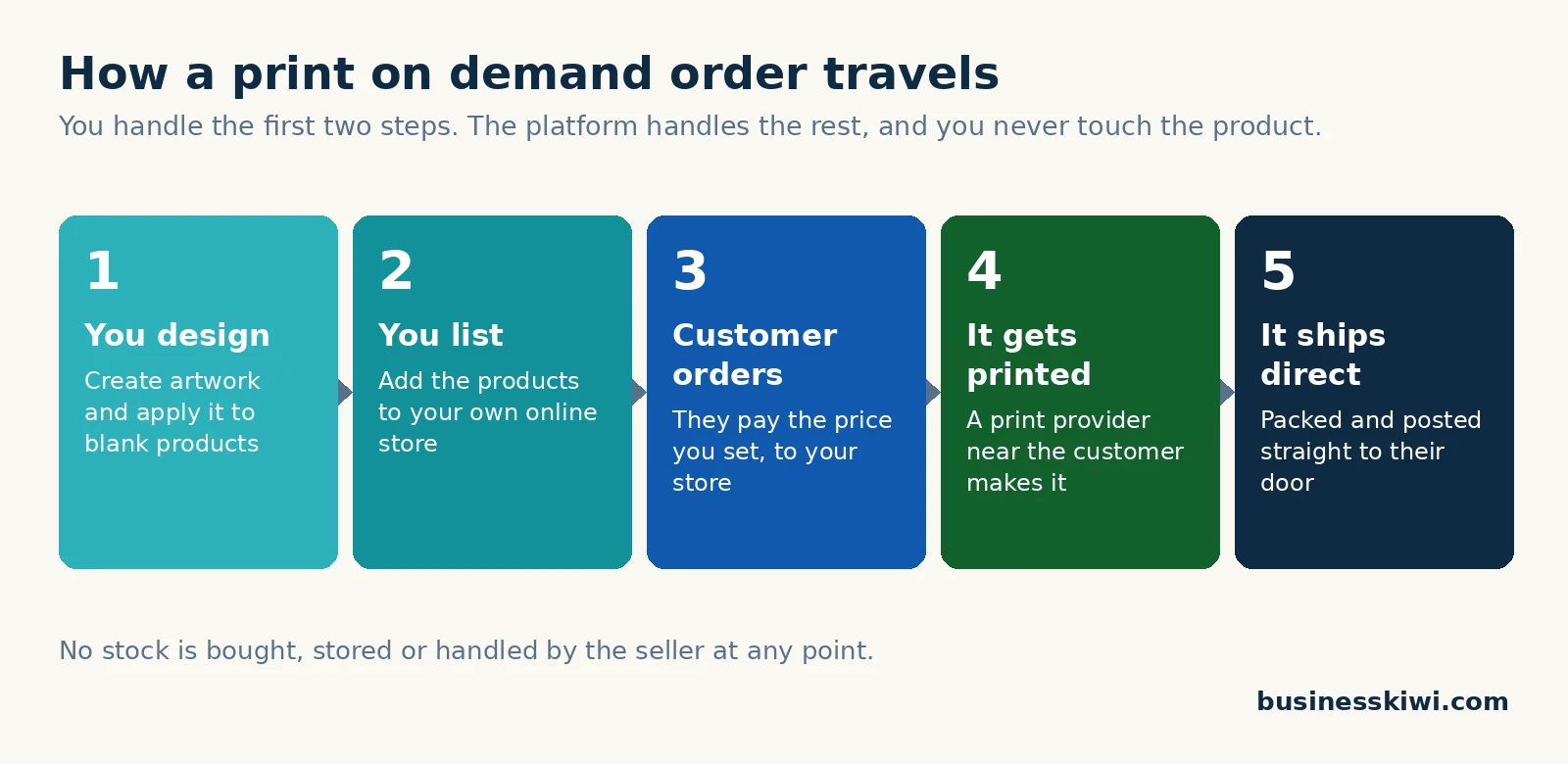
The chain has five links, and you only handle the first two.
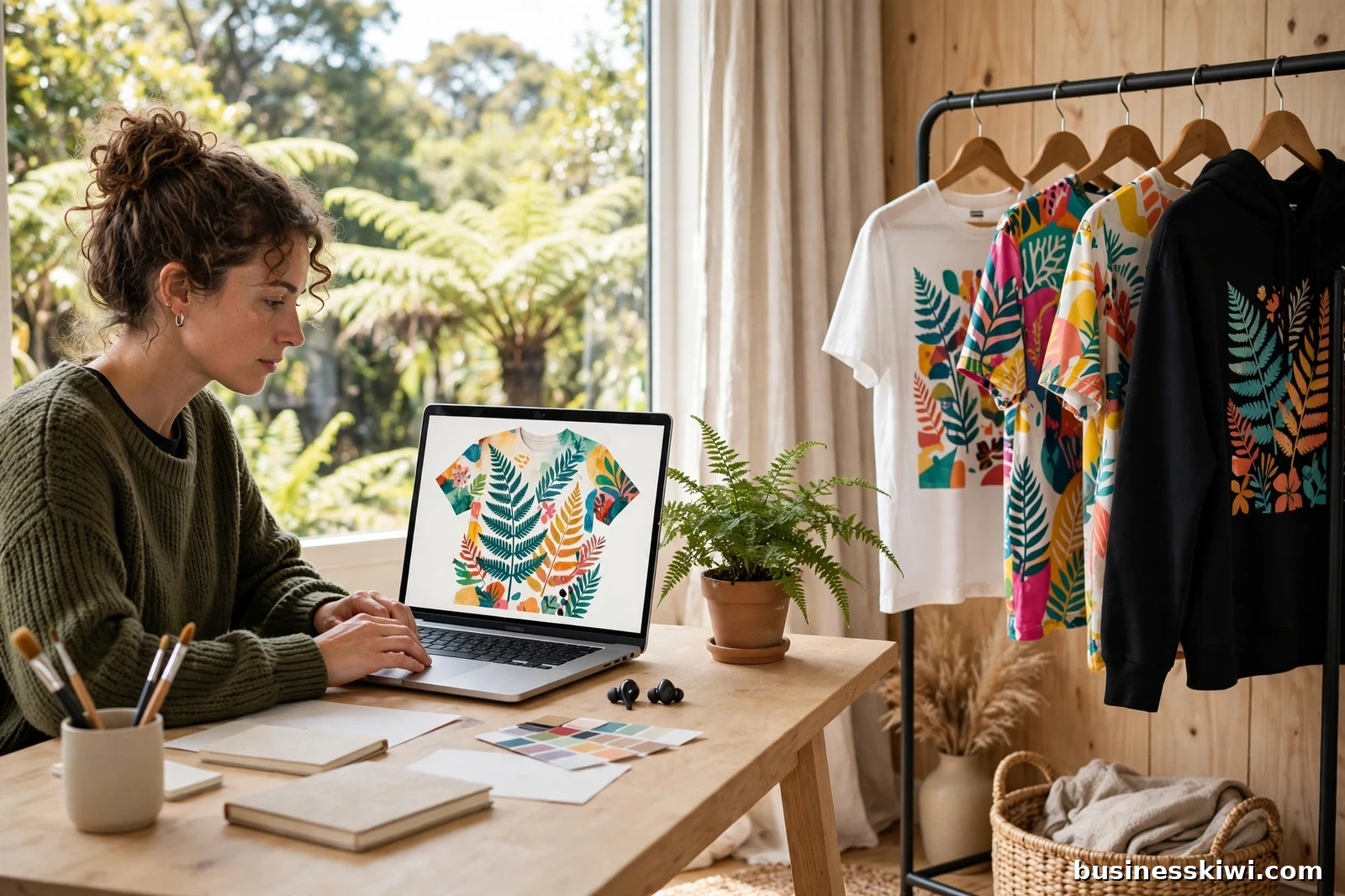
You design and list. You create artwork, apply it to products in the platform’s catalogue, and list those products in your own store. Most platforms connect to common store systems such as Shopify, Etsy and WooCommerce, so the listing, the payment and the order all happen inside your store, under your name.
The customer orders from you. The customer pays your price, to you. Legally and practically, you are the seller. That point matters later, because the customer’s rights run against your business, not against the printer.
The platform routes the order. Print on demand platforms describe the same basic flow. Gelato, one of the larger networks, puts it in four steps on its own site: connect your store, list your products, the customer places an order, and the platform sends that order to a nearby print provider, which produces it and ships it. Printful describes the same model from the money side: the customer pays the retail price you set, the platform deducts production and shipping, and the rest is your profit.
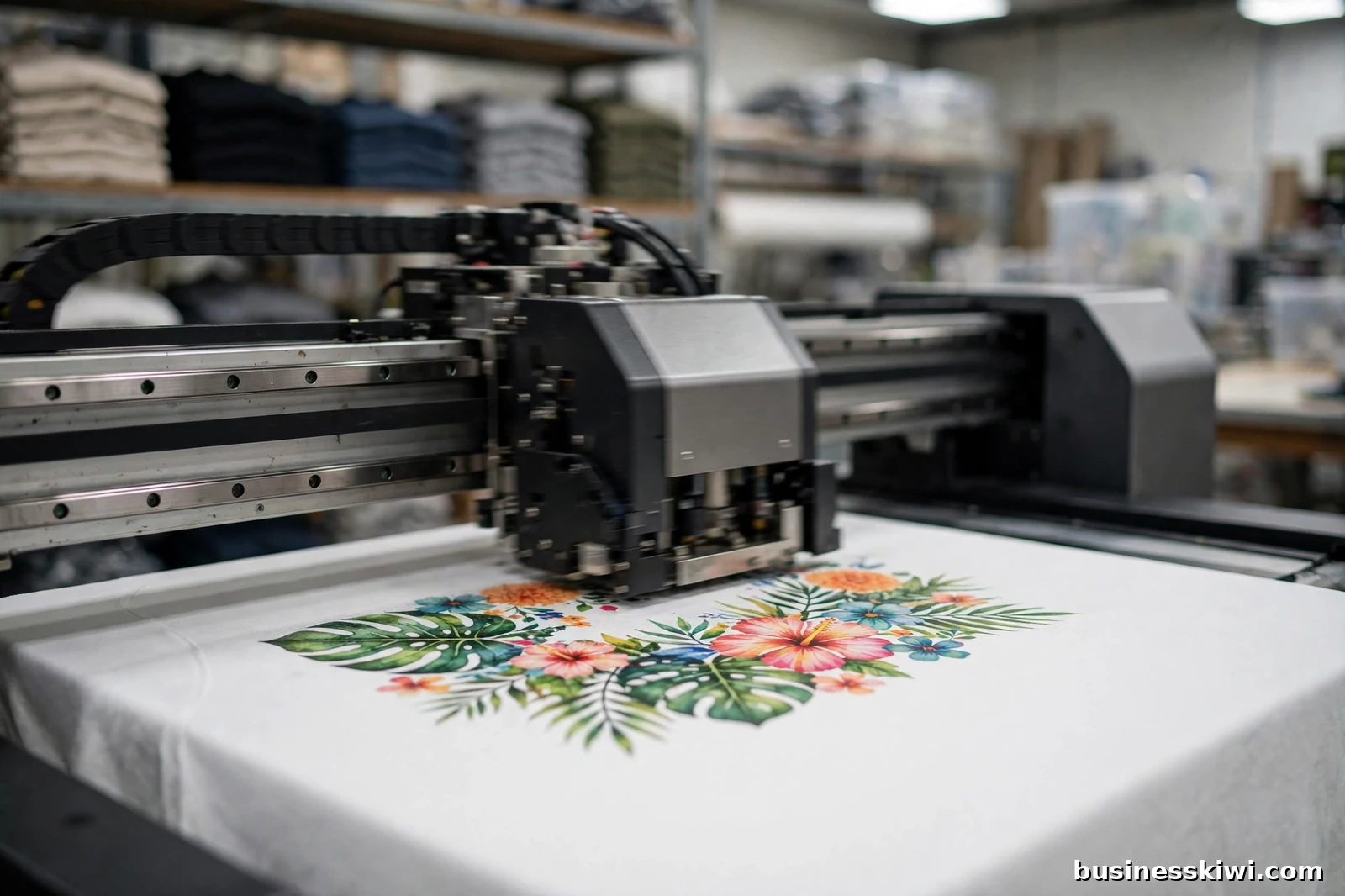
A print provider makes it. The provider prints your design on the blank product, using methods such as direct-to-garment printing for clothing or digital printing for posters and mugs. Some providers also offer embroidery.
The parcel goes direct to the customer. The provider packs and posts the item with your branding on the label. You never see or touch the product, which is the whole appeal of the model, and also its main weakness, covered below.
There is a second way to sell that works differently. On artist marketplaces, the platform owns the store, sets most of the prices, and pays you a royalty or a fixed markup on each sale. You give up price control and the customer relationship in exchange for the platform’s existing traffic. Most NZ sellers who treat this as a business choose the first model, their own store with a fulfilment partner, because the customer list and the pricing stay theirs.
Where your products actually get printed
This is the section most overseas guides skip, and it is the one that decides whether print on demand works well from New Zealand.
Most of the big platforms print outside New Zealand. Printful, for example, makes products in its own facilities in North America and Europe, with partner facilities in Brisbane and Melbourne. For a customer in Auckland, a Printful order is most likely printed in Australia and flown across the Tasman. That adds days and shipping cost compared with a seller whose customers live next door to a fulfilment centre.
Gelato is the exception worth knowing. Its network runs to more than 130 production partners in 32 countries, and its own country list for the Asia-Pacific region includes New Zealand. Its New Zealand page offers local production here, which means a Kiwi customer can receive a product printed in New Zealand rather than imported one order at a time. Gelato also states that close to 90 percent of its orders are produced in the customer’s own country. Treat that as the company’s own figure, but the direction is right: production close to the customer is faster, cheaper to ship and easier on delivery promises.
Three practical lessons follow.
- Match the platform to where your customers are, not where you are. If your buyers are mostly in the United States, a platform with US production serves them better than one strong in Australasia. If your buyers are Kiwis, local or Australian production matters more than a big catalogue.
- Delivery time is part of the product. A t-shirt that takes two days and one that takes two weeks are different offers at the same price. Your listings must state delivery timeframes honestly, and Consumer Protection’s guidance on selling costs is relevant here: delivery charges and timeframes are part of what a customer relies on. Our guide to postage costs in NZ shows what domestic delivery normally costs when you post items yourself, which is a useful yardstick for judging a platform’s shipping charges.
- Samples are not optional. Because you never see production, the only way to know what your customer receives is to order your own products first. Platforms support this with discounted sample orders. Check the print quality, the colours against your artwork, and the real delivery time to a NZ address before you advertise anything.

What it costs, and how the money works
Print on demand removes the biggest starting cost in retail, stock, but it does not make selling free. The costs sit in each order instead.
Production cost. Every product has a base cost that covers the blank item and the printing. You pay it per order, after the customer has paid you. There is no minimum order and no leftover stock, which is the model’s real strength when you are testing designs.
Shipping cost. The platform charges shipping per item on top of production, and it varies with where the product is printed and where it is going. This is why the production location section above matters in dollars, not just days.
Store and payment costs. Your store platform charges its own subscription and transaction fees, and your payment provider takes a percentage of each sale. These sit outside the print platform’s prices, and new sellers forget them most often.
Optional subscriptions. The base service at the major platforms is free to join and free to list. Paid plans exist for sellers who want product discounts. Gelato’s paid tier, for example, advertises discounts of up to a third off product prices for a monthly fee in US dollars. A subscription only pays for itself once your order volume is steady, so it is a later decision, not a starting one.
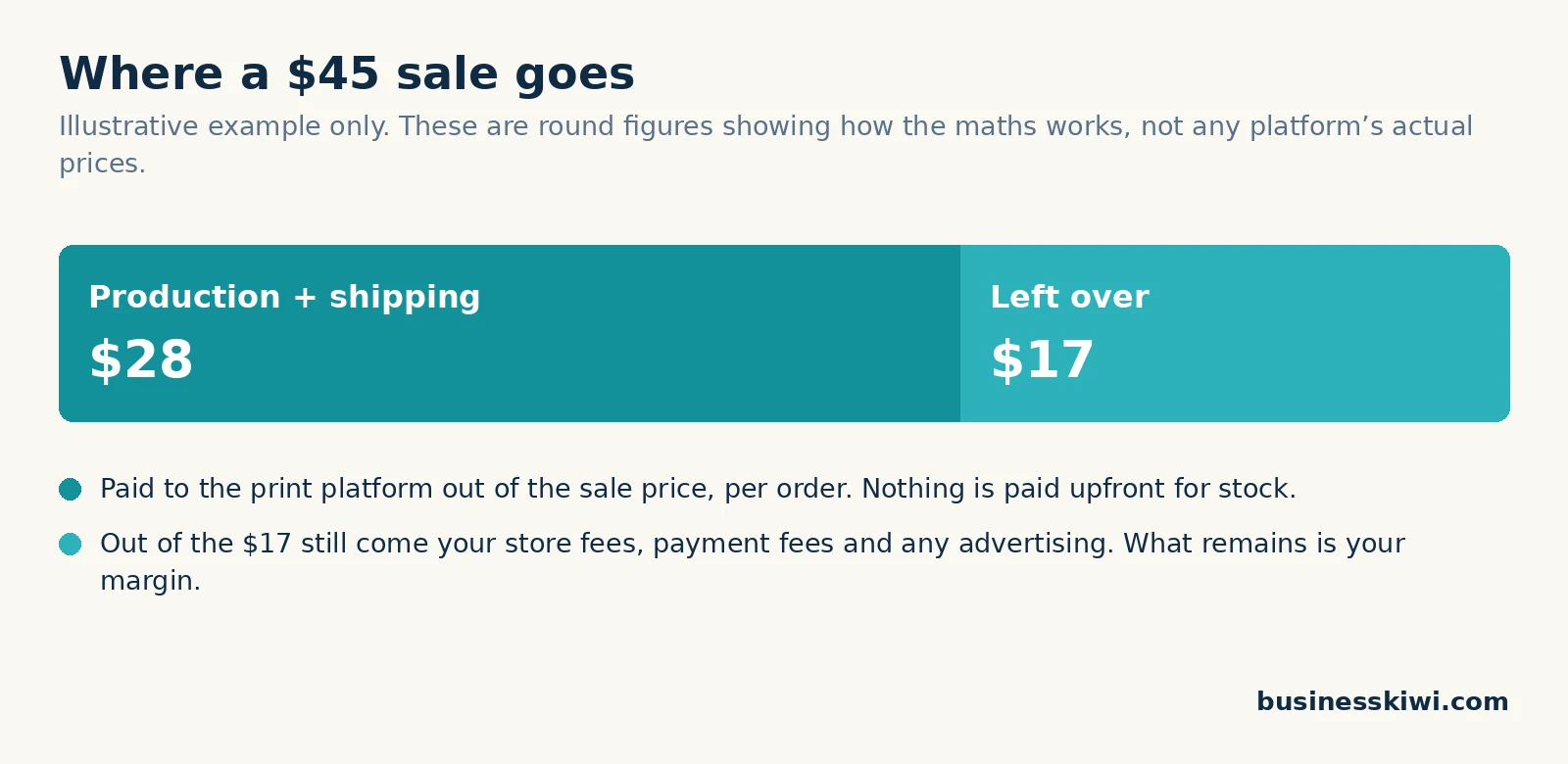
A simple example shows how the margin maths behaves. Say you price a printed t-shirt at $45. Production and shipping together come to $28. That leaves $17, and out of that $17 still come your store fees, payment fees and any advertising you ran to get the sale. The numbers in this example are round figures chosen to show the maths, not any platform’s actual prices, but the shape is real: print on demand margins per item are modest, and the model rewards designs that sell repeatedly over a long period, not a single busy week.
Who does what
Setting up as a New Zealand business
You do not need a company to start. Most NZ print on demand sellers begin as sole traders, because the setup is quick and the costs are low. Business.govt.nz sets out the steps: have an IRD number, tell Inland Revenue you are working for yourself through myIR, register for GST if you need to (the next section covers when), and set up your MyACC account, since self-employed people are covered by ACC CoverPlus and pay levies based on their work type and earnings. Our step-by-step guide to registering as a sole trader in NZ walks through the same process in full.
A company structure becomes worth a conversation with an accountant once sales grow, because a company separates your personal assets from the business and pays tax at the company rate. It also adds Companies Office filings and cost. Nothing about print on demand itself requires one structure over the other.
Two setup points are specific to this model:
- You can sell to the world from day one. Your customers can be anywhere the platform ships. That is a genuine advantage of the model, and it feeds into the GST treatment of overseas sales below.
- Keep business money separate. A separate bank account for the store makes the record-keeping below far easier, and it costs nothing.
Tax and GST for print on demand sellers
The income is ordinary business income. You declare it in your tax return, you can claim the genuine costs of earning it, such as production, shipping, store fees and design tools, and you pay tax on the profit. Selling through a platform does not change any of that; the platform is your supplier, not your employer.
GST has one number that matters most:
The $60,000 rule. You must register for GST as soon as you expect your turnover to pass $60,000 in any 12-month period. Below that line, registration is your choice. Inland Revenue can charge penalties if you should have registered and did not. (Business.govt.nz)
Once you are registered, the routine is set: charge GST on your NZ sales, file GST returns at the frequency you chose (most small businesses file two-monthly), and keep your invoices and receipts for seven years. If you want to see what GST does to a price, our NZ GST calculator runs the numbers both ways.
One GST point is specific to this model and works in your favour. Goods and services sold from New Zealand to overseas customers are usually zero-rated, meaning GST is charged at 0 percent rather than 15 percent. Zero-rated sales still go on your GST return, in their own section, so keep those invoices separate from your NZ sales from the start. For a print on demand seller with customers in the US or Europe, that separation is weekly bookkeeping, not a once-a-year fix.
Registering voluntarily before you reach $60,000 is a real option some sellers take, because it lets them claim GST back on costs. Weigh it properly: once you are registered you must charge GST on your NZ prices and file returns whether sales are strong or not, and you stay registered until you tell Inland Revenue otherwise.
Your legal duties to customers
The fact that you never touch the product does not dilute your duties. You are the seller, and New Zealand consumer law treats you that way.
The Consumer Guarantees Act applies to your sales. Products you sell must be of acceptable quality, fit for purpose and match their description. If a shirt arrives with a crooked print or the wrong size, the customer’s claim is against your business. Your recovery from the print platform sits under that platform’s own terms, which commonly cover reprints or refunds for faulty production. Good platforms sort production faults quickly, but the customer conversation is always yours.
The Fair Trading Act governs how you sell. Consumer Protection’s guidance for businesses is direct: the Act applies to internet traders exactly as it applies to a physical shop. You must represent your products accurately, you must not mislead customers even by accident, and you must not hold back important information. The same guidance lists information you must give, including whether a price includes GST and any extra fees. For clothing sellers there is one more: new clothing and footwear must carry country of origin labels, which is a detail to confirm with your print provider, since the garment’s origin and the printing location are two different things.
Delivery promises are claims. If your listing says five days and the parcel takes fifteen because it was printed overseas, that gap is a Fair Trading Act problem, not just an unhappy customer. State timeframes that reflect where the product is actually printed, and update them when a platform changes providers.
Protect your designs, and respect everyone else’s
Your designs are the only part of this business that is truly yours, so treat them that way.
A trade mark protects the signs your customers recognise you by: your brand name, logo, or even a distinctive colour or shape. The Intellectual Property Office of New Zealand (IPONZ) handles registration, and MBIE’s guidance makes the practical point that a registered mark lets you use the ® symbol and makes your brand easier to defend. IPONZ also offers a search and preliminary advice service that checks your proposed mark before you pay for a full application. A plain word mark is usually the stronger starting point, because it protects the words themselves in any style, where a logo mark mainly protects that particular design.
The other side of the same coin catches more sellers out. Printing someone else’s protected design, a sports team’s logo, a band’s artwork, a cartoon character, a famous brand’s slogan, is infringement even if you drew your own version of it. Platforms scan for this, remove listings and close repeat offenders’ accounts under their terms. Every design in your store should be your own work, properly licensed, or checked clear before it goes on sale.
Print on demand, holding stock, or a local printer?
Each model wins somewhere different.
Print on demand wins when you are testing designs, your budget is small, or your catalogue is wide and shallow: many designs, few sales of each. The risk per design is close to zero.
Holding stock wins once one design sells steadily. Buying blank products in bulk and printing them yourself, or paying a local printer per run, cuts the per-unit cost hard. The trade-off is money tied up in stock that may not sell, plus storage and packing work that lands back on you.
A commercial print service wins for business printing rather than products for resale: runs of flyers, signage, uniforms or packaging where you need a set quantity by a set date. That is a different service from print on demand, and our guide to online printing in NZ covers how it works and what moves the price.
Many established sellers end up hybrid: proven designs move to bulk printing for margin, new designs launch on print on demand to test demand, and nothing is stocked until customers have voted with real orders.
How to start, step by step
- Choose a narrow audience and a first set of designs. Specific beats broad. Designs for one identifiable group of people outsell generic slogans.
- Check your name and designs with IPONZ before you build anything on them.
- Pick your platform by production location. Work out where most of your customers will be, then choose the platform that prints closest to them. For a NZ-focused store, a network with New Zealand or Australian production has a real edge.
- Set up the business side. IRD number, tell Inland Revenue you are self-employed, open a separate bank account, and decide your GST position using the $60,000 rule.
- Connect your store and list a small range. Start with a handful of products you would be proud to receive.
- Order samples of everything you list. Wear them, wash them, and time the delivery to your own address.
- Price from the full cost stack. Production, shipping, store fees, payment fees and a realistic allowance for marketing, then your margin. If the price that produces has to be higher than customers will pay, the design or the product is wrong, not the maths.
- Write honest listings. Real delivery timeframes, clear sizing, accurate photos or mockups, and your returns approach stated up front, as the Fair Trading Act expects.
- Launch small and read the feedback. Print quality complaints and delivery complaints are your two early-warning signals. Fix the cause, which is usually the product choice or the provider, before you spend on advertising.
- Review after your first twenty or so orders. By then you know your real margins, your real delivery times and which designs carry the store. Scale what the numbers support.
Frequently asked questions
Is print on demand a real business, or a side income? It is a real business in the eyes of Inland Revenue and consumer law from your first regular sale, whatever the size. Plenty of sellers run it as a side income, and some build full-time stores, but no official figures exist for what NZ sellers earn, so treat any income claim you see in marketing with suspicion. The honest summary is that margins per item are modest and marketing, not printing, is usually the deciding cost.
Do I need to register for GST to sell print on demand? Only once your turnover is expected to pass $60,000 in 12 months. Below that, registering is optional. If you do register, you must charge GST on NZ sales and file returns, and sales to overseas customers are usually zero-rated but still recorded.
Who handles returns and faulty items? You do, because you are the seller. If the fault is in production, the platform’s terms normally provide a reprint or refund to you, but the customer’s rights under the Consumer Guarantees Act run against your business either way.
Can print on demand products be printed in New Zealand? Yes, through some networks. Gelato’s production network includes New Zealand partners, so orders for Kiwi customers can be printed here. Most other large platforms print offshore, with Australia the closest production point for several of them.
Do I need a company to start? No. Most sellers start as sole traders. A company is a later option as sales grow, mainly for liability separation and tax planning, and it adds filing obligations.
Can I print famous designs if I redraw them myself? No. Redrawing does not remove trade mark or copyright protection. Sell your own designs, or designs you hold a proper licence for, and check anything borderline with IPONZ first.
How fast will my customers get their orders? It depends on where the item is printed and where it is going. Locally printed orders can arrive within days; orders printed overseas take longer and cost more to ship. Gelato states that 90 percent of its orders arrive within five days, which is the company’s own worldwide figure. Set your listing timeframes from your sample orders, not from a platform’s best case.
The bottom line
Print on demand suits New Zealand sellers who have designs and an audience but no spare cash for stock. The model itself is simple, and the platforms handle everything physical. The parts that decide whether it works are the unglamorous ones: choosing a platform that prints near your customers, pricing from the full cost stack rather than the product cost alone, ordering samples before you advertise, and running the business properly from the start, with your tax, GST and consumer law duties handled like any other NZ trader. Do those four things well and print on demand is a low-risk way to find out whether your designs can carry a real business.
More guides for NZ business owners sit in our Business & Industry section.