Net Profit: What It Means, How to Work It Out and How to Read Yours

The short answer
Net profit is the money a business has left after every cost of running it has been taken away from its income. It sits on the last line of the profit and loss statement, which is why people call it the bottom line.
The short formula looks like this:
Net profit = Revenue − Cost of goods sold − Operating expenses − Interest − Tax
Work down that line in order and you pass two other profit figures on the way. Revenue minus cost of goods sold gives you gross profit. Gross profit minus operating expenses gives you operating profit. Take off interest and tax as well, and what remains is net profit.
Inland Revenue puts the tax version of the same idea in one sentence: businesses and organisations pay income tax on their profit, meaning their income minus any expenses. So net profit is not just an accounting label. For most small businesses it is also the figure the tax system starts from.
How to calculate net profit, step by step
You calculate net profit in five steps. Each step uses the result of the step before it.
Step 1: Start with revenue. Revenue is the total income from selling your goods or services in the period, before anything is taken off. It is sometimes called sales or turnover, and accountants call it the top line.
Step 2: Take off the cost of goods sold. The cost of goods sold, often shortened to COGS and also called cost of sales, is what it directly cost you to make or buy the things you sold. For a shop, that is mostly the stock it bought. For a tradie, it is materials and the subcontractors used on each job. Revenue minus COGS leaves gross profit.
Step 3: Take off operating expenses. Operating expenses are the day to day costs of keeping the business running, such as rent, wages, power, insurance, marketing and accounting fees. They are also called overheads. Gross profit minus operating expenses leaves operating profit.
Step 4: Take off interest. If the business borrows money, the interest on loans and overdrafts comes off next. That leaves profit before tax.
Step 5: Take off tax. Income tax is the final deduction. What remains is net profit after tax, the true bottom line for the period.
A worked example
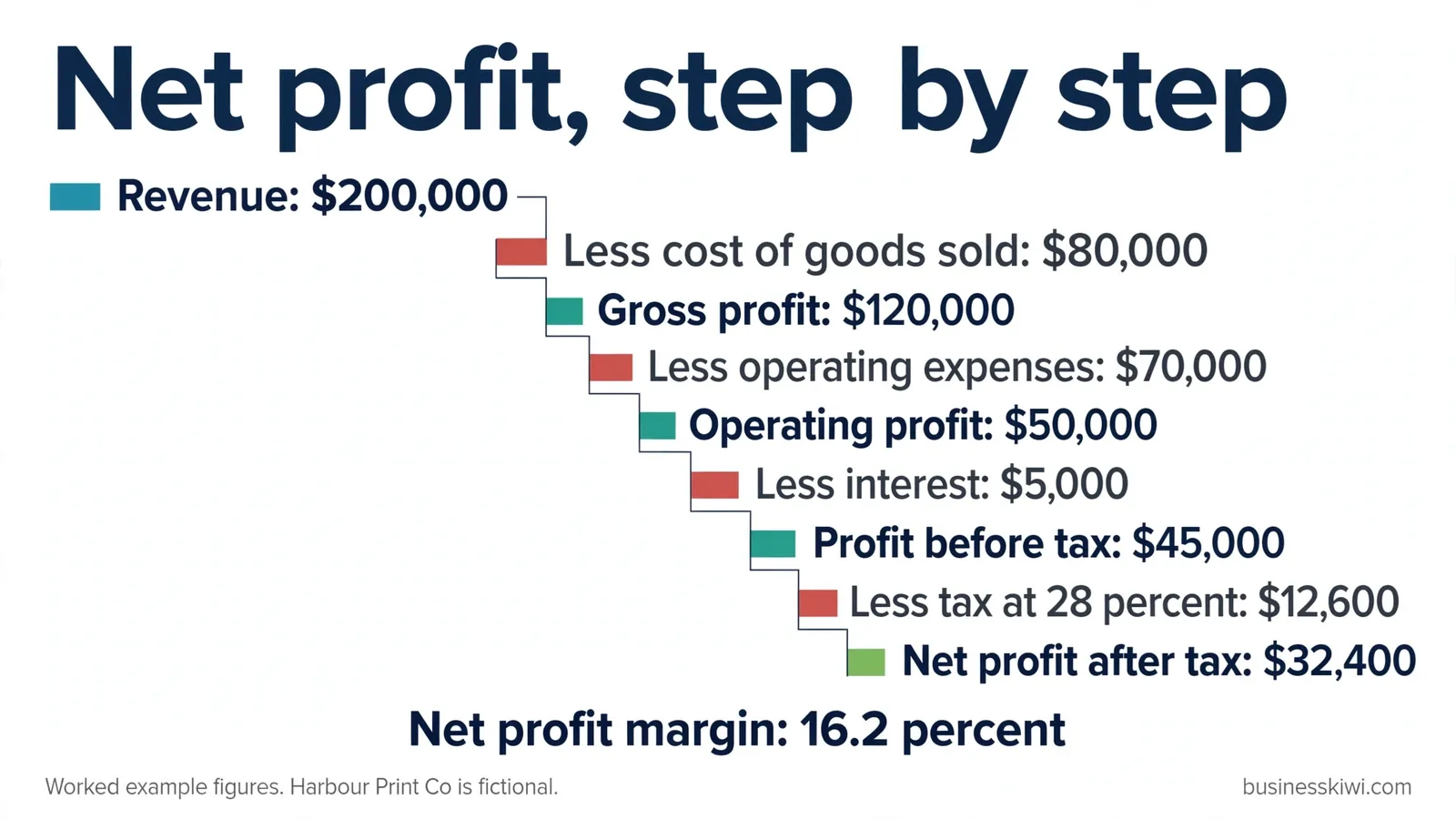
The example below uses a fictional company, Harbour Print Co, for one year. The figures are round numbers chosen to show the method, and they exclude GST. The tax line uses the 28 percent rate Inland Revenue lists for most companies. Treat it as an illustration of how the calculation works, not as a real business.
-
Revenue: $200,000
-
Less cost of goods sold: $80,000
-
Gross profit: $120,000
-
Less operating expenses: $70,000 (rent $24,000, wages $30,000, other overheads $16,000)
-
Operating profit: $50,000
-
Less interest on the business loan: $5,000
-
Profit before tax: $45,000
-
Less income tax at 28 percent: $12,600
-
Net profit after tax: $32,400
Read the story those numbers tell. Harbour Print Co sold $200,000 worth of work and kept $32,400 of it after every cost and its tax. The other $167,600 went on stock and materials, the costs of running the shop, the bank and the tax bill.
The same steps work for a sole trader, with one difference at the end. A sole trader is not taxed inside the business. The waterfall stops being a company calculation at profit before tax, and that profit is the amount the owner is taxed on as an individual. Inland Revenue’s self-employed guidance sums it up: if you are self-employed, you pay tax on net profit by filing an individual income return, and you can claim back expenses for the business activity you carry out.
Gross profit vs net profit
Gross profit and net profit answer different questions, and mixing them up leads to bad decisions.
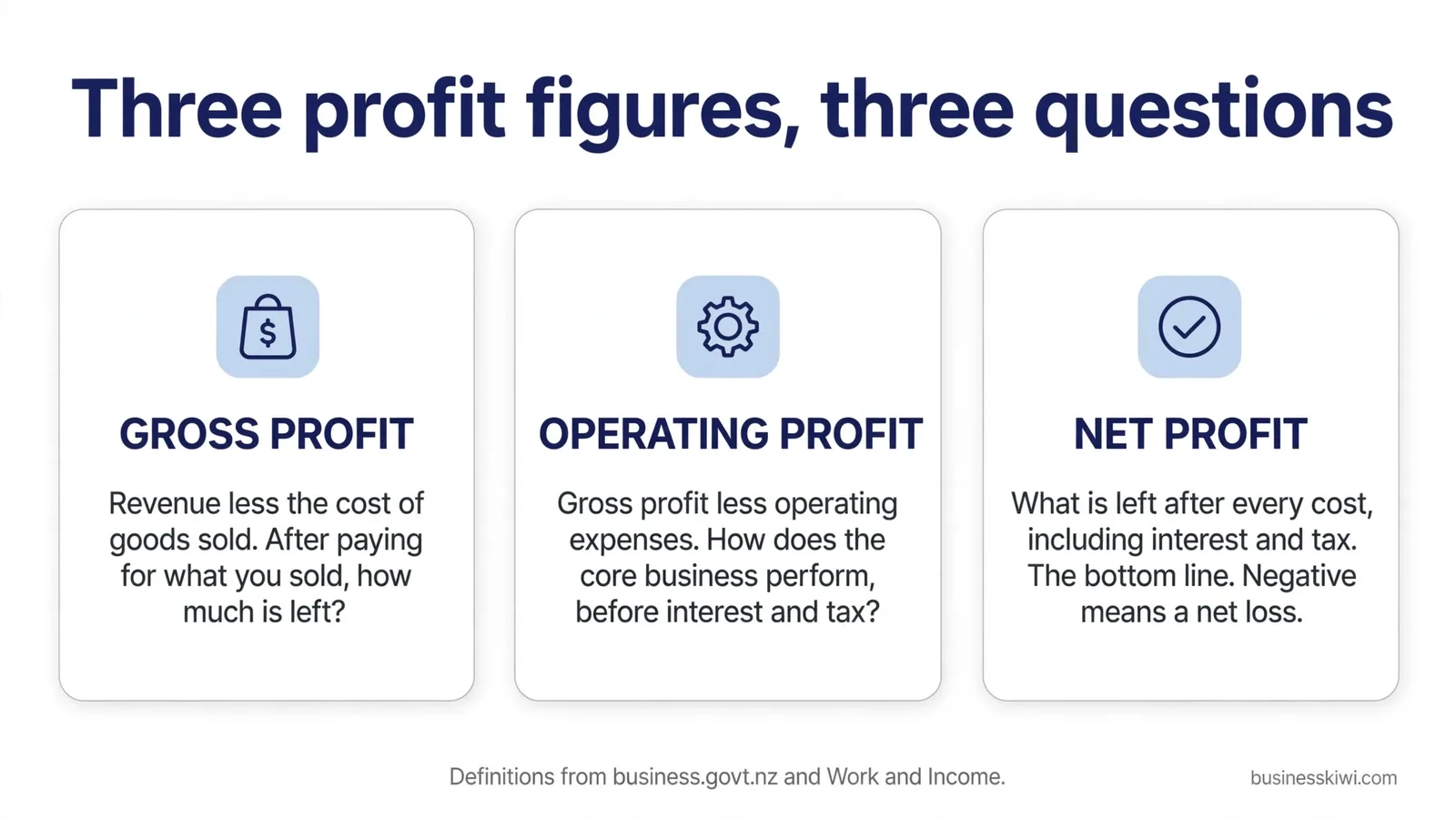
Gross profit asks: after paying for the things I sold, how much is left? It tests your pricing and your direct costs. If gross profit is thin, the problem sits in what you charge or what your products and jobs cost you to deliver.
Net profit asks a bigger question: after paying for everything, how much is left? It tests the whole business, including the rent, the wages, the loan and the tax. A business can have a healthy gross profit and still finish with a small net profit, or even a loss, if its overheads are heavy.
Business.govt.nz makes the same point on its profit and loss guidance. The higher your gross profit, the more money the business has to cover its operating expenses and other expenses. Gross profit is the fuel. Net profit is what is still in the tank at the end of the trip.
One practical warning follows from this. Never compare your net profit with someone else’s gross profit, and never quote a profit figure without saying which one it is. The two numbers for Harbour Print Co, $120,000 and $32,400, describe the same business in the same year.
Operating profit and where it sits
Operating profit sits in the middle of the calculation, between gross profit and net profit. It is gross profit minus operating expenses, before interest and tax are taken off.
Owners watch operating profit because it strips out two things that are not really about trading. Interest depends on how the business is funded, not on how well it sells. Tax depends on the business structure and the owner’s situation. Operating profit therefore shows how the core business performs on its own.
Two businesses with the same sales can report the same operating profit and very different net profits, simply because one carries a large loan and the other does not. That is why a buyer or a bank may look at operating profit to judge the business itself, then look at net profit to judge what the current owner actually keeps.
Operating profit is also the figure that moves first when you fix the basics. A rent increase, a new staff member or a price rise shows up in operating profit straight away, long before it flows through to the bottom line.
What gets taken off between gross and net
Between gross profit and net profit, three groups of costs come off. It helps to know what sits in each group.
Overheads. These are the operating expenses from step 3: rent and rates, wages and salaries for staff who are not directly making the product, power and phone, insurance, vehicle running costs, software, marketing and professional fees. Overheads tend to be steady from month to month, which is why they are sometimes called fixed costs. They keep being charged whether you sell a lot or a little.
Depreciation. Equipment and vehicles lose value as they age, and accounts spread that cost across the years the asset is used. The business.govt.nz profit and loss guidance makes a point worth remembering: the statement includes items that do not appear in a cash flow statement, such as vehicles and machinery losing value over time. Depreciation is a real cost in the net profit figure even though no bill arrives for it each month.
Interest and tax. Interest is the price of borrowed money, and it comes off after operating profit. Tax comes last. For a company, tax is charged on the profit and the after tax figure is the final net profit. For a sole trader, there is no tax line inside the business accounts. The profit before tax is the owner’s taxable income, and the owner pays tax on it at individual rates.
Net profit, net income and profit after tax: the name problem
Three labels cause most of the confusion around this topic, so it pays to sort them out.
Net profit and net income usually mean the same thing. Both describe income left after expenses. Work and Income states this plainly in its self-employment guidance: some businesses refer to net income before tax in their accounts, and it has the same meaning as net profit before tax. If you see net income on a statement from overseas software or an American website, read it as net profit.
Profit after tax is net profit with the tax already removed. Where a statement just says net profit, check whether tax has been taken off, because the label is used both ways. Business.govt.nz describes net profit as the money the business makes minus all its expenses, including tax. Work and Income, by contrast, defines net profit before tax, because that is the figure it needs for sole traders.
The safe habit is to use the full label every time: net profit before tax, or net profit after tax. Those two phrases cannot be misunderstood, and the difference between them is real money. In the Harbour Print Co example, the gap between the two is $12,600.
Net profit margin in one line
Turn net profit into a percentage and you get the net profit margin: net profit margin = net profit ÷ revenue × 100. For Harbour Print Co, $32,400 ÷ $200,000 × 100 gives a net profit margin of 16.2 percent, meaning the business kept 16.2 cents of every sales dollar after all costs and tax. Use the margin to compare periods of different sizes, and leave the detailed ratio work to your accountant or your profit and loss statement review.

What does a good net profit look like?
There is no official benchmark for a good net profit, and you should be wary of anyone who quotes one without naming a source. Neither Inland Revenue nor business.govt.nz publishes a table of healthy margins by industry, and this article does not invent one. A margin that is strong for a supermarket would be weak for a software firm, because their cost structures are completely different.
Compare your net profit against things that are actually meaningful instead:
-
Your own past results. Is the figure, and the margin, better than last year and the year before? A steady upward trend in your own business is the most honest benchmark there is.
-
Your budget. Business.govt.nz lists a budget as one of the core reports for knowing how well your business is doing. Profit only means something against the plan you set for it.
-
Your break-even point. Net profit tells you how far above break-even you finished. A small profit in a hard year can be a good result, and a large profit can still disappoint if you expected more.
-
What the owner still needs. For a sole trader, net profit has to cover the owner’s living costs and tax, because there is no separate wage. A company needs enough profit to pay tax, service its loans and leave something to reinvest.
The single most useful question is not “is this margin good” but “is it moving the right way, and do I know why”.
When net profit is negative: a loss
If expenses are higher than income, net profit is negative and the business has made a net loss. Work and Income uses exactly that wording: if the difference between gross income and allowable expenses is negative, it is called a net loss.
A loss is common in the first year or two, and during a deliberate growth phase. Business.govt.nz describes the pattern plainly: businesses often operate at a loss temporarily when starting out or in periods of growth, and that is okay if there is enough in the bank to cover running costs until income picks up. The same guidance carries the warning that matters. If the business is frequently operating at a loss because of slow sales, something in how it runs needs to change.
For tax, a loss is not wasted. Business.govt.nz explains that a loss claimed in a tax return can be carried forward to lower income in the next tax year. Sole traders and partnerships report the loss in the individual return, and Inland Revenue advises the amount that can be carried forward. Companies report the loss in the company return and generally pay no income tax for a loss year. The detailed rules sit with your tax return, so get advice before relying on a carried forward loss.

Why net profit is not cash in the bank
New owners often ask why the accounts show a profit while the bank account is empty. The two figures measure different things, and at least four gaps sit between them.
First, profit counts sales when they are invoiced, not when they are paid. A busy month with slow paying customers lifts net profit and does nothing for the bank balance. Business.govt.nz lists invoicing late and not chasing debtors among the common finance mistakes, precisely because it hurts cash flow.
Second, depreciation reduces profit without touching cash. The truck loses value on paper each year, but no payment leaves the account for that loss of value.
Third, some cash payments never appear as expenses. Repaying the principal of a loan is the big one. The interest is an expense, but the principal repayment just reduces what you owe, so it drains cash without reducing net profit. Buying equipment works the same way: the cash goes out at once, while the cost reaches the profit figure slowly through depreciation.
Fourth, tax and GST timing pulls cash away from profit. Money collected from customers may include GST that belongs to Inland Revenue, and business.govt.nz warns against spending money in the bank account without realising some of it is set aside for bills and taxes.
The lesson is to read net profit and cash flow together. Profit tells you whether the business model works. Cash flow tells you whether the business can pay its bills this month. A business needs both answers to be yes.
Related guides: our profit and loss statement guide shows the statement this figure comes from, our disbursements guide explains the charges that sit inside a professional bill, our break-even guide shows the point your profit is measured from, and our claiming business expenses guide covers the costs that reduce profit. For more business guides, browse the Business & Industry section.
Frequently asked questions
What is net profit in simple terms?
Net profit is what a business keeps after every cost has been paid. Take the total income, subtract the cost of the goods or services sold, subtract the running costs, interest and tax, and the amount left is net profit. If nothing is left and the costs are bigger, the result is a net loss instead.
What is the formula for net profit?
Net profit = revenue − cost of goods sold − operating expenses − interest − tax. You can also build it in stages: revenue minus cost of goods sold is gross profit, gross profit minus operating expenses is operating profit, and operating profit minus interest and tax is net profit.
Is net profit the same as net income?
Yes, in normal business use the two terms mean the same thing. Work and Income confirms that net income before tax in a business’s accounts has the same meaning as net profit before tax. Net income is the label used more often in American material and some accounting software.
Do I work out net profit before or after tax?
Both versions exist, so always check which one a figure uses. Net profit before tax is the result after all expenses and interest but before income tax. Net profit after tax, also called profit after tax, is the final figure once tax has been deducted. For a sole trader, the before tax figure is the important one, because it is the income the owner is taxed on.
What is a good net profit margin?
There is no official benchmark, and no honest single answer. Inland Revenue and business.govt.nz do not publish standard margins for industries. Judge your margin against your own previous years, your budget and your break-even point, and look at whether it is improving and why.
Can a business make a net profit and still run out of cash?
Yes, and it happens often. Profit counts sales when they are invoiced, not when customers pay, and it includes non-cash costs like depreciation. Loan principal repayments and equipment purchases take cash out without reducing profit. That is why owners track cash flow as well as profit.
Where do I find my net profit?
On your profit and loss statement, which business.govt.nz describes as a summary of how much you have earned and spent over a financial year. Net profit is the last line, which is why it is nicknamed the bottom line. Your accounting software will produce the statement from your records, and Inland Revenue requires you to keep records of your sales, purchases, income and expenses for 7 years.
The bottom line
Net profit is the final score of a business for a period: total income minus every cost of earning it, ending with tax. Gross profit shows whether your pricing and direct costs work. Operating profit shows whether the core business works. Net profit shows whether the whole thing works, after the bank and the tax bill take their share. Work it out in stages, label it before tax or after tax every time, and read it next to your cash flow rather than on its own. Do that, and one small figure at the foot of a statement will tell you more about your business than any other number in the accounts.
Sources
-
Inland Revenue, Tax rates for businesses, https://www.ird.govt.nz/income-tax/income-tax-for-businesses-and-organisations/tax-rates-for-businesses
-
Inland Revenue, Self-employed, https://www.ird.govt.nz/roles/self-employed
-
Inland Revenue, Records of income and expenses, https://www.ird.govt.nz/managing-my-tax/record-keeping/records-of-income-and-expenses
-
Business.govt.nz, Business finance basics, https://www.business.govt.nz/tax-and-money/business-finance-basics
-
Business.govt.nz, Understanding your profit and loss statements, https://www.business.govt.nz/strategy-and-performance/strategic-finance/understanding-your-profit-and-loss-statements
-
Business.govt.nz, If your business is operating at a loss, https://www.business.govt.nz/tax-and-money/business-finance-basics/if-your-business-is-operating-at-a-loss
-
Work and Income (Ministry of Social Development), Net profit, https://www.workandincome.govt.nz/map/income-support/core-policy/income/types-of-income/self-employment/net-profit.html
This article is general information about net profit and how it is worked out. It is not accounting or tax advice for your situation. Figures in the worked example are fictional and chosen to show the method. Talk to an accountant or tax adviser before acting on anything in this article, and check Inland Revenue’s website for the current rules that apply to your business.