Health and Safety Courses in New Zealand: Types, Qualifications and Prices

Health and safety training in New Zealand runs from a single two-credit unit standard for elected representatives through to full NZQA certificates for people who hold a health and safety role. Most workplace courses are built on unit standards registered by the New Zealand Qualifications Authority (NZQA). The best known is unit standard 29315, because achieving it is the legal test of initial training for a Health and Safety Representative (HSR). This guide explains the main course types, the standards and qualifications behind them, who is entitled to training and paid time to attend it, what providers publish about length, delivery and price, and how to check a course before booking. First aid courses sit in a separate guide on this site and are not covered again here.
Who needs health and safety training
Training needs differ by role, and the law treats one role differently from all others. An elected HSR has a specific legal entitlement to training, covered in depth in the next section. No other role has the same statutory package of paid leave and paid fees.
Beyond that entitlement, providers pitch their courses at clear audiences. Besafe Training designs its representative course for elected or appointed representatives, managers who want to understand the representative role, and staff who want to improve safety systems. EMA aims its Level 3 certificate at representatives, team leaders, HR and office administrators, small business owners and anyone starting a health and safety career. IMPAC builds its staged courses for elected HSRs and for managers who work alongside them. In practice, three groups book most courses: representatives who need the legal qualification, supervisors and managers who carry health and safety duties in their jobs, and workers moving into a dedicated health and safety role who need a recognised qualification.
Health and Safety Representative training in depth
An HSR is a worker elected by the members of a work group to represent them on health and safety matters. How representatives are elected sits outside this guide. What matters here is the training that follows election.
The paid leave entitlement
HSWA requires a PCBU to give an elected HSR two days’ paid leave each year to attend health and safety training. WorkSafe’s interpretive guidelines explain how the entitlement works:
- A year runs from 1 April to 31 March.
- Attendance at training counts as normal paid work. The HSR receives the pay they would have earned at work, including regular shift, overtime or allowance entitlements.
- Training leave is on top of annual leave. Annual leave is not used for HSR training.
- Training should generally happen inside usual work hours.
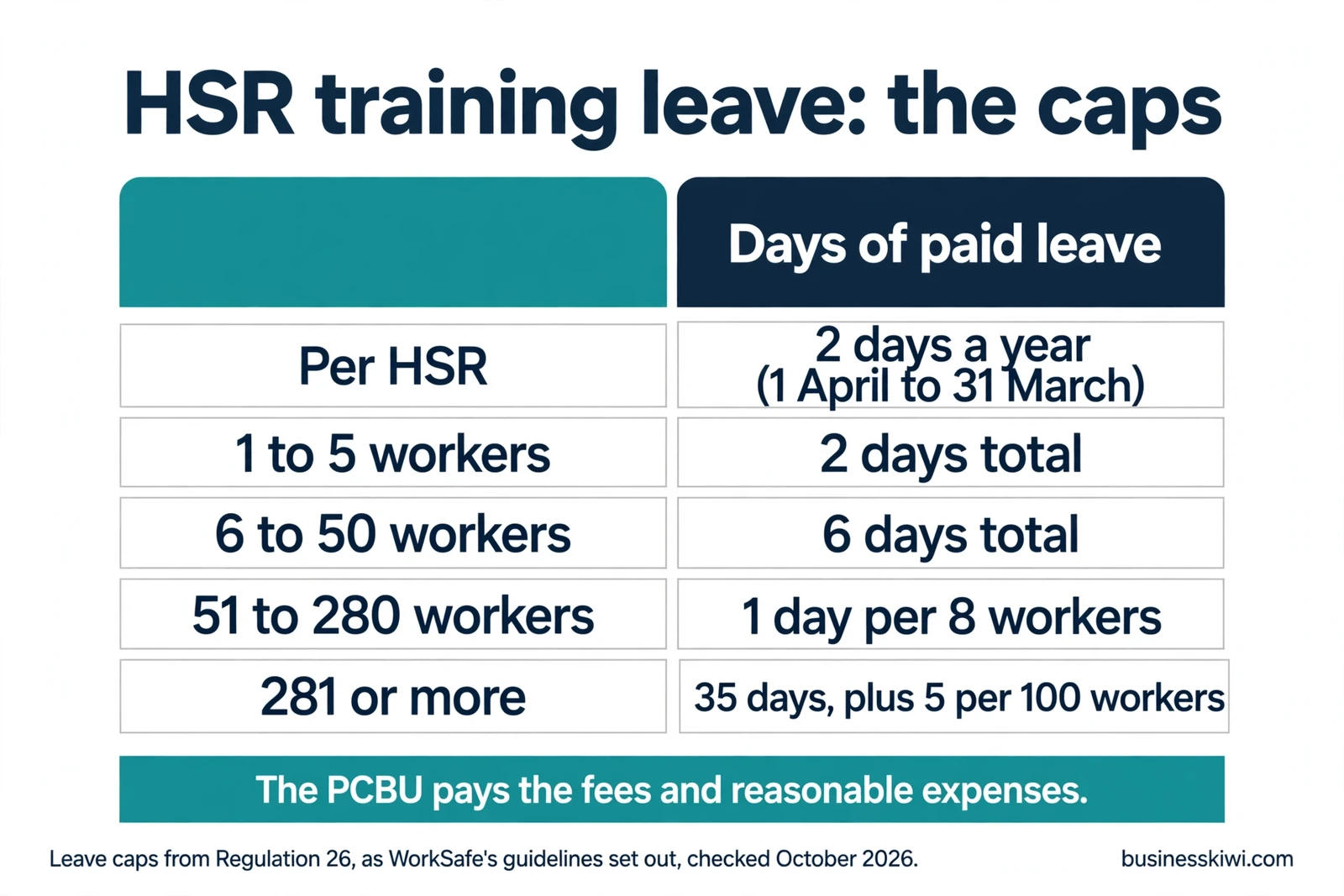
There is a cap on the total leave a PCBU must allow across all of its representatives in a year. The cap is set by the Health and Safety at Work (Worker Engagement, Participation and Representation) Regulations 2016 and is worked out from the number of workers on 1 April. A PCBU with 1 to 5 workers must allow 2 days in total. A PCBU with 6 to 50 workers must allow 6 days. With 51 to 280 workers the cap is one day for every 8 workers or part of that number. With 281 or more workers it is 35 days, plus 5 days for every 100 workers or part of that number.
Initial training and unit standard 29315
Regulation 21 sets the test: an HSR has completed initial training when they have been assessed as having achieved NZQA unit standard 29315, Describe the role and functions of the Health and Safety Representative in a New Zealand workplace. The standard sits at Level 3 and carries 2 credits.
The standard’s six outcomes show what a trained representative can do. They cover the role and functions of the HSR under HSWA and the Regulations, the HSR as an advocate for workers, the obligations of a PCBU and WorkSafe towards the HSR, the risk management process and communication, the purpose and procedures of a Provisional Improvement Notice (PIN), and the rights and process for ceasing unsafe work.
Two powers depend on this training. Only an HSR who has completed initial training can issue a PIN or direct a worker to cease unsafe work. An HSR who has not yet trained can still carry out the other functions of the role.
Choosing training, and who pays
The HSR chooses the training, in consultation with the PCBU about the time, date, location and costs, including fees. WorkSafe suggests weighing up how soon after election the training happens, course costs where prices differ, where courses are held, travel and accommodation costs for remote workplaces, whether a hazard-specific course suits the work group, and how many workers need training.
Regulation 24 then puts duties on the PCBU. It must decide as soon as practicable whether the HSR can use the entitlement, and a decision not made within three months of the request breaches the Regulations. The PCBU must pay the training fees. It must also pay the HSR’s other reasonable expenses of attending, including travel and accommodation. Where a work group spans more than one PCBU, the PCBUs share the training costs equally unless they agree otherwise.
The annual entitlement is not limited to initial training. Under Regulation 22 it can also fund additional training: further training in work health and safety, or an aspect of it, that sits within the occupational health and safety subfield of the New Zealand Qualifications Framework, or that the PCBU and the HSR agree is relevant to the role.

The main course types and qualifications
Short unit standard courses
The building block of health and safety training is the single unit standard course. A learner enrols, studies the material, and is assessed against one standard. Five Level 3 standards carry most general workplace training:
| Unit standard | Title | Level | Credits |
|---|---|---|---|
| 29315 | Describe the role and functions of the Health and Safety Representative in a New Zealand workplace | 3 | 2 |
| 30264 | Describe duties, rights, representation and the regulator in terms of New Zealand health and safety legislation | 3 | 3 |
| 30265 | Apply health and safety risk assessment to a job role | 3 | 8 |
| 30266 | Demonstrate knowledge of workplace health and safety culture and practices | 3 | 6 |
| 30433 | Describe the role and function of a health and safety committee in a New Zealand workplace | 3 | 2 |
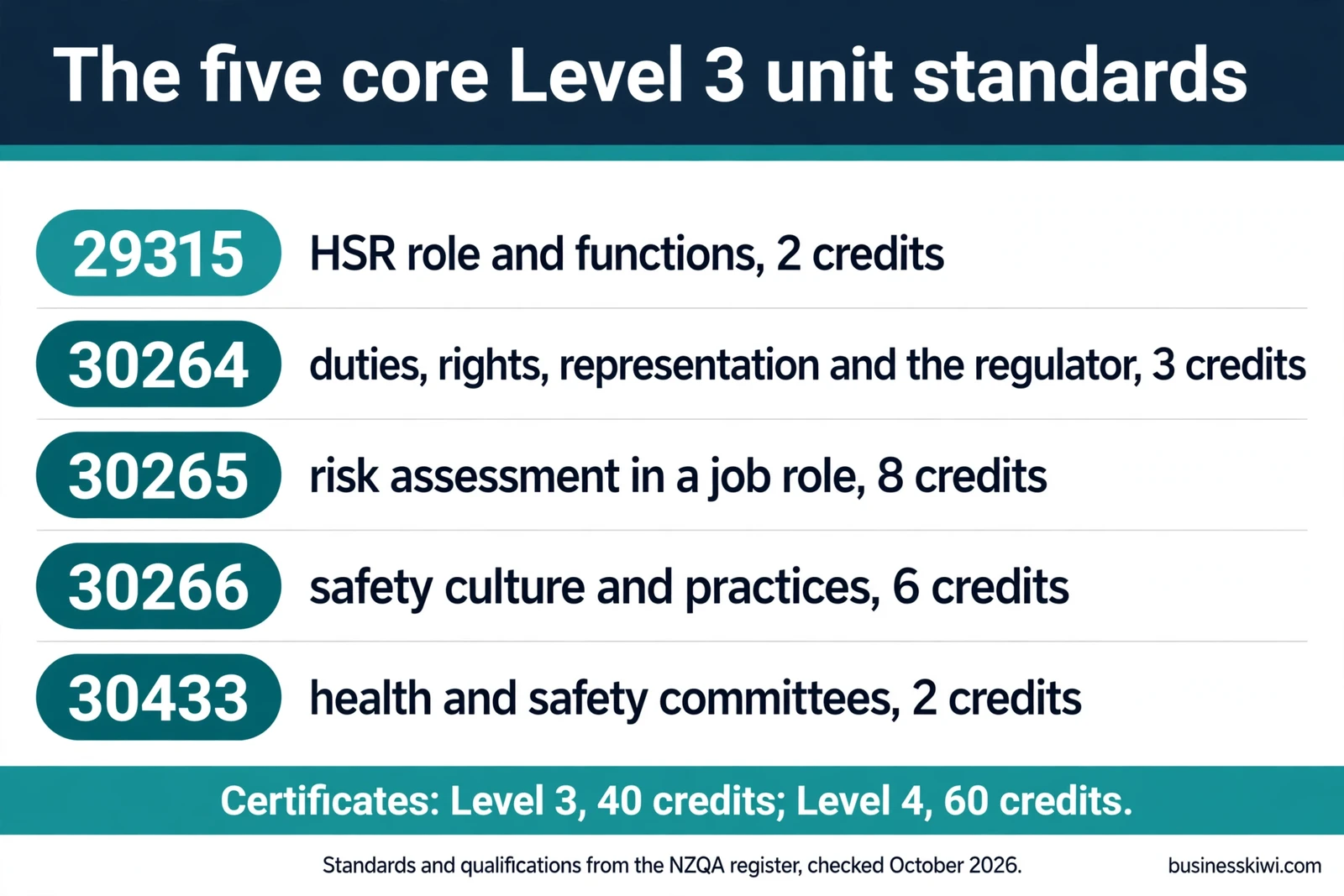
Standard 30264 gives an operational understanding of the legislation: the key duties of PCBUs, officers and workers, and the roles of representatives, committees and the regulator. Standard 30265 is the practical risk standard, built around identifying hazards, assessing risk, and setting, monitoring and reviewing controls in a real job role. Standard 30266 covers safe work practices, reporting and documentation, communication, and workplace safety culture. Standard 30433 serves committee members rather than representatives.
Providers group these standards into stages. IMPAC’s pathway is typical. Stage 1, Introduction to the HSR role, combines the representative standard 29315 with the legislation standard 30264. Stage 2 adds risk assessment standard 30265 and incident investigation standard 17601. Stage 3 is the culture and communication standard 30266.
The New Zealand Certificates in Workplace Health and Safety Practice
Above the short courses sit two NZQA qualifications. The New Zealand Certificate in Workplace Health and Safety Practice (Level 3) [Ref: 3533] is a 40-credit certificate. NZQA states its purpose as giving people foundation health and safety skills and knowledge to participate in workplace health and safety, with graduates applying those skills under limited supervision. Fifteen organisations are listed by NZQA as able to assist with it.
The New Zealand Certificate in Workplace Health and Safety Practice (Level 4) [Ref: 3534] is a 60-credit certificate. It targets people who hold a health and safety function as part of their primary job role and who apply their skills in a supervisory capacity. It builds on the Level 3 certificate, and NZQA records it as the recommended minimum entry point for the New Zealand Diploma in Workplace Health and Safety Management (Level 6).
A certificate is a programme, not a single course. IMPAC’s approved programme for the Level 3 certificate carries 19 compulsory credits: standards 29315, 30264, 30265 and 30266. Learners then choose 21 further credits from electives such as incident investigation, job safety analysis, committee training under standard 30433, and permit and hazard-specific standards. EMA delivers the same certificate through four two-day modules: roles and rights under HSWA, common workplace health issues, work practices and safety culture, and hazard identification and risk assessment.

How courses are delivered, and how long they take
The same unit standard can be studied in very different ways. Three delivery modes dominate.
Face-to-face courses run over one or two days at a training centre or at the employer’s site. Tai Poutini Polytechnic offers the representative standard as a two-day short course in Greymouth, with pre-course reading to complete before the class day. Besafe Training runs one to two day unit standard courses at its Auckland training centre and in-house for client organisations.
Online courses split into two kinds. Self-paced online learning lets the learner work through material remotely and in their own time; both Besafe Training and Safety ‘n Action offer the 29315 representative course this way. Instructor-led online classes run to a timetable with a facilitator. IMPAC prices both kinds separately in its learner handbook, listing online and eLearning as different delivery methods for the same standards.
Qualification programmes take longer by design. EMA spreads its Level 3 certificate across four two-day modules over four months. IMPAC gives learners one year to complete its Level 3 certificate programme, which carries 400 learning hours across facilitator-led sessions, assignments and workplace application.
What courses cost: published prices
Prices below are the figures providers publish on their own pages and documents, stated as each provider states them. Several providers publish no price at all and ask you to enquire, so treat this as a sample of the market, not a full price list.
Besafe Training publishes a single per-person price for its online initial training course for HSRs, which covers unit standard 29315: $380.75 + GST per person.
IMPAC publishes public prices in the learner handbook for its Level 3 certificate programme, and states that the prices are GST exclusive and subject to change. Its H&S Representative Fundamentals course, which assesses standard 29315, is priced at $360 to $645 face-to-face and $325 to $595 online. The legislation course for standard 30264 is $645 face-to-face, $595 online and $395 by eLearning. The risk assessment course for standard 30265 is $645 face-to-face and $595 online, as is the Stage 3 culture and communication course for standard 30266. Its online Health and Safety Committees course, assessing standard 30433, is $395.
EMA publishes the full certificate price on its programme page: $3,690 + GST for members and $4,290 + GST for non-members, for the four-module Level 3 certificate.
Safety ‘n Action’s online representative course page shows no price, and Tai Poutini Polytechnic lists no fee for its two-day course, asking applicants to enquire. Expect in-house group courses to be quoted per group rather than per person.
Because a PCBU must pay an HSR’s training fees by law, the published price is usually the employer’s cost, not the worker’s. Check whether a quoted figure includes GST before comparing providers, since most publish GST-exclusive prices.
Choosing a course and checking a provider
Start with the entitlement. If the learner is a newly elected HSR, the course must assess unit standard 29315 for the training to count as initial training. Check the standard number and title against the NZQA register entry, not just the provider’s course name, because course names vary while the standard does not.
Next, check the provider’s authority to assess. A provider assessing NZQA standards needs consent to assess against them, and a provider delivering a full qualification needs an NZQA-approved programme and accreditation. EMA states on its programme page that its Level 3 certificate programme is approved by NZQA and that EMA is accredited to provide it. IMPAC records in its learner handbook that it has been an NZQA-registered private training establishment since 2000 and that its certificate programme is NZQA approved. Besafe Training states that it is a Category 1 provider under NZQA’s review system.
Then match the format to the learner. Self-paced online suits a representative who cannot leave site for two days, while face-to-face courses build in group exercises and discussion. Compare the full cost, including GST, any assessment or NZQA fees, and travel. WorkSafe’s own choosing factors, timing, cost, location, travel expenses and relevance to the work group, are a sound checklist for the consultation the law requires.
The guides around this one: our health and safety policy template guide covers the written policy and the duties in legal depth, and our health and safety management guide covers running the system day to day. For the first aid side, our CPR course guide covers first aid training, and our dairy health and safety guide shows the rules applied on farms. More business guides are in the Business and Industry section.
Frequently asked questions
What is initial training for a Health and Safety Representative?
Initial training is complete when the HSR has been assessed as having achieved NZQA unit standard 29315, Describe the role and functions of the Health and Safety Representative in a New Zealand workplace. The definition sits in Regulation 21 of the Worker Engagement, Participation and Representation Regulations 2016.
How much paid leave does an HSR get for training each year?
Two days’ paid leave per year, running from 1 April to 31 March. It is paid at the HSR’s normal earnings and is separate from annual leave. A cap in the Regulations limits the total training leave a PCBU must allow across all its representatives, based on worker numbers on 1 April.
Who pays for HSR training?
The PCBU pays. It must pay the training fees and the HSR’s other reasonable expenses of attending, including travel and accommodation. It must also decide on a training request as soon as practicable, and within three months at the latest.
Can HSR training be done online?
Yes. Besafe Training and Safety ‘n Action both offer the unit standard 29315 course online and self-paced, and IMPAC offers its representative courses online and by eLearning as well as face-to-face. The paid leave entitlement applies to attending training, including online courses.
What is the difference between a unit standard course and the Level 3 certificate?
A unit standard course assesses one standard, such as the 2-credit representative standard 29315, and usually takes one or two days or the online equivalent. The New Zealand Certificate in Workplace Health and Safety Practice (Level 3) is a 40-credit qualification made up of many standards, delivered as a programme over months.
How much do health and safety courses cost?
Published prices vary by provider and format. Besafe Training lists its online representative course at $380.75 + GST per person. IMPAC’s published public prices for Level 3 courses run from $325 to $645 per course, GST exclusive, depending on the standard and delivery method. A full Level 3 certificate with EMA costs $3,690 + GST for members or $4,290 + GST for non-members. Other providers quote on enquiry.
Can an HSR still act before completing training?
Yes. An untrained HSR can carry out the general functions of the role, such as representing workers and raising health and safety matters. Only two powers wait for initial training: issuing a Provisional Improvement Notice and directing a worker to cease unsafe work.
The bottom line
Health and safety courses in New Zealand are built on a small set of NZQA unit standards, and one matters more than any other. Unit standard 29315 defines a trained Health and Safety Representative, unlocks the PIN and cease-work powers, and sits inside a legal package of two days’ paid leave a year with fees and reasonable expenses paid by the PCBU. Around it, standards 30264, 30265, 30266 and 30433 cover legislation, risk assessment, safety culture and committees, and they stack into the 40-credit Level 3 and 60-credit Level 4 certificates. Published prices for a representative course run from the mid hundreds of dollars per person, while a full certificate costs several thousand. Check the standard number on the NZQA register and the provider’s NZQA approval before you book.
Sources
- WorkSafe New Zealand, Interpretive guidelines: Worker representation through Health and Safety Representatives and Health and Safety Committees (HSWA and the Worker Engagement, Participation and Representation Regulations 2016), including sections 6.2 to 6.4 on paid leave, types of training and access to training: https://www.nzism.org/api/Website/DownloadFile?FileGuid=6f608c73-73d1-4c73-906d-54cdb0350f41
- WorkSafe New Zealand, Regulations at a glance: https://www.worksafe.govt.nz/laws-and-regulations/regulations/regulations-at-a-glance/
- NZQA, New Zealand Certificate in Workplace Health and Safety Practice (Level 3) [Ref: 3533], qualification overview: https://www.nzqa.govt.nz/nzqf/search/viewQualification.do?selectedItemKey=3533
- NZQA, New Zealand Certificate in Workplace Health and Safety Practice (Level 4) [Ref: 3534], qualification overview: https://www.nzqa.govt.nz/nzqf/search/viewQualification.do?selectedItemKey=3534
- NZQA, unit standard 29315 version 2: https://www.nzqa.govt.nz/nqfdocs/units/pdf/29315.pdf
- NZQA, unit standard 30264 version 2: https://www.nzqa.govt.nz/nqfdocs/units/pdf/30264.pdf
- NZQA, unit standard 30265 version 2: https://www.nzqa.govt.nz/nqfdocs/units/pdf/30265.pdf
- NZQA, unit standard 30266 version 2: https://www.nzqa.govt.nz/nqfdocs/units/pdf/30266.pdf
- NZQA, unit standard 30433 version 2: https://www.nzqa.govt.nz/nqfdocs/units/pdf/30433.pdf
- Besafe Training, Health and Safety Representative Training, NZQA Unit Standard 29315: https://besafetraining.co.nz/?p=2312
- Safety ‘n Action, Online Health and Safety Representative: Initial: https://www.safetynaction.co.nz/en/elearning/elearning/online-health-and-safety-representative/
- IMPAC, Learner Handbook: Certificate in Applied Workplace H&S Practice (programme overview and programme content, including public prices stated as GST exclusive): https://cdn.sanity.io/files/0b1m8onq/impac/d0de8c66c8e58c8a588edfe93a03255401bcf442.pdf?dl
- EMA, New Zealand Certificate in Workplace Health and Safety Practice (Level 3): https://learn.ema.co.nz/w/events/17-new-zealand-certificate-in-workplace-health-and-safety-practice-level-3
- Tai Poutini Polytechnic, Health and Safety Representatives in the Workplace: https://tpp.ac.nz/study/short-courses/health-and-safety-representatives
This article is general information about health and safety courses in New Zealand. It summarises training entitlements, NZQA standards and qualifications, and prices that providers published when the article was researched. Prices change, courses are withdrawn, and entitlements depend on your workplace’s arrangements, so confirm details with the provider and check the current law before acting. Nothing here is legal advice or a substitute for advice about your own situation.