RCD Testers in NZ: What They Measure, What They Cost and Who Can Use One
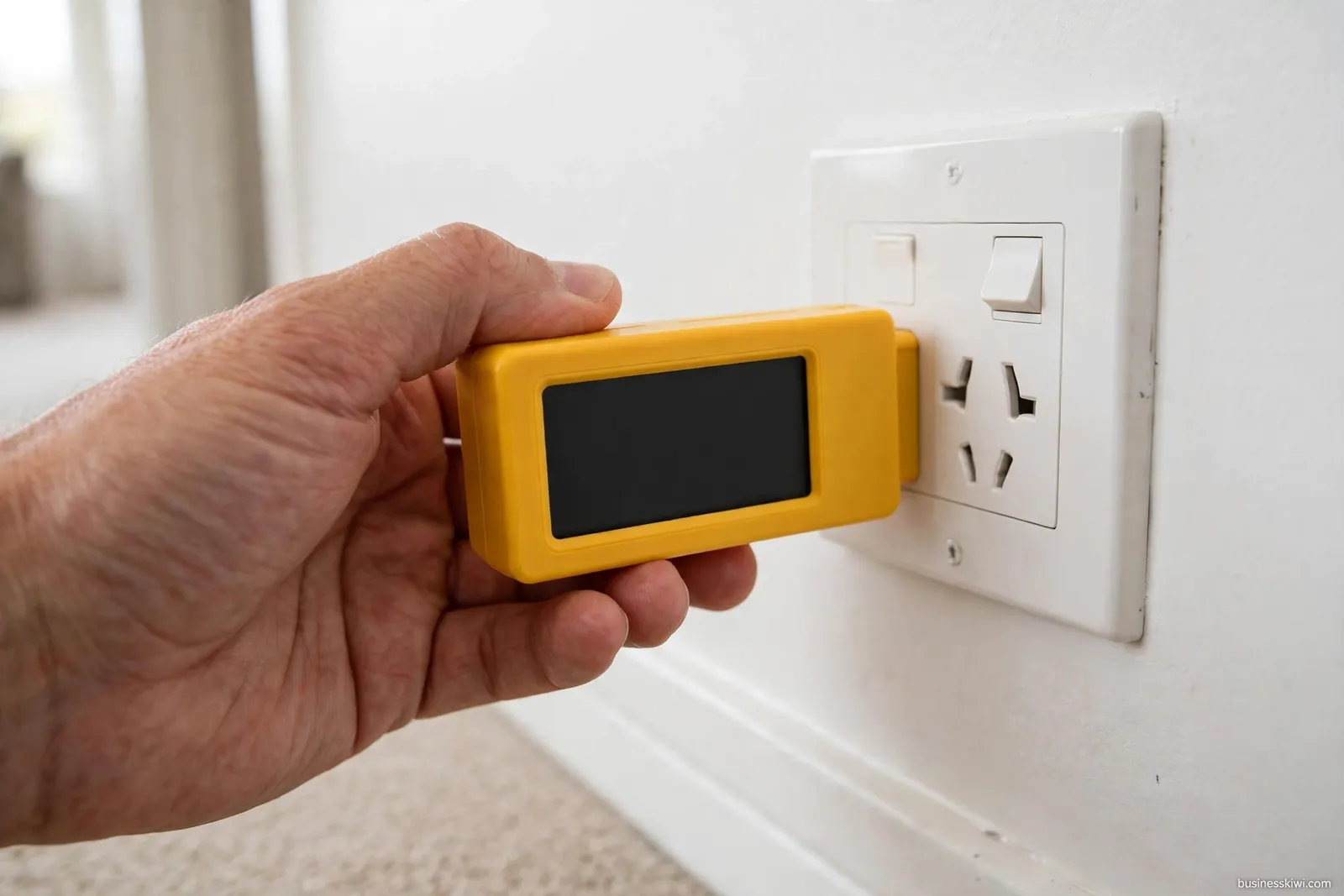
An RCD tester is an instrument that plugs into a power point and deliberately sends a small, controlled current to earth. It measures the two things an RCD’s own test button never can: how much current made the RCD trip, and how many milliseconds the trip took. Those numbers are the real proof a residual current device will protect a person. The test button is a basic go or no-go check, and it is the check homeowners are expected to make. The plug-in tester is how electricians verify an RCD against set limits, and the starting point for diagnosing nuisance tripping. This guide explains how the two checks differ, what testers measure, what they cost in NZ, and where the legal line sits.
What an RCD does
WorkSafe New Zealand describes an RCD as a device that constantly monitors the electric current flowing along a circuit, and quickly disconnects the supply if it detects a fault, in many situations where someone would otherwise receive a fatal electric shock. Jaycar New Zealand’s explainer gives the mechanism in plain terms: the RCD compares the current in the active and neutral wires, and if a person touches a live wire, or a fault lets current leak away, the two no longer match. The RCD breaks the circuit within milliseconds, fast enough to prevent cardiac arrest.
That people-protection role separates an RCD from a circuit breaker. A breaker, like the wire fuses before it, responds to too much current in the wiring: its job is to stop cables overheating and starting fires. Jaycar states that breakers are not intended to cut power quickly enough to save a person from harm. An RCD instead watches for the small leakage currents that signal danger to a person, far below anything a breaker would notice.
WorkSafe lists three types of RCD. A switchboard RCD sits in the switchboard and protects all the electrical wiring and appliances supplied from that circuit, and WorkSafe calls it the best option in most situations. A socket-outlet RCD is built into a power point and protects equipment plugged into that point, and, if required, other power points downstream of it. A portable RCD moves from power point to power point: some plug directly into a power point with the appliance plugged into them, and others are built into extension leads or portable socket-outlet assemblies.
One figure runs through both the official guidance and the instruments: 30 mA. WorkSafe’s electric vehicle charging guidelines require RCDs with a residual operating current of not greater than 30 mA for those supplies, and the manuals for the testers covered below use 30 mA as their default setting. WorkSafe is also honest about the device’s limit: RCD protection minimises the risk of serious electric shock, but does not eliminate it. That is one reason RCDs are checked rather than simply trusted.
The test button and the plug-in tester are different checks
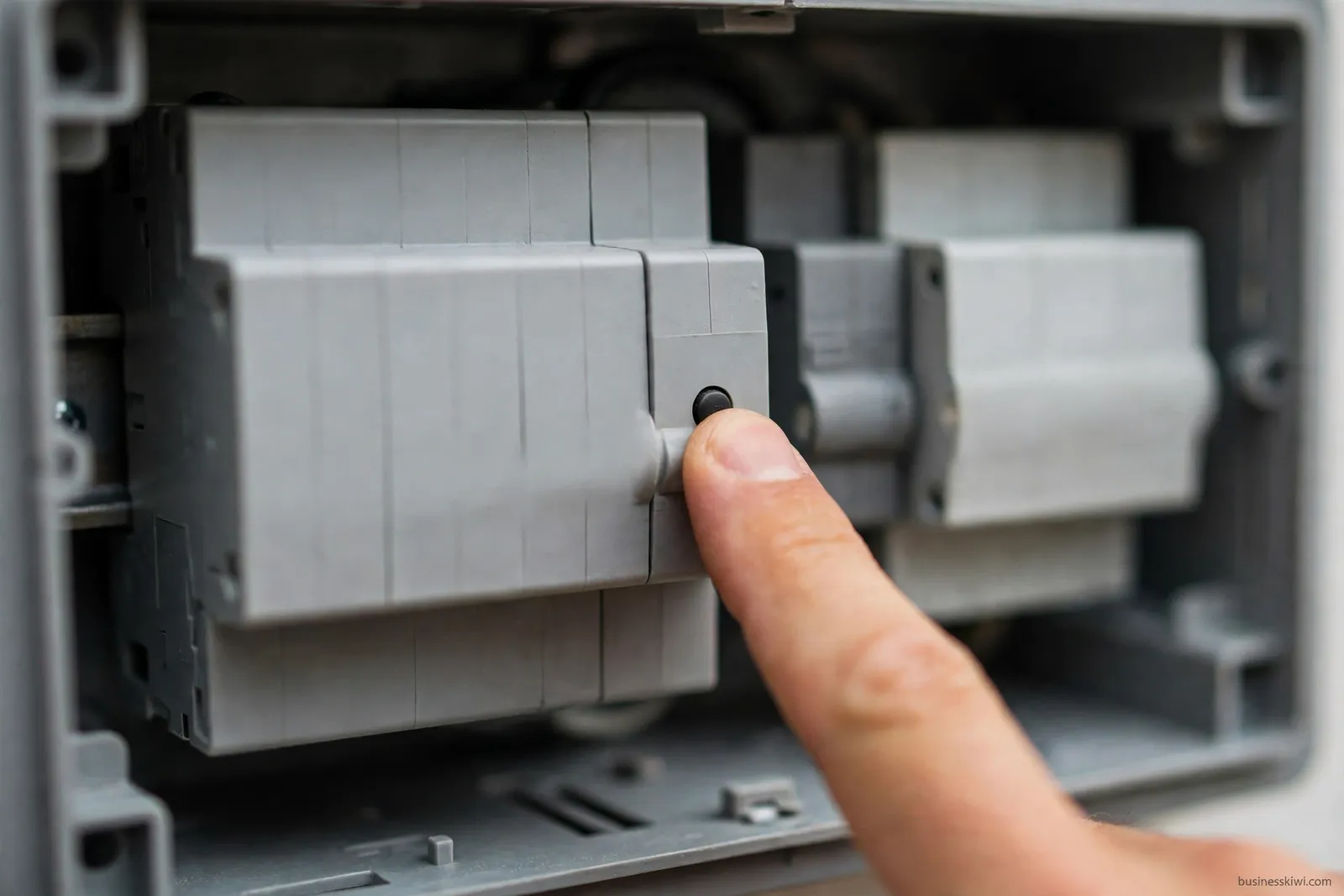
Every RCD has a built-in test facility, usually a button marked Test or T. Pressing it creates a small internal imbalance that imitates a fault, and a healthy RCD trips; you then reset it. WorkSafe’s recreational safety guidance tells caravan and motorhome owners to check their RCDs this way every time they connect to the electricity supply, using the in-built test facility. On construction sites the same check is a daily routine: WorkSafe’s small construction site guide says to test RCDs using the test button every day, including RCDs on portable socket-outlet assemblies, before use.
What the button cannot tell you is how the RCD performed. It gives no trip time and no trip current. An RCD can pass a button test while tripping too slowly, or only at well above its rated current, and the button will not reveal either problem. It also tests the device itself, not the circuit from the power point.
A plug-in RCD tester works from the power point. The tester connects through the socket outlet, applies a measured fault current, and times the RCD’s response on a digital display. Because the test current is calibrated, the tester can run the RCD at set fractions and multiples of its rating, and on models with a ramp function it can raise the current gradually until the RCD lets go. That turns a yes-or-no check into a measurement. It is the difference between knowing the RCD moved and knowing it moved fast enough, at the right current, to protect someone.
A simpler class of plug-in device is worth separating out. Basic socket testers check that a power point is wired correctly and show the result with indicator lights. Some add a button that applies a fixed test current to trip an RCD. That is a step up from the RCD’s own button, because the fault is applied at the socket, but it still returns no measured trip time or trip current. Only a dedicated RCD tester, or a multifunction installation tester with an RCD function, produces those numbers.
What a plug-in tester measures
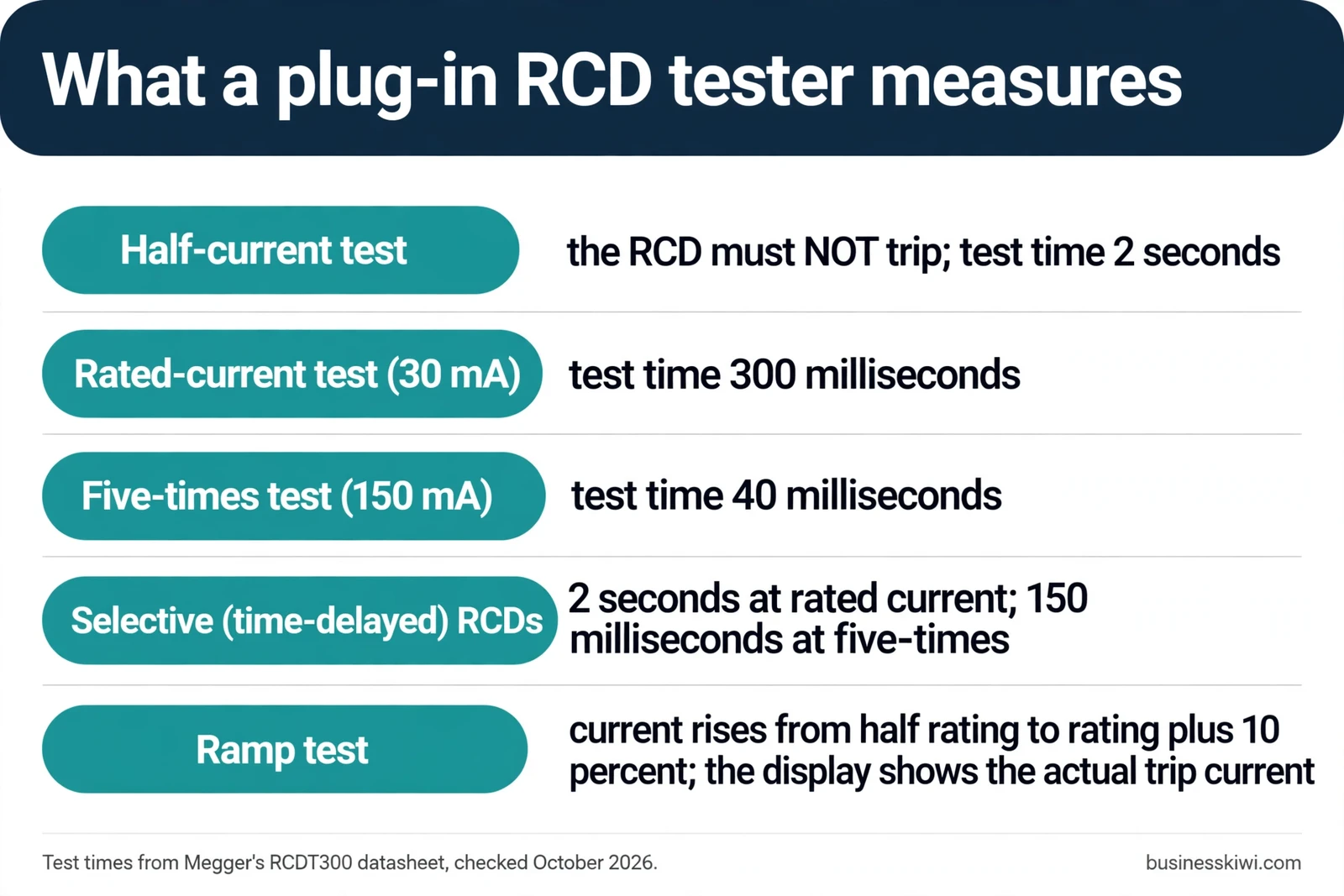
Testers assess an RCD against its rated residual operating current, written as IΔn and given in milliamps. A 30 mA RCD should trip when leakage reaches 30 mA, stay on well below that level, and trip much faster when the fault current is larger. Makers build their instruments around three standard tests, with a fourth diagnostic test on the better models.
The first is the no-trip test, run at half the rated current. Megger’s RCDT300 datasheet lists this half-current test with a two second test time: the RCD must hold. A device that trips at half its rating is too sensitive. The second test runs at the full rated current, where Megger lists a test time of 300 milliseconds for a standard RCD. The third runs at five times the rating, where Megger lists 40 milliseconds for a standard RCD. Time-delayed selective RCDs get longer allowances in the same datasheet: two seconds at rated current and 150 milliseconds at five times rating.
The fourth test is the ramp. Instead of applying a fixed current, the tester raises the current slowly until the RCD trips, then displays the actual trip current. Megger describes its ramp test rising from half the rated current to the rating plus ten percent, and calls it very useful for diagnosing nuisance tripping. UNI-T’s UT582+ calls the same idea AUTO RAMP and runs it from 20 percent to 110 percent of the rated current, displaying trip time and trip current together. Kyoritsu’s KEW 5410 ramps from 40 percent to 110 percent of the rating in five percent steps. An RCD that lets go well below its rating is a nuisance-tripping suspect; one that has not tripped by the top of the ramp range has failed.
The makers publish accuracy figures for the readout. Megger states trip time accuracy of plus or minus one percent, plus or minus one millisecond, across the RCDT300 series, with test current accuracy of minus eight to minus two percent on the no-trip test and plus two to plus eight percent on the trip tests. UNI-T states trip time accuracy of plus or minus two percent plus two digits for the UT582+, and trip current accuracy of plus or minus ten percent. Kyoritsu states plus or minus one percent of reading plus three digits for the KEW 5410. The instruments also guard against unsafe conditions as they work: Megger’s measure touch voltage at the start of a test and can be set to stop at 25 or 50 volts, while Kyoritsu’s detects contact voltage automatically and stops the measurement at 50 volts AC or more.
The main types of RCD tester
Three kinds of product do this job. The first is the dedicated RCD tester: a single-purpose instrument that runs the half, full and five-times tests, and on higher models adds the ramp test, automatic test sequences and result storage. Megger’s RCDT330, for example, stores over 1,000 results for download, and its auto test cycles through the sequence while the electrician stands by the RCD to reset it after each trip. The second kind is the multifunction installation tester, a larger instrument that adds RCD tests to insulation resistance, loop and continuity testing. Electricians verifying a whole installation carry these. The third kind is the basic plug-in socket tester described above, useful for wiring checks but not measurements.
The table compares four dedicated testers using their makers’ own published figures. Specs differ between models in each range, so treat it as a guide to what each instrument measures rather than a buying shortlist.
| Tester | Test currents (maker’s figures) | Trip-time tests | Ramp test | Trip-time accuracy (maker’s figure) |
|---|---|---|---|---|
| Megger RCDT310 | 30, 100, 300, 500 mA | Half, full and five times rating | No | Plus or minus 1%, plus or minus 1 ms |
| Megger RCDT320 and RCDT330 | 10, 30, 100, 300, 500, 1000 mA | Half, full and five times rating, plus auto sequence | Yes | Plus or minus 1%, plus or minus 1 ms |
| UNI-T UT582+ | 10, 20, 30, 100, 300, 500 mA | Half, full and five times rating | Yes, AUTO RAMP | Plus or minus 2%, plus 2 digits |
| Kyoritsu KEW 5410 | 15, 30, 50, 100, 200, 500 mA | Half, full and five times rating (five times test up to 100 mA) | Yes, Auto Ramp | Plus or minus 1% of reading, plus 3 digits |
NZ price evidence for these instruments is thin, because most electrical wholesalers sell to trade accounts without publishing public prices. One NZ test equipment retailer that does publish figures is Metrotest. Its tester guide lists RCD testers at $333.50 to $1,430 including GST, and multifunction installation testers at $1,430 to $3,600 including GST. Confirm the price of the exact model before you buy, and remember the ongoing cost: UNI-T’s manual recommends periodic calibration by a qualified service centre for professional use.
Who can test what in New Zealand
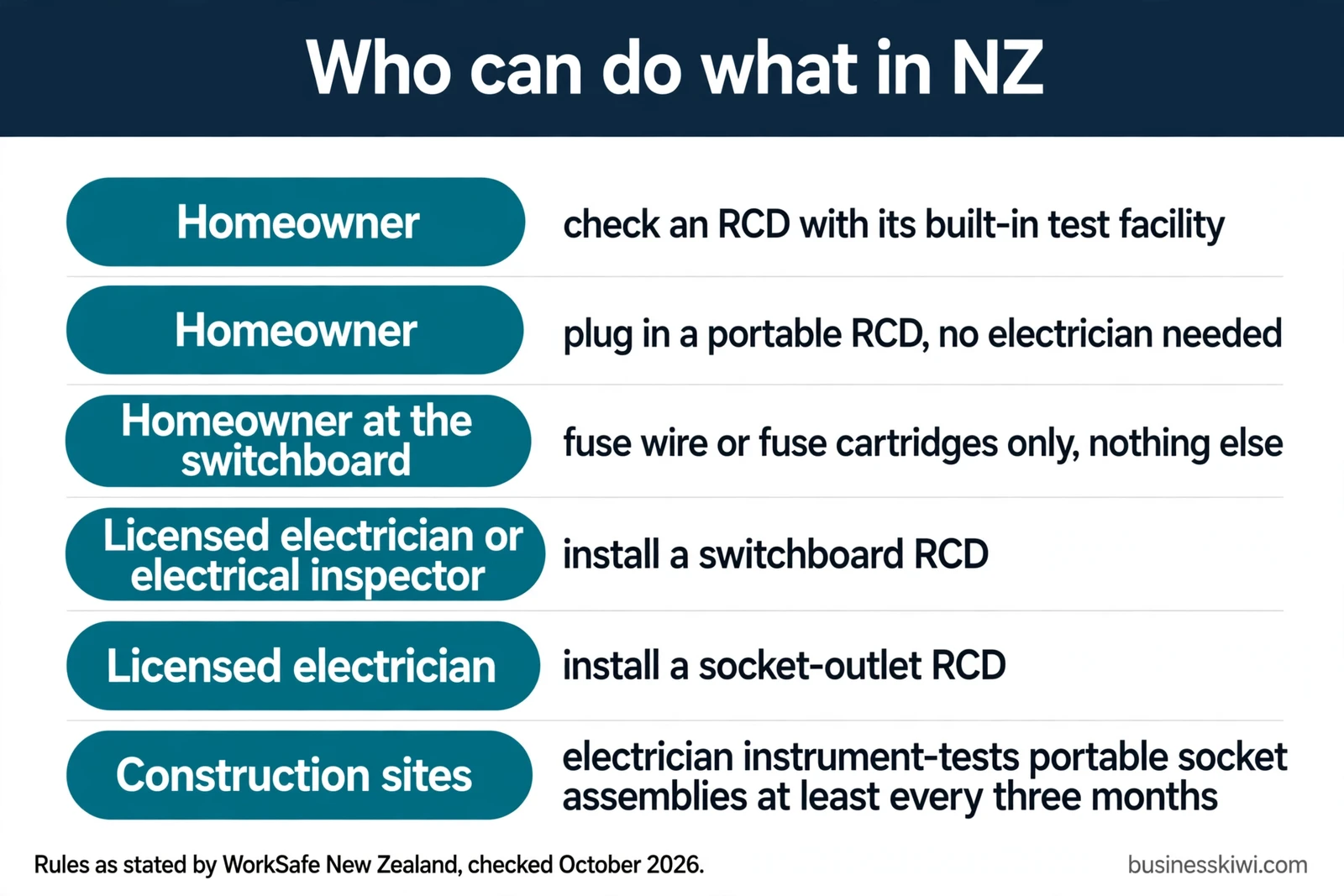
The test-button check sits with the user of the equipment. Caravan owners check their RCD with its in-built test facility each time they connect. Site workers test RCDs with the test button daily. Plugging in a portable RCD is equally open: WorkSafe notes that no electrician is needed for one, because you can buy a portable RCD at a hardware shop or an electrical equipment supplier. A plug-in tester is likewise used at a socket outlet, and WorkSafe’s homeowner rules govern work on fittings and wiring, not checks made by plugging a device into a power point.
Everything past that point is where the line falls. WorkSafe’s page on doing your own electrical work is cautious: it does not recommend doing your own electrical work unless you have the necessary skills and knowledge, and it recommends a licensed worker if you are in any doubt. The law allows an owner-occupier, living in the property and taking no payment or reward, a limited list of jobs: replacing fittings such as switches, socket outlets and light fittings where the work does not involve the switchboard, replacing fuse links, connecting and disconnecting fixed wired appliances, and installing or altering subcircuits under strict conditions, with the finished work tested and connected by a licensed electrical inspector. One sentence in WorkSafe’s guidance deserves emphasis: never do any work on a switchboard apart from replacing fuse wire or fuse cartridges.
Installing an RCD sits squarely on the licensed side of that line. WorkSafe states that a licensed electrician or electrical inspector must install a switchboard RCD, and that a licensed electrician must install a socket-outlet RCD. So if a test shows your home needs an RCD added or replaced, that job is not DIY.
The line tightens further outside your own home. WorkSafe states that employers, employees, landlords, tenants and school staff, including caretakers, cannot carry out electrical work in their workplace or any rented property unless they are registered electrical workers and hold current practising licences. A landlord cannot legally replace a faulty RCD in a rental property, and neither can a tenant.
Instrument testing of fixed RCDs sits with the trades for practical reasons as well as legal ones. On construction sites, WorkSafe’s guide has portable socket-outlet assemblies tested by an electrician regularly, at least every three months, on top of the daily button tests. For business appliances, WorkSafe explains there is no legal requirement for testing and tagging, and no formal licence is required to do it, but the limit is plain: a tester who is not a qualified electrician cannot resolve any problems the results reveal. A failed RCD result therefore always ends in the same place, with a licensed electrician. WorkSafe’s DIY page points anyone hiring one to the Electrical Workers’ Register to check that their electrician is licensed.
What a failed test means
A failed test is information, not a repair job. If an RCD does not operate when checked with its in-built test facility, WorkSafe’s recreational guidance says to have it serviced by a licensed worker as soon as possible. WorkSafe’s construction guide lists RCDs not tripping when tested among its indicators of unsafe equipment, and its approach to faulty gear is to disconnect it, label it so it will not be used, and have it repaired by a licensed electrical worker or replaced. An instrument result tells the same story with numbers: no trip at rated current, a trip time beyond the maker’s test limit, or a ramp result far from the rating all mean the device is not doing its job.
Do not be tempted to open the switchboard and investigate. That is exactly the work the rules reserve, and WorkSafe is blunt about the stakes: accidents, and sometimes fatalities, occur because people do not know what they are doing. Its advice, if you are unsure about anything, is to turn the main switch off and call a licensed electrician. An RCD that keeps tripping in normal use is also sending a message: it is detecting leakage somewhere on its circuit, and tracking that fault down is diagnostic work for an electrician.
Related guides: our electricity prices NZ guide covers what power costs, our house insurance guide covers protecting the home, and our rental properties guide covers landlord duties. More home and business guides are in the Business and Industry section.
Frequently asked questions
What does an RCD tester check that the test button cannot?
It produces numbers. The button shows only that the RCD can trip. The tester measures the trip current in milliamps and the trip time in milliseconds, at set fractions and multiples of the rating. That is how an electrician verifies a 30 mA RCD properly, against published test times such as Megger’s 300 milliseconds at rated current and 40 milliseconds at five times rating for a standard RCD.
What is a ramp test on an RCD tester?
It raises the fault current gradually until the RCD trips, then displays the exact current that tripped it. Megger describes its ramp rising from half the rated current to the rating plus ten percent, and says it is very useful for diagnosing nuisance tripping. UNI-T’s AUTO RAMP runs from 20 to 110 percent of rating, and Kyoritsu’s Auto Ramp runs from 40 to 110 percent in five percent steps.
How often should an RCD be tested?
It depends on the setting. WorkSafe’s construction guidance has RCDs tested with the test button every day on site, including RCDs on portable socket-outlet assemblies, and those assemblies tested by an electrician at least every three months. For caravans and motorhomes, WorkSafe says to check the RCD every time you connect to a supply. Its pages set no single interval for homes, where the built-in test facility check is the standing homeowner check.
Can a homeowner use a plug-in RCD tester in NZ?
A plug-in tester is used at a power point, and WorkSafe’s homeowner rules are about electrical work on fittings and wiring, not about plugging a device into a socket. What a homeowner cannot do is act on most of what a tester finds. Replacing an RCD is licensed work, and WorkSafe’s rule is to never work on a switchboard apart from replacing fuse wire or fuse cartridges.
My RCD did not trip when I pressed the test button. What should I do?
Treat the circuit as unprotected and call a licensed electrician. WorkSafe says an RCD that does not operate should be serviced by a licensed worker as soon as possible, and its construction guide lists an RCD not tripping when tested as a sign of unsafe equipment. Do not open the switchboard to investigate it yourself.
Is an RCD the same as a circuit breaker?
No. A circuit breaker protects wiring and appliances. It cuts the power when too much current flows, to prevent overheating and fire, and it is not intended to cut power quickly enough to save a person from harm. An RCD watches for small leakage currents, the kind that can flow through a person during a shock, and disconnects within milliseconds. Switchboards often carry both because the two jobs are different.
How much does an RCD tester cost in New Zealand?
Published prices are scarce, because most suppliers sell to trade accounts. New Zealand test equipment retailer Metrotest publishes RCD testers at $333.50 to $1,430 including GST, and multifunction installation testers at $1,430 to $3,600 including GST. Confirm the current price of the exact model before buying, and budget for periodic calibration if the tester is for professional use.
The bottom line
The test button and the plug-in tester answer different questions. The button asks whether the RCD still moves. The tester asks whether it moves at the right current and within the right time. Homeowners own the first question, and WorkSafe’s guidance expects them to keep using the built-in test facility. The second question belongs with electricians, because everything it can uncover, from a dead RCD to a leaking circuit, is licensed work to put right. If your RCD fails its button test, the decision is made for you: a licensed electrician, as soon as possible.
Sources
- WorkSafe New Zealand, Doing your own electrical work: https://www.worksafe.govt.nz/managing-health-and-safety/consumers/safe-living-with-electricity/getting-electrical-work-done/doing-your-own-electrical-work
- WorkSafe New Zealand, Electrical safety on small construction sites: https://www.worksafe.govt.nz/topic-and-industry/electricity/electrical-safety-on-construction-sites/
- WorkSafe New Zealand, Recreational electricity safety: https://www.worksafe.govt.nz/managing-health-and-safety/consumers/safe-living-with-electricity/recreational-safety/
- WorkSafe New Zealand, Ensuring safety of plug-in electrical appliances: https://www.worksafe.govt.nz/about-us/news-and-media/ensuring-safety-of-plug-in-electrical-appliances/
- WorkSafe New Zealand, Check before you DIY: https://claude.worksafe.govt.nz/claude/diy/
- Megger, RCDT300 Series Residual Current Device Testers datasheet: https://www.meggertestequipment.com/filesdirectserver/itp1/574f8b104b1a155e/RCDT300DSenz-z456338212695.pdf
- UNI-T, UT582 Digital RCD (ELCB) Tester specification sheet (maker’s datasheet): https://www.meraserw5.pl/images/UNIT/UNI-T_582_karta.pdf
- Kyoritsu, KEW 5410 RCD Tester specification sheet (maker’s datasheet): https://www.swoy.fi/wp-content/uploads/2018/04/Kyoritsu_KEW5410_vikavirtasuojatesteri.pdf
- Metrotest, Voltage Testers: Which One Do I Need? (published NZ price ranges): https://metrotest.co.nz/voltage-testers-which-one-do-i-need/
- Jaycar New Zealand, RCD: Top 4 Ways to Ensure Electrical Safety: https://www.jaycar.co.nz/about-rcd
This article is general information about RCD testers and electrical safety in New Zealand. It is educational only, and it is not a substitute for advice from a licensed electrician about your own property. Nothing in it authorises electrical work that the law reserves to licensed electrical workers. If an RCD fails a test, or you are in any doubt, switch off the power and call a licensed electrician.