Workplace Investigations in NZ: How They Work and What a Fair Process Looks Like

The short answer
A workplace investigation is how an employer finds out what happened before deciding what to do about it. Employment New Zealand is clear on the order: before taking disciplinary action or responding to a complaint, an employer should find out as much as they can. An employer must carry out a fair investigation before deciding whether to take disciplinary action.
This guide explains when an investigation is needed, who should carry it out, the steps a fair one follows, the rights of the employee under investigation, and what happens if the process goes wrong.
What a workplace investigation is
An investigation is a structured way of gathering facts about something that may have gone wrong at work. It is not a court case, and it is not a punishment. Its job is to work out, on the evidence, what most likely happened, so the employer can make a decision based on facts rather than assumptions.
An investigation may be quite simple or complex. A straightforward case might involve one conversation and a look at a roster or an email. A complex case can include examining documents and data, checking electronic records, and interviewing people who saw what happened. The approach depends on the situation, and Employment New Zealand notes that investigations can be time consuming and sometimes expensive.
The investigator’s role is to determine the facts, not to decide any disciplinary outcome. That separation matters. The person who gathers the facts should present them in a balanced way, and the decision about what action to take, if any, comes after, from the decision maker. Employment New Zealand is explicit that the investigation report should not contain a decision or recommendation on what disciplinary action should be taken.

When is an investigation needed?
An employer may need to investigate an issue involving an employee in several common situations. Possible misconduct is the most frequent trigger. Misconduct is when an employee does something wrong through what they do, do not do, or how they behave, and it may justify disciplinary action. Examples Employment New Zealand gives include using inappropriate language, internet misuse, spending too much time on social media during work hours, not following reasonable and lawful instructions, minor breaches of the employment agreement, and repeated lateness.
More serious matters need investigation too. Serious misconduct covers behaviour such as violent behaviour, theft or fraud, bullying or harassing another employee, sexual, racial or other harassment, dishonesty, using illegal drugs at work, and behaviour that causes danger to the employee or others. Misconduct is generally considered serious if the behaviour has undermined or destroyed the employer’s trust in the employee and has affected the employee’s ability to do their job. Whether behaviour counts as misconduct or serious misconduct depends on the facts, including the employee’s explanation.
A complaint of bullying is another common trigger. Bullying at work is a serious health and safety breach, a form of misconduct, and it must be dealt with responsibly. Sexual, racial and other forms of harassment are serious issues that employers must properly investigate and act on. Other triggers include a complaint from a customer, a theft where nobody knows who is responsible, a health and safety incident, or a breakdown in a working relationship.
Not every problem needs a formal investigation. A minor issue can be handled with an informal conversation, letting the employee know that if it happens again a formal process will begin. If the facts are disputed, the allegation is serious, or disciplinary action is a possible outcome, an investigation is needed before any decision is made.
The law behind it: natural justice and the fair and reasonable test
Two ideas sit behind every workplace investigation in New Zealand. The first is natural justice. Investigations must be carried out in good faith and use the principles of natural justice, which includes not jumping to conclusions. The second is the test in section 103A of the Employment Relations Act 2000: whether the employer’s actions, and how the employer acted, were what a fair and reasonable employer could have done in all the circumstances at the time the dismissal or action occurred.
When the Employment Relations Authority or the court applies that test, it must consider four things. First, whether, having regard to the resources available to the employer, the employer sufficiently investigated the allegations against the employee before dismissing or taking action against the employee. Second, whether the employer raised the concerns it had with the employee before dismissing or taking action. Third, whether the employer gave the employee a reasonable opportunity to respond to those concerns. Fourth, whether the employer genuinely considered the employee’s explanation, if any, before dismissing or taking action.
Employment New Zealand puts the same requirements in plain language on its fair process page. To follow a fair process, employers must fully investigate concerns, considering the resources available to them, properly raise their concerns with the employee by communicating exactly what the problem is, providing all relevant information and the possibility of disciplinary action, give the employee a reasonable opportunity to tell their side of the story, and genuinely consider the employee’s explanations if provided. Employers should also make sure the decision maker is as impartial as possible and has the appropriate level of authority, inform the employee that they may have a representative or a support person present at any disciplinary meetings, give the employee an opportunity to seek independent advice throughout the process, and give the employee full and relevant information, for example interview notes, statements about the behaviour from others, and surveillance footage. No decision on what action to take should be made until after hearing and considering the employee’s response to the proposed course of action.
Good faith runs through all of this. All parties must meet the good faith obligations in the employment relationship. And if an employer has a set procedure for disciplinary action or dismissal, whether in the employment agreement or in workplace policies, it has a contractual or good faith obligation to follow it. A small employer is judged with regard to the resources available to it, so the process does not have to be elaborate, but it does have to be fair.
Who should investigate
The person who investigates should be neutral. They should not take sides, and they should consider all the information in a balanced way. It is not a requirement to use an independent investigator, meaning someone other than the manager who will make the final decision, as long as the person who gathers the facts is neutral. However, using another manager, Human Resources, or someone external to gather the facts and present them in a balanced way can be useful.
Whether the investigator is internal or external generally depends on the size and complexity of the issue. A larger organisation may be able to use its Human Resources, Audit and Risk, or Health and Safety teams; a small organisation may not have that option. Employment New Zealand suggests an organisation consider using an external investigator when the investigation involves difficult or complex issues, for example a fraud or drug use allegation, a risk of a toxic work environment such as a complex bullying allegation, sensitive allegations such as a sexual harassment allegation, questions of credibility, or an organisation wide issue such as money going missing with no person identified.
For disciplinary investigations, where possible the investigator should be independent. The key question is whether the decision maker needs to be seen as unbiased. If so, it is a good idea to use someone independent to gather the facts, and that person could still be internal. What matters is the separation of roles. If the workplace policy states that the person who gathers the information cannot be the decision maker, then the roles must be separate.
For bullying, harassment or discrimination investigations, the investigator should be experienced and independent because of the sensitive nature of the complaint and the need to be seen as unbiased. This type of complaint is often complex and time consuming. An investigator from Human Resources is an option. WorkSafe can also investigate bullying complaints.
If an organisation chooses to use an external independent investigator, it should check the regulatory requirements. Those in the business of providing investigation services are required to be licensed under the Private Security Personnel and Private Investigators Act 2010, unless they are regulated by another Act, for example a lawyer being required to hold a practising certificate. Employers should make sure they are engaging suitably qualified and licensed individuals. To check whether a workplace investigator has a private investigator licence, the Ministry of Justice holds a public register of licence and certificate holders. If the investigator is a lawyer, check that they hold a practising certificate from the New Zealand Law Society.
| Type of investigation | Who should investigate |
|---|---|
| Disciplinary investigation | Where possible, an independent investigator; internal or external depending on size and complexity |
| Bullying, harassment or discrimination | An experienced and independent investigator; Human Resources is an option; WorkSafe can also investigate bullying complaints |
| Health and safety investigation | A specialist area; external help depends on the nature of the incident, for example whether it caused serious harm |
| Team dysfunction or relationship breakdown | Often Human Resources or someone external |
The steps of a fair investigation
A proper investigation has a number of steps and decisions to be made. The order below follows the structure Employment New Zealand sets out.
1. Check the agreement and the policies. Before anything else, read the employment agreement and the relevant workplace policies. They may set out the process that must be followed, including who can investigate, what counts as misconduct or serious misconduct, and what the possible outcomes are. If a set procedure exists, the employer must follow it.
2. Decide who will investigate. Choose the investigator before the facts are gathered. Consider whether the matter needs someone independent, whether anyone involved has a conflict of interest, and whether the investigator has the skill for the type of issue. Record the decision and the reason for it.
3. Plan the investigation and draft the terms of reference. The terms of reference are a roadmap for the investigation. They should identify the matters to be investigated and what is outside the scope, set out the issues or allegations, name the investigator, state the process to be followed, refer to the relevant rules and policies, list who should be interviewed where possible, give timeframes, make clear that the investigator’s role is not the decision maker’s role, confirm that anyone can have a support person or representative in interviews, set out what the report will contain and who will see a draft for comment, and name the sponsor and the contact person.
4. Share the draft terms of reference for feedback. Once it is known who the investigation is about, share the draft terms of reference with the employee, as well as with the person who made the complaint if it affects them personally, for example in a bullying case, and get their feedback before finalising. The draft terms of reference should be given to the complainant and to any employees whose conduct is under investigation for feedback before finalising.
5. Tell the employee what the allegation is. An employee should be told the details of the allegation. Getting the timing right can be a challenge. Employers need to have enough information to be confident there is an issue, without undertaking a full investigation before advising the employee. Usually, once an employer feels there is an issue to be answered, it is appropriate to put this to the employee and advise them that a full investigation will be undertaken. In some situations, for example where information could be destroyed or people threatened, employers may want to resolve those matters before talking to the employee. Either way, the employer should let the employee know what is happening in writing.
6. Gather the evidence. Collect the documents, data and records that are relevant. This can include rosters, emails, messages, CCTV footage, system logs and policy documents. Keep the scope as narrow as it needs to be. Employment New Zealand advises trying not to make the investigation wider than is needed, while making sure important questions are not left unanswered.
7. Interview witnesses, then interview the employee. Witness interviews come first, so the investigator knows what to put to the employee. The employee concerned is then interviewed with the full picture in front of them.
8. Write the report and share a draft for comment. The report sets out the findings and the reasons for them. It is provided to the employee for comment, and possibly to the complainant, before it is finalised.
9. Decide what action to take. Only after the investigation is complete and the employee has had a chance to respond does the decision maker decide what to do. Whatever is decided, a fair disciplinary process must be followed, and the response must be appropriate and reasonable.
Interviewing witnesses
Witnesses are the people who saw the act or behaviour, or who have direct knowledge or experience of what is said to have happened. How they are handled is one of the places investigations most often go wrong, so the rules are worth setting out plainly.
Employees are entitled to know the identity of witnesses so they can respond to them fully. Witnesses should not be anonymous, and they should not be able to make off-the-record comments. Witnesses should be told that the information they give will be confidential to the investigation, but that the person whose conduct is under investigation will be given the notes, or a summary of the meeting notes, and that these will identify them.
In very rare cases it may be acceptable for witnesses to be anonymous, but there needs to be a good reason for this and enough information, without identification, for the employee to give a reasonable response. It is best to get expert advice if anonymity is being considered.
When interviewing a witness, be clear with the person about the purpose of the interview and what the information will be used for. Ask open-ended questions that cannot be answered with yes or no, and follow up with clarifying questions. Do not talk too much. Use who, what, when, how and why questions, and then listen. Record the interview, either electronically if the person gives permission to be recorded, or by taking notes, or a mixture of both. Confirm the meeting notes back with the witness before giving them to the employee concerned. At the end, ask if there is anything the person wants to add.
When interviewing the employee concerned, provide all documents and summaries of what the other people interviewed have said in advance. Invite the employee to have a representative. Record the interview with permission, or take notes. Request comments and confirmation of notes, and follow up with further questions if needed.

The employee’s rights during an investigation
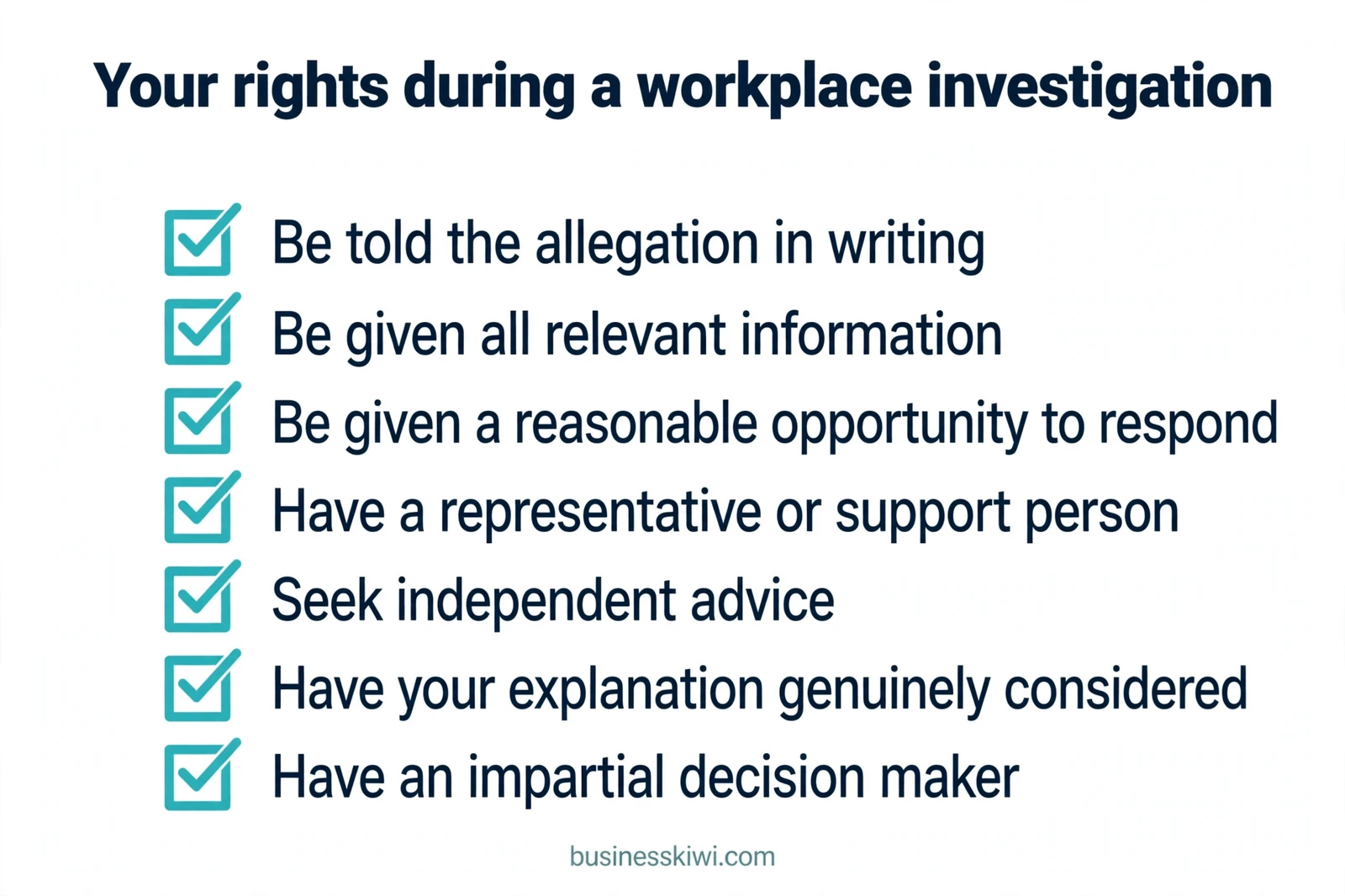
An employee under investigation has rights that run through the whole process:
- To be told the details of the allegation, in writing, including what happened, when it happened, and what policy or expectation may have been breached.
- To be given all relevant information the employer is relying on, including interview notes, statements from others, and surveillance footage, before being asked to respond.
- To be given a reasonable opportunity to respond, with reasonable time to prepare, to read the information, to get advice, and to arrange a support person or representative.
- To have a representative or a support person present at any disciplinary meetings, and to have a support person or representative in interviews at any time in the process.
- To seek independent advice throughout the process.
- To have their explanation genuinely considered before any conclusions are made, and to have the decision maker keep an open mind rather than deciding the outcome in advance.
- To have the decision made by someone as impartial as possible, with the appropriate level of authority.
No decision should be made on what action to take until after hearing and considering the employee’s response to the proposed course of action. The employer should also consider all options before making a final decision, and treat the employee without bias and in a way that considers any similar situations that have occurred.
For the employee, the practical advice is simple. Ask for the allegation and the evidence in writing. Take the time offered to prepare. Bring a support person or representative. Answer honestly, and raise anything the investigator has missed. If new information comes out in the interview, expect the investigator to follow it up rather than decide on the spot.
Bullying, harassment and discrimination investigations
Complaints of bullying, harassment or discrimination need extra care. Bullying at work is a serious health and safety breach and a form of misconduct, and it must be dealt with responsibly. Sexual, racial and other forms of harassment are serious issues that employers must properly investigate and act on.
The investigator for this type of complaint should be experienced and independent, because of the sensitive nature of the complaint and the need to be seen as unbiased. These complaints are often complex and time consuming. A Human Resources investigator is an option. WorkSafe can also investigate bullying complaints, and the health and safety angle means the employer’s duties under the Health and Safety at Work Act 2015 sit alongside the employment process. Our health and safety management guide explains how a small business runs its safety system day to day.
Because these complaints are sensitive, confidentiality matters more, not less. Both the complainant and the employee under investigation should be told what the process will be, who will see what, and when they will get to comment. If the complaint is not upheld, that should be recorded clearly, with reasons.
Suspension during an investigation
Suspension sometimes comes up while an investigation is running. Employment New Zealand is clear that an employer can only suspend an employee in limited circumstances. Two are named: where the employee’s behaviour is under disciplinary investigation and having them at work may compromise the investigation or cause further issues, for example if the employee is suspected of fraud and needs to be removed to protect the workplace during the investigation, and where the employee poses a risk to health and safety, for example if the employee works in a safety sensitive area and is under the influence of drugs or alcohol or is not in a fit emotional state to do their job safely.
A suspension is a drastic measure that should not be lightly undertaken. It should not be used as a disciplinary tool. The length of the suspension should reflect the time needed to conduct the investigation or the time needed to reduce the health and safety risk, so the employer should not let it drag on. It is good practice to have a clause about suspension in the employment agreement or to have it covered in workplace policies. In some situations it is possible to suspend without a clause, although it can be more difficult.
The employer should follow a fair process when deciding to suspend. There may be some rare exceptions when an employer does not have to give the employee an opportunity to comment on the concerns, for example where there could be an immediate danger to the employee or to others, or the employee is unable to perform safety sensitive work. Generally, if the employer does not follow a fair process or does not have a good reason for the suspension, the employee may have a personal grievance against the employer.
Any suspension should be on full pay. Suspension without pay can only be considered if it is specifically provided for in the employment agreement. Other interim steps are often better than suspension: changing rosters, separating the people involved, limiting systems access, or allowing someone to work from home while the investigation runs.
Privacy and confidentiality
An investigation collects personal information about real people, so the Privacy Act 2020 applies to how it is gathered, held and shared. The Office of the Privacy Commissioner has dealt with several cases where employers collected information during employment investigations, and the principles that come out of those cases are practical ones.
Collect only the information that is needed for the investigation, and only for a lawful purpose connected with the employer’s functions. Do not go wider than the allegation requires. In one case the Commissioner found an employer had breached the Act by using keystroke logging to access an employee’s personal email account, because that collection was unnecessary and disproportionate to the employer’s needs. Information should generally be collected directly from the person it is about, and the person should be told that information is being collected and why. Information should not be collected by unlawful means, or by means that are unfair or unreasonably intrusive in the circumstances.
Keep what is collected secure, share it only with the people who need it for the investigation, and do not discuss findings with people outside the process. Employment New Zealand’s own guidance reinforces this: do not have off-the-record conversations, do not talk to people about potential findings while investigating, and be careful to put all the information relied on in the report. People also have a right to ask for their own personal information, and an employer should know how it will handle that request.
The report and what happens next
The investigation report is where the work is tested. It should contain findings, meaning a careful balanced assessment of what has been learned and whether the allegations are more likely to have been true than not. It should address each concern or issue raised, contain the reasons for the findings, keep emotions or moral judgements out of the process, and have a clear link or reference back from the findings to the evidence.
The report should be provided to the employee for comment, and possibly to the complainant depending on the terms of reference, before it is finalised. It should not contain a decision or recommendation on what disciplinary action should be taken. That decision belongs to the decision maker, after the employee has had a chance to respond to the proposed course of action.
The outcomes after an investigation vary. They can include no action, where the allegation is not upheld; training or support; a warning; a final warning; or, in serious cases, dismissal. There is no set number of warnings that need to be issued before an employee can be dismissed. As always, the employer’s response must be fair and reasonable, and the outcome should match the seriousness of what was found.
If the investigation finds that the allegations were untrue, the employer can investigate whether the complaint was brought maliciously, meaning it was done on purpose to upset or harm the employee. This would generally only happen if the investigation found that the person who made the complaint had lied. A complaint that is not upheld is not the same as a malicious complaint, and the two should not be confused.
What happens if the process was unfair
If an employee believes the investigation or the decision that followed it was unfair, the main route is a personal grievance under the Employment Relations Act 2000. An employee can raise a personal grievance if they believe they were unjustifiably dismissed, unjustifiably disadvantaged in their employment, discriminated against, sexually or racially harassed, or treated unfairly in other ways the Act covers.
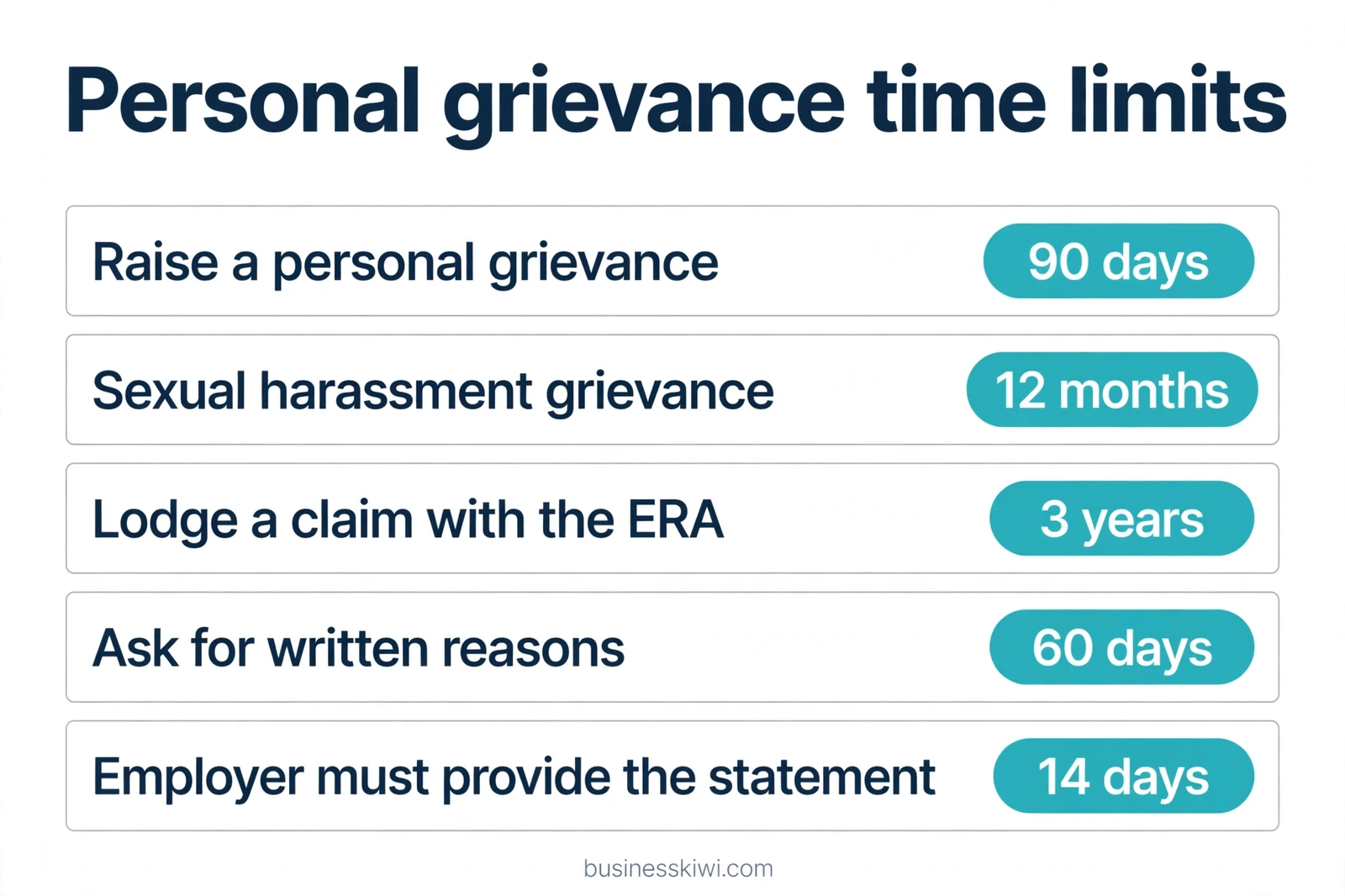
The time limits are short, and they matter more than most people realise.
| What | Time limit |
|---|---|
| Raise a personal grievance with the employer | Within 90 days of the issue arising or coming to your attention, whichever is later |
| Raise a personal grievance about sexual harassment | Within 12 months of it happening or the date you became aware of it, whichever is later |
| Lodge a claim with the Employment Relations Authority after raising the grievance | Within 3 years of first raising the grievance with the employer |
| Ask the employer for a written statement of the reasons for dismissal | Up to 60 days after finding out about the dismissal |
| Employer must provide that written statement | Within 14 days of the request |
If the time limit has passed, the employee may still raise a grievance if the employer agrees, or may ask the Employment Relations Authority to decide if they can still raise it. That is only possible if the delay was due to exceptional circumstances, for example a representative failing to raise the grievance in time, or health issues caused by the problem.
Mediation through Employment New Zealand is the usual first formal step after a grievance is raised, and most employment problems are resolved there rather than at the Authority. If the matter does go to the Authority, it will look at the facts and decide on the merits. It must also consider whether the employee’s behaviour contributed to the situation, which can affect the remedies available.
Common mistakes that make an investigation unfair
The same errors appear again and again in investigations that fail. Employment New Zealand’s guidance, read together, points to a short list.
Deciding the outcome before investigating. If the decision maker has already made up their mind, the process is unlikely to be fair, whatever the evidence shows. Keep an open mind until the report is in and the employee has responded.
Not telling the employee what they are accused of. Vague allegations, or allegations raised for the first time at the disciplinary meeting, leave the employee unable to respond properly. Put the allegation and the evidence in writing, in advance.
Using anonymous witnesses or off-the-record comments. Employees are entitled to know who the witnesses are so they can respond fully, and off-the-record conversations create information the employee cannot answer.
Ignoring facts that do not fit. Do not ignore facts because they are inconsistent with other information. If the employee’s explanation raises a new question, follow it up before deciding.
Rushing the report. The report must be complete, fair and neutral. Be sure the investigation supports the findings, and put all the information relied on in the report. Do not rush the process.
Letting the investigator decide the outcome. The investigator determines the facts. The decision about disciplinary action belongs to the decision maker, after the employee has responded. Mixing the two roles undermines the fairness of the whole process.
Forgetting the paperwork. Take careful meeting notes, confirm them with the people interviewed, keep the terms of reference, the evidence and the report together, and record the reasons for each decision. If the matter is later challenged, the record is what shows the process was fair.
For more on employment matters, browse the Business and Industry section.
Frequently asked questions
Does every workplace problem need a formal investigation?
No. A minor issue can be handled with an informal conversation. A formal investigation is needed when the allegation is serious, the facts are disputed, or disciplinary action is a possible outcome. Employment New Zealand says employers must carry out a fair investigation before deciding whether to take disciplinary action.
Can an employer investigate without telling the employee?
Not for long. The employee should be told the details of the allegation once the employer has enough information to be confident there is an issue to answer, and should be told what is happening in writing.
Can I bring someone with me to an investigation interview?
Yes. Anyone can have a support person or representative in interviews at any time in the process. The terms of reference should say this. At disciplinary meetings, the employer should inform the employee that they may have a representative or a support person present.
Does the investigator have to be independent?
It is not a requirement, as long as the person who gathers the facts is neutral, does not take sides, and considers all the information in a balanced way. For disciplinary investigations, where possible the investigator should be independent. For bullying, harassment or discrimination complaints, the investigator should be experienced and independent.
Can an employer suspend me while they investigate?
Only in limited circumstances, for example where having the employee at work may compromise the investigation, or where the employee poses a risk to health and safety. Suspension is a drastic measure, it should not be used as a disciplinary tool, and it should generally be on full pay. Suspension without pay is only possible if the employment agreement specifically provides for it.
What standard of proof applies in a workplace investigation?
The investigator’s findings are a careful balanced assessment of whether the allegations are more likely to have been true than not. That is a lower standard than the criminal standard of beyond reasonable doubt, and it is the standard Employment New Zealand describes for investigation reports.
What can I do if I think the investigation was unfair?
Raise a personal grievance with your employer. You must do this within 90 days of the issue arising or coming to your attention, whichever is later. Mediation through Employment New Zealand is the usual next step, and if the matter is not resolved there, a claim can be lodged with the Employment Relations Authority within 3 years of first raising the grievance.
This guide is general information only. It is not legal advice. Employment law is fact specific, and the right process depends on the circumstances. If you are an employer starting an investigation, or an employee facing one, get advice from Employment New Zealand, a union, a community law centre, or an employment lawyer before you act.