A1 Frames in NZ: The Exact A1 Size, Snap Frames vs A-Frame Boards, Prices and the Footpath Rules

The short answer
An A1 frame is built to hold an A1 sheet, which measures 594 x 841 millimetres. That figure is the poster size, not the size of the frame itself. The frame is bigger on the outside, and it shows slightly less than the full sheet because its rails overlap the edges.
A1 frames come in two main forms. A snap frame is a flat aluminium frame that fixes to a wall, window or stand. An A-frame board is a hinged, double sided sign that stands on the ground and takes posters or printed panels on both faces.
On price, Brackens Office Products Depot lists a wall mounted A1 snap frame at $123.48 plus GST, and Auckland printer 3A Print lists printed double sided A-frame signs from $180. If the board will stand on a public footpath, your council’s signage rules apply as well, and some councils set a maximum width that many A1 boards exceed.
The A sizes around A1
A1 sits in the middle of the A paper series. Every step down the series halves the sheet area, and every step up doubles it. A0 is two A1 sheets. A2 is half an A1, and the steps continue down to the A4 sheet in your office printer.
Auckland print company UPL lists the standard trim sizes in its artwork guideline. The sizes around A1 are:
| Paper size | Trim size (mm) |
|---|---|
| A0 | 841 x 1189 |
| A1 | 594 x 841 |
| A2 | 420 x 594 |
| A3 | 297 x 420 |
| A4 | 210 x 297 |
| A5 | 148 x 210 |
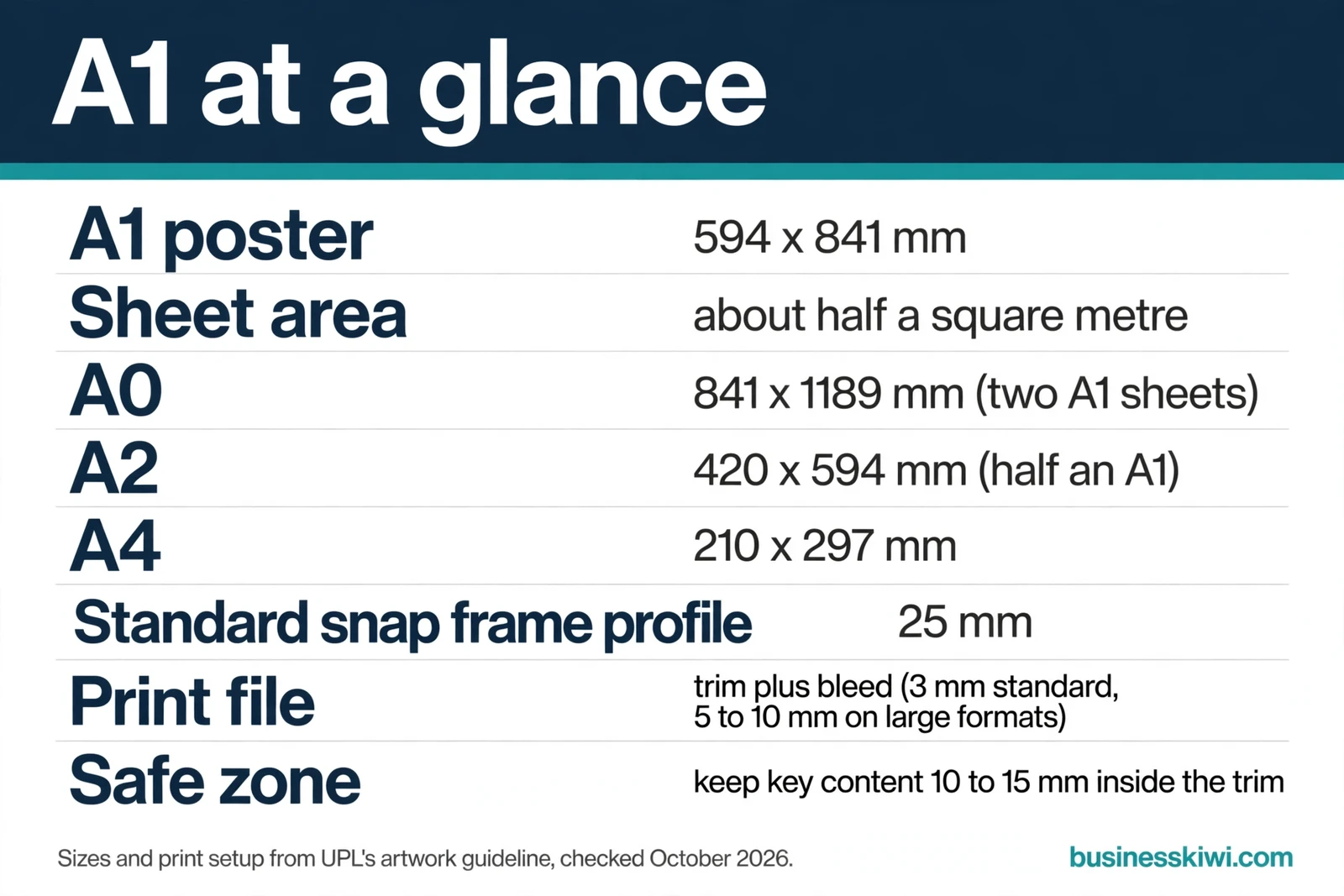
An A1 sheet covers about half a square metre. In portrait orientation it stands 594 millimetres wide and 841 millimetres tall. Turned to landscape, it is 841 wide and 594 tall. Most A1 frames work in either orientation. The Boyd frame sold through Office Products Depot dealers, for example, is listed for portrait or landscape display, with pre-drilled holes in the frame for wall mounting.
A portrait A1 frame is a tall, narrow display that suits menus and event posters. A landscape frame is a wide display that suits timetables, site plans and group photographs.
Poster size, frame size and visible size are three different numbers
The most common buying mistake with A1 frames is to measure only the poster. Three measurements decide whether a frame fits your space and shows your artwork properly.
The first is the poster size: 594 x 841 millimetres. The second is the frame’s outer size. The aluminium rails sit outside the poster’s edges, so the whole unit is wider and taller than the sheet it holds. The standard profile width on NZ display suppliers’ frames is 25 millimetres. If a frame has to fit an alcove or a space between windows, ask for the external dimensions of the exact model before you order.
The third measurement is the visible area, the part of the poster you can actually see. The snap rails fold over the poster’s edges, so a border of artwork hides under the rails on all four sides. Keep headlines, prices and logos well inside the sheet edges for this reason, on top of the normal print margins covered below.
Footpath buyers need the outer measurement for a different reason. Council limits apply to the whole sign, frame included, not to the poster inside it. The Dunedin example later in this guide sets a maximum sign width of 0.6 metres. An A1 poster at 594 millimetres wide fits inside that on paper, but the frame around it can push the board over the limit. Mills Display lists an easel A-frame stand at 655 x 1155 x 600 millimetres overall. Measure the board you are buying, not the poster it holds.
Snap frames: the wall mounted option
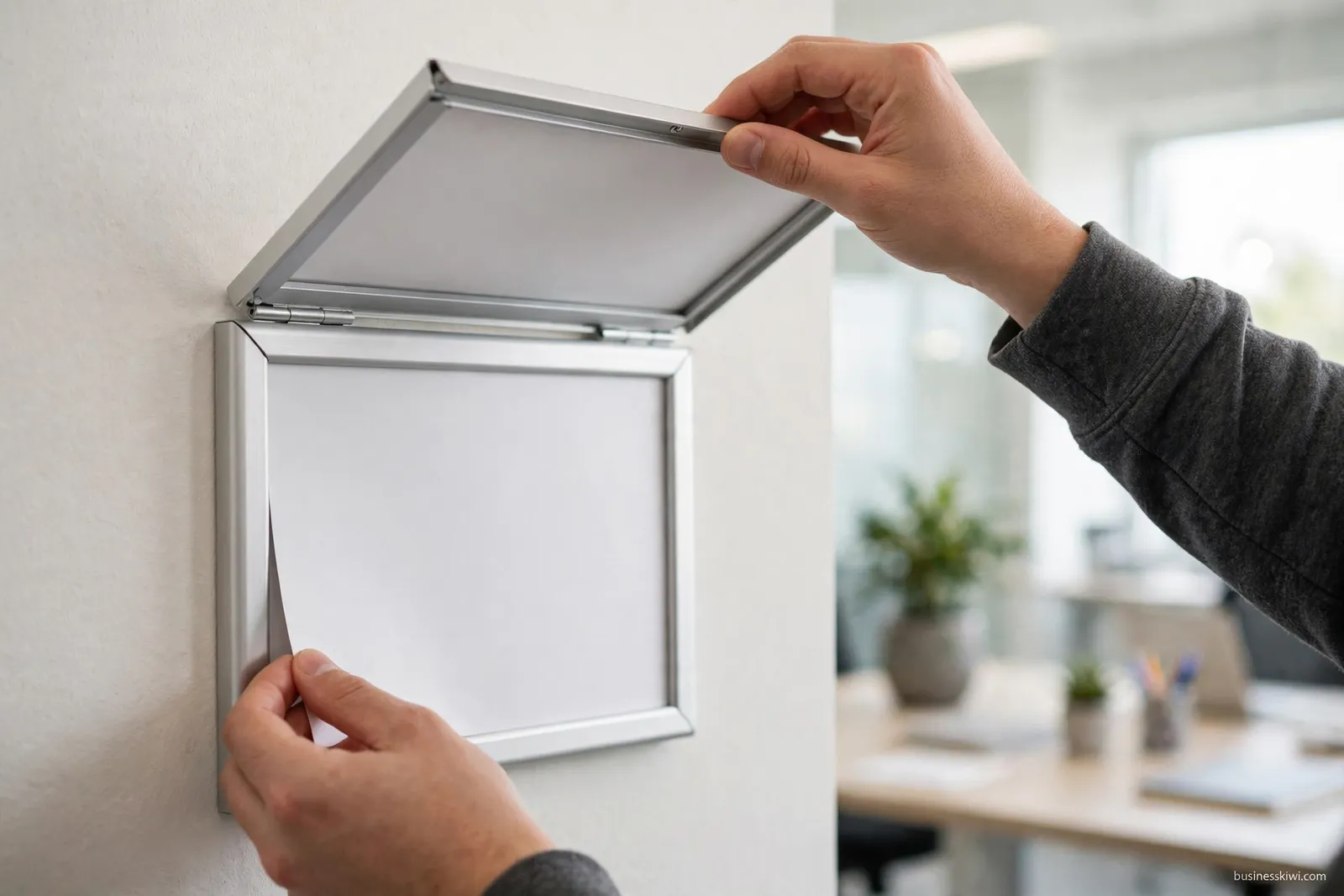
A snap frame holds a poster flat against a wall, window or stand. Each of its four aluminium rails is hinged and spring loaded. You lift the rails open, slide the poster and its cover sheet in over the backing board, then press the rails shut. The poster changes in seconds, with the frame still fixed in place.
The Boyd Slim Snap Frame sold by Office Products Depot dealers shows the standard construction at this size: a wall mounted frame with a 25 millimetre mitred corner profile, an MDF backing board and an anti-reflective cover sheet. The mounting holes are pre-drilled, and screws and wall plugs are included. Brackens also lists the smaller A4 size in the same Boyd range, in silver and in black.
Auckland supplier Mills Display sells the wider snap frame family. Its standard snap frames use 25 millimetre profiles, from A4 to A0, in colours that include silver, black, red, blue, green and timber-look oak and pine. Window snap frames from A4 to A1 mount on glass and can display to both sides. Standing and hanging snap frames cover counters, ceilings and shop floors.
Snap frames suit any display that changes often or needs to stay flat and tidy. Boyd lists posters, menus and certificates as the typical contents. Because the poster sits behind a cover sheet, it stays cleaner and flatter than a pinned or taped sheet.
A-frame boards: the standing option
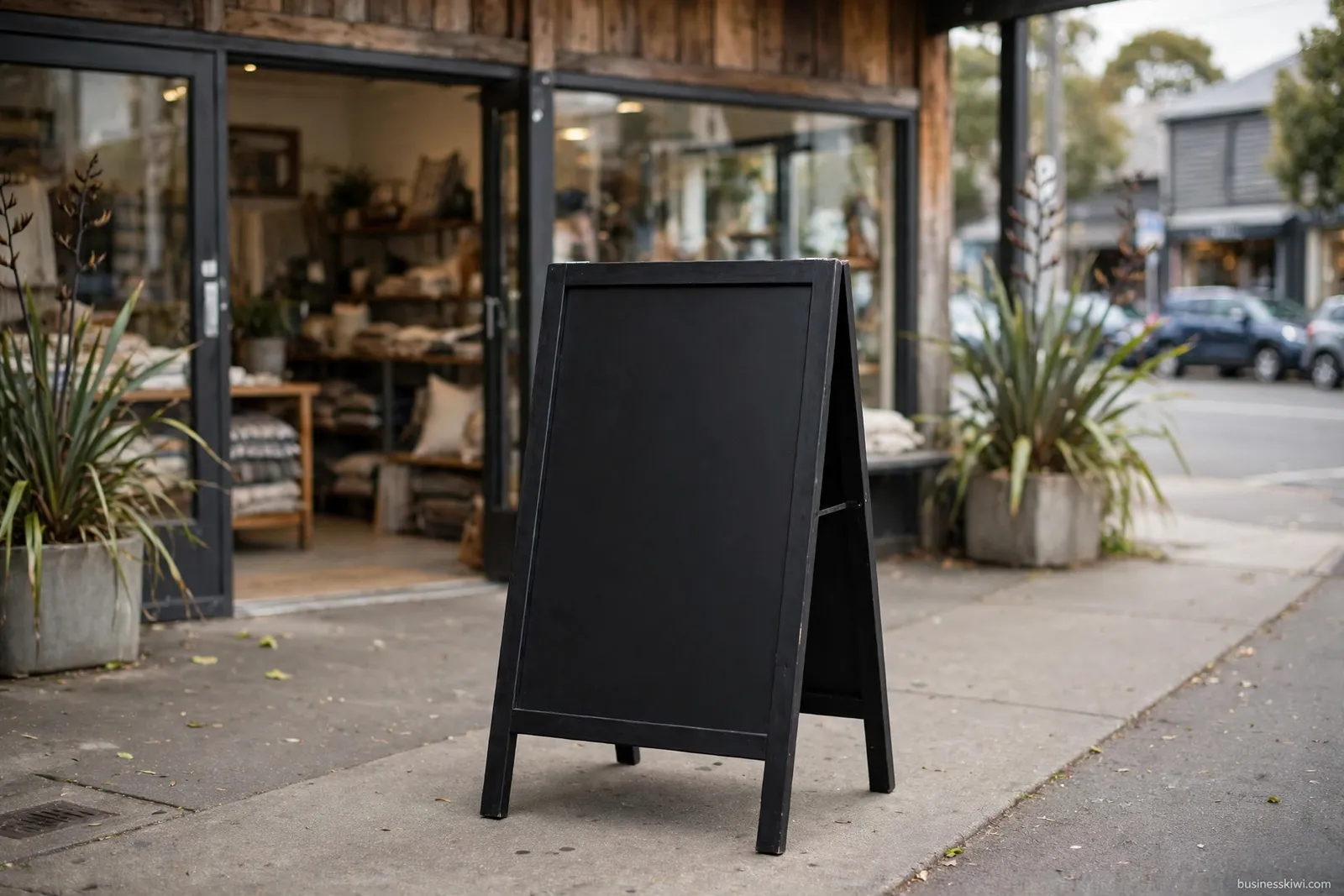
An A-frame board is two display faces hinged at the top, opened out into an A shape. It stands without fixings, shows a message to people walking in both directions, and folds flat at the end of the day.
Auckland printer 3A Print sells its double sided A-frame signs with a collapsible aluminium frame that fits two inserts, a weatherproof lens included and full colour printing. Buyers choose Corflute or ACM panels. The listed panel sizes are 600 x 900 millimetres and 900 x 1200 millimetres. Note that neither size is A1. A 600 x 900 panel is a common footpath board size, but it will not take an A1 poster, and an A1 frame will not take a 600 x 900 panel. Check the insert size in millimetres, not the product name.
The same supplier also sells plastic sandwich boards and metal A-frames. On its plastic frames, added sand or water ballast makes the sign suited to outdoor use, and the signs carry a handle and stacking lugs for storage. Mills Display sells A-frame floor standing blackboards for handwritten messages, which cafes use for daily specials that change too often to print.
Boards that take posters behind a lens give the cheapest message changes, because a reprint is all you need. Boards with printed panels cost more to update but shrug off weather better. The two types are not interchangeable, so decide before you buy.
Materials, finishes and weather use
Aluminium is the standard frame material in both forms. It is light enough to carry and hang at A1 size, it does not rust, and anodised finishes hold up in shopfront sun. Silver and black are the standard colours, with wider ranges on retail display lines like the Mills standard frames.
The cover sheet holds the poster flat, protects it from handling and spills, and its anti-reflective surface cuts glare from shop lights and windows. Outdoors, a cover or lens also keeps the worst of the rain off a paper poster.
Weather rating is where the ranges split. A standard snap frame is an indoor product. Mills Display separates out weather resistant snap frames, which clip from the front and run from A4 to A1 in black and silver, and outdoor lockable poster frames from A4 to A0 for public places. Choose the lockable type for unsupervised outdoor walls, and the weather resistant type for covered outdoor areas.
Wind is the A-frame board’s weakness. 3A Print describes its A-frames as usable indoors and outdoors in all weather except extreme conditions. Ballast helps, but the safe habit is to bring boards in during storms and overnight, which also protects them from theft.
Where A1 frames are used
Footpath and shopfront advertising is the best known use. 3A Print lists restaurants, cafes, bars and stores as the typical buyers of its A-frame signs, placed outside to advertise sales, openings and new products. The A1 face is large enough to read from across a footpath, and the double sided format catches traffic in both directions.
Inside, snap frames do the quiet work. Retailers use them for price and promotion posters that change weekly. Hospitality businesses frame menus and specials. Offices, schools and clinics display notices, certificates and safety information. Trade show and event teams use A-frames and standing frames for directions and schedules, because the frames fold, stack and travel well.
Printing the poster that goes in the frame
The frame is only half the purchase. The poster has to be printed at the right size and set up correctly, or the edges will crop badly once the rails close over them.
UPL’s artwork guideline sets out the standard print setup. Set the document to the exact trim size, 594 x 841 millimetres for A1. Add bleed on all sides so background colour runs past the trim line: 3 millimetres is standard, and larger formats such as posters may need 5 to 10 millimetres. Keep text, logos and other key content inside a safe zone: at least 5 millimetres inside the trim line generally, and 10 to 15 millimetres for large format prints such as posters. Work in CMYK, use images at 300 DPI, and supply a PDF with bleed and crop marks included.
For a framed poster, that safe zone matters twice over, because the frame’s rails cover the outer border of the sheet as well.
Poster stock is a choice too. 3A Print prints its posters on options that include a 190gsm PET film and a 260gsm PP grey-back film, with gloss or matt lamination available. Film stocks and lamination stand up to handling and damp far better than plain paper. The same supplier lists custom posters from $24, so reprints for a poster-style board are cheap relative to the frame.
What A1 frames cost in New Zealand
Published prices are patchy in this market, because many sign companies quote per job. These are the prices NZ suppliers publish on their own pages, checked in October 2026.
For a wall mounted snap frame, Brackens Office Products Depot lists the Boyd Slim Snap Frame A1 in silver at $123.48 excluding GST, each. The same listing describes the 25 millimetre mitred frame, backing board and anti-reflective cover sheet set out above. The smaller A4 frame in the same Boyd range lists at $39.02 excluding GST, which shows how the price climbs with size. The listing does not mention a poster being included.
For a printed A-frame sign, 3A Print lists its double sided A-frame signs from $180 on its signage pages. That is a printed sign with two faces, in the panel sizes above, rather than a poster-changeable A1 frame. Its poster printing starts at $24.
Mills Display publishes its ranges with sizes and specifications but sells by enquiry, so there is no listed price to compare. Whatever supplier you use, confirm whether the quote includes GST, delivery and the printed poster or panels.
Footpath rules: one council example
There is no single national rule for footpath signs. Each council sets its own bylaw, permit conditions and fees, and the numbers differ between cities. Expect to need your council’s permission and to face limits on sign size and placement, and read your own council’s conditions before you buy a board.
Dunedin City Council shows how specific these rules get. Its Trading in Public Places Bylaw 2025 covers commercial use of footpaths, and the council publishes the conditions and fees on its own website. What follows is Dunedin’s position only.
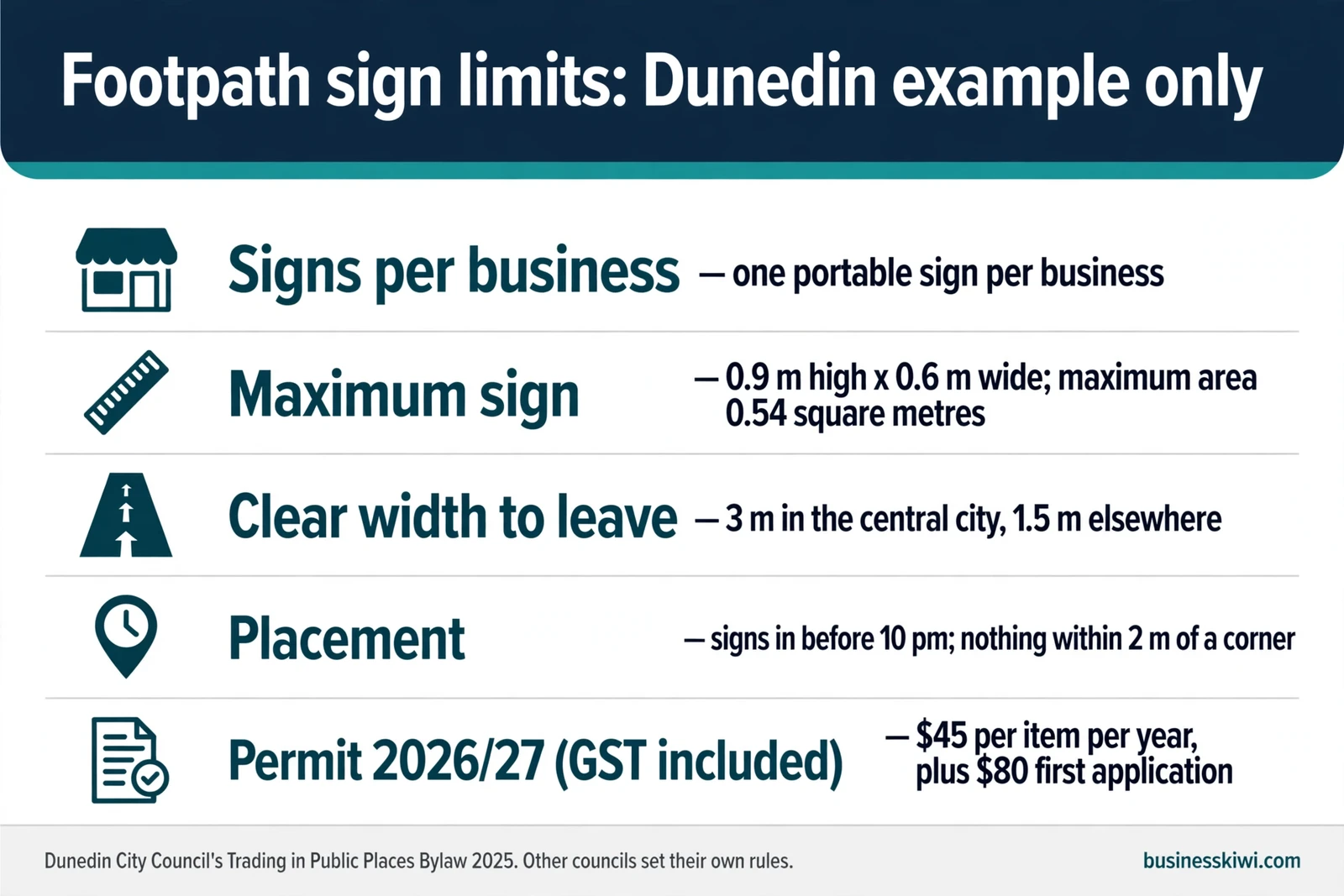
Under Dunedin’s conditions, any item placed on a footpath needs a permit, called a licence on the council’s pages. A business may have one portable sign. A portable sign must be no more than 0.9 metres high and 0.6 metres wide, with a maximum surface area of 0.54 square metres. Small signs under that size that are secured flat against a building face, and cannot project into the footpath, are exempt from charges and approval.
Placement rules follow. An unobstructed width of at least 3 metres must remain in the central city, and 1.5 metres elsewhere, so people can pass. Nothing may sit within 2 metres of a road corner or intersection. Signs must not use reflective materials or flashing lights, and objects must be removed before 10pm unless the council approves otherwise.
Dunedin’s charges for the 2026/27 year, GST included, are $45.00 per item per year for signs and other objects on the footpath, plus an $80.00 initial application fee. Impounding an item costs $80.00 per item, and a replacement permit costs $13.50.
The A1 lesson from Dunedin is about width. The poster fits the size limits, but the frame around it decides whether the board complies. Other cities set different numbers, so the council check comes before the purchase, not after.
Buying checks before you pay
Confirm the insert size in millimetres. A true A1 frame takes a 594 x 841 millimetre poster. Boards sold by panel size, such as 600 x 900, are different products.
Ask for the frame’s external dimensions and visible area. The external size decides whether the frame fits your wall or your council’s limits. The visible area decides how much of your artwork shows.
Check what is in the box. A cover sheet, backing board and wall fixings come with the Boyd frame above, but not every listing includes them. For an A-frame, check whether posters sit behind a lens or panels are fixed.
Match the weather rating to the position. Standard frames are for indoors. Covered outdoor spots need a weather resistant model, and unsupervised public walls need a lockable one. Plan ballast and storage for a footpath board.
Finish with the money and the rules. Get the GST and delivery position in writing, price the poster or panels on top of the frame, and read your council’s footpath conditions before the board goes out.
For the wider signage picture, our footpath signs NZ guide covers the rules across four councils in depth, and our pull up banners NZ guide covers the indoor display alternative. Our online printing NZ guide covers poster printing services, and our personalised pens guide covers the giveaway side. More product guides are in the Business and Industry section.
Frequently asked questions
What size is an A1 frame?
An A1 frame is made to hold an A1 poster, which measures 594 x 841 millimetres. The frame itself is larger, because its rails sit outside the poster’s edges. The exact outer size varies by model, so check the external dimensions on the listing before you rely on a tight wall space.
How much of the poster stays visible in a snap frame?
Less than the full sheet. The snap rails fold over all four edges of the poster, so a border of the artwork sits hidden under the rails. Keep headlines, prices and logos inside a clear margin. Print guidance for large posters advises a safe zone of 10 to 15 millimetres, and the rail overlap is a second reason to respect it.
Can an A1 snap frame be used outdoors?
Only if it is built for it. Standard snap frames are indoor products. NZ display suppliers sell weather resistant snap frames that clip from the front, in sizes up to A1, and lockable outdoor poster frames for public places. Paper posters still fare badly in driving rain, even behind a cover.
What is the difference between a snap frame and an A-frame board?
A snap frame is a flat frame fixed to a wall, window or stand, and it displays one poster. An A-frame board is a freestanding hinged sign with two faces that stands on the floor or footpath. Snap frames suit permanent spots with changing content. A-frames suit portable advertising that comes in at night.
How much does an A1 frame cost in NZ?
Brackens Office Products Depot lists the Boyd Slim Snap Frame A1 at $123.48 excluding GST; the listing does not mention a poster being included. Printed double sided A-frame signs from 3A Print start at $180, and its poster printing starts at $24. Many sign companies quote per job instead of listing prices, so confirm GST and delivery on any quote.
Do I need a permit to put an A-frame on the footpath?
In most centres, expect yes, under your council’s signage or trading bylaw. Dunedin City Council, as an example, requires a permit for any item on a footpath, allows one portable sign per business, and caps portable signs at 0.9 metres high and 0.6 metres wide. Rules and fees differ by council, so check your own council’s conditions before the board goes out.
What file size do I send the printer for an A1 poster?
Set the artwork to the A1 trim size of 594 x 841 millimetres. Add bleed on all sides, 3 millimetres as standard and up to 5 to 10 millimetres on large formats. Keep key content inside a safe zone of 10 to 15 millimetres on a poster this size. Supply a print-ready PDF in CMYK with images at 300 DPI and crop marks included.
The bottom line
An A1 frame is a 594 x 841 millimetre poster in a frame. Choose a snap frame for walls and windows, an A-frame board for portable double sided display, and a weather resistant or lockable model for outdoor spots. Published NZ prices start at $123.48 plus GST for a wall mounted A1 snap frame and $180 for a printed A-frame sign. Measure the whole unit, keep your artwork inside the margins, and check your council’s footpath rules before the board leaves the shop.
Sources
- UPL, Artwork Guideline (trim sizes, bleed and safe zone guidance): https://upl.co.nz/artwork-guideline/?srsltid=AfmBOorvsCGyD4iaiVdiW6BrUL15teNiKF_G0Lh8RvrSttFWhe_z_hnK
- Brackens Office Products Depot, Boyd Slim Snap Frame A1 Silver product page: https://brackens.opd.co.nz/product/manhattan-snap-frame-standard-a1-silver/7521428
- Mills Display, Instore Signage: https://millsdisplay.co.nz/instore-signage/amp/
- Mills Display, Snap Frames category page: https://millsdisplay.co.nz/product-category/retail-poster-displays/snap-frames/
- Mills Display, Poster Display Ideas (Retail Trends and Tips blog): https://millsdisplay.co.nz/category/blog/retail-trends-and-tips/page/2/
- 3A Print, Business Signage Auckland (Signage and Display): https://3a.co.nz/signage-display/
- 3A Print, Double-Sided A-Frame Signs product page: https://3a.co.nz/product/a-frame-signs-2-sides/
- 3A Print, Poster Printing product page: https://3a.co.nz/product/poster/
- Dunedin City Council, Conditions for commercial use of footpaths: https://www.dunedin.govt.nz/services/business/commercial-use-of-footpaths/conditions-for-commercial-use-of-footpaths
- Dunedin City Council, Commercial use of footpaths (fees): https://www.dunedin.govt.nz/services/business/commercial-use-of-footpaths
This article is general information about A1 frames in New Zealand. Prices and product details were checked against suppliers’ own pages in October 2026 and can change. Footpath signage rules are set by each council and change over time, so check your own council’s current bylaw and permit conditions before placing a sign on a public footpath.