Invoice Template NZ: Every Field, the Legal Minimum and the Rest

A good invoice template does two jobs at once. It gives your customer everything they need to pay you without a follow-up phone call, and it quietly assembles the records the tax system expects you to hold. Most templates floating around online were built for one of those jobs and guess at the other, which is why so many carry fields the law never asked for and miss details it did.
This guide is about the document itself: what belongs on an invoice template in New Zealand, why each field is there, and which parts are legal requirements as opposed to habits worth copying. A separate BusinessKiwi guide covers how to write an invoice step by step, so the focus here stays on the template, its variations for sole traders and companies, and the different version you need if you are not GST-registered.
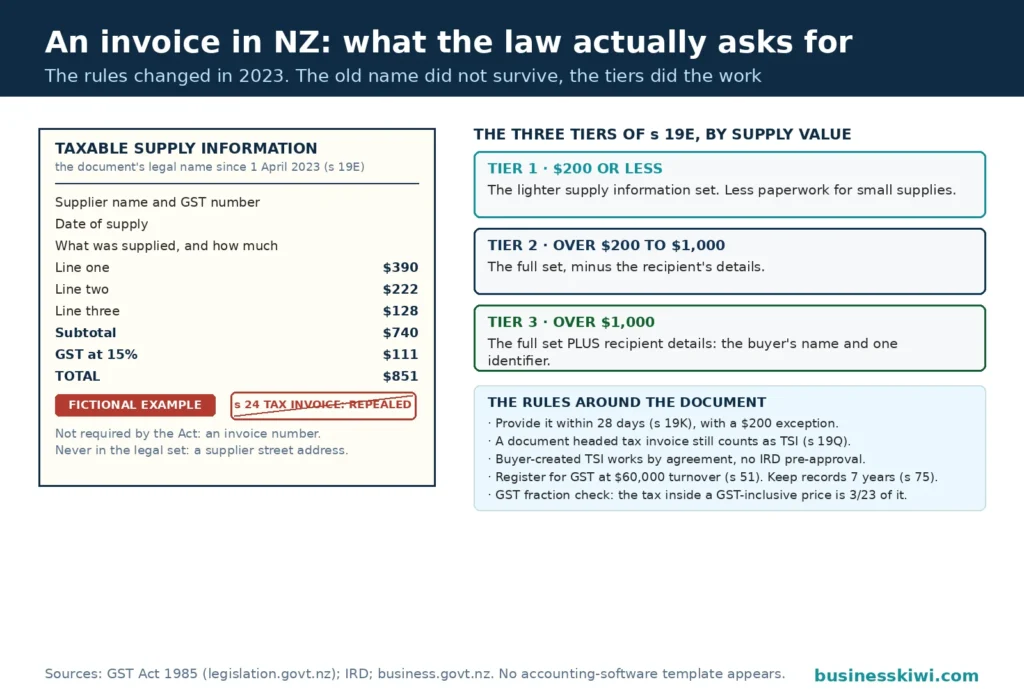
One thing is worth knowing before you copy anyone’s layout. Since 1 April 2023, New Zealand law has not required a document called a tax invoice. The rules were rewritten around a broader concept, taxable supply information, and that change altered what your template has to capture.
The legal backbone: taxable supply information
Until April 2023, the Goods and Services Tax Act 1985 required GST-registered suppliers to issue tax invoices in a prescribed form, with matching rules for debit notes, credit notes and buyer-created tax invoices that needed Inland Revenue approval. That apparatus was repealed and replaced. The current law instead requires registered businesses to provide and keep taxable supply information, a defined set of facts about each supply. Inland Revenue’s summary is plain: the way GST itself is calculated did not change, only the invoicing and record keeping rules around it.
Three consequences matter for your template.
First, the law no longer prescribes a single document. Inland Revenue points out that the required information can live across several records, such as an invoice, a supplier agreement, a contract and bank statements, in combination to back up a GST return. A complete invoice template is still the simplest way to keep those facts together, but it is the information that is compulsory, not the piece of paper.
Second, the vocabulary changed. Tax invoices became taxable supply information, debit and credit notes became supply correction information, and buyer-created tax invoices became buyer-created taxable supply information. None of this forces you to reprint anything: Inland Revenue confirms you can keep issuing a single document headed “tax invoice”, and the GST Act itself (section 19Q) reads references to a tax invoice in documents as including taxable supply information. A template built under the old rules still complies, provided it captures what the new rules ask for.
Third, the amount of information scales with the size of the supply. That tiering, set out in section 19E of the GST Act, is the real skeleton of a compliant template.
The three tiers: what the law asks for at each value
The information set grows in steps at $200 and $1,000, measured by the total consideration for the supply.
A few details deserve emphasis. The buyer’s details only become compulsory above $1,000, which surprises people used to the old full tax invoice. At the lowest tier, a registered business keeping records does not even have to record the supplier’s GST registration number for supplies of $200 or less. And GST is charged at 15 percent under section 8 of the Act, so the GST figures on any template are that rate applied to the GST-exclusive amount, or three twenty-thirds of a GST-inclusive total. One timing rule sits alongside the content: if a GST-registered buyer asks for taxable supply information, the supplier generally has to provide it within 28 days of the request, unless a different date is agreed, and no such duty applies to supplies of $200 or less.
The template, field by field
Here is a complete template specification. The notes column separates what the GST Act requires from what is there because it gets you paid faster, drawing on the invoice guidance published by business.govt.nz, the Ministry of Business, Innovation and Employment’s small business site.
The layout behind this table matches the free template business.govt.nz publishes: header block with your details and the customer’s, itemised lines in the middle, subtotal, GST and amount due at the bottom right, and the payment account and due date at the bottom left. You do not need that geometry for tax purposes; it persists because accounts staff can find everything where they expect it.

A filled example: GST-registered sole trader
The following invoice is fictional. The people, businesses, numbers and amounts are invented to show the fields working together, and the arithmetic has been checked.
The workings: the three lines add to $740.00. GST at 15 percent of $740.00 is $111.00, giving a total of $851.00. If the customer had been quoted a GST-inclusive price instead, the check runs in reverse: the GST inside $851.00 is three twenty-thirds of it, exactly $111.00. Because this supply is under $1,000, the customer’s name and address are good practice rather than a legal requirement, but the rest of the GST block is part of the information set for a supply of this size.
The sole trader template, in depth
Sole traders are the biggest group of invoice senders in the country, and their template has a few quirks company templates do not.
The starting point is that you and the business are the same person. business.govt.nz puts it simply: a sole trader does not set up a separate legal company, trades with a personal IRD number, and chooses their own business name. That flows straight into the template header. If you trade under your own name, your name is the business name. If you trade under a business name, the robust layout is both together, your name with “trading as” and the trading name, as in the fictional example above.
The GST Act backs the trading name up. For the purposes of issuing supply information, a registered person’s “name” includes a trading name they specified in their GST registration application or later notified to Inland Revenue under section 53 of the Act. A trading name is therefore not just branding; once Inland Revenue has it, it is a name you can lawfully issue invoices under. If you rebrand, notify the new trading name and its start date, and change the template header at the same time.
The GST number field is simpler than most sole traders expect. Your GST number is your IRD number, the personal one, because Inland Revenue uses the same number for both. Companies are in the same position, one level removed: a company has its own IRD number rather than a director’s, and that number is its GST number once it registers. Either way, the template field is the registered person’s own tax number, which is what the Act means by the supplier’s registration number.
The NZBN field is optional but increasingly useful: business.govt.nz’s invoicing guidance treats the NZBN as your business’s identifier and the address your eInvoices are delivered to, and sole traders can hold one just as companies do. And the address question settles itself: nothing in the GST information set requires a supplier’s street address, at any tier, so a sole trader working from home can run a fully compliant template with just an email address and phone number as the contact block.
The other template: when you are not GST-registered
If your supplies have not passed $60,000 in a 12-month period, you are generally not required to register for GST, and your template is a different document.
You do not charge GST. GST is a tax charged by registered persons on their supplies, and Inland Revenue lists charging GST among the responsibilities that begin once you register. So the not-registered template has no GST number field, no GST line, and no split between excluding-GST and including-GST amounts. The price is the price: a single total. Never present a figure as if it includes GST when none has been charged, because a registered customer may try to claim a GST component that does not exist.
Head the document “Invoice”, not “Tax invoice”. The tax invoice label belongs to the GST system: taxable supply information is something registered businesses provide and keep, and a document calling itself a tax invoice signals that there is GST in the price for a registered customer to claim. Keeping the two documents visually distinct avoids the most common invoicing error small businesses make.
Everything else survives the change. business.govt.nz’s invoice contents list is written for invoices generally, not just GST ones: your business name, your customer’s name and address, the invoice number, the date sent and the due date, a description, the amount payable, your payment details and any buyer reference. A fictional unregistered example needs no more: Hana’s Home Cleaning (fictional), invoice HHC-0087, a line reading “Regular clean, 3 hours” at a flat $180.00, a due date, and a bank account. Total due $180.00, with no GST shown because none applies.
The trap sits at the boundary. Registration stops being optional once your supplies exceed $60,000 in any 12-month period. From the day your GST registration takes effect, the GST template takes over and GST goes on your prices.
Progress payments, deposits and buyer-created documents
Long jobs rarely suit a single end-of-job invoice, and the template adapts in two variations.
Progress payments come first. business.govt.nz suggests that for work stretching over a long period, such as a six-month project, you split the total into smaller payments, for example at the beginning, middle and end of the work, agreed with the customer before you start. Each stage is billed on the same template with its own invoice number and date, and the description does the heavy lifting: the stage reached, the value claimed this time, and, for clarity, the contract total and the amount already claimed on earlier invoices. That running record matters for GST as much as for goodwill, because each invoice feeds your GST return figures. The same structure handles a deposit: invoice it on the template when it is agreed, describe it as a deposit for the named job, and show it as a credit line on the final invoice so the customer sees the full trail.
Buyer-created documents are the second variation, common where a small supplier works to a large customer that measures the work itself. Since April 2023 these are buyer-created taxable supply information, and the supplier no longer needs Inland Revenue’s approval for the arrangement, as the old buyer-created tax invoice rules did. What the current law requires instead is a genuine agreement: supplier and recipient agree that the supplier will not issue the information and the recipient will issue it for each supply covered, the reasons are recorded if the arrangement is not just the pair’s normal terms of business, and Inland Revenue has not stepped in to invalidate it. The fields are the same as on any invoice template; only the hand that fills them in changes. Get the agreement in writing before the first document is issued.
Fixing mistakes: supply correction information
Templates do not prevent errors; they just make them easier to spot. When an invoice turns out to be wrong, the current law’s mechanism is supply correction information, the replacement for the old credit and debit notes. Its contents mirror the invoice fields: your name and GST registration number, information identifying the original supply information, the date of the correction, and the correction itself, including any change to the GST charged.
Two habits follow. Do not edit an issued invoice and resend it as if the first version never existed, and do not issue a second document that looks like another original. Send a correction that references the original invoice number and shows what changed. A template library of three documents, the invoice, a progress claim variant and a correction, covers nearly everything a small business will ever send.

Payment terms and getting paid: the practice layer
Almost nothing in the previous sections is about the law of payment itself, because the GST rules barely touch it. Due dates, payment terms and follow-ups are matters of agreement, and business.govt.nz’s guidance is the practical standard: agree costs up front so there are no surprises, send the invoice as soon as the work is finished, keep the details clear, including what you provided, when, the cost, the due date and the payment terms, and offer flexible payment methods where you can.
The same source is blunt about follow-up: keep a record of who owes you what and how overdue it is, chase early with short, polite reminders, and run a set process, such as a reminder a couple of business days after the due date and a phone call if there is no response after a week. A short terms line on the template that restates the due date and what was agreed turns chasing from an argument into a reference back to a document the customer has already seen.
Keeping invoices: the seven-year rule
A template is also a filing decision. Registered businesses must keep their records, which include invoices, taxable supply information and supply correction information, for at least seven years after the end of the taxable period the records relate to. The records can be electronic; the Act’s definition covers manual, mechanical and electronic formats. They are to be kept in English or te reo Māori, and in New Zealand unless Inland Revenue authorises otherwise, which matters if your only copies live in an overseas cloud account. Inland Revenue can also direct a business under audit to hold records for up to three further years.
So every invoice you send should be retrievable, readable and complete for seven years from the end of the GST period it belongs to. The same discipline supports your income tax return, where the invoices are the evidence behind your income and expense figures.
Frequently asked questions
Do I still have to put the words “tax invoice” on my invoices?
No. That requirement disappeared with the old rules in April 2023. Inland Revenue confirms documents already marked “tax invoice” still comply with the new rules, so you can keep the heading, but a template that just says “Invoice” and contains the required information is equally valid for a GST-registered business.
Does my invoice legally need an invoice number?
No. A unique invoice number is not one of the facts the GST Act requires. It is still close to essential in practice: business.govt.nz recommends a simple sequence, and numbers are how you, your customer and your accountant match payments to supplies.
I am not GST-registered. What should my invoice show?
The same basic fields as any invoice: your business name, your customer, a number and date, a description, the amount payable, a due date and your payment details. What it must not show is GST: no GST number, no GST line and no GST split, because you are not charging GST. Head it “Invoice” rather than “Tax invoice” so no customer mistakes it for a GST document.
What extra detail do I need on invoices over $1,000?
Recipient details. Above $1,000, the information set adds the buyer’s name plus at least one identifier: an address, a phone number, an email address, a trading name if different, their NZBN or their website address. Below that threshold those details remain good practice but stop being a legal requirement.
Can my customer create the invoice for work I did for them?
Yes, under a buyer-created arrangement. Since April 2023 the customer can issue buyer-created taxable supply information if you both agree they will issue it and you will not, with the agreement recorded. Inland Revenue approval is no longer part of the process. The document still needs the full information set for the value of the supply.
Can I show one GST-inclusive price instead of adding GST on top?
Yes. The Act allows either presentation: itemised GST with the excluding-GST and including-GST amounts, or a single total with a statement that it includes GST. If you work GST-inclusive, the GST content of any total at the 15 percent rate is three twenty-thirds of that total.
How long do I need to keep copies of my invoices?
At least seven years after the end of the taxable period they relate to, if you are GST-registered. Electronic copies are acceptable, and Inland Revenue can require records to be held for up to three further years where a business is under audit or investigation.
This article is general information about invoice templates and GST record keeping in New Zealand, based on Inland Revenue and business.govt.nz guidance and the Goods and Services Tax Act 1985 as at October 2026. It is not tax or legal advice for your specific situation. If your invoicing involves unusual supplies, exports or buyer-created arrangements, check the detail with Inland Revenue or a tax adviser before locking your template in.
Sources
- Inland Revenue, “Taxable supply information for GST”, ird.govt.nz
- Inland Revenue, “How taxable supply information for GST works”, ird.govt.nz
- Inland Revenue, “Register for GST”, ird.govt.nz
- Goods and Services Tax Act 1985, sections 2, 8, 19E, 19F, 19K, 19Q, 51 and 75, legislation.govt.nz
- business.govt.nz (Ministry of Business, Innovation and Employment), “Getting paid on time”, business.govt.nz
- business.govt.nz (Ministry of Business, Innovation and Employment), “How to prepare an invoice” (Tips for tradies), business.govt.nz
- business.govt.nz (Ministry of Business, Innovation and Employment), “Sole trader”, business.govt.nz