Labour Hire in NZ: How It Works, Who Your Employer Is and What Each Side Signs Up For

Sign up with one company, get paid by that company, then spend your working day somewhere else entirely, taking instructions from people who do not employ you. That is labour hire, and it confuses almost everyone the first time they meet it. Which business is actually responsible for you? Who do you complain to when something goes wrong on site? And what exactly is the host business paying for when the hourly charge on its invoice bears little resemblance to the wage in the worker’s pocket?
New Zealand’s official guidance has a name for the arrangement: triangular employment. Employment New Zealand uses that term for any set-up where a person is employed by one organisation but does their day-to-day work for another. Labour hire is the most common example, and secondments are another. The rules that govern it are not exotic. Ordinary employment law still applies, health and safety duties are shared rather than shifted, and the paperwork matters more than the labels anyone uses. This guide works through how the arrangement is built, how the money flows, and what it means for the two audiences who search for it: businesses thinking about bringing agency workers in, and workers thinking about signing up.
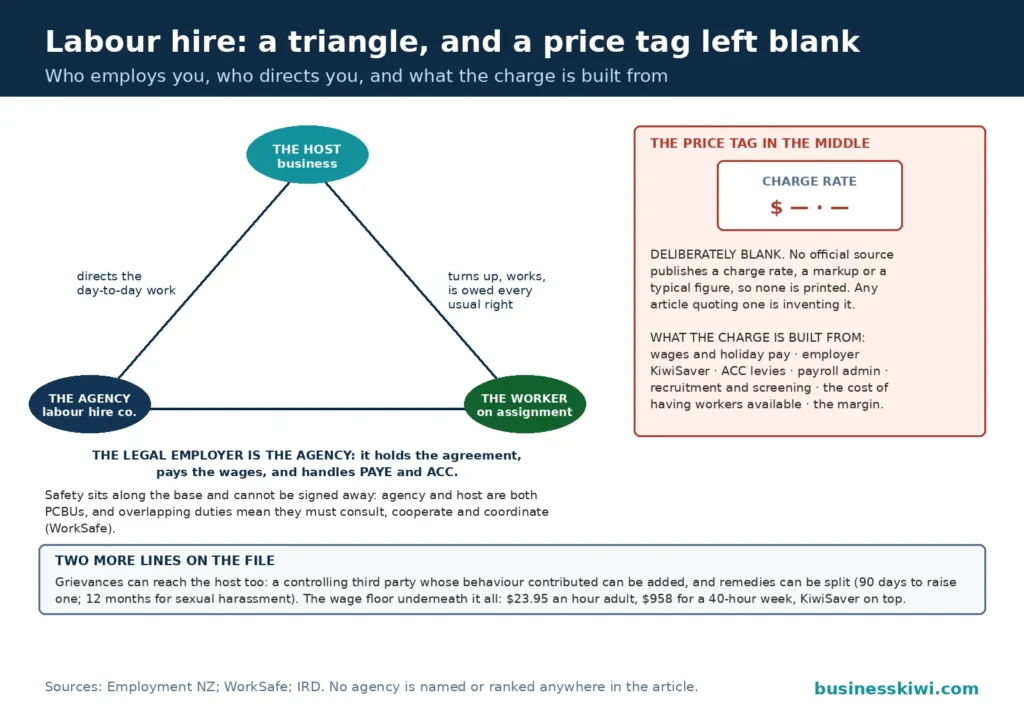
What labour hire is, and how the triangle fits together
A labour hire company, sometimes called an employment agency or temp agency, recruits workers and employs them itself. It then places those workers with client businesses, usually called host businesses, for assignments that might last a day, a season or many months. Think of a builder signed up by an agency and sent to work on a construction company’s site, or seasonal staff supplied into agricultural and horticultural work. Inland Revenue’s own examples of labour-related arrangements include a builder contracted to a labour hire business and companies supplying labour into the agricultural, horticultural and viticultural sectors, which gives a fair picture of where the model shows up.
Three parties are involved, and the roles split in a way that matters legally:
- The labour hire company is the employer. It signs the employment agreement with the worker, pays the wages and carries the obligations that come with being an employer.
- The worker is the agency’s employee, even though they may rarely set foot in the agency’s office.
- The host business directs the work. Its supervisors decide what gets done each day, when, and to what standard.
Employment New Zealand is clear that a worker in this situation is still an employee, with an employment agreement and the rights that go with it. The fact that someone else controls the daily work does not turn the worker into a contractor, and it does not dilute their entitlements. All the usual employment rights apply in a triangular arrangement.
There are two contracts sitting behind the scenes. One is the employment agreement between the agency and the worker. The other is a commercial agreement between the agency and the host business, covering things like the charge for the worker’s time, how assignments start and finish, and each side’s responsibilities. The worker is not a party to that second contract, which is why its terms, including what the host pays, are usually invisible to the person doing the work.
Four ways to get work done: labour hire, recruiters, direct hiring and contractors
People use “agency” loosely, and it helps to separate arrangements that look similar from the outside.
With labour hire, the agency is the employer throughout. It finds the worker, employs them, pays them, and sends them to your site. Your business never employs the worker directly.
With a recruitment agency placing a permanent staff member, the agency’s job ends at the introduction. The business interviews, chooses and then employs the worker itself, under its own employment agreement. That is ordinary two-party employment once the person starts, not labour hire, and there is no triangle.
With direct hiring, there is no intermediary at all. The business advertises, selects, employs and pays the worker, and carries every employer obligation from day one.
With a contractor, the worker is self-employed and engaged under a contract for services rather than an employment agreement. Employment New Zealand sets out the practical differences: contractors invoice for their services, pay their own tax and ACC levies, are not covered by most employment law and cannot raise a personal grievance. Employees, by contrast, receive wages or a salary, have an employment agreement, and have their PAYE tax and ACC handled by their employer. Health and safety law is the exception that covers both groups.
The distinction matters inside labour hire too, because not everyone supplied by an agency is the agency’s employee. Some workers are engaged by agencies as contractors, and Inland Revenue treats payments in that situation differently, as covered below. Labels are not decisive, either. Employment New Zealand stresses that what type of worker someone is depends on the real nature of the relationship, tested against the actual work situation, not just what the paperwork calls it. Its guidance describes legal tests for employee status, including a gateway test that came into law in February 2026, sitting alongside the tests the courts have developed over time. A worker who is in reality an employee does not lose that status because a document says “contractor”.

How the money works
Follow the payments and the arrangement makes sense. The host business pays the labour hire company an agreed charge for the worker’s time, usually calculated by the hour. The labour hire company pays the worker’s wages out of its own payroll. The worker’s pay rate and the host’s charge rate are two different numbers, set in two different agreements, and the gap between them is where most misunderstandings live.
That gap is not simply profit. Because the agency is the employer, the charge has to carry everything an employer pays for on top of the wage itself. Based on the obligations Employment New Zealand places on employers generally, those costs include paid annual holidays and leave entitlements, employer KiwiSaver contributions, which must be paid on top of at least the minimum wage rather than carved out of it, ACC levies, and the payroll administration involved in deducting PAYE and keeping wage and time records. On top of the employment costs sit the agency’s own expenses: finding and screening workers, holding a pool of people ready at short notice, covering the gap when a worker is between assignments or does not show up, and its margin for doing all of that.
So what does a labour hire company actually charge? There is no published answer, and any article that gives you a typical markup percentage is inventing it. No government source publishes charge rates or standard margins for labour hire in New Zealand, because there is no standard. Rates are negotiated business to business, and they move with the occupation, the scarcity of the skill, the length and certainty of the assignment, the location and how much risk and administration the agency is absorbing. A short-notice assignment of a hard-to-find tradesperson will be priced very differently from a long-running booking of general labour, and neither figure tells you anything reliable about the other.
What you can do is compare like with like. If you are a business, ask each agency to quote on the same role, the same hours and the same assignment length, and check what the quoted charge includes. If you are a worker, the number that matters to you is your own pay rate in your employment agreement, and that rate must meet the legal minimums whatever the host is paying. Since 1 April 2026 the adult minimum wage has been $23.95 an hour, with the starting-out and training rates at $19.16 an hour. A 40-hour week at the adult rate is $958 before tax.
One tax wrinkle is worth knowing about. Where an agency supplies someone who is genuinely a contractor rather than its employee, Inland Revenue’s schedular payment rules can apply. IRD describes schedular payments as payments to contractors for work that mainly involves the supply of labour, and its examples include an IT project manager contracted by a labour hire business to one of its clients. Under the rules for payments under labour hire arrangements, a labour hire business must deduct tax from payments it makes for work performed directly for its clients, including payments made to a company. The contractor tells the payer their tax rate using the IR330C form. None of that changes the worker’s employment status question, which is decided by the real nature of the relationship, but it explains why two people on the same site, supplied by the same agency, can be taxed in completely different ways.
Using labour hire as a business: what you take on
Businesses reach for labour hire when the work is real but the commitment is awkward: covering parental leave or a resignation gap, meeting a seasonal peak, staffing a project with an end date, or filling a shift at short notice. Employment New Zealand’s own guidance for employers even suggests using a recruitment agency as an option when workers are needed at short notice. The appeal is that recruitment, payroll and the employment relationship sit with the agency, and the arrangement can expand or shrink with demand.
What does not sit with the agency is everything that happens under your roof. Three duties follow the worker through your gate.
First, health and safety. Your business and the agency are both PCBUs, persons conducting a business or undertaking, under the Health and Safety at Work Act 2015, and your duties overlap. WorkSafe New Zealand’s position is that a PCBU is responsible not only for workers it employs or contracts, but also for workers it influences and directs, and for other people at the workplace. You cannot contract out of those duties by pointing at the agency. The next section deals with this in detail.
Second, fair treatment. Since the Employment Relations (Triangular Employment) Amendment Act 2019 changed the law, a worker who believes they have a personal grievance can apply to have the controlling third party joined to it. Employment New Zealand explains that the third party can be added where its behaviour or actions contributed to the problem, with things like bullying, harassment or discrimination given as examples, and that both the employer and the third party could end up responsible for remedies or compensation, which can be divided between them. If your supervisor is the person whose conduct is complained about, “they are not our employee” is not a shield.
Third, accuracy about status. If you direct agency workers exactly like your own staff for month after month, expect questions about whether arrangements on paper match reality. Employment law looks at the real nature of relationships, and the safest course is to keep the arrangement genuine: the agency employs, you direct the work, and both of you honour the split.
Before signing with an agency, read the commercial terms with those duties in mind. Points worth pinning down include what the charge covers and when it is invoiced, what happens if a worker is unsuitable or leaves mid-assignment, who provides induction, site-specific training and any protective equipment, how incidents and injuries get reported between the two businesses, what notice either side needs to end an assignment, and whether the agreement restricts you from employing the worker directly later or charges a fee if you do. None of these have standard answers, which is exactly why they need to be in writing.
Signing up as a worker: what the arrangement means for you
Your employer is the labour hire company. That single fact answers most of the questions workers ask. Your employment agreement is with the agency, your wages come from the agency, your leave entitlements build up with the agency, and if you have an employment problem, the agency is the employer you raise it with, although, as explained below, the host business can sometimes be brought into a grievance as well.
Read the agreement before you sign it, and note which type of employment it describes. Employees can be permanent, fixed-term or casual, and agency work is frequently casual because assignments come and go. Employment New Zealand describes casual employment as a situation with no guaranteed hours, no regular pattern of work and no ongoing expectation of employment. The employer does not have to offer work, and the employee does not have to accept work that is offered. A casual agreement should say so plainly, along with how you will be told about available work and how much you will be paid. It still has to contain the mandatory clauses every employment agreement needs.
Being casual changes how some entitlements operate, but it does not remove them. Casual employees have the same rights to rest and meal breaks as anyone else. All employees are entitled to four weeks of paid annual holidays after 12 months of continuous employment, although where work is genuinely irregular or intermittent, holiday pay can instead be paid as you go, at 8 percent of gross earnings, and that amount has to be identifiable in your pay records. Sick leave, bereavement leave and family violence leave are available once you have completed six months of continuous employment, or met the alternative test based on average hours over six months. And the minimum wage applies to every hour you work. It cannot be averaged out over a quiet week and a busy one.
On pay, expect the agency to deduct PAYE from your wages as your employer, because that is what employers do. A payslip is not legally required unless your agreement promises one, but Employment New Zealand confirms you can ask your employer for your wages and time records and your holiday and leave records, which show your pay rate, the hours you worked and what you were paid. Keep your own note of hours and sites worked. It takes seconds, and it is the easiest way to spot a payroll error early.
So what happens between assignments? If you are a casual employee, the honest answer is that gaps are unpaid and there is no obligation on either side. The agency does not have to find you work, and you do not have to sit by the phone. Casual employees can work for more than one employer at the same time, so nothing stops you registering with a second agency or picking up other work, although your hours with each employer are counted separately for leave entitlements. One caution: if an assignment settles into a regular pattern, with set days, rosters and an expectation that you will always be there, Employment New Zealand’s guidance says the real situation may have stopped being casual at all. In that case you may actually be a permanent part-time employee, entitled to a new agreement that reflects reality. The label in the agreement does not win over the facts.
If something goes wrong at the host’s workplace, act promptly. Employment New Zealand advises raising the issue with the party you are having the problem with first where you can. If it cannot be sorted out, a personal grievance can be raised against your employer, the agency, and the controlling third party can be added where its actions contributed to the problem. Personal grievances generally have to be raised within 90 days of the issue arising or coming to your attention, with a longer 12-month period for sexual harassment, so do not let things drift.

Health and safety when two businesses share one worker
Labour hire is a textbook case of what the Health and Safety at Work Act 2015 calls overlapping duties. The agency has duties as the employer that recruited, trained and placed the worker. The host has duties as the business that controls the site, the plant, the systems of work and the pace of the day. Neither can hand its share to the other.
WorkSafe New Zealand’s published position on overlapping duties sets out what the law expects of PCBUs whose duties overlap. They must, so far as is reasonably practicable, consult, cooperate and coordinate with each other about the duties they share. Each PCBU manages the risks to the extent of its ability to influence and control the matter, which in practice means the host carries most of the weight for site hazards it controls, while the agency carries weight for things like sending a worker who is competent and fit for the task and following up on concerns the worker raises. Businesses do not have to duplicate each other’s work, and they can make reasonable arrangements about who does what, but the responsibility itself stays with both.
In practical terms, WorkSafe expects businesses that work together to identify the risks that need managing, plan ahead through each stage of the work, think about how the work affects the other business and the public, agree which business is best placed to control each risk, define roles and responsibilities clearly, and monitor whether the arrangements are actually working. WorkSafe also says it expects PCBUs to be able to explain the steps they have taken, and that it may take enforcement action against more than one PCBU where duties are not met. For a host business, the sensible habits are exchanging health and safety information with the agency before the worker starts, inducting the worker like your own, and telling the agency about incidents and near misses rather than treating them as internal matters. For a worker, it means raising hazards with the host supervisor on site and with the agency, since both have duties toward you.
Where people get it wrong
“They are not our employee, so they are not our problem.” The host business directs the work, carries health and safety duties for workers it influences and directs, and can be joined to a personal grievance where its actions contributed. The triangle shares responsibility. It does not delete it.
Assuming the other business did the safety work. Overlapping duties fail quietly when the agency assumes the host inducted the worker and the host assumes the agency did. WorkSafe’s expectation is consultation and coordination, arranged in advance, not discovered after an incident.
Calling someone a contractor to keep things simple. Employment New Zealand warns that employers must not use casual arrangements to avoid giving employees their legal entitlements, and the same spirit applies to mislabelling employees as contractors. Getting status wrong can leave a worker without minimum entitlements and KiwiSaver contributions, and leave the business facing back-pay and penalties. The real nature of the relationship decides, not the heading on the document.
Workers assuming the host sets their pay. Your pay rate is set in your agreement with the agency and must meet the legal minimums. The commercial charge between agency and host is a separate bargain. Confusing the two leads people to negotiate with the wrong business.
Letting a regular roster run on a casual agreement. A casual arrangement that has become fixed days, every week, with no real ability to decline, is probably not casual any more. Both sides are better off updating the agreement to match reality, as Employment New Zealand recommends, than discovering the mismatch during a dispute.
Frequently asked questions
Who is my employer if I work through a labour hire company?
The labour hire company. It signs your employment agreement, pays your wages and holds the legal responsibilities of an employer, even though a host business directs your work each day. Employment New Zealand calls this a triangular employment situation.
How much do labour hire companies charge?
There is no official or standard figure. Charge rates are negotiated between the agency and the host business and are not published by any government source. The charge has to cover the worker’s wages plus the costs of being the employer, such as holiday pay, KiwiSaver contributions and ACC levies, along with the agency’s recruitment and administration costs and its margin, so it will always be higher than the worker’s pay rate.
Can I raise a personal grievance against the business I actually work at?
Yes, in the right circumstances. You raise the grievance against your employer, the agency, and the host business can be added as a controlling third party where its behaviour or actions contributed to the problem, for example bullying, harassment or discrimination. Either you or your employer can apply to the Employment Relations Authority to add the third party, and remedies can be split between the two businesses.
What happens when an assignment ends?
That depends on your agreement with the agency. If you are a casual employee, the end of an assignment usually just means no work is being offered at that moment. The agency does not have to offer more work and you do not have to accept it, although an employer who sends you home partway through an accepted shift may be treated as having dismissed you. Workers on fixed-term or permanent agreements with the agency have whatever rights those agreements and the law provide.
Do agency workers get holiday pay and sick leave?
Yes. Agency workers are employees, so the minimum code applies to them in the same way. That means four weeks of annual holidays after 12 months of continuous employment, or, where work is genuinely irregular, holiday pay of 8 percent of gross earnings paid as you go and shown in your pay records. Sick leave and other leave types become available once the qualifying tests in the Holidays Act are met, commonly after six months of continuous employment.
Who is responsible for my safety: the agency or the site I work on?
Both. Under the Health and Safety at Work Act 2015 the agency and the host business are both PCBUs with overlapping duties, and WorkSafe expects them to consult, cooperate and coordinate. The host controls the site and the day-to-day risks. The agency is responsible for placing you appropriately and following up concerns. Raise hazards with both.
I have worked the same shifts for months. Am I still casual?
Possibly not. Employment New Zealand says casual employment has no regular pattern and no expectation of ongoing work, and that it is the actual work situation, not the wording of the agreement, that decides. A settled roster with consistent days and an employer who relies on you points toward permanent part-time employment, with a new agreement to match.
Sources
- Employment New Zealand, “Triangular employment situations”, employment.govt.nz
- Employment New Zealand, “Personal grievances”, employment.govt.nz
- Employment New Zealand, “Understanding types of workers”, employment.govt.nz
- Employment New Zealand, “Employee or contractor?”, employment.govt.nz
- Employment New Zealand, “Casual employment”, employment.govt.nz
- Employment New Zealand, “Minimum wage rates and types”, employment.govt.nz
- Employment New Zealand, “Payslips”, employment.govt.nz
- WorkSafe New Zealand, “Working with other businesses (also called overlapping duties)”, worksafe.govt.nz
- WorkSafe New Zealand, “Overlapping duties”, worksafe.govt.nz
- Business.govt.nz, “Minimum wages increase from 1 April 2026”, business.govt.nz
- Inland Revenue, “Schedular payments”, ird.govt.nz
- Inland Revenue, “About schedular payments for contractors”, ird.govt.nz
This article is general information about how labour hire arrangements work in New Zealand, based on official sources published by Employment New Zealand, WorkSafe New Zealand, business.govt.nz and Inland Revenue. It is not legal advice, and it is not a substitute for advice about your own employment agreement or commercial contract. If you are unsure about your rights or obligations, contact Employment New Zealand or get independent legal advice before acting.