Year 8 Spelling Words in NZ: The Patterns That Matter and How to Practise Them

By Year 8, most New Zealand students are 12 or 13 years old and in their final year before secondary school. Some spend Years 7 and 8 at an intermediate school, others at a full primary school or a composite school, but wherever they are, spelling has quietly changed character. In the early years, spelling was mostly about sounds: hearing the parts of a word and matching them to letters. By Year 8 the emphasis has shifted. The words students meet in science, maths, social studies and their own reading are longer, often built from Greek and Latin parts, and full of letters that do not behave the way they sound.
That shift surprises many parents. A child who cruised through spelling tests at age nine may suddenly stumble over words like “conscience”, “rhythm” and “explanation”. The problem is rarely laziness. Year 8 spelling asks for a different kind of knowledge, and once students understand how words are built, the patterns start to make sense.
This guide explains what spelling actually involves at Year 8 in New Zealand, why there is no single official word list handed down by the Ministry of Education, and which patterns are worth practising. The example words are grouped by pattern, because patterns are what students are really expected to learn.
What changes about spelling by Year 8
The refreshed English learning area of Te Mātaiaho, the New Zealand Curriculum, places Years 7 and 8 in Phase 3. By the end of that phase, students are expected to know most of the complex rules of grammar and spelling in English, and to be able to spell complex words with unusual spelling patterns. The Ministry is clear that spelling still needs explicit teaching in these years, several times a week. It is not treated as finished business from primary school.
The big change is the role of morphology, the study of how words are built from meaningful parts. A prefix, a root and a suffix each carry meaning, and knowing the parts often tells you the spelling. A Year 8 student who knows that “photo” means light and “graph” means writing has a real chance of spelling “photography” correctly, even on first meeting. Sounding it out letter by letter would not get them there.
Alongside morphology, syllables do heavy lifting. Breaking a long word into beats, then spelling each part, turns one hard problem into several easy ones. The curriculum also expects students to explore where words come from, because etymology explains many of the oddities, such as why “pterodactyl” starts with a silent p.
Is there an official Year 8 spelling list?
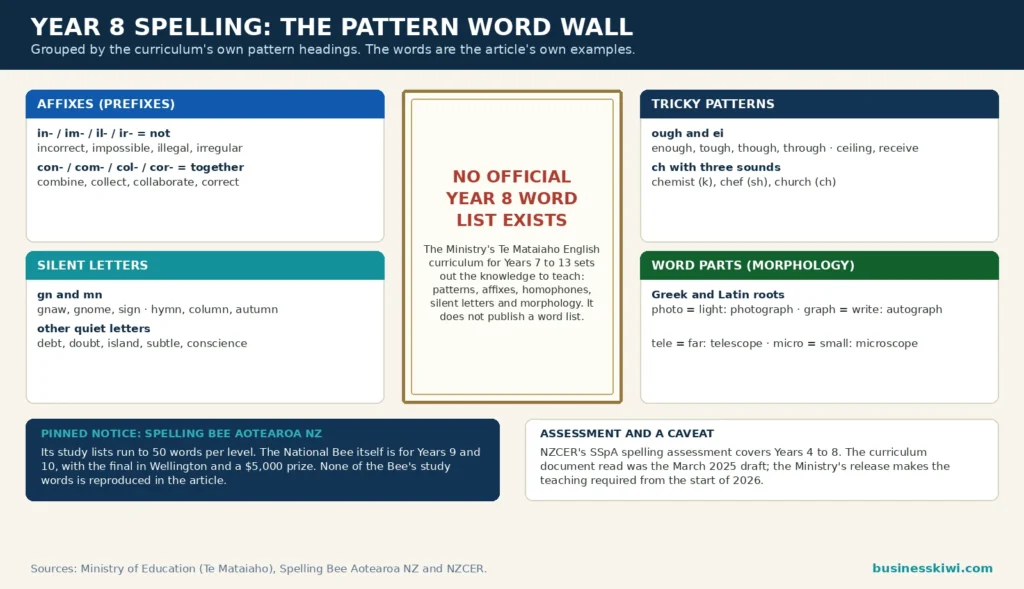
This is the question parents ask most, so here is the plain answer: no. The Ministry of Education does not publish a single official list of words that every Year 8 student in New Zealand must learn. The curriculum sets out knowledge instead of words. It describes the patterns, prefixes, suffixes and tricky spellings students should master, and teachers build their class lists from those expectations and from the texts their students are reading and writing.
That means two Year 8 classes in different towns can work from quite different lists, and both can be doing exactly what the curriculum intends. It also means the lists sold online as “the NZ Year 8 spelling list” are commercial products, not official documents. Some are borrowed from overseas curricula, which can be a genuine problem in a country that spells “organise” with an s and “behaviour” with a u.
There is one well known New Zealand exception. The Aotearoa New Zealand Spelling Bee, a charitable trust, publishes study words for its Classroom Spelling Bee programme, including sets for Years 7 and 8 at graded levels. Each study list contains 50 words grouped by theme, with the part of speech, a definition and an example sentence for every word. Those lists are the Bee’s own teaching material, written for its programme, and they are a useful benchmark for what keen spellers of this age can handle. They are still not a curriculum requirement, and no school is obliged to use them.
The patterns that matter most
The groups below follow the knowledge the curriculum names for this phase. Every group is a pattern first and a list second. Students who learn the pattern can spell dozens of words they have never been tested on.
Prefixes that change their shape
Some prefixes adjust their final letter to match the word they join. The prefix “in”, meaning not, becomes “im” before letters like p and m, “il” before l, and “ir” before r. The prefix “con”, meaning together or with, does the same trick.
Longer two-part prefixes also feature in this phase. Look for them in words such as international, intercept, interrupt, overdue, overreact, circumstance, antiseptic, antidote, anticipate and anti-clockwise.
Suffixes: able, ible and ure
Words ending in “able” usually attach to a complete base word: readable, washable, breakable, predictable, comfortable, reasonable. Words ending in “ible” tend to come from Latin roots that cannot stand alone: visible, possible, terrible, edible, responsible, accessible, sensible. The “ure” ending appears in picture, future, structure, culture, adventure, furniture, temperature and creature.
There is no rule that works every time, which is why these endings catch students out. A useful habit is to ask whether what remains after removing the ending is a word in its own right. If it is, “able” is the safer bet.
When adding a suffix changes the base word
This is a named focus for Year 8, and it is where many errors hide. Sometimes the consonant changes: mischief becomes mischievous, and pronounce becomes pronunciation in the related noun form. Sometimes the vowel changes: explain becomes explanation, describe becomes description, reduce becomes reduction, decide becomes decision. Other examples worth practising include fame and famous, nerve and nervous, vary and various, maintain and maintenance, and advise and advice.
The lesson is that word families share a root, but the root does not always keep the same spelling. Learning words in families, rather than one at a time, makes these changes visible.
Silent letters
By Year 8 students are expected to handle the less common silent letters, including combinations where the first letter is not heard at all.
Etymology helps here. The p in “pneumonia” and the ps in “psychology” are there because these words arrived from Greek, and the spelling kept a record of the journey.
The schwa: the lazy vowel that causes half the trouble
The most common vowel sound in English is the weak “uh” sound in unstressed syllables, called the schwa. Because it gives no clue to its letter, it is the single biggest source of Year 8 spelling errors. It is the reason students write “seperate” for separate, “definate” for definite and “choclate” for chocolate. Words to study closely include separate, definite, desperate, interest, favourite, vegetable, camera, history, family, temperature, doctor, similar and particular.
The fix is partly pronunciation: saying the word slowly, in its full “spelling voice”, can expose the missing letter. The other fix is pattern knowledge. Endings such as “ar”, “er” and “or” in doctor, similar and water are worth learning as units.
Tricky vowel and consonant spellings
Some letter groups can stand for several sounds, and students are expected to sort them out by Year 8.
None of these groups can be sounded out reliably, which is exactly why the curriculum lists them as knowledge to be taught rather than left to chance.
Greek and Latin roots: the master key
Phase 3 reading expects students to know the meanings of common Greek and Latin roots and affixes, and to use them to work out new words. For spelling, this knowledge is the closest thing to a master key, because so many long words are assembled from a small kit of parts.
A student who knows twelve roots owns a piece of hundreds of words. Building words from cards, one card for each part, is one of the most effective practice games at this age: tele + scope, micro + scope, photo + graph + y.
Homophones: same sound, different spelling
Year 8 students move beyond their, there and they’re to a harder set of pairs where both words are common in school writing.
New Zealand English adds a pair of its own conventions: practice is the noun and practise is the verb. A doctor works at a medical practice, but a student must practise her spelling. Advice and advise follow the same noun and verb pattern, with a difference in sound to help.
Subject words students are expected to spell
From Year 8 onwards, much of the spelling load comes from other subjects. Each learning area has its own core vocabulary, and teachers expect it spelled correctly in that subject’s writing.
Te reo Māori words matter too, and spelling them well means getting the macrons, or tohutō, right, because a macron changes meaning. Words students meet daily include whānau, kaiako, kura, marae, iwi, hapū, whakapapa, manaakitanga and Matariki. A missing macron in kūmara turns a sweet potato into something else entirely, so care with these words is a mark of respect as much as accuracy.
New Zealand spellings to get right
Because so much online material uses American spelling, Year 8 students absorb American forms without noticing. The New Zealand conventions to hold onto include organise, recognise, behaviour, favour, colour, centre, travelled, labelling, and the practise and practice distinction described above. Spellcheckers can be set to New Zealand English, and doing so is a five minute job that pays off all year. The curriculum expects students in this phase to use print and digital dictionaries for spelling, pronunciation and definitions, in both English and everyday te reo Māori, so reaching for a dictionary is a skill to build, not a weakness to hide.
How spelling is taught and checked at school
In most Year 8 classrooms, spelling is taught explicitly in short sessions several times a week, then applied in writing. Teachers group words that share a pattern, build in review of older material alongside new words, and mix the two so that last month’s learning is not forgotten. That spaced, interleaved approach is exactly what the curriculum’s teaching guidance recommends for this phase.
Assessment is mostly woven into writing. Teachers watch how a student spells in real compositions, because a word spelled correctly in a Friday test and incorrectly in an essay has not really been learned. Some schools also use standardised tools. The New Zealand Council for Educational Research (NZCER) publishes the Supplementary Spelling Assessments for Years 4 to 8, which let schools compare a student’s spelling against national norms and track progress through a developmental sequence. There are also diagnostic subtests for students from Year 5 up who are making slower progress, including Year 7 and 8 students.
There is no national spelling exam in Year 8, and NZQA exams sit years ahead in the senior school. What matters at this stage is steady growth in the patterns, picked up through writing, feedback and targeted practice.
Spelling bees and competitions
For students who love words, the Spelling Bee offers a genuine challenge. The Aotearoa New Zealand Spelling Bee runs two free programmes. Its Classroom Spelling Bee provides study words for Years 1 to 8, including the Years 7 and 8 sets described earlier, so a Year 8 student can absolutely take part at classroom level. The National Spelling Bee competition itself is for Years 9 and 10 students, so it becomes available once a student reaches secondary school: competitors work through regional events to reach the national final in Wellington, where the winner takes away $5,000 towards their education. Year 8 is the perfect year to build the word knowledge that competition demands, since the Bee’s lists lean heavily on the same Greek and Latin roots, subject vocabulary and te reo Māori words covered in this guide.

How to practise at home
Short, regular practice beats a long Sunday night cram. Ten to fifteen minutes, four or five times a week, lines up with the spaced practice schools use, and the school holidays are a good time to keep the habit ticking over at a gentler pace. These methods work well for this age group:
- Dictation. Read a sentence aloud, from a book the student is reading, and have them write it. Sentences force homophones and punctuation to be decided in context, which single words never do.
- Word sorts. Write twenty words on cards and sort them by pattern: all the “ible” words in one pile, the silent letter words in another. Finding the pattern is the learning.
- Word building games. Make cards for prefixes, roots and suffixes, then race to build the longest real word. Follow up by checking it in a dictionary.
- Word sums. Write the joins out in full, such as mischief + ous = mischievous, so the change in the base word is seen rather than guessed.
- A personal list. Keep a notebook of words the student has misspelled in their own writing. Ten words that genuinely trip them up are worth more than a hundred generic ones.
- Look, say, cover, write, check. An old method that still earns its place for stubborn words that break every pattern, such as conscience and rhythm.
- Reading. Wide reading quietly teaches spelling, because students who have seen “necessary” in print fifty times rarely invent a new spelling for it.
Research published by NZCER adds one more ingredient. In a study of how students explain their own spelling strategies, those achieving at the expected level combined several strategies and linked new words to things they already knew, while students who were behind tended to rely on a single strategy. Talking through how a word might be built, not just drilling the letters, helps students develop that flexible approach.
When spelling is still a struggle
Some Year 8 students spell well below their reading level, and it is worth raising early rather than waiting for secondary school. Talk to the teacher about what the errors show: a student who spells by sound alone may never have been taught the morphology layer, while a student who knows the patterns but cannot apply them in writing may need more supported practice. Schools can use diagnostic assessments, such as the NZCER diagnostic subtests, to pinpoint the gap. Dictionaries and spellcheckers are legitimate tools, named in the curriculum itself, and learning to use them well is part of the answer rather than a way of avoiding it.
Frequently asked questions
Is there an official list of Year 8 spelling words in New Zealand?
No. The Ministry of Education does not publish one fixed list for Year 8. The curriculum describes the spelling knowledge students should have, such as prefixes, suffixes, silent letters and Greek and Latin roots, and teachers build their lists from that guidance and from class texts. The closest thing to a national list is the study words published by the Aotearoa New Zealand Spelling Bee for its classroom programme.
How old are Year 8 students in NZ?
Most Year 8 students are 12 or 13 years old. Year 8 is the final year of primary schooling in New Zealand, whether it is spent at an intermediate school, a full primary school or a composite school, and students move on to secondary school in Year 9.
How is spelling assessed in Year 8?
Mainly through writing. Teachers assess the spelling students produce in their everyday compositions and may also run class tests on the patterns being taught. Some schools use the NZCER Supplementary Spelling Assessments, designed for Years 4 to 8, which compare results with national norms. There is no national spelling exam at this year level.
Can a Year 8 student enter the New Zealand Spelling Bee?
Yes, at classroom level. The Aotearoa New Zealand Spelling Bee’s Classroom Spelling Bee provides study words for Years 1 to 8, including Years 7 and 8 sets. The National Spelling Bee competition is for Years 9 and 10, so a Year 8 student becomes eligible for the full competition once they start secondary school.
What is the difference between practice and practise?
In New Zealand English, practice with a c is the noun and practise with an s is the verb. You go to football practice, but you practise your spelling. The same pattern applies to advice, the noun, and advise, the verb.
Which spelling patterns should a Year 8 student focus on first?
Start with word building: prefixes such as in, im, il and ir, suffixes such as able and ible, and common Greek and Latin roots like photo, graph, port and spect. Add the silent letter words, the schwa endings, and the advanced homophone pairs. Those patterns unlock far more words than any single memorised list.
How much spelling practice should happen at home?
Little and often works best: around ten to fifteen minutes, several times a week, mixing new words with older ones so nothing fades. Short dictations, word sorts and a personal list of words from the student’s own writing are more useful than copying out long lists the night before a test.
My child passes spelling tests but misspells words in their writing. Why?
A test asks for one word at a time with full attention on it. Writing asks for ideas, sentences, punctuation and spelling all at once, and spelling is often the first thing to slip. It usually means the word is learned but not yet automatic. Applying patterns during real writing, and proofreading with a personal checklist of known trouble words, closes the gap.
Sources
- Ministry of Education, Te Mātaiaho | The New Zealand Curriculum: English Years 7–13 (Phase 3 teaching sequence): http://files-au-prod.cms.commerce.dynamics.com/cms/api/qwxsnqcpfm/binary/MLbhNv
- Ministry of Education, Years 7 to 13 English learning area released: https://www.education.govt.nz/news/years-7-13-english-learning-area-released
- Spelling Bee Aotearoa New Zealand, Home: https://spellingbee.co.nz/
- Spelling Bee Aotearoa New Zealand, Classroom Spelling Bee 2025 Study Words: Year 7 – Year 8, Level Three: https://spellingbee.co.nz/images/docs-2025/2025_NZSB_StudyWords_Yr7-8_L3_B.pdf
- New Zealand Council for Educational Research, Supplementary Spelling Assessments (SSpA): https://www.nzcer.org.nz/assessments/supplementary-spelling-assessments
- New Zealand Council for Educational Research, Using metacognition to explore spelling strategies: https://www.nzcer.org.nz/node/71475
This article is general information about spelling learning at Year 8 in New Zealand schools. Curriculum content and school programmes change over time, and individual schools set their own word lists and teaching programmes, so check with your child’s teacher for the expectations in their classroom. If you are concerned about a student’s spelling progress, raise it with the school, which can arrange appropriate assessment and support.