IRD Tax Debt in NZ: Instalment Arrangements, Hardship Relief and When Debt Is Written Off

Owing Inland Revenue money is stressful, and it gets more stressful the longer it sits there. Tax debt does not stay still. Interest runs on it every day, penalties land in stages, and a balance that looked manageable in April can look quite different by Christmas. IRD does publish clear routes for dealing with debt you cannot pay in full: an instalment arrangement, financial relief where the legal tests are met, and, in a narrow set of circumstances, a write-off. None of those routes works if you do nothing. This guide explains how tax debt builds, what each option involves, and what IRD can do when debt is ignored.
The short answer
If you cannot pay, contact IRD early and put something formal in place. An instalment arrangement lets you repay in weekly, fortnightly or monthly amounts through myIR, and keeping to it can hold off further collection action, although interest generally keeps running. If repaying would leave you unable to meet basic living costs, you can apply for financial relief on serious hardship grounds, and IRD can write off some or all of the debt, defer payment, or set instalments you can sustain. Write-offs also happen where a debt cannot be recovered, or chasing it would cost more than it is worth. IRD will not quietly forget a debt because time has passed. Ignored debt escalates, from reminders and phone calls to bank deductions and, at the end of the line, bankruptcy or liquidation action.
How tax debt arises, and how to check what you owe
Tax debt rarely starts as one big bill. For employees it might be an assessment after a second job, a wrong tax code, or a Working for Families overpayment that has to be repaid. For sole traders and companies it is usually provisional tax that fell short of the final bill, a GST return filed in a tight month and never quite caught up, or PAYE deducted from staff wages that did not reach IRD on time. Interest and penalties then attach to the core tax outstanding, which is why two people with the same original bill can owe quite different totals a year later.
Filing and paying are separate obligations. If you cannot pay, still file on time. An unfiled return does not hide the debt, and it can attract late filing penalties on top of everything else.
To see where you stand, log in to myIR. Your accounts show the balance for each tax type, split between core tax, interest and penalties. That breakdown matters, because the options differ: core tax is the hardest part to shift, while penalties are sometimes remitted and interest is occasionally written back in defined situations. If the figures do not match what you expected, query that first.
Use-of-money interest: the daily cost of owing
On top of any penalties, IRD charges use-of-money interest, usually shortened to UOMI, on underpaid tax. IRD frames this as compensation rather than punishment. The idea is that the Crown has been without money it was entitled to, so interest restores that position. The same logic runs in reverse at a lower rate: if you overpay, IRD pays you credit interest for the period it held your money.
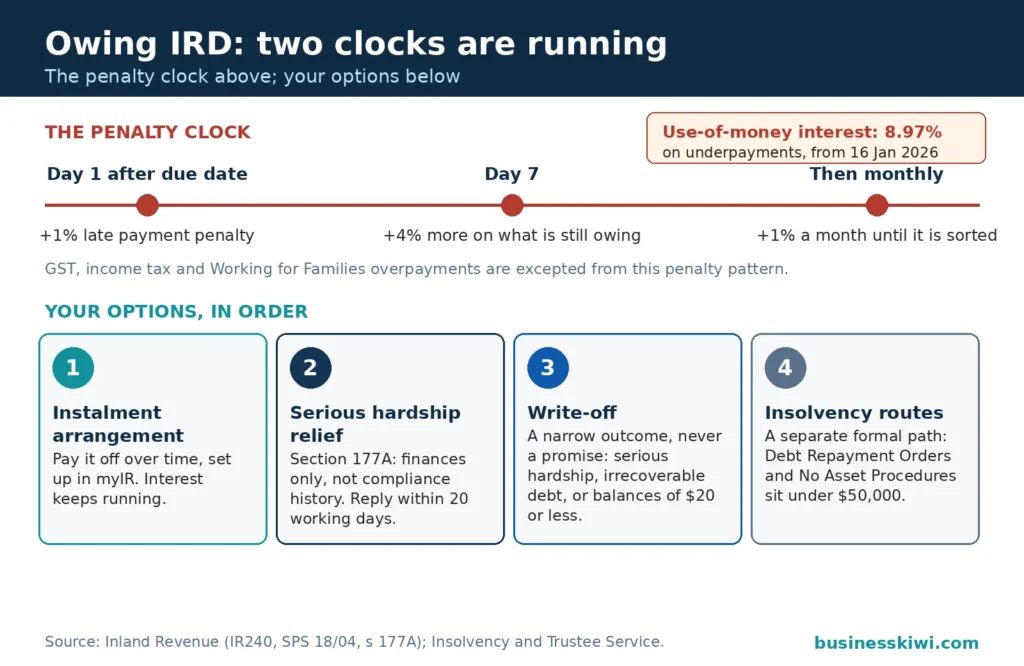
Interest is calculated daily, and the rates are set by regulation and reviewed against market rates, so they change over time. The current rates, which took effect on 16 January 2026, are 8.97 percent per annum on underpayments and 2.25 percent per annum on overpayments. Before that change, the rates were 9.89 percent and 3.27 percent, in place from 8 May 2025. Always check the current figures on IRD’s website before relying on them, because a guide like this one can be overtaken by the next rate change.
Two practical points follow. Part payments help straight away, because every dollar paid reduces the balance tomorrow’s interest is worked out on. And interest normally continues while an instalment arrangement runs. IRD states this plainly: interest on overdue amounts is charged and forms part of what your instalments cover. An arrangement limits fresh penalties and collection pressure, but it does not freeze the interest clock.

Late payment penalties
Late payment penalties are separate from interest, and they arrive quickly. IRD’s published structure has three stages. A penalty of 1 percent applies on the day after the payment due date. If tax is still unpaid on the seventh day after the due date, a further 4 percent penalty applies to the remaining amount, including penalties already charged. After that, a penalty of 1 percent is added each month the debt remains unpaid, with an important exception: that monthly stage does not apply to GST, to income tax including provisional tax, or to Working for Families overpayments. For those tax types the sting is concentrated in the first week, plus daily interest from then on.
There is one piece of softness in the system. If it is your first late payment in a two year period, IRD may give you a grace period and a new due date before penalties are charged. You will be told if that applies to you. Miss the new date and the penalty is charged from the original due date, so a grace period is a second chance, not a discount.
Employers face a harsher penalty alongside these. If you file employment information but do not pay the amounts deducted, a non-payment penalty of 10 percent of the overdue amount can apply, with another 10 percent added each month it stays unpaid. When the amount is paid, or an arrangement is entered into, the most recent 10 percent penalty reduces to 5 percent. Child support is different again: these rates do not apply to it, and it has its own process.
Notice the effect over time. Penalties are calculated on the remaining tax including penalties, and interest runs on the growing total. A debt left alone steps up in the first week, then keeps climbing. That is the strongest argument for acting in the first fortnight.
Shortfall penalties are a different animal
One more category should not be confused with late payment penalties. Shortfall penalties apply when a return itself is wrong, for example where a tax position understated the tax payable. They are charged as a percentage of the tax shortfall, depending on behaviour. IRD technical guidance lists 20 percent for not taking reasonable care or for an unacceptable tax position, 40 percent for gross carelessness, 100 percent for an abusive tax position, and 150 percent for evasion or a similar act. Reductions can apply, for good previous behaviour or voluntary disclosure. If one appears on your account, the underlying return needs attention, not just the payment.

Instalment arrangements: paying it off over time
An instalment arrangement is IRD’s preferred way of resolving tax debt, and it is the option most people will end up using. In IRD’s own framing it is a form of financial relief rather than a payment method: it is for debt you cannot pay in full by the due date, or debt that is already overdue. Individuals, companies, partnerships and trusts can all apply.
You apply in myIR, or by phone. Before you begin, IRD asks you to know how much you can afford, whether you will pay by direct debit or another method, and when payments should start. Inside the application you will see the total owing by tax type and a minimum payment amount shown for your situation. If you can meet that minimum on a weekly equivalent basis, you choose your frequency (weekly, fortnightly or monthly), pick a payment method, set the first date, review the schedule and submit. If you cannot afford the minimum, you confirm your contact details and IRD will call to talk through your options. That call is not a rejection. It is how below-minimum arrangements get negotiated.
A few honest points:
- There is no single published dollar minimum or fixed maximum term for everyone. The minimum in myIR is calculated for your debt, and anything outside the standard settings is decided case by case.
- Arrangements cover all tax types except child support.
- IRD may ask for more information, particularly from businesses. A common request is a twelve month cash flow forecast on form IR591.
- Keeping to the plan matters. Staying on track may stop further collection action. Fall behind without making contact, and that protection falls away.
- Current tax still has to be paid as it falls due. An arrangement covers the old debt; it is not a licence to build a new one, and IRD may decline one where ongoing obligations are not being met.
Default and the arrangement will be revisited, with collection activity resuming and interest having run throughout. If a payment is going to fail, contact IRD before the due date, not after.
One warning while you are sorting an arrangement out. Borrowing elsewhere to clear tax debt swaps a creditor who offers instalment arrangements and hardship relief for one who offers neither, usually at a higher interest rate. Before taking that step, read up on the real cost of high-cost credit in our small loans guide, and compare it honestly with what an IRD arrangement would cost you in interest over the same period.
Serious hardship: when repayment itself is the problem
Some debts cannot be repaid at any instalment level without causing genuine harm. The law recognises that through the serious hardship provisions of the Tax Administration Act 1994. You apply for financial relief either by claiming recovery would place you in serious hardship, or by asking for an instalment arrangement. The Commissioner can accept a request, ask for more information, make a counter offer, or decline it. If IRD seeks information or makes a counter offer, you generally have 20 working days to respond, or longer if allowed.
Serious hardship has a legal meaning, and it is narrower than feeling stretched. Under section 177A of the Act, the test is whether your financial information shows you would likely face significant financial difficulties after paying, because of factors such as a serious illness affecting you or a dependant, or because you would likely be unable to meet minimum living expenses judged by normal community standards, the cost of medical treatment for you or a dependant, or the cost of education for a dependant. Other factors the Commissioner considers relevant can also count. Two safeguards are built into that test. The decision is made only on the financial information IRD holds at the date of decision, and your compliance history, good or bad, must not be considered when deciding whether serious hardship exists. Compliance can matter later in the process, but it cannot be used to deny that the hardship itself is real.
Expect to evidence everything. The myIR application asks about your living situation, dependants, housing and any mortgage, your income and assets, and your liabilities and expenses. IRD suggests uploading three months of bank and credit card statements, loan contracts, and contracts for current or future work. There is also a paper form, IR590, if you cannot use myIR. IRD assesses living costs using its Household Expenditure Guide for your region, so expenses well above that guide will need explaining.
Outcomes are not limited to writing the whole debt off. Relief can mean a full or partial write-off, payment deferred, or instalments at a reduced level, and combinations happen too. IRD also treats relief as temporary in one sense: if you still cannot meet ongoing tax, you may need to change how you operate, for example how you pay provisional tax. Student loan and child support debt follow different rules, so a decision on income tax debt does not settle those balances.
Write-offs beyond hardship
Hardship is the best known ground for a write-off, but it is not the only one. IRD’s Standard Practice Statement on relief from tax debt, SPS 18/04, summarises the Commissioner’s wider position.
The Commissioner must generally maximise recovery. Against that duty, the Act allows recovery to stop where collecting would be an inefficient use of IRD’s resources, or where the amount is irrecoverable. Both judgements are case by case, weighing the amount, the prospects of recovery, and the wider effect on voluntary compliance. IRD will sometimes pursue a debt even where collection costs more than the amount owing, if walking away would damage the integrity of the tax system. Small balances are treated pragmatically: the Commissioner may permanently write off tax where the balance is $20 or less.
Some write-offs are not discretionary. Where amounts cannot be recovered because a taxpayer has been made bankrupt, a company liquidated, or an estate distributed, the Commissioner must write off what cannot be recovered once final advice is received from the Official Assignee, liquidator or administrator. Even here, there is a limit. The hardship provisions do not oblige IRD to write a debt off instead of pursuing bankruptcy, and the courts have confirmed IRD may judge bankruptcy the right path in a particular case. A write-off is an outcome IRD reaches after testing the evidence. It is never an entitlement, and any business that guarantees you one is promising something that is not theirs to give.
Remission: when penalties and interest can be removed
Write-off deals with the debt itself. Remission is narrower: it removes penalties, and sometimes interest, that were correctly charged but should not stand. The clearest case is reasonable cause. Where an event beyond your control caused the failure, for example serious illness around the due date or a death in the family, and you put things right as soon as practicable, late filing and late payment penalties may be remitted. Ask too where a charge flows from wrong information or a mistake on IRD’s side.
Interest is harder to shift, because it is compensation rather than punishment. IRD practice statements allow interest remission in limited circumstances, including where a declared emergency event prevented payment, and where remission fits the duty to collect the highest net revenue over time. Shortfall penalties sit at the most restrictive end and are generally handled through their own reduction and dispute rules. Ask specifically: name the charge, the dates, and the event that caused the problem.
If you ignore it: IRD’s collection powers
Now the other side of the ledger. IRD is running an active campaign on overdue debt and returns, focused on GST and employer debt, and its published approach is methodical. It contacts you directly and tries to resolve things through payment or an arrangement. If there is no response, it leaves a message, then makes a final attempt. If those attempts fail, the next steps can include a visit from community compliance staff, a deduction from your bank account, and consideration of bankruptcy or liquidation.
The bank deduction surprises people. Under a deduction notice, IRD can require your bank, your employer, or another person who owes you money to pay IRD instead of you. Deduction notices are not the first move, and they are unlikely while you are keeping to an arrangement or have a relief application under active consideration. Silence is what moves you toward the enforcement end of the process.
For companies, the end of that process can be liquidation. For individuals it can be bankruptcy. Both carry consequences well beyond the tax bill, which is why the cheapest time to deal with tax debt is before enforcement starts.
The formal last resort: personal insolvency options
If your overall debts are beyond any arrangement, New Zealand has three formal personal insolvency procedures administered by the Insolvency and Trustee Service. A Debt Repayment Order suits someone who owes less than $50,000 in unsecured debt and can still make some repayments, giving extra time under a supervised plan. A No Asset Procedure suits someone who owes less than $50,000, has no assets to sell, and has no spare money for repayments. Bankruptcy is available where you owe more than $1,000 in unsecured debt, and it is the only formal option once unsecured debt exceeds $50,000. Each carries a real cost to your credit record, assets and freedom to run a business, and each requires a full statement of your affairs. Take free advice before choosing one over an IRD arrangement.
Getting help without paying for promises
Start with IRD itself. Its contact routes and the myIR applications above are free, and the staff who assess relief are the only people who can grant it. If your wider finances are tangled, free financial mentoring is available through the government funded Building Financial Capability network; a mentor can help you build the budget and cash flow picture a strong relief application needs.
Be careful with paid tax debt help. Accountants and tax agents have a legitimate role: preparing forecasts, checking assessments and dealing with IRD for a transparent fee. What nobody can do is guarantee a write-off, stop interest by their involvement alone, or access a scheme that is not open to you directly. The decision sits with the Commissioner, on evidence. If someone wants a large upfront fee for a promised outcome, walk away and contact IRD yourself.
Check your balance in myIR, be honest about what you can pay, and put an arrangement or relief application in front of a decision maker. That step changes your position from someone avoiding a debt to someone resolving one, and IRD’s system responds very differently to the second person. You will find more guides like this one in our Finance hub.
Frequently asked questions
Does interest keep charging while I am on an instalment arrangement?
Yes, in general it does. IRD states that interest is charged on overdue amounts and is included as part of your instalment amounts. The arrangement protects you from further collection action while you keep to it, but it does not stop the interest clock, which is why paying more than the minimum, when you can, shortens the arrangement and reduces the total interest.
Will IRD write off my tax debt if I ask?
Only where the legal grounds are met. The main grounds are serious hardship, where repayment would leave you unable to meet minimum living costs or necessary medical or education costs for dependants, a debt that cannot in practice be recovered, or collection that would be an inefficient use of IRD’s resources. Decisions are made case by case on your financial evidence, and there is no general amnesty or entitlement to a write-off.
What happens if I miss a payment on my arrangement?
Contact IRD before the payment fails if you possibly can. The protection an arrangement gives you depends on keeping to the agreed plan. Missed payments can see the arrangement revisited and ordinary collection activity resume, including deduction notices, while interest continues to run on the balance.
Can IRD take money straight from my bank account?
Yes. If contact attempts fail and the debt remains unpaid, IRD can issue a deduction notice requiring your bank, employer or another person who owes you money to pay IRD instead. IRD’s published approach is to try direct contact and an arrangement first, and deductions sit further along that process, which is why responding early matters so much.
Are student loan and child support debts treated the same way?
No. Instalment arrangements through the standard process are not available for child support, which has its own penalty rates and its own team, and student loan borrowers are directed to separate relief options for their loan. A decision on your income tax or GST debt does not automatically settle those balances, so check each account in myIR separately.
Sources
- Inland Revenue, Debt and insolvency, ird.govt.nz
- Inland Revenue, Apply for an instalment arrangement, ird.govt.nz
- Inland Revenue, Apply for financial relief, individuals in New Zealand, ird.govt.nz
- Inland Revenue, Late payment penalties, ird.govt.nz
- Inland Revenue, Penalties and interest guide IR240, ird.govt.nz
- Inland Revenue Tax Policy, Taxation (Use of Money Interest Rates) Amendment Regulations (No 2) 2025, Order in Council commentary, taxpolicy.ird.govt.nz
- Inland Revenue, Use of money interest (UOMI) rate change, news release 10 April 2025, ird.govt.nz
- Inland Revenue Tax Technical, Standard Practice Statement SPS 18/04, Options for relief from tax debt, taxtechnical.ird.govt.nz
- Inland Revenue, Overdue debt and returns campaign updates, ird.govt.nz
- Tax Administration Act 1994, sections 176, 177 and 177A, legislation.govt.nz
- Insolvency and Trustee Service, Personal debt, insolvency.govt.nz
Disclaimer
This article is general information about how IRD deals with tax debt in New Zealand. It is not tax advice, and it does not take your circumstances into account. Interest rates, penalties and IRD processes change over time, so confirm current figures on ird.govt.nz. If you owe tax or are considering a relief application or an insolvency procedure, talk to Inland Revenue directly or to a qualified tax professional before you act.