Power Company Deals in NZ: How to Compare Plans and Switch Providers

Ask a room of New Zealanders who has the best power deal and you will get confident answers, most of them based on a headline rate someone saw in an ad. The honest answer is less satisfying but much more useful: there is no single best power company, and no plan that is cheapest for everyone. A deal is a package of charges, discounts and conditions. Whether it saves you money depends on how much power your household uses, when you use it, and whether you actually meet the conditions attached to the discounts.
That is how the Electricity Authority treats the question, and it is the approach this guide follows. You will not find a ranking of retailers here, or a table of this month’s prices, because prices change constantly and a ranking built on someone else’s usage will mislead you. Instead, this guide explains what a deal is made of, where the traps sit, and how to run a comparison using your own numbers.
The quick answer
The cheapest plan for your home is the one with the lowest total cost for your actual usage pattern, not the one with the lowest advertised rate. Every deal is built from a daily fixed charge plus one or more per-unit (kWh) rates, so you have to price both parts against your own consumption. Check the fine print before you move: whether you are on a fixed term contract with a break fee, whether discounts depend on paying by direct debit or on time, and whether a bundle makes the electricity component hard to isolate. When you are ready, switching is straightforward. You sign up with the new company, they arrange the transfer for you, the Electricity Authority says it takes 3 to 4 days on average, and your supply is not interrupted. The comparison tool the Authority itself runs is called Billy, and it is free.
What a power deal is actually made of
Strip away the branding and every residential deal has the same skeleton.
The first part is a daily fixed charge. This is the amount you pay every day simply for being connected, whether you use a lot of power or none at all, as anyone who has left a house empty for a month and still received a bill can confirm. The Electricity Authority explains that fixed charges cover the basic costs of maintaining your connection, and they generally include lines charges for the local network, metering, and in some buildings a connection to a secondary network. Because much of the fixed charge recovers network costs, it differs around the country; the Authority notes bills vary between regions mainly because lines charges and generation costs vary. A plan that looks sharp in one city may be ordinary in another.
The second part is the variable charge, priced in cents per kilowatt-hour (c/kWh) for the power you actually use. Behind that single rate sits a stack of costs: generating the electricity, transmitting and distributing it, the retailer’s own operating costs, metering, government levies, and GST at 15 percent. Our electricity prices guide pulls that stack apart in detail if you want to see where the money goes.
Two practical points follow. First, always compare prices on the same GST basis; household quotes are usually GST-inclusive, but check. Second, anything that changes the balance between the fixed and variable parts changes who wins. A low daily charge with a higher unit rate suits a small household and can be the expensive option for a large one. That trade-off is the whole game, which is why the worked example later matters more than any headline rate.
A third, smaller component appears on some bills: a controlled rate. If your hot water cylinder is on a controlled circuit, your retailer may charge less for that power in exchange for the right to switch the cylinder off when network demand is high. The Authority points out that a well-insulated cylinder holds its heat for hours, so most households never notice. Rarely the deciding factor in a comparison, but if much of your usage is hot water, check a new plan keeps a controlled rate available.
Anytime, day and night, and time-of-use pricing
The variable part of a deal can be structured several ways.
An anytime (sometimes labelled 24 hour) plan charges one rate around the clock. It is simple, predictable, and for households whose usage is spread evenly through the day it is often hard to beat once the fixed charge is counted.
Day and night pricing splits the day into two rates, with nights cheaper. Time-of-use pricing goes further, with several windows: higher rates at peak times, typically weekday mornings and evenings, and lower rates off-peak, sometimes including a free hour of power or very cheap overnight rates aimed at EV charging. The Authority describes time-of-use plans as offering cheaper electricity at times when overall demand is likely to be lower, rewarding people who can shift usage into those windows.
The catch is measurement. Time-of-use plans need half-hourly data from a smart meter, as the Authority notes. If you do not have one, your new company may be able to install one, but there may be a cost, so ask before you sign rather than after. The other catch is behaviour. A time-of-use plan only pays if you genuinely move a meaningful share of your usage: the dishwasher and washing machine on timers, the EV charging overnight, the heat pump pre-warming the house before the evening peak. If your household is home all day and cooks at six, peak rates will apply to most of what you use and the plan can cost more than a flat rate.
At the far end sit spot price plans, where your rate follows the wholesale market and updates every half hour. The Authority notes these are uncommon: cheap when wholesale prices are low, painfully expensive during winter peaks. For most households they are a specialist product, not a default.
Low user or standard user? A distinction on its way out
For two decades, residential plans have come in two flavours. As MBIE explains, low-use plans were designed for households using less than 8,000 kWh a year, or 9,000 kWh in the lower South Island. They pair a lower daily fixed charge with a higher per-unit rate. Standard plans do the opposite: a higher fixed charge, a lower per-unit rate. Pick the wrong flavour and, in MBIE’s words, you will pay more than you need to.
That distinction is being dismantled. The low fixed charge regulations that forced retailers to cap the daily charge on low-use plans are in the final stages of a five-year phase-out. MBIE’s schedule shows the maximum low fixed charge (excluding GST) rising in 30-cent steps, from $0.30 a day before April 2022 to $1.80 a day from 1 April 2026. From 1 April 2027 the regulations are removed altogether and power companies are no longer required to offer a low fixed charge at all.
Why does this matter for comparing deals today? Because the gap between low-user and standard pricing is narrower than it used to be, and it will keep shrinking. If you are a genuinely low user, a low fixed charge plan can still suit you, but run the numbers rather than assuming the label guarantees savings. And if the phase-out has left you worse off and struggling to pay, MBIE notes an industry-funded Power Credits Scheme: a $110 credit through your retailer, for customers who have been on a low-use plan within the last six months.
Fixed term or open term: certainty versus flexibility
Alongside the pricing structure sits the contract length.
A fixed term plan holds your prices for a set period, commonly a year or two. The value is certainty: wholesale spikes and network increases during the term are the retailer’s problem, not yours. The price of that certainty is commitment. If you leave before the term ends, you may be charged a break fee (retailers also call it an early termination fee). The Electricity Authority’s advice is to check your terms and conditions before switching, and if a break fee applies, to talk to your current company about how the fee is calculated and whether they can offer you a better deal to stay. Under the Authority’s Consumer Care Obligations, fees charged by power companies must be reasonable and reflect actual costs, so a break fee should represent what leaving early genuinely costs the retailer. Ask how it is made up.
An open term plan has no fixed end date. You can leave whenever you like without a break fee, but the retailer can also change your prices under the contract, so the rate that attracted you is not locked in.
Whichever type you are on, find two dates and write them down: when your term ends, and what your contract says happens next. Contracts differ on what happens at the end of a fixed term, and drifting for months on whatever arrangement follows, without checking, is one of the quietest ways households overpay. Compare the market a few weeks before the end date, while you still have time to move cleanly.
Discounts, credits and bundles: reading the sweeteners
The headline rate is rarely the whole price. Most deals carry sweeteners, and each one comes with a condition.
Prompt payment discounts are the classic example. Pay by the due date and a percentage comes off; pay late and it does not, which makes the discount function a lot like a late fee wearing better clothes. The Government’s Electricity Price Review took a dim view of how these operated: its position was that discounts should be available to all consumers and reflect the true costs of managing late payments. When you compare, treat the discounted price as your price only if your payment habits will reliably earn it. If your cash flow is lumpy, the undiscounted price is the honest basis for comparison.
Payment method discounts reward direct debit, online billing or both. They are small, but they stack, and missing the conditions quietly lifts your real rate.
Sign-up credits put a lump sum against your first bills. Spread the credit across the contract term when comparing, and note that credits are often paid in instalments, so leaving early can mean part of it never arrives.
Bundles combine power with gas (dual fuel), broadband, or both, sold on a bundle discount or the convenience of a single bill. The problem is comparison: priced together, it is much harder to tell what the electricity itself costs. The Electricity Authority’s plan comparison work has specifically flagged that greater transparency around bundled plans is needed. Before signing, ask for the electricity price stated separately, in writing, and compare that figure. Check the terms across the whole bundle too: contract lengths may not line up, and a break fee may apply to more than the power.
Bonds are the other condition to watch. Some retailers ask new customers for an upfront lump sum, often where a credit check is a problem. The Consumer Care Obligations require retailers to be clear about discounts and bonds, including how a bond is refunded. If a retailer cannot explain its bond clearly, that is information in itself.

Compare deals using your own usage
This is the step that turns a guess into a decision.
Start with your own data. Gather the last 12 months of bills and note two things: your total annual usage in kWh, and roughly when you use power. Twelve months matters because winter usage dwarfs summer usage for most households, and a plan compared on a single mild month will flatter the wrong features. If you have a smart meter, you can ask your company for your usage information. If you want a sense of how your usage sits against typical households first, our average power bill guide works through what average bills look like.
Then price each candidate plan against the same usage. Here is a worked example with deliberately round, illustrative numbers. They are not any retailer’s prices; they are there to show the arithmetic.
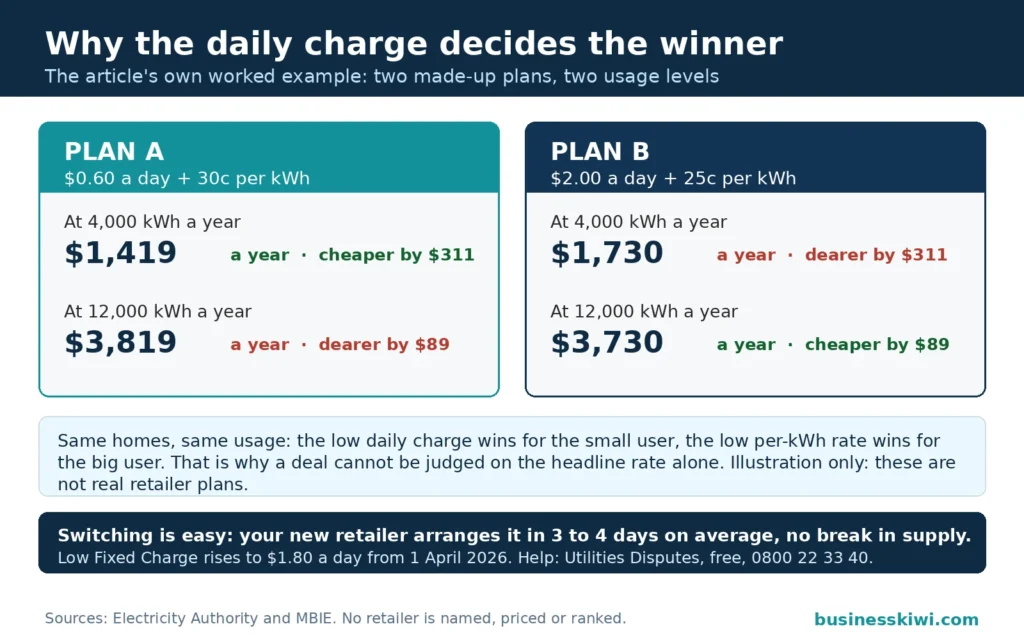
Imagine two plans, both GST-inclusive. Plan A charges $0.60 a day plus 30 cents per kWh. Plan B charges $2.00 a day plus 25 cents per kWh.
A household using 4,000 kWh a year would pay $219 in fixed charges plus $1,200 in usage on Plan A, a total of $1,419. On Plan B the same household pays $730 fixed plus $1,000 usage: $1,730. Plan A wins by $311.
Now run a household using 12,000 kWh a year. Plan A: $219 plus $3,600, total $3,819. Plan B: $730 plus $3,000, total $3,730. Plan B wins by $89, despite a daily charge more than three times higher.
Same two plans, opposite answers, and the only thing that changed was usage. That is why a headline unit rate tells you so little, and why a neighbour’s recommendation may be worthless for your home. Apply your discounts only after this base calculation, and only the ones you will actually earn.
Once you have a shortlist, test it on the Electricity Authority’s free comparison website, Billy, which lets you upload a power bill or answer questions about your use and compare deals on that basis. The Authority also part-funds Powerswitch, the long-running comparison service run by Consumer NZ, which ranks offers by annual cost for your location and usage. One timing note: from 30 October 2026, bills must be clearer and more consistent across retailers, and retailers should provide a better plan assessment, which should make this exercise easier.

Switching providers, step by step
The administrative side is simpler than most people expect, because the system was built for it. Every connection has an ICP number on a national registry, and switching simply updates which retailer is responsible for yours.
Step 1: Check your current contract. Find your term end date, whether a break fee applies and how it is calculated, whether your power is bundled with broadband or gas (and what leaving means for those services), and whether you paid a bond. If a break fee applies, ask your current company whether they will offer a better deal before you commit elsewhere; the Authority suggests exactly that conversation.
Step 2: Sign up with the new company. Online, by phone or in person: give them your address and ICP number (it is on your current bill) and they take it from there. If the sign-up came to you, through a door knock or a cold call, treat it as an uninvited direct sale. Consumer Protection advises you can cancel within five working days for a full refund, so use that window to check the deal with a cool head.
Step 3: The new company arranges the transfer. You do not need to ring your old company to disconnect, have anyone visit, or have your meter changed (unless you are getting a smart meter installed as part of the move). The Authority says a switch takes 3 to 4 days on average; its comparison work notes retailers have up to 10 business days to action an agreed switch, so allow for that outer limit.
Step 4: Your supply continues as normal. Nothing physical changes. The same lines bring the same electricity to the same meter; only the company billing you is different. There is no gap in supply because of a switch.
Step 5: Settle up with the old company. Your old retailer closes your account and sends a final bill covering usage up to the switch date, based on your meter data. Check it, pay it, and only then cancel any direct debit you had with them, so the final payment is not missed. If you paid a bond, confirm when it comes back.
Your rights, and where to go when something goes wrong
Since 1 April 2025, every power company has had to follow the Electricity Authority’s Consumer Care Obligations. These are binding rules, not aspirations. Under them, your power company must treat you with respect and communicate clearly, publish an easy-to-find consumer care policy, and work with you to keep your supply connected and affordable, including advice on energy use, suitable pricing plans and payment options. Fees must be reasonable and reflect actual costs, and retailers must be clear about discounts and bonds. If you tell your company you are having trouble paying, they must help: the required steps include reminding you about overdue amounts, offering a payment support plan if you cannot pay, and trying to contact you at least three times in a week, all before disconnection for non-payment can even be considered. Households where someone relies on electricity for medical reasons get specific protections, including registration as a medically dependent consumer.
If something does go wrong, complain to your power company first and keep a record. If they cannot sort it, Utilities Disputes is the free, independent dispute resolution service for electricity complaints. It can help you put your complaint in writing, works with you and the company to resolve it, and covers complaints about the Consumer Care Obligations as well. You can reach it on 0800 22 33 40. Separately, if you believe your company has breached the Consumer Care Obligations, the Authority monitors and enforces compliance, and you can raise a concern with the Authority once you have contacted the company.
A short note for businesses
Business electricity is usually bought differently. Commercial supply is commonly arranged through negotiated contracts with agreed pricing and terms, rather than picked from published household plans, so the comparison that matters is contract against contract: rates, term, renewal wording and termination clauses. Smaller businesses are not entirely outside the consumer framework, though. The Authority’s billing guidance extends some protections to small business consumers, including limits on how far back a retailer can reach with a back bill for an undercharged amount. Whatever your size, the switching mechanics are the same registry-based process: know your contract end date and exit costs before you sign anything new.
Frequently asked questions
Is it free to switch power companies?
There is no charge for the transfer itself: your new company arranges it. The costs to watch are indirect ones. Leaving a fixed term contract early can trigger a break fee, and if a new plan needs a smart meter installed, the Authority notes there may be a cost for that. Check both before you sign.
How long does switching power companies take?
The Electricity Authority says 3 to 4 days on average. Its comparison and switching work notes that a retailer has up to 10 business days to action an agreed switch, so a complicated switch can take longer than the average without anything being wrong.
What is a break fee, and can my power company charge whatever it likes?
A break fee (or early termination fee) is a charge for leaving a fixed term contract before the end date. It has to be in your contract to apply at all, and under the Consumer Care Obligations the fees power companies charge must be reasonable and reflect actual costs. Ask your company how the fee is calculated, and whether they will offer you a better deal instead; the Authority recommends that conversation before you switch.
Am I a low user or a standard user, and does it still matter?
Traditionally, a low user was a household using under 8,000 kWh a year (9,000 kWh in the lower South Island), on a plan with a lower daily charge and higher unit rate; standard users paid the reverse. It matters less each year: the regulated cap on low fixed charges reaches $1.80 a day (excluding GST) from 1 April 2026, and the regulations disappear on 1 April 2027. Rather than trusting the label, compare the total cost of each plan against your annual usage.
Will my power be cut off at any point while I switch?
No. Switching changes which company bills you; it does not touch your physical supply, your lines or your meter. Your electricity keeps flowing throughout, and your old company simply sends a final bill for usage up to the switch date.
Sources
- Electricity Authority, Compare and switch to save, ea.govt.nz
- Electricity Authority, Your power bill, ea.govt.nz
- Electricity Authority, Consumer Care Obligations, ea.govt.nz
- Electricity Authority, If you’re finding it hard to pay your bill, ea.govt.nz
- Electricity Authority, Options to support consumer plan comparison and switching, ea.govt.nz
- Ministry of Business, Innovation and Employment, Mid-point review of the phase-out of the Low Fixed Charge Regulations, mbie.govt.nz
- Ministry of Business, Innovation and Employment, Electricity Price Review recommendations, mbie.govt.nz
- Consumer Protection, Contracts and sales agreements, consumerprotection.govt.nz
- Utilities Disputes, utilitiesdisputes.co.nz
Disclaimer
This article is general information about how residential power deals and switching work in New Zealand. It is not financial advice, and it does not recommend any particular retailer or plan. Prices, plans and discount conditions change frequently, and contract terms differ between retailers, so check the current terms with the retailer before you sign up or switch.
More guides for households and business owners are in our Business & Industry hub.