Kindergartens in New Plymouth: Enrolment, Fees and the Whānau Manaaki Network Explained
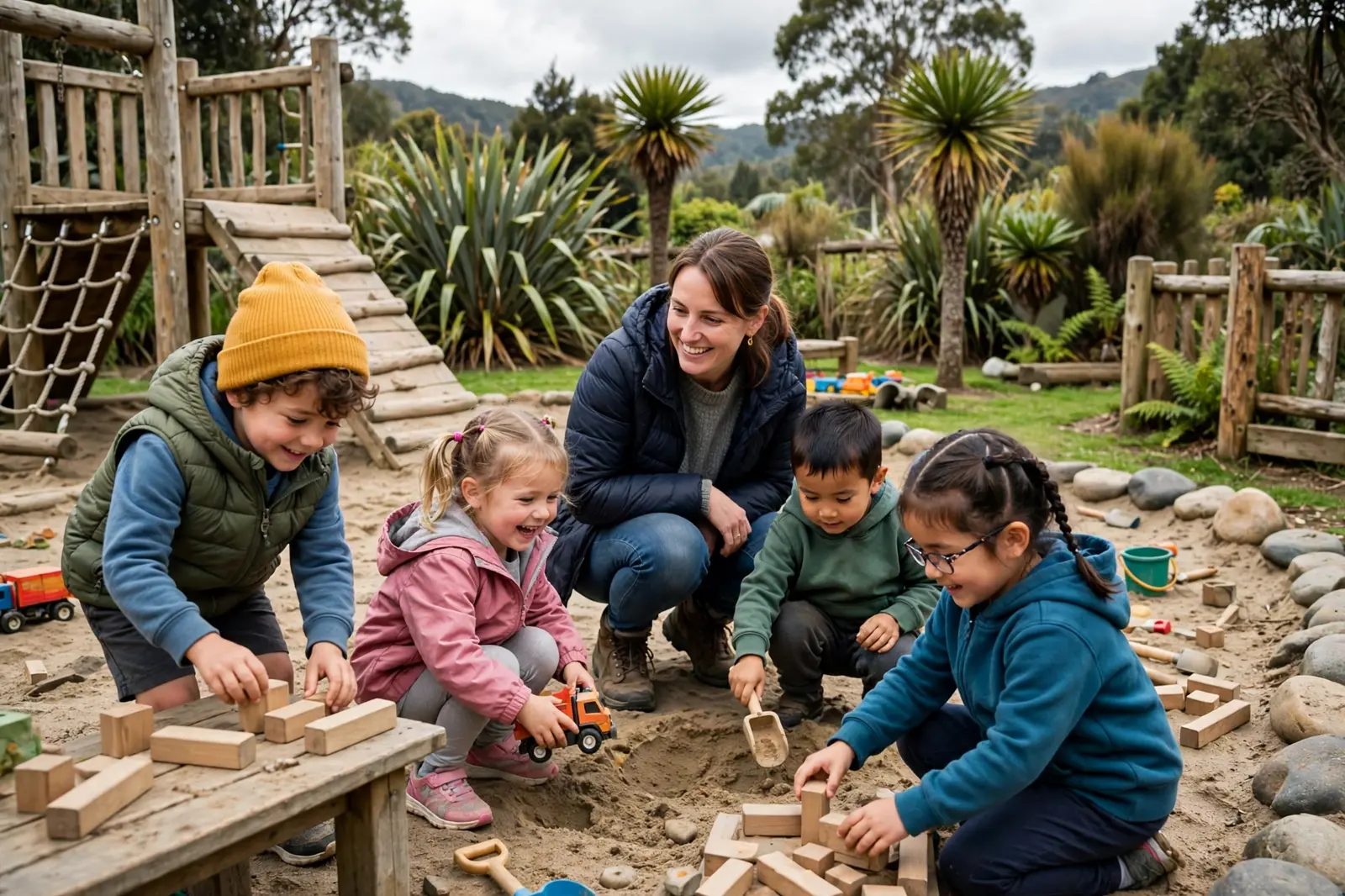
If you search for a kindergarten in New Plymouth, you will not find one big service with that name. What the city has instead is a network. Sixteen kindergartens spread across the New Plymouth District, from Bell Block and Waitara in the north to Ōakura and Koru on the coast road, are all run by a single community association. Until March 2026 that association was Kindergarten Taranaki. The kindergartens now sit inside Whānau Manaaki Kindergartens, one of the largest kindergarten associations in the country, after local members voted to merge the two organisations.
That structure matters for parents, because almost everything practical flows from it. The same enrolment policy, the same fees policy and the same waiting list rules apply at every kindergarten in the network, while each kindergarten still runs its own programme shaped by its own community. This guide pulls together what the Ministry of Education directory and the association itself publish: which kindergartens there are, who runs them, how enrolment and waiting lists work, what it costs after 20 Hours ECE, and how quality is checked. Where the official record does not publish a detail, such as session times for an individual kindergarten, the guide says so rather than guessing.
The sixteen kindergartens of the New Plymouth District
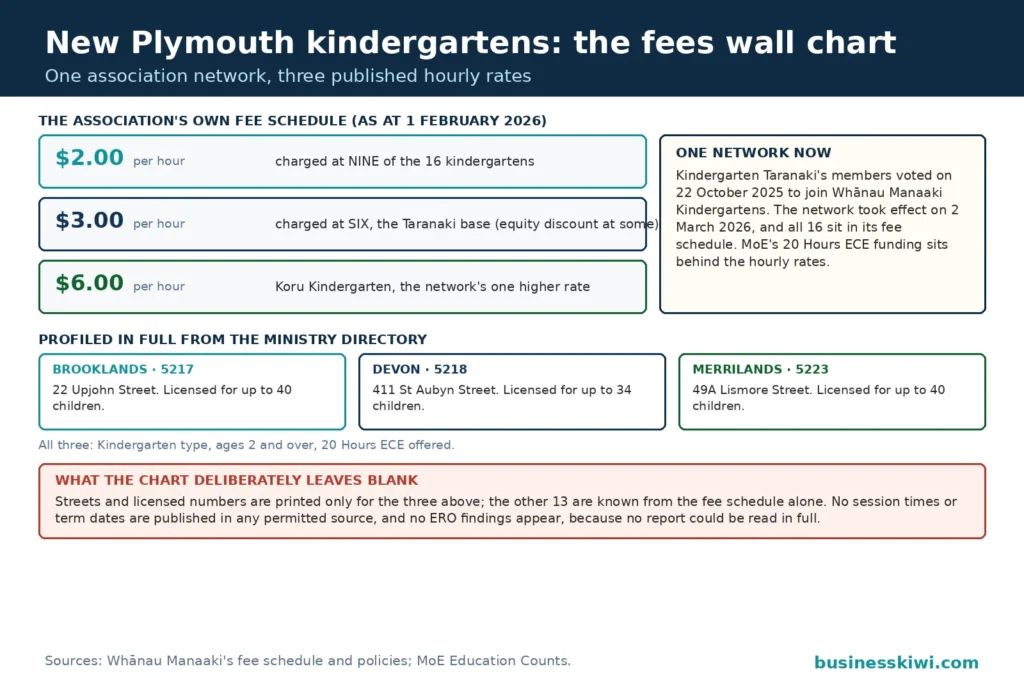
The association’s current fees schedule, dated 1 February 2026, lists twenty-four kindergartens across Taranaki. Sixteen of them are in the New Plymouth District: twelve in and around the city itself, plus Inglewood, Waitara Central, Kaitake at Ōakura, and Koru. The full list is below, with the hourly fee the association charges at each one for hours that are not covered by an attested 20 Hours ECE claim. Fees are explained properly in the costs section further down.
Every one of these services is licensed under the service type the Ministry of Education calls Kindergarten, which is a specific licence category, not just a word in a name. That distinction catches some families out. A service can carry kindergarten in its name and still hold a different licence: The Redwoods Country Kindergarten in Hurdon, for example, is listed in the Ministry directory as an Education and Care service, and it is not part of the association network covered here.
The directory profiles the Ministry publishes for the network’s kindergartens follow a consistent pattern. Three examples, read in full for this guide, show the shape of it. Brooklands Kindergarten (institution number 5217) is at 22 Upjohn Street and is licensed for a maximum of 40 children. Devon Kindergarten (5218) is at 411 St Aubyn Street and is licensed for up to 34 children. Merrilands Kindergarten (5223) is at 49A Lismore Street in Merrilands and is licensed for up to 40 children. On each profile the service type is Kindergarten, the age field records that the service provides for two-year-olds and over only, there are no places for children under two, and each one offers 20 Hours ECE. The remaining kindergartens in the table are listed in the same directory under the same service type, and each has its own profile there with its own address and licensed maximum.
Who runs them: from Kindergarten Taranaki to Whānau Manaaki
For decades the city’s kindergartens were run by the local association, Kindergarten Taranaki, which described itself as the largest early childhood provider and the largest employer of early childhood teachers in Taranaki. That changed recently, and parents researching kindergartens will still come across the old name everywhere, including in the Ministry directory, where the contact emails and website on the profiles still point to Kindergarten Taranaki. The old web address now takes you to the Whānau Manaaki site.
The two associations spent about eighteen months working through a merger before putting it to a vote. At a special general meeting on 22 October 2025, Kindergarten Taranaki members voted in favour, and Kindergarten Taranaki officially joined Whānau Manaaki on 2 March 2026. The kindergartens themselves, their teachers and their communities carried on; what changed is the organisation behind them.
Whānau Manaaki’s full legal name is He Whānau Manaaki o Tararua Free Kindergarten Association Incorporated. It was formed in 2014 when the Rimutaka and Wellington kindergarten associations merged, and the Whanganui, South Otago and Taranaki associations have joined since. It is a non-profit incorporated society, and it provides administration, management and property support to more than 100 kindergartens, supporting over 800 teaching staff and educators, with around 5,000 children enrolled. Its stated vision is to be a respected leader in early childhood education and a strong advocate for children and families.
One feature of the structure surprises many parents. When you enrol a child at one of these kindergartens, you are joining an association, not just a service. Parents and caregivers of enrolled children are ordinary members of the society unless they choose to opt out on the enrolment form. Membership carries voting rights at general meetings and makes you eligible to stand for the association’s governance board, which is an elected mix of parent and staff representatives that sets policy and strategic direction. It is a genuinely community-owned model, and it is part of why the merger needed a member vote rather than a boardroom decision.
What kindergarten is, and how these kindergartens teach
Kindergarten in New Zealand is teacher-led early childhood education for the years before school. Whānau Manaaki states that its kindergartens are staffed by 100 percent qualified and registered kindergarten teachers, supported by trained educators, and that commitment to fully qualified teachers is one of the things the kindergarten movement has historically set itself apart on.
The teaching follows Te Whāriki, New Zealand’s early childhood curriculum. Within that shared framework, the association is clear that there is no single network-wide programme handed down from head office. Each kindergarten builds its own individual programme around the interests of its own community, so the kindergarten in Marfell and the kindergarten in Fitzroy will feel different from each other in the detail of their days, even though the enrolment rules, fees approach and curriculum framework behind them are the same. The association describes the aim as giving children a strong start to their formal education in a caring community environment, with learning, connection and enjoyment sitting together.
For parents comparing options, the practical reading of this is simple. Choose the kindergarten on the things that genuinely differ: where it is, how its programme and environment feel when you visit, and how its sessions fit your family. The policy settings behind the scenes will be identical whichever one you pick.
Ages, licences and group sizes
The Ministry directory records the network’s kindergartens as providing for children aged two and over, with no licensed places for children under two. In practice that makes kindergarten a two-to-school-age service: most children start somewhere between two and four, and leave when they start school at five. The maximum children figure on a directory profile is the maximum number of licensed child places, meaning the largest group the service is allowed to have at one time under its licence. On the profiles verified for this guide those maxima were 40 places at Brooklands, 34 at Devon and 40 at Merrilands, which gives a fair sense of the scale of these services. They are neighbourhood-sized kindergartens, not large centres.
Koru Kindergarten is the exception parents may notice in the table. Its hourly fee, $6.00, is double the Taranaki base rate, and the association sets it apart in its own schedule. If you are considering Koru, ask the kindergarten directly how its programme and charges work, because it does not follow the standard pattern of the other fifteen.
Session times and term dates are set by each kindergarten rather than published in one place for the whole network, and they are not stated in the association’s policy documents. The honest position is that you confirm the session pattern, opening hours and term dates with the kindergarten itself when you register your interest. What the fees policy does confirm at network level is that kindergartens close on public holidays and for closures such as teacher only days, and no fees are charged for those days.

How enrolment and waiting lists work
Enrolment across the network follows one association policy, updated in July 2026, and its starting point is inclusive: every eligible child has the right to enrol, and no child is to be excluded from enrolment at any Whānau Manaaki service.
The process begins with registering your interest, which you can do through the association’s website or directly with the kindergarten. The kindergarten then gets in touch to talk through the next steps. Each kindergarten’s head teacher is responsible for its roll and its waiting list, and places are generally offered in age order, oldest to youngest. Age order is the default rather than the whole story. The policy lists other factors a head teacher may weigh when deciding the order of admission: keeping numbers within the licence, the needs or circumstances of the family, any special education or development needs the child has, whether siblings or other whānau members attend, any previous or current attendance at another kindergarten or early childhood service, and whether the family lives locally where a kindergarten operates a zone. Families can register or enrol at more than one kindergarten, although the policy asks you to tell each head teacher that you have done so, and the association can limit multiple registrations in a particular community if it decides that is needed.
A few administrative points are worth knowing before you start. An enrolment form must be completed before your child can start, and completing it is also where the funding paperwork happens, including the attestation that sets out which hours you are claiming as 20 Hours ECE. Not having a birth certificate or passport does not stop you enrolling. When a place is confirmed, the kindergarten works through an induction with you. The standard induction pack covers the fees policy, a media consent form, the sleep policy, Ministry of Health guidance on reducing food-related choking, and the membership information sheet that explains your place in the association. Teachers are also required to point parents to the service’s operational documents, including its philosophy, its policies and its most recent Education Review Office report, and to explain how parents can be involved in the service.
Attendance is not a formality in this system. The association is a not-for-profit whose funding comes mostly from the Ministry of Education, and that funding depends on enrolled children actually attending. That is why kindergartens follow up absences, and it is also why the fees policy treats long absences seriously, as the next section explains.
What it costs: 20 Hours ECE and the association’s fees
Start with the government scheme, because it does most of the work. Under 20 Hours ECE, every child aged three, four or five is eligible for up to 20 hours of early childhood education a week at a participating service, funded by the Ministry of Education. The limits are up to six hours in any one day and twenty hours across the week. A service cannot charge you fees for hours you have signed up to receive as 20 Hours ECE. You claim the hours on your enrolment form, and you can split them between two services if your child attends more than one, as long as the daily and weekly totals are not exceeded. The Ministry also draws a clear line around extra payments: donations are voluntary, a service cannot require one or describe it as a fee, and optional charges for specific extras are only payable if you agreed to them when you enrolled.
Whānau Manaaki’s own fees policy, effective from February 2026, builds on that scheme in two ways that matter for New Plymouth families. First, the association offers the 20 Hours ECE entitlement to all children enrolled in its kindergartens, up to the same maximums of six hours a day and twenty hours a week. Second, its website states plainly that all of its kindergartens offer fees free for two-year-olds, which extends free hours below the age the government scheme starts. For a three, four or five-year-old attending within the entitlement and with the attestation form signed, kindergarten in this network can genuinely cost nothing in fees.
Fees enter the picture for hours that sit outside an attested 20 Hours ECE claim. The association charges those hours per hour, at a rate set for each kindergarten in its fees schedule. Across Taranaki the base rate is $3.00 an hour. Where a kindergarten receives Ministry equity funding, a discount of $1.00 an hour applies, which is why most New Plymouth District kindergartens in the table charge $2.00 an hour: Bell Block, Brooklands, Devon, Marfell, Merrilands, Ngamotu, Puketapu, Waitara Central and Westown. Fitzroy, Frankleigh Park, Inglewood, Kahikatea, Kaitake and Pukekura charge $3.00 an hour, and Koru charges $6.00 an hour. Those are the rates as at 1 February 2026. If your child attends more hours than you have attested, you are charged for the unattested hours until an updated attestation is in place, so keeping the form current is worth doing.
The rest of the fees rules are unusually family-friendly, and they are worth knowing. Fees are payable weekly in arrears. The association must give at least two months’ written notice of any change to fees, and all fees collected are pooled across its services rather than kept by the individual kindergarten. No fees are charged on public holidays or on closure days such as teacher only days. If your family receives a Work and Income Childcare Subsidy or an Early Learning Payment, you remain responsible for any shortfall between the subsidy and the fee. If fees fall behind, the policy is explicit that unpaid fees are never sent to debt collectors, and families are encouraged to talk to their head teacher so a solution can be worked out; the chief executive can waive or write off fee debt. The one hard edge is absence: if a family asks for an absence of more than three weeks, the child gives up their place and goes back on the waiting list until a place is available again, although the policy makes an exception where vulnerable children are concerned.
Quality checks: licensing and ERO reviews
Every service in the network is a licensed early childhood service, and licensing is what sets the maximum group sizes described earlier. On top of licensing sits the Education Review Office, which reviews early childhood services on average once every three years. Each service’s Ministry directory profile links through to its Education Review Office report, and kindergartens are required to tell parents where to find that report and how to be involved in the service. This guide has not summarised individual review findings: reports differ from kindergarten to kindergarten and from cycle to cycle, and the useful step for a parent is to open the current report for the specific kindergarten you are considering, from its directory profile, and read what reviewers found most recently. If you are weighing up two kindergartens, their reports are the most like-for-like official comparison available.
Practical points to settle before your child starts
Because session times are set kindergarten by kindergarten, there are a handful of questions the official sources leave for you to ask directly, and asking them early saves surprises later. Confirm the session times and the days on offer, and whether the kindergarten runs through school holidays or closes, since practice varies across the wider association. Ask what your child needs to bring each day, and how settling-in visits work, because the induction process is designed to handle exactly those conversations. Check how the waiting list is looking for your child’s age, and register your interest in good time, since places are offered mainly in age order and popular kindergartens fill their rolls. If your child will attend more hours than the funded entitlement, ask for the hourly charge in writing and make sure your attestation form matches the hours you actually use. And if cost is tight, raise it with the head teacher at the start. The fees policy is built around keeping children attending, and the association would rather make an arrangement than lose a family over an unpaid bill.
Frequently asked questions
Is there a single main kindergarten in New Plymouth?
No. There is no one service called Kindergarten New Plymouth. The city’s kindergartens are sixteen separate neighbourhood kindergartens across the New Plymouth District, all run by one association, Whānau Manaaki Kindergartens, under the same enrolment and fees policies.
Who runs the kindergartens in New Plymouth now?
Whānau Manaaki Kindergartens, a non-profit incorporated society whose full name is He Whānau Manaaki o Tararua Free Kindergarten Association Incorporated. The local association, Kindergarten Taranaki, merged into it on 2 March 2026 after members voted in favour at a special general meeting on 22 October 2025.
What age can my child start kindergarten?
The Ministry of Education directory lists these kindergartens as providing for children aged two and over, with no places for under-twos. Government 20 Hours ECE funding begins at age three, and the association states that all of its kindergartens offer fees free for two-year-olds.
How much does kindergarten cost in New Plymouth?
For three, four and five-year-olds, up to 20 hours a week is funded under 20 Hours ECE, with no fees chargeable for those hours. Hours outside an attested claim are charged per hour at the rate set for each kindergarten: $2.00 an hour at nine of the district’s kindergartens, $3.00 at six of them, and $6.00 at Koru, as at 1 February 2026.
How do waiting lists work?
Each kindergarten’s head teacher keeps its waiting list, and children are generally admitted in age order, oldest first. Head teachers can also consider licence limits, family circumstances, a child’s additional needs, siblings attending, and previous attendance. You register your interest through the association’s website or at the kindergarten itself.
Can I put my child’s name down at more than one kindergarten?
Yes. The association’s enrolment policy allows families to register or enrol at more than one kindergarten, as long as each head teacher is told. The association can limit multiple registrations within a particular community if it decides that is necessary.
What happens if we need a long holiday or cannot pay the fees?
An absence of more than three weeks means giving up the place and rejoining the waiting list, with an exception for vulnerable children. On fees, the association never sends unpaid fees to debt collectors, gives at least two months’ written notice of fee changes, and expects families in difficulty to talk to the head teacher so an arrangement can be made.
How can I check the quality of a particular kindergarten?
Open the kindergarten’s profile in the Ministry of Education’s Education Counts directory and follow the link to its Education Review Office report. Early childhood services are reviewed on average once every three years, and the kindergarten must be able to tell you where to find its report and its other operational documents.
Sources
- Ministry of Education, Education Counts directory: profiles and contact details for Brooklands Kindergarten (5217), Devon Kindergarten (5218) and Merrilands Kindergarten (5223), and the directory’s definitions for licensed child places, 20 Hours ECE and Education Review Office reports
- Ministry of Education (education.govt.nz): 20 hours funding for early childhood education, covering the 20 Hours ECE scheme, donations, optional charges and the Work and Income Childcare Subsidy
- Whānau Manaaki Kindergartens (wmkindergartens.org.nz): Fees Policy and Kindergarten Fees Rates as at 1 February 2026, including the Taranaki schedule
- Whānau Manaaki Kindergartens: Enrolment and Admission, Induction and Parent and Whānau Engagement Policy, effective July 2026, including the Becoming a Member information sheet
- Whānau Manaaki Kindergartens: Parent Information page and Register your Interest information
- Whānau Manaaki Kindergartens: Our Structure page and homepage, covering the association’s history, scale and teaching commitments
- Kindergarten Taranaki: merger information page recording the 22 October 2025 vote and the 2 March 2026 joining date
This article is general information about kindergarten provision in New Plymouth, based on official sources published by the Ministry of Education and the kindergarten association, and fees and policies can change. It is not advice about an individual child’s enrolment. Before enrolling, confirm session times, current fees and waiting list position with the kindergarten you are considering.