Flanshaw Road School, Te Atatu South: A Parent Guide to Enrolment, the Zone and Starting School

Flanshaw Road School is the state primary school on Flanshaw Road in Te Atatu South, West Auckland. It teaches children from their fifth birthday through to Year 6, organises them into four Māori-named teams, and runs one of the longer-standing kapa haka and enviro programmes in the area. This guide brings together what the school itself publishes for parents: how enrolment works, what the zone position actually is, how starting school is handled, the shape of the school day, and the practical costs and arrangements around uniform, stationery and donations.
One honesty note before the detail. Some of the standard facts directories carry for this school could not be verified from the official profile when this guide was researched, and where that is the case the guide says so rather than filling the gap from other websites.
Flanshaw Road School at a glance
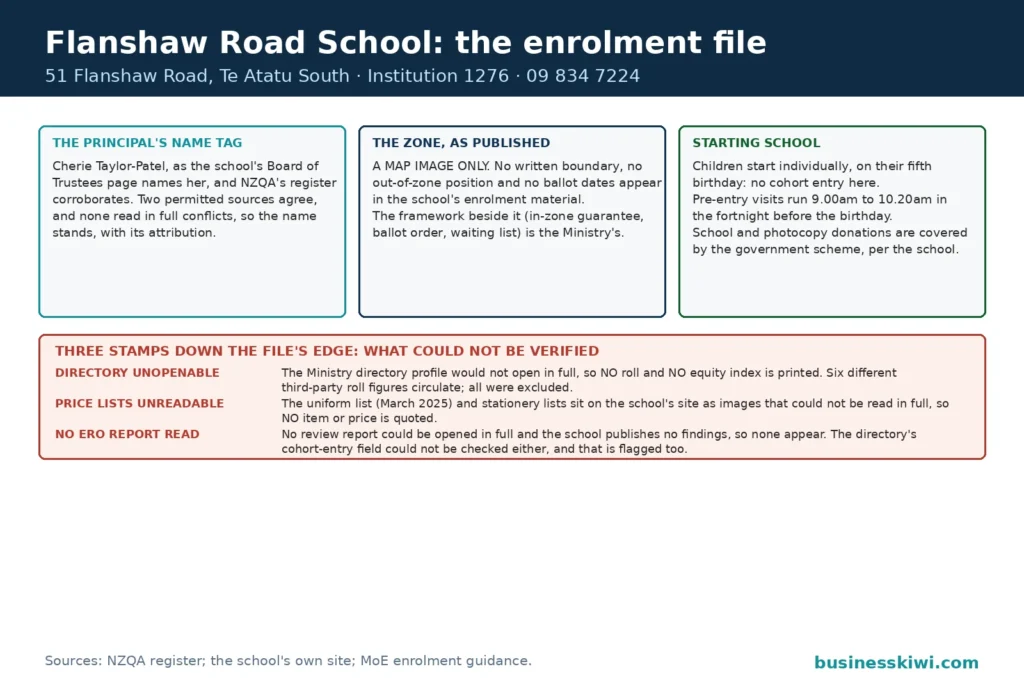
Two standard directory fields are deliberately missing from that table. The school’s Education Counts profile, the Ministry of Education directory page that normally publishes a roll and an Equity Index (EQI) value, could not be opened in full while this guide was being researched, despite repeated attempts. Because of that, this guide publishes no roll figure and no EQI for Flanshaw Road School. Roll numbers for this school appear on third-party websites, but they disagree with each other and none could be checked against the directory itself, so none is used here. For the same reason, the directory’s cohort entry field could not be checked. What the school itself says about starting school is set out in the starting school section below, and it describes children starting individually rather than in cohorts.
Where the school sits and the community it serves
The school stands at 51 Flanshaw Road in Te Atatu South, in West Auckland. Its principal’s welcome message, published on the school’s own site, describes a vibrant, diverse and innovative learning community, and the welcome is offered in the languages of that community: te reo Māori, Samoan, Tongan, Cook Islands Māori, Niuean, Fijian, Croatian, Korean, Hindi and English. The school’s vision, published on its homepage, is to develop students who are academically strong, culturally centred, socially resilient and physically confident, and who know they can make a difference in the world.
The school’s connection to its local environment is long-running and practical rather than decorative. Its Enviro School page records that the school has been involved in the Waitakere City Twin Streams Project since 2005 and was selected to become an Enviro School in 2009. More on that programme sits in the school life section below.
Vision, mission and values
The school’s mission, as its welcome page puts it, is to work in partnership with its community in nurturing and developing the children in its care, giving students the opportunity to achieve their potential socially, academically, physically and culturally, and to become successful lifelong learners. The welcome describes parents as having an authentic and meaningful role as first teachers in the school years, and students as the leaders of tomorrow.
Five values headline the school’s homepage: Manaakitanga, Ako, Pono, Wananga and Mana motuhake. The school’s core values page expands the set and explains each one in its own words. In summary, Manaakitanga is about working with moral purpose and being responsible, reliable and responsive to learners’ needs. Ako is students, staff and whānau learning together, with and from each other. Mana motuhake is shared aspirations and high expectations. Wananga is creating rich interactions and building new knowledge together. Pono is self-belief and resilience. The page adds Awhinatanga (guiding and supporting, with respect and empathy), Nga Whakapiringatanga (an environment that optimises achievement), Kotahitanga (unity, celebrating diversity and inclusiveness), Rangatiratanga (partnership with the Māori community through the principles of the Treaty of Waitangi), Kaupapa Ako (learning for sustainability) and Iwi Whanui (community partnership with parents). The page sums the whole set up with one line: students being at the heart of all we do.

Enrolment and the school zone
Flanshaw Road School has an enrolment zone. The school’s enrolment page publishes the zone as a map image that parents can click to enlarge. That is all the page publishes about the zone in readable form: there is no written street-by-street boundary description on the page, and no statement of the school’s out-of-zone position, application dates or ballot arrangements anywhere in the enrolment material read for this guide. Families who need the boundary in writing should use the Ministry of Education’s Find a School service, which carries each scheme’s map and written description, or ask the school office.
What can be stated confidently is the general framework the Ministry of Education publishes for all state school enrolment schemes, from its own enrolment schemes FAQ for parents. A child living inside a school’s home zone is guaranteed a place at that school. A child living outside the zone can apply only where the school has places available. The school must advertise the availability of places and the application process, including dates. If there are more applicants than places, places are allocated by ballot, worked through in a fixed order of priority published by the Ministry: first, students accepted into a special programme run by the school; second, siblings of current students; third, siblings of former students; fourth, children of former students; fifth, children of board employees and children of board members; and sixth, all other students. Applicants who miss out in a ballot go on a waiting list and are told their place on it. Schools may require proof of residence, such as a tenancy agreement or utility bill, and an enrolment can be refused or annulled if false information is given.
So the honest position for Flanshaw Road School is this. In-zone children have a guaranteed place under the standard rules. Out-of-zone families need to ask the school directly whether places are being offered in a given year, because the school does not publish that information on the enrolment page read for this guide.

Starting school at five
The school encourages pre-enrolment, so it can predict staffing and resourcing needs. Families on the pre-enrolment roll receive a letter inviting them and their child to visit the school before enrolment, which is also a chance to discuss the child, their medical history and any family circumstances the school should know about.
Pre-entry visits are usually arranged within the two weeks before a child starts. The visits generally run from 9.00am to 10.20am, so the child can become familiar with classroom routines, and a parent or caregiver stays with the child during them. On a visit, families are given a starter pack from the school office containing enrolment material and a stationery list. Stationery can be bought through the school office, and the school asks that it is ready for the child’s first day.
Children can start at Flanshaw Road School from the day they turn five. That is individual, fifth-birthday entry, and it matches what the school’s enrolment page describes throughout: a start date tied to the child’s own birthday, preceded by visits in the fortnight before. The Ministry directory keeps a cohort entry field for every school, and as noted beside the table above, that field could not be checked for this school. Nothing on the school’s own pages describes cohort entry dates or grouped intakes, so parents should plan around the fifth-birthday start the school itself describes, and confirm timing with the office when they pre-enrol.
Enrolment itself is completed at the office. Enrolment forms can be downloaded from the school’s site, printed and filled in before coming in, and the office also holds the forms. The office staff will ask to photocopy the child’s birth certificate and immunisation certificate, and the office must hold a copy of the birth certificate before the child can start. Once the paperwork is done, the child is shown to their classroom, and parents are welcome to stay while their child settles in. The forms pack on the enrolment page includes parental agreements on images and work, internet use and digital agreements for home and school, a questionnaire for new families, a transport van permission slip and the school code of conduct.
The school day
Classrooms open each morning at 8.30am, and the office is staffed from 8.30am until 3.45pm. The day itself runs as follows.
- 8.55am to 10.20am: lessons
- 10.20am to 10.55am: morning tea
- 10.55am to 12.40pm: lessons
- 12.40pm to 12.50pm: children eat lunch with teacher supervision
- 12.50pm to 1.30pm: lunch break
- 1.30pm to 3.00pm: lessons
Children who arrive late need to report to the office for a green late slip. The school’s hours page pairs the timetable with a plain request: make sure your child has a good night’s sleep and is on time. No lunch ordering service is described on the school’s site pages read for this guide, and lunch is eaten together under teacher supervision in the middle of the day.
Term dates
The school publishes its term dates a year at a time. The 2026 dates on its term dates page are:
- Term One: Monday 2 February to Thursday 2 April. Waitangi Day falls on Friday 6 February, and Easter falls in the first weekend of the holidays that year.
- Term Two: Monday 20 April to Friday 3 July. ANZAC Day falls on Saturday 25 April and is observed on Monday 27 April; King’s Birthday is Monday 1 June; Matariki is Friday 10 July, in the holidays.
- Term Three: Monday 20 July to Friday 25 September, with no public holidays listed.
- Term Four: Monday 12 October to Wednesday 16 December. Labour Day is Monday 26 October.
The school’s homepage also flags the practical detail that goes with the Term Four start: children need to bring a sun hat from 12 October.
Learning at Flanshaw Road School
Children are grouped in four teams that carry through the parent information on the site. Kakano covers Year 0 and Year 1, Pihinga covers Year 1 and Year 2, Rerenga covers Year 3 and Year 4, and Te Mahuri covers Year 5 and Year 6. The staff page is organised into a senior leadership team, a teaching team, a learning support team and a support team.
Learning support has its own section on the school’s site, with three named strands. Mutukaroa is the school’s home and school partnership programme for the early years. At Mutukaroa meetings, time is spent explaining what a child can do and what they need to learn next, and families are given activities and games to support learning at home. The school describes these learning conversations and resources as very positively received, and names Maggie Reid as the Mutukaroa co-ordinator. The ESOL programme supports children for whom English is a second language, with activities in class and in small group sessions with specialist learning support staff, targeted at oral and written language skills, alongside full participation in academic, sporting and cultural activities. The library is the third strand: classes visit through the week, students can read or play library games there at lunchtimes, and Ashton Scholastic Book Club orders run through the year. The library page states the aim plainly: students becoming lifelong readers.
Culture and the wider life of the school
Kapa haka is the school’s flagship cultural programme, and it has serious history. The school’s kapa haka page records that the group began in 1989 and in any given year has over 100 members, drawn from Year 1 to Year 6. Students meet for an hour each week to learn aspects of Māori tradition, culture and language from a team of teachers and parents. Students with a passion and talent for kapa haka are invited into the performance group, which leads the whole-school pōwhiri held each term and performs at events in the wider community. A highlight of the school year is the Māori kapa haka and cultural group concerts, held in Term 2. The page also records the Te Whanau Awhiawhi Award, donated by the group’s founder, Whaea Diane Hobby, and displayed in the office area; it is awarded each year to the family who has supported the kapa haka students with the most passion and love. Parents can get information about joining from the office or their child’s teacher.
The enviro programme is the other long thread. The school has been involved in the local Twin Streams Project since 2005, became an Enviro School in 2009 and gained Bronze Award status from the Enviro-Schools Foundation at the end of that year, followed by Silver in 2012 and Green-Gold in 2013. The early projects were student-led: a native plant nature trail, along which every student in the school helped plant over 1000 trees and shrubs on a track created by parents. The student enviro team won an Ecowise Community Award for student leadership in 2010, and the school gained Auckland City Gold status in the Travelwise programme in 2011.
Music has a smaller but concrete place. Group guitar lessons are offered to Year 5 and 6 students during school hours, beginners are welcome, and practice is essential. Each child needs their own guitar, and families register their interest with the school office.
Uniform and stationery
The school has a uniform. The evidence sits across its own pages: the stationery and uniform page links to the school’s uniform price list, and the donations page lists the school uniform among the costs the government donation does not cover. That price list document (dated March 2025) is linked from the school’s site, but the document itself could not be opened in full when this guide was researched, so no uniform items and no prices are quoted here. Parents should read the current price list on the school’s stationery and uniform page, or ask the office, rather than relying on any list reproduced elsewhere.
Stationery is organised by team. The stationery and uniform page publishes a separate list for each of the four teams (Kakano, Pihinga, Rerenga and Te Mahuri), as documents linked from the page. Stationery packs are available at the beginning of the year at what the school describes as a very competitive price, families may buy through other outlets if they wish, and some items are only available from the school office, which is noted on the child’s stationery form. Stationery needs to be purchased and given to the child before the end of the first week back at school. New entrants receive their stationery list in the starter pack at their pre-entry visit.
Donations and payments
The school’s donations page states that the school donation and the photocopy donation are covered by the government, which is the donations scheme position: the school does not ask families for those donations, and the government funding instead covers curriculum resources, photocopying and printing, school trips and school shows. The same page is clear about what the scheme does not cover: overnight stays, school camp, extracurricular activities such as netball, basketball and music courses, school stationery and the school uniform. Those remain costs families should expect to meet.
The donations page wording refers to the 2024 year, so the detail is worth confirming with the office for the current year. What the page does not publish is any donation amount requested from families, and none is stated here. For payments generally, the school publishes that funds can be transferred to the school bank account, with the child’s name and what the payment is for as the reference.
Before and after school care
Before and after school care operates at the school through Kowhai Kids Club, an outside provider whose programme runs in the school. The school’s care page carries the provider’s own description: supervised care on site at the school, enrolments completed online through the provider’s website, and the note that some parents may qualify for Work and Income OSCAR subsidies, with applications available on site and help offered through the process. Families deal with the provider directly for hours, fees and enrolment.
Communication and reporting an absence
The school’s main communication channel is the Skool Loop school app, which the site promotes throughout: parents download the app, choose the school once installed, and use it for notices and absence reporting. Newsletters are published on the site weekly during term time. Absences for today or tomorrow can be reported through the absence form on the site or the absence button in the school app. The office email is office@flanshawroad.school.nz and the phone number is 09 834 7224.
The board and school policies
The school is governed by a Board of Trustees. The board page records that board elections take place every three years, that board meetings are held twice a term, and that the meetings are open, with parents very welcome to attend. The page lists Luke Faesen Kloet as presiding member, Cherie Taylor-Patel as principal, Frances Atwell as staff representative, and Debra Barron, Courtney Armstrong, Shantashri Gokarn and Frances Monro as parent representatives. The board describes its commitment as supporting the principal, teachers, staff, students and parents to provide the best possible education and grow leaders of tomorrow in a supportive, inclusive community.
School policies are held on SchoolDocs, the policy platform many New Zealand schools use; the school’s policies page explains how parents access them and links the school’s Attendance Management Plan and its stepped attendance response procedures.
ERO
The Education Review Office reviews every state school, and Flanshaw Road School’s Education Counts profile links to its ERO report. For this guide, no ERO report document for the school could be opened in full, and the school’s own website does not publish ERO findings on the pages read for this guide. Following the rule this site applies to every school profile, no ERO findings, ratings or judgements are reported here. Parents who want the current picture should read the school’s latest report through its Education Counts profile or on the ERO website, where reports are published in full.
Frequently asked questions
Where is Flanshaw Road School, and what year levels does it teach?
The school is at 51 Flanshaw Road, Te Atatu South, Auckland 0610. It teaches from Year 0 to Year 6, organised into four teams: Kakano (Year 0 and 1), Pihinga (Year 1 and 2), Rerenga (Year 3 and 4) and Te Mahuri (Year 5 and 6).
When can my child start, and how do pre-entry visits work?
Children can start from the day they turn five. The school encourages pre-enrolment, and pre-entry visits are usually arranged in the two weeks before the start date, generally from 9.00am to 10.20am, with a parent or caregiver staying with the child. Families receive a starter pack with enrolment material and a stationery list at the visit.
What documents does the school need before my child starts?
The office will ask to photocopy your child’s birth certificate and immunisation certificate, and it must hold a copy of the birth certificate before your child can start. Enrolment forms can be downloaded and completed in advance, and enrolment is completed at the school office.
Does Flanshaw Road School have an enrolment zone?
Yes. The school publishes its zone as a map on its enrolment page. Children living in zone are guaranteed a place under the Ministry of Education’s enrolment scheme rules. The school does not publish an out-of-zone position or ballot dates on its enrolment page, so out-of-zone families should check the written scheme description on the Ministry’s Find a School service and ask the school office whether places are being offered.
What are the school hours?
Classrooms open at 8.30am, lessons run from 8.55am to 3.00pm, with morning tea from 10.20am to 10.55am and lunch eaten under teacher supervision from 12.40pm before the lunch break to 1.30pm. The office is staffed from 8.30am to 3.45pm. Late arrivals report to the office for a green late slip.
Does the school ask for a donation?
The school’s donations page says the school donation and photocopy donation are covered by the government under the donations scheme, and lists what that funding covers: curriculum resources, photocopying and printing, school trips and shows. It also lists what is not covered, including overnight stays, school camp, extracurricular activities, stationery and uniform. The page wording refers to 2024, so confirm the current position with the office.
Is there a uniform, and where do I find prices?
Yes, the school has a uniform, and its uniform price list is linked from the school’s stationery and uniform page. That document could not be opened in full for this guide, so no items or prices are listed here. Check the price list on the school’s site or ask the office for current items and prices.
What before and after school care is available?
Kowhai Kids Club runs before and after school care at the school. Enrolments are made online with the provider, and the school’s care page notes that some families may qualify for Work and Income OSCAR subsidies.
Sources
- NZQA organisations register entry for Flanshaw Road School, nzqa.govt.nz
- Flanshaw Road School official website: Welcome and About Us pages, flanshawroad.school.nz
- Flanshaw Road School official website: Core Values, flanshawroad.school.nz
- Flanshaw Road School official website: Enrolment, flanshawroad.school.nz
- Flanshaw Road School official website: School Hours, flanshawroad.school.nz
- Flanshaw Road School official website: Term Dates 2026, flanshawroad.school.nz
- Flanshaw Road School official website: School Donation and Payments, flanshawroad.school.nz
- Flanshaw Road School official website: Stationery and Uniform, flanshawroad.school.nz
- Flanshaw Road School official website: Kapa Haka, flanshawroad.school.nz
- Flanshaw Road School official website: Enviro School, flanshawroad.school.nz
- Flanshaw Road School official website: Learning Support pages (Mutukaroa, ESOL Programme, Library), flanshawroad.school.nz
- Flanshaw Road School official website: Group Guitar Lessons, flanshawroad.school.nz
- Flanshaw Road School official website: Before and After School Care, flanshawroad.school.nz
- Flanshaw Road School official website: Board of Trustees and Staff pages, flanshawroad.school.nz
- Flanshaw Road School official website: School Policies, Procedures and Report Absence pages, flanshawroad.school.nz
- Ministry of Education, FAQs about Enrolment Schemes, education.govt.nz
This article is general information about Flanshaw Road School drawn from the school’s own published material and official registers. Enrolment, zone and cost details can change, so confirm anything you are relying on with the school office or on the school’s website before making decisions.