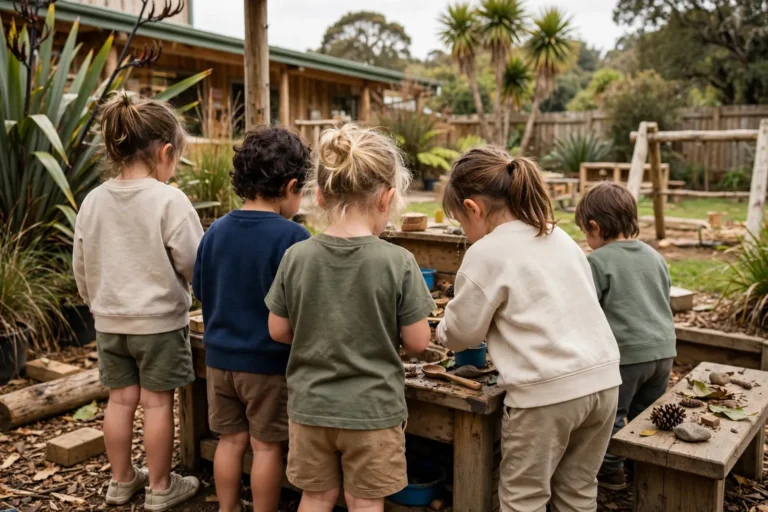
Pohutukawa Preschool in Whakatāne: Fees, Hours and Learning in Kopeopeo
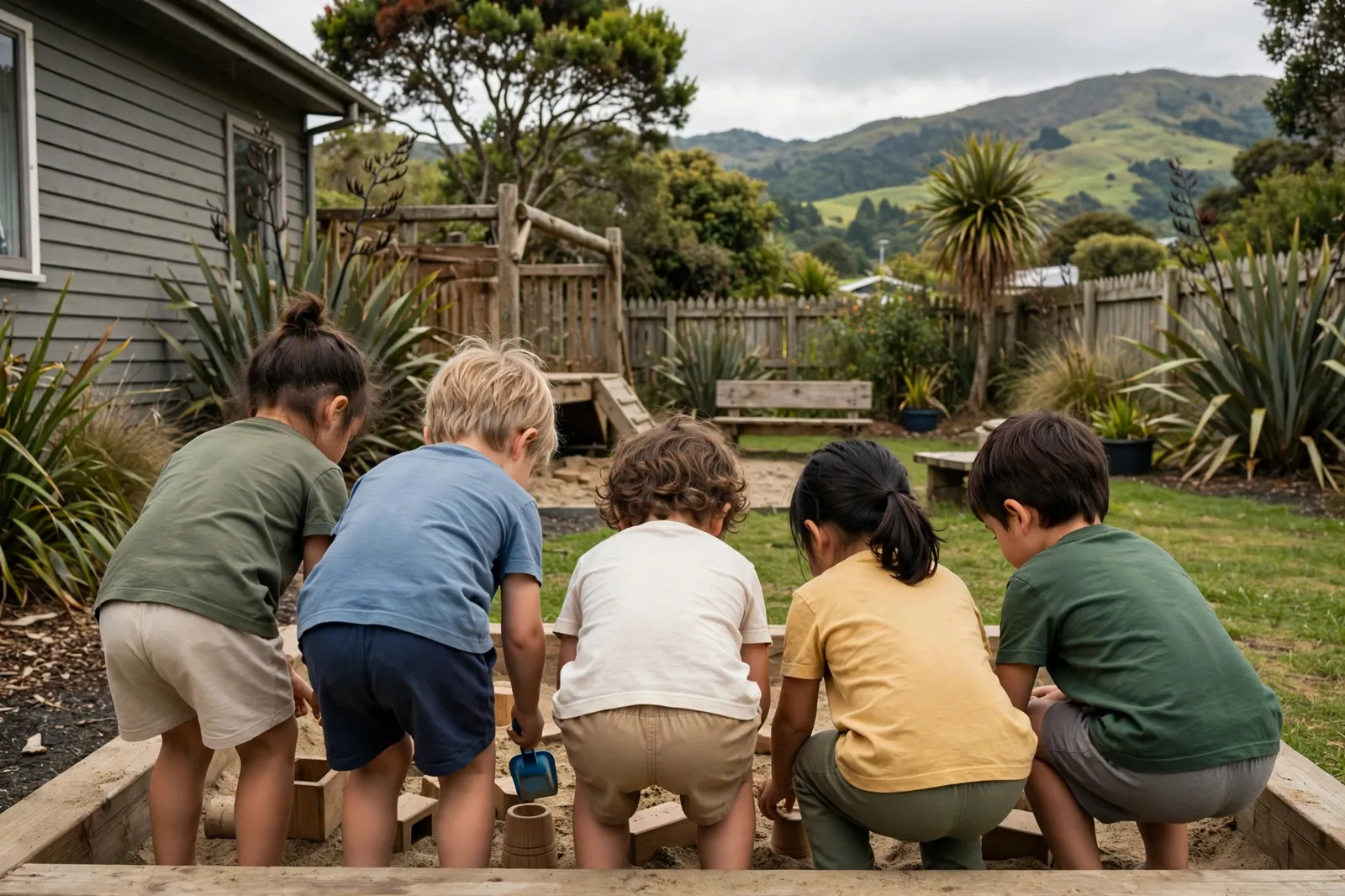
Pohutukawa Preschool is a privately run education and care centre on James Street in Kopeopeo, Whakatāne. It is licensed by the Ministry of Education for up to 75 children at a time, including up to 20 children under two, and it looks after children of all ages, from infants through to children getting ready for school. Its rooms are organised around three stages of early childhood, it provides food, nappies, wipes and sunscreen inside its fees, and it publishes a full fee schedule on its own website, which makes it unusually easy for a family to work out what a week there would cost before they ever pick up the phone.
This profile brings together what the centre itself publishes, on its own website and on its Ministry of Education directory profile. Two limits need saying plainly at the start. The centre’s Education Review Office report could not be retrieved for this research, so no ERO finding or judgement is quoted anywhere below. The Education Counts profile does not publish a current roll figure on the page read for this profile, so no roll is stated either. Everything else traces to pages published by the centre or the Ministry and read in full.
Pohutukawa Preschool at a glance
Where it is, and who runs it
Pohutukawa Preschool sits at 53-55 James Street in Kopeopeo, the suburb on the western side of Whakatāne in the eastern Bay of Plenty. Education Counts lists the service type as education and care, which is the Ministry’s category for centre-based services offering full-day or part-day education and care. The centre describes its premises as purpose built, and says the facilities were designed for the three age groups it teaches.
Ownership is local and hands-on in character. The centre describes itself as 100 percent NZ locally owned and operated, and repeats that line in several places on its website. It is not part of a national chain, and its published material is written for this one centre in this one town. One gap is worth recording for families who like to know who is in charge before they visit: the centre’s own website does not name a centre manager or head teacher anywhere on the pages it publishes. Its contact page lists a first name, Nicole, as a mobile contact, but it does not attach a role or a surname to that name, so this profile does not present her as the manager. Families who want to know who leads the centre day to day can ask when they visit or call.
What the centre does publish about its people is a description of its teaching team. It calls its kaiako professional, loving, passionate and enthusiastic, committed to improving learning outcomes, and it stresses an open door: parents and whānau are encouraged to stay and play. That open-door position appears on its team page, its home page and its commitment page, so it reads as a genuine part of how the centre presents itself rather than a slogan used once.
Three rooms: Teina, Tuakana and Kindy
The centre is organised into three rooms, and the names carry the centre’s philosophy in miniature. The Teina Room is the infant and toddler room. The Tuakana Room serves toddlers and preschoolers. The Kindy Room is the room for the oldest children, and it is where the centre runs its 20 Hours ECE sessions and its focus on transition to school. Teina and tuakana are the Māori terms for a younger sibling and an older sibling, and the centre uses them deliberately: the Teina and Tuakana rooms sit next to each other so siblings can be together, and the centre says it embraces whanaungatanga and tuakana-teina, the idea that children learn and grow together, with older children modelling for younger ones.
Within those two younger rooms, the centre encourages full-day enrolments, and it says why in its own words: to ensure sustained and uninterrupted care and learning. That is a position a family should weigh against their own pattern of work and care, because it interacts with the minimum bookings in the fee schedule, covered below. For the youngest children, the Teina Room is where the under-twos licence matters: Education Counts records the centre as licensed for a maximum of 20 children under two at any one time, within its overall maximum of 75.
The Kindy Room works differently. The centre offers 20 Hours ECE sessions there of four, five and six hours a day, alongside the full-day pattern, and places an emphasis on a bicultural curriculum and on transition to school. A comprehensive transition to school programme is woven into the curriculum for young children, as the centre’s own curriculum page puts it. So the oldest room is where the centre’s school-readiness work concentrates, while the two younger rooms are built around continuity of care.
Hours and the shape of the day
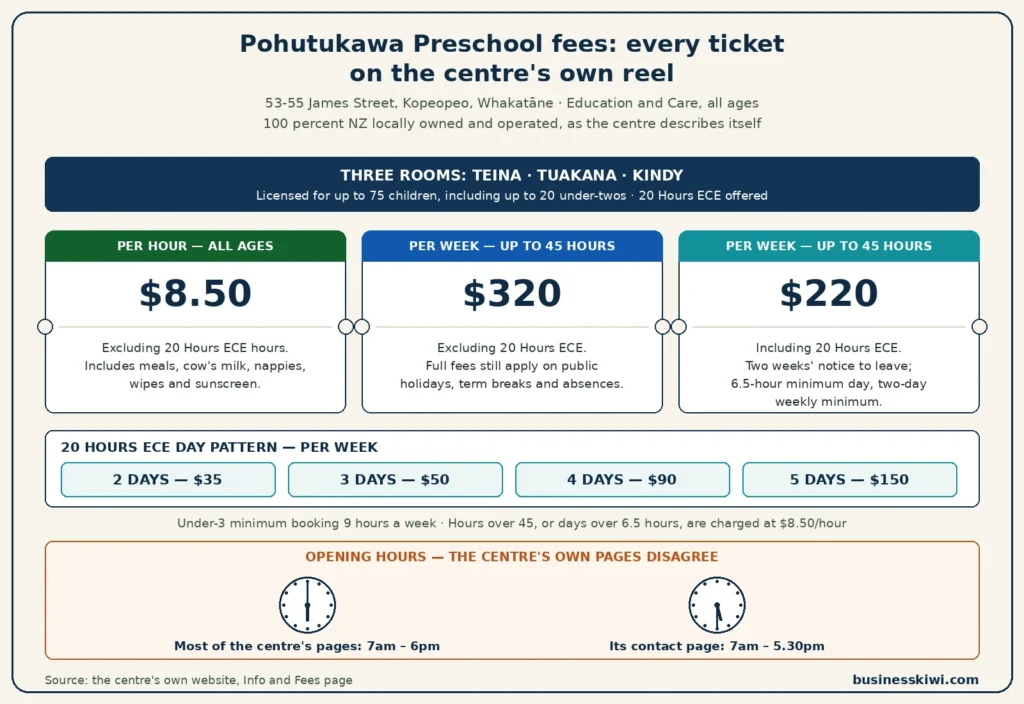
The centre opens Monday to Friday and is closed at weekends. On hours, its own website is not perfectly consistent, and this profile reports the position as published rather than tidying it up. Most of its pages, including its commitment page and the footer that runs across the site, give the opening hours as 7am to 6pm, and the commitment page describes those longer hours as catering for working families. Its contact page, however, lists the hours as 7am to 5.30pm. A family arranging a late pickup needs to know which time applies on the day, so confirm the closing time directly with the centre. The fees page adds a related rule: children dropped off early or picked up late have the additional time charged at $8.50 an hour.
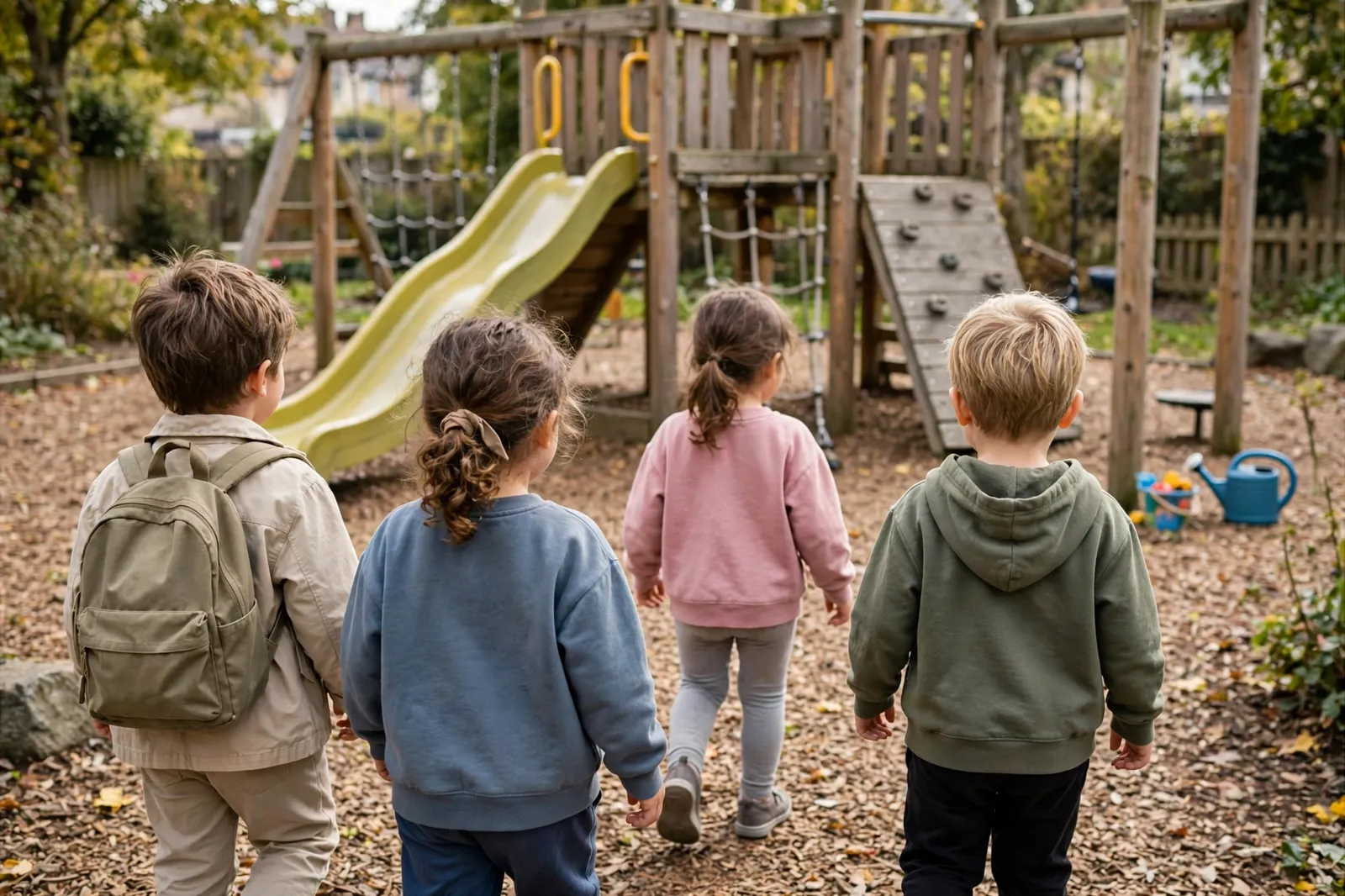
The shape of the day itself is described by the centre in terms of rooms and routines rather than a published timetable. For infants, the centre promises a predictable and calm environment, with individualised programmes adjusted to each baby’s own rhythms, which is its way of saying the day bends around sleeps and feeds rather than the other way around. For toddlers, it describes a programme that mixes challenges with predictable happenings and leaves room for spontaneity. For young children, the emphasis shifts to sustained projects, co-operative ventures and conversations that stretch thinking. No bell times or session-by-session timetable are published, and none are invented here.
One calendar point matters for budgeting. The fee schedule states that full fees apply to public holidays, school term breaks and absences. Unlike some centres, Pohutukawa does not discount the weeks a child is away or the days the centre is closed for a public holiday, at least as its published schedule reads. That is a standard enough position in the sector, but it is stated plainly on the centre’s own page, and it belongs in any family’s cost calculation.
Fees: what the centre publishes
Pohutukawa Preschool publishes its fee schedule in full on its own website, on its Info and Fees page. Every figure in this section comes from that page, exactly as the centre publishes it.
The base rate is $8.50 per hour for all ages, excluding 20 Hours ECE. That hourly figure includes nutritious meals, cows milk for bottles, nappies, wipes and sunscreen, a point the centre repeats in every fee line it publishes, because those inclusions are a large part of its offer. For families booking by the week, the schedule gives two caps: $320 per week for up to 45 hours, excluding 20 Hours ECE, or $220 per week for up to 45 hours, including 20 Hours ECE. Hours booked beyond 45 in a week are charged at $8.50 for each additional hour.
There are minimum bookings underneath those rates. Children under three have a minimum booking of nine hours a week. For children over three, a minimum booking of 6.5 hours a day applies.
Children aged three, four and five can use 20 Hours ECE, the government scheme under which up to 20 hours a week of early childhood education carries no compulsory fee. Education Counts confirms the centre offers it. The centre structures its 20 Hours ECE bookings as two, three, four or five days a week, with a minimum of 6.5 hours a day and a minimum of two days a week. The published weekly charges for those bookings are $35 for two days, $50 for three days, $90 for four days and $150 for five days. Hours beyond 6.5 in a day are charged at $8.50 per additional hour. Those day-based figures are the centre’s own optional charges and top-up structure sitting around the funded hours, published as its standard 20 Hours ECE booking pattern.
Some worked examples help, using only the published rates and simple arithmetic. A child under three booked for the nine-hour weekly minimum, with no funded hours available at that age, would be charged $76.50 a week at the hourly rate. A toddler booked for 30 hours a week would cost $255 at the hourly rate, while a full-time booking at the 45-hour cap costs $320. A four-year-old attending five days a week on the centre’s 20 Hours ECE pattern is charged $150 a week on the published schedule, plus $8.50 for any hour beyond 6.5 in a day. These are illustrations built from the published schedule, not quotes: the actual invoice depends on the days and hours a family books and how its 20 Hours ECE is attested.
Two conditions complete the picture. Full fees apply to public holidays, school term breaks and absences, as noted above. Two weeks’ notice is required to end an enrolment. The centre also points families towards help with costs: its fees page says families should enquire with WINZ, as they may qualify for a childcare subsidy, and that Childcare Subsidy application and change-of-circumstances forms are available at reception. No subsidy rates or thresholds are given here, because the centre does not publish them and they are Work and Income decisions that change.
The learning programme: Te Whāriki and relationships
The centre states that Aotearoa New Zealand’s national early childhood curriculum, Te Whāriki, is the foundation for its learning programme. Around that foundation it builds a philosophy it describes as relationship-based and inclusive: building strong, positive relationships, where everyone feels respected and included, is presented as the key to a successful learning community. Its stated goal is optimal social and emotional growth in a loving, caring and safe environment, alongside physical and intellectual development, and teaching children the importance of being patient, kind and self-confident.
Its commitment page sets out the programme’s foundations as the centre sees them. Parents and whānau share their values, beliefs and aspirations for their children. Teachers set learning goals on a regular basis and provide experiences to meet them. Individual learning goals, and a mix the centre calls structured and emergent learning, form the foundation of the programme. The centre also commits to acknowledging and reflecting the unique place of Māori as tangata whenua, to encouraging children to be confident in their own culture and to understand and respect other cultures, and to providing a positive learning environment that responds to each child’s interests, strengths and capabilities.
Play runs through the home page’s account of the day. The centre describes play as space for discovery and self-driven exploration, engaging a child’s mind and body, with group play teaching teamwork and social roles. Alongside play it nurtures individuality, aiming for each child to develop competency in the social, emotional, intellectual and creative parts of themselves, and it describes its balance between exploratory play and structured learning as paramount. Independence and creative thinking are fostered from the earliest stages.
The centre publishes separate accounts of its care for each age group, and they are worth summarising because they show how the programme changes as children grow. For infants, it promises one-to-one responsive interactions in which teachers follow the infant’s lead, teachers who are consistently responsible for and available to each infant, a high teacher to infant ratio (described in those terms, with no numeric ratio published), sociable and physically responsive teachers who tune into an infant’s needs, individualised programmes, and a predictable, calm environment that builds trust, all in partnership with parents and whānau. For toddlers, it promises a secure environment with both challenges and predictable happenings, opportunities for independent exploration and movement, a flexible approach that can accommodate toddler spontaneity, teaching that encourages cognitive skills and language development, and responsive, predictable teachers who understand developmental swings. For young children, it promises resources, challenges and support for widening interests and problem-solving, unfamiliar routines and self-directed challenges, co-operative ventures and sustained projects, sustained conversations and complex thinking including fairness, difference and similarity, rich opportunities for creative expression, activities that keep pace with physical development, and the transition to school programme already mentioned.
Food, nappies and the everyday practicalities
A large part of this centre’s practical offer is what it includes. The centre provides kai, meaning food, cows milk for bottles, nappies, wipes and sunscreen, and it frames that as a deliberate convenience so families get quality time together rather than spending it packing bags. It grows its own fruit and vegetables and uses them to cook nutritious meals. Meals are included in every fee line it publishes, hourly and weekly alike.
That means the daily packing list for a Pohutukawa family is shorter than at many centres: no lunchbox of meals, no nappy supply to maintain, no sunscreen to send in. What the centre does not publish on the pages read for this profile is the detail of menus, allergy handling, sleep arrangements or settling-in visits, so none of that is described here. Families will want to ask about those things on a visit, particularly sleep arrangements for infants, where the centre’s published emphasis is on individual rhythms rather than fixed sleep times.
The centre also describes a wrap-around support role for families, linking them to people who can help. It says it has teamed up with local boards, charities, schools, agencies and not-for-profit organisations in the community. In practical terms, that is a promise about connections rather than a service list, and a family needing a specific kind of support should ask what the centre can connect them to.
Enrolling, visiting and leaving
The enrolment route the centre publishes is simple. It invites families to visit, saying it would love to meet them and their whānau, and its home page repeats the invitation to come and see the preschool. Enquiries can be made by phone on 07 308 7752, by email, or through the form on its contact page. The open-door policy cuts both ways: families are welcome to stay and play, which makes a visit a reasonable way to judge the rooms before committing.
What the centre does not publish is waiting list information. There is no statement on its website about the length of any waiting list, current vacancies by room, or how places are allocated as children move up through the rooms or leave for school. This profile therefore makes no claim about availability, and a family should ask directly about the position for their child’s age and the room they would enter, especially for the Teina Room, where the under-twos licence caps numbers at 20 across the centre.
The booking rules in the fee schedule are the practical core of an enrolment here: the nine-hour weekly minimum for under-threes, the 6.5-hour daily minimum for over-threes, the two-day weekly minimum on 20 Hours ECE bookings, and full fees through holidays, term breaks and absences. Leaving is governed by one published rule: two weeks’ notice is required to end an enrolment.
What about the ERO report and the roll?
Most profiles of this kind summarise the service’s Education Review Office report and its official roll. This one does not, for two separate reasons that are worth stating plainly.
ERO’s report for this centre could not be retrieved for this research. The Education Counts profile links to the centre’s Education Review Office report, but ERO’s website returned an access error when the report was sought, and no report was read in full. So no ERO finding, judgement or recommendation is stated anywhere in this article. Treat any ERO claim about this centre on a third-party directory site with caution until you have read the report itself on ERO’s website.
The roll, meaning the number of children currently enrolled, is not published on the Education Counts profile page read for this profile. What that profile does publish is the licensed capacity: a maximum of 75 children, including a maximum of 20 under two. Licensed capacity and the actual roll are different figures, and this profile gives only the one it could verify. A parent who needs the current roll can ask the centre directly.
Frequently asked questions
Where is Pohutukawa Preschool?
It is at 53-55 James Street, Kopeopeo, Whakatāne, in the eastern Bay of Plenty. Its phone number is 07 308 7752, its email is pohutukawapreschool@outlook.co.nz, and its website is pohutukawapreschool.co.nz.
What are Pohutukawa Preschool’s opening hours?
The centre opens Monday to Friday. Most of its published pages give the hours as 7am to 6pm, and its commitment page describes those hours as catering for working families, but its contact page lists 7am to 5.30pm. Confirm the closing time with the centre, especially if you rely on a late pickup, because time beyond your booking is charged at $8.50 an hour.
How much does Pohutukawa Preschool charge?
The centre publishes its schedule on its own website. The base rate is $8.50 per hour for all ages, excluding 20 Hours ECE. Weekly bookings are capped at $320 for up to 45 hours excluding 20 Hours ECE, or $220 for up to 45 hours including 20 Hours ECE. On its 20 Hours ECE pattern, bookings cost $35 a week for two days, $50 for three days, $90 for four days and $150 for five days, with a 6.5-hour minimum day. Every rate includes meals, cows milk for bottles, nappies, wipes and sunscreen.
Does Pohutukawa Preschool offer 20 Hours ECE?
Yes. Education Counts confirms the centre offers 20 Hours ECE, and the centre publishes its own 20 Hours ECE booking pattern for three, four and five year olds: two to five days a week, a minimum of 6.5 hours a day and a minimum of two days a week. The Kindy Room also runs 20 Hours ECE sessions of four, five and six hours a day.
What ages does Pohutukawa Preschool take, and how is it organised?
Education Counts records the service as providing for all ages, licensed for up to 75 children including up to 20 under the age of two. Children move through three rooms: the Teina Room for infants and toddlers, the Tuakana Room for toddlers and preschoolers, and the Kindy Room for the oldest children, where the transition to school programme sits.
Do I need to supply food or nappies?
No, on the centre’s published information. The centre provides kai, cows milk for bottles, nappies, wipes and sunscreen, and those items are included in its fees. It grows some of its own fruit and vegetables and cooks nutritious meals on site.
Is there a minimum booking?
Yes. Children under three have a minimum booking of nine hours a week. For children over three a minimum booking of 6.5 hours a day applies, and 20 Hours ECE bookings require a minimum of two days a week. Full fees apply to public holidays, school term breaks and absences, and two weeks’ notice is required to end an enrolment.
What is Pohutukawa Preschool’s ERO rating?
This profile does not state one. The centre’s ERO report could not be retrieved for this research and no report was read in full, so no judgement is quoted. Read the report itself on the Education Review Office website rather than relying on a rating shown by a third-party directory.
Sources
- Ministry of Education, Education Counts, Pohutukawa Preschool profile and contact details (educationcounts.govt.nz): service number 46814, address, phone, service type (education and care), provides for all ages, offers 20 Hours ECE, maximum 75 children, maximum 20 under two years old.
- Pohutukawa Preschool, home page (pohutukawapreschool.co.nz): the centre’s description of itself, its philosophy, Te Whāriki as the foundation of its programme, its play and learning approach, its teaching team and its address and hours.
- Pohutukawa Preschool, Our Commitment page: the three rooms (Teina, Tuakana and Kindy), sibling placement, tuakana-teina, Kindy Room 20 Hours ECE sessions of four, five and six hours, transition to school, provided food, nappies, wipes and sunscreen, garden produce and meals, 7am to 6pm hours, wrap-around family support, local ownership, and the centre’s published commitments.
- Pohutukawa Preschool, Info and Fees page: the full published fee schedule, including the $8.50 hourly rate, the $320 and $220 weekly caps, the 20 Hours ECE day-based charges, minimum bookings, full fees on public holidays, term breaks and absences, early and late charges, the WINZ subsidy pointer, and the two weeks’ notice rule.
- Pohutukawa Preschool, Our Curriculum page and its three care pages (Care for Infants, Care for Toddlers, Care for Young Children): what the centre promises for each age group, and the transition to school programme for young children.
- Pohutukawa Preschool, Our Team page: the teaching team’s published description and the centre’s open-door position.
- Pohutukawa Preschool, Get in Touch page: contact details, the invitation to visit, and the hours the centre lists there.
- Education Review Office (ero.govt.nz): the report for this service could not be retrieved for this research (access error); no ERO finding is stated in this article.
This article is general information about Pohutukawa Preschool in Kopeopeo, Whakatāne, based on the centre’s own published pages and its Ministry of Education directory profile, as read in October 2026. Fees, hours, licensed places and availability change, and the centre’s own website was not internally consistent about its closing time, so confirm the details that matter to your family, including the current fee schedule and closing time, directly with Pohutukawa Preschool before making enrolment decisions.