Registered Valuation Cost in NZ: What Affects the Fee and When You Need One

Sooner or later, most people who buy, build or borrow against a house in New Zealand run into the same instruction from a bank, a lawyer or an insurer: you will need a registered valuation. The follow-up question is always the same. How much does that cost, and why does nobody seem to publish a simple price for it?
There is a straightforward reason for the vagueness. A registered valuation is a formal report prepared by a Registered Valuer, and the work involved changes a lot from one property to the next. A standard three-bedroom house on a flat suburban section is a different job from a character villa with additions, a unit title apartment with body corporate paperwork, or a lifestyle block with sheds, fencing and water supply to assess. Most valuation firms therefore quote each job individually, and only a minority put any prices on their websites at all.
This guide explains what a registered valuation actually is, how it differs from the free or cheap estimates that surround it, who is legally allowed to produce one, and the situations where you are likely to be asked for one. It also sets out the fee figures that valuation firms do publish, in their own words and attributed to them, and the factors that push a fee up or down, so you can read a quote with some context and compare written quotes on equal terms.
What a registered valuation is
A registered valuation is a formal, written assessment of a property’s market value, prepared and signed by a Registered Valuer. The New Zealand Institute of Valuers (NZIV) describes Registered Valuers as the independent authority on property value in this country, providing objective, evidence-based advice that supports property transactions, lending decisions, legal processes and investment decisions. That description matters because it explains why banks and courts rely on these reports: the person signing one is regulated, qualified and accountable for the opinion in a way that no other provider of property price opinions is.
The report itself is a substantial document. It identifies the property and its legal description, records who owns it, describes the land and buildings, sets out the valuation methods used, lists comparable sales, comments on the local market, and states the valuer’s assessment of current market value. Hawke’s Bay firm Williams Harvey, in its client booklet on market valuations, lists the same core ingredients: a general description of the property, the registered proprietors, the legal description, statements on the factors considered, a list of comparable sales and a general market comment, all prepared to NZIV and Property Institute of New Zealand (PINZ) reporting standards.
In plain terms, you are paying for three things. First, a physical inspection of the property by someone trained to notice value-relevant detail. Second, research and analysis that tests the property against recent sales of similar properties. Third, a signed professional opinion that a bank, an insurer, a court or another party can rely on, with the valuer’s registration and professional obligations standing behind it.
How it differs from an appraisal, a rating valuation and an online estimate
Several cheaper numbers float around every property transaction, and confusing them with a registered valuation is the most common source of disappointment in this area.
A market appraisal from a real estate agent is an estimate of what a property might sell for, usually given free to a prospective seller. Williams Harvey draws the line clearly in its booklet: appraisals are a guide to pricing based on local knowledge and recent sales, they are only ever an estimate of price, and they have no legal standing. Agents rarely charge for them because the appraisal is part of winning the listing. An appraisal can be useful for deciding an asking price. It is not a document a bank can lend against.
A rating valuation, sometimes still called a government valuation or capital value, is the figure on your rates bill. PINZ and NZIV both make the same point about these: rating valuations are produced by mass appraisal, covering whole districts at once, for the single purpose of apportioning council rates. They are reassessed only periodically, typically every three years, individual properties are generally not inspected, and the values are fixed at a set date, so they drift further from the market as time passes. NZIV states plainly that rating valuations are not intended for property transactions, lending decisions or legal purposes. The fact that your rating valuation is higher or lower than your purchase price tells you very little about either figure.
An automated estimate, of the kind produced by property websites and some bank apps, is generated by a model working from sales data and property records. Both professional bodies note the limitation: an algorithm cannot robustly consider a dwelling’s layout, elevation and views, the quality and condition of the building, or the character of its immediate surroundings, and local market dynamics can shift faster than a model updates. Automated estimates are a reasonable starting point for curiosity. They are not evidence.
A registered valuation sits apart from all three because a qualified person has inspected the property, applied professional judgement to the sales evidence, and signed a report that meets professional standards. It is also worth separating it from a building inspection. A valuation answers the value question on your house inspection checklist; it does not test whether the roof leaks, the piles are sound or the wiring is safe. If you need condition answers, you need an inspector as well.
Who can call themselves a Registered Valuer
Valuation is one of the few property occupations in New Zealand with a statutory registration regime. Registration is governed by the Valuers Act 1948 and overseen by the Valuers Registration Board (VRB), an independent statutory body administered by Toitū Te Whenua, Land Information New Zealand (LINZ). The Valuer-General chairs the Board. LINZ’s page on the Board explains that it registers qualified valuers, handles complaints, and may discipline Registered Valuers who do not meet its standards.
The pathway to registration explains some of the cost of the end product. According to PINZ and NZIV, a Registered Valuer must hold an approved tertiary qualification in valuation, complete at least three years of full-time practical experience working under the guidance of a Registered Valuer, and pass written and oral examinations conducted by the VRB. The Valuers Act 1948 eligibility criteria also require an applicant to be at least 23, of good character and reputation, and to have demonstrated professional competence under supervision. Once registered, a valuer who signs reports for the public must hold a current Annual Practising Certificate issued by the VRB and complete ongoing professional development. All Registered Valuers must also be members of NZIV and comply with its code of ethics and professional standards.
Two practical consequences follow. First, if someone offers you a valuation report, you are entitled to check that the person signing it is actually registered; the register exists precisely so the public can do this. Second, if you have a genuine complaint about a Registered Valuer’s conduct, there is a formal channel: LINZ advises that you can apply to the VRB to have the complaint investigated, and the Board has disciplinary powers. Complaints are about conduct and standards, though. Disagreeing with the value figure on its own is not usually a conduct matter, and neither the Board nor NZIV awards compensation; that is a matter for the civil courts.
When you are likely to need one
For most homeowners, the trigger is a bank. Lending decisions rest on the value of the security property, and NZIV notes that many laws, legal agreements and lending institutions require valuations to be completed by Registered Valuers. The situations that commonly produce the request include the following.
Buying with a mortgage. If you are borrowing a high proportion of the purchase price, buying privately without an agent involved, or buying a property type the bank considers less standard, expect the bank to require a registered valuation before it confirms the loan. The bank is checking that the property supports the amount it is being asked to lend.
Building or renovating. Construction lending runs on valuations at several points. ANZ’s guide to planning a building or renovation project explains that it approves a total borrowing limit based on the tentative on-completion value of the finished home, and that during the project you may need to provide a Registered Valuation Report showing the value of the work to date, commonly called the as-is value, so staged drawdowns stay in line with the property’s value. ANZ also advises borrowers to factor the cost of valuations into the project budget, which is a hint about who pays: you do.
Refinancing, topping up or restructuring lending. When you move lenders or ask an existing lender for more money against the property, the lender may want current evidence of value rather than relying on the figure from when you first borrowed.
Relationship property, estates and trusts. When a couple separates, an estate is settled, or property is transferred into or out of a trust, the parties need a defensible value that everyone, and if necessary a court, can rely on. Whanganui-based firm Wanganui Property Valuers lists relationship property settlements, estate and trust matters, and legal and Family Court proceedings among its standard residential purposes, and QV likewise lists transferring a property to a trust among the reasons people order its full market valuation.
Insurance. A market valuation and an insurance valuation are different products. For setting a sum insured, valuers assess what it would cost to rebuild the home, including demolition, professional fees and consents. CBRE’s residential insurance valuations page describes exactly that scope and notes that its reports are used by homeowners to set their sum insured with insurers.
Pre-purchase and pre-sale decisions. Some buyers and sellers order a valuation without any bank requirement, simply to anchor a negotiation in evidence rather than opinion. Wanganui Property Valuers lists pre-sale and pre-purchase decision-making among its purposes, and QV’s full market valuation service is aimed at buyers and sellers as well as people managing investments, leases and asset reporting.
What the valuer actually does
Understanding the workflow helps explain the fee, because most of the work happens away from your house.
It starts with instructions: who the report is for, its purpose, and the standard it must meet. A valuation ordered for a bank is prepared to the bank’s requirements. Wanganui Property Valuers, for example, states that its reports are prepared in accordance with the Residential Valuation Standing Instructions, the International Valuation Standards and the PINZ and NZIV code of ethics and guidance papers. That compliance work is part of what the fee buys.
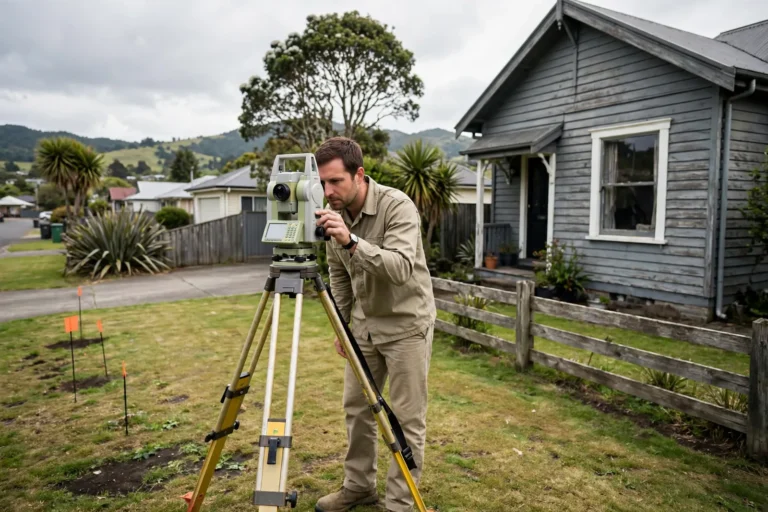
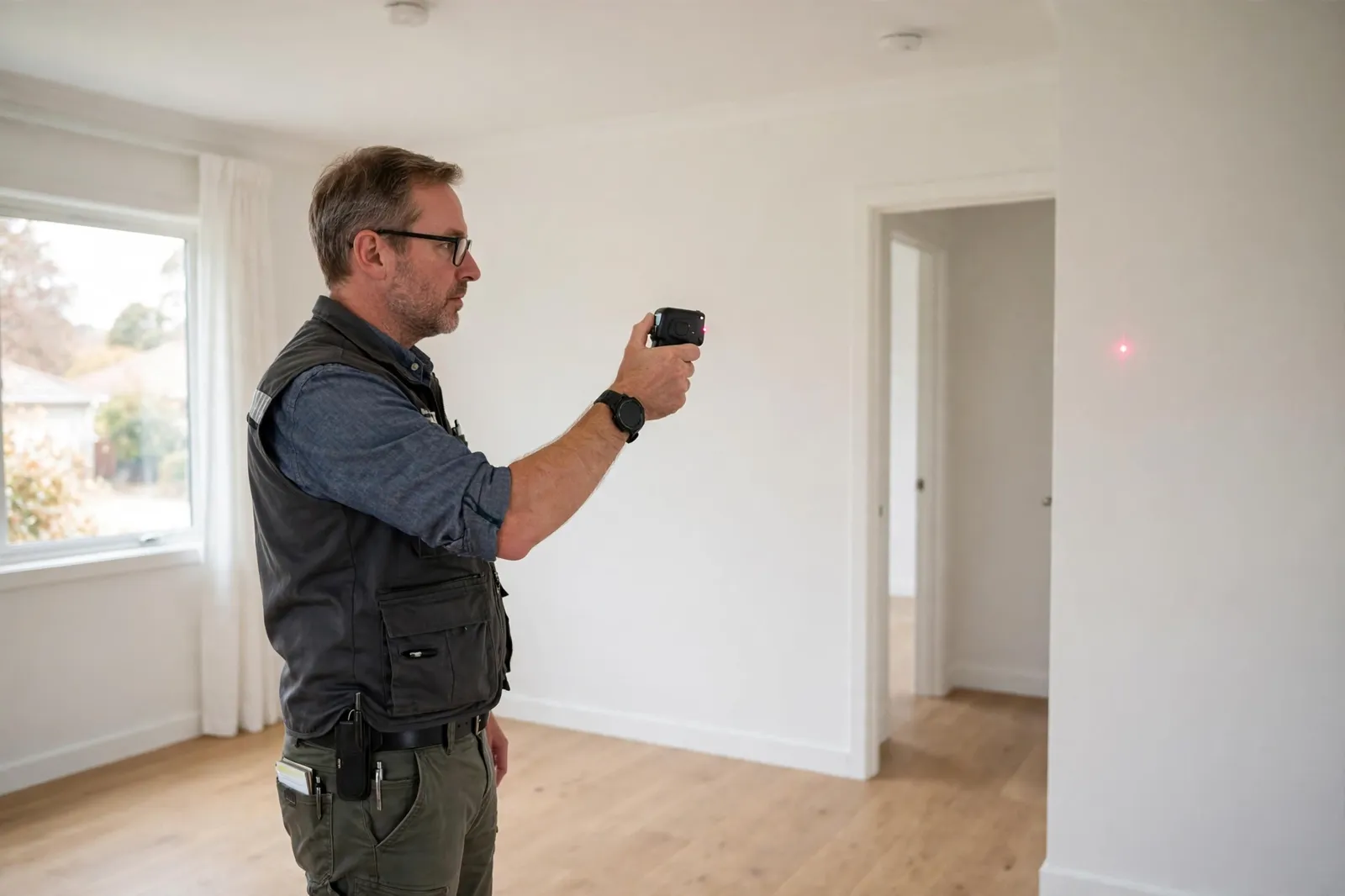
Next comes the inspection. Williams Harvey’s booklet describes the valuer inspecting the property inside and out, taking detailed notes on construction materials, fixtures, fittings and condition, measuring and calculating the floor areas of the improvements, and viewing the property from the road. CBRE’s insurance valuation process describes a similar visit: measuring the building, noting materials and finishes, photographing the property, and reviewing plans or earlier valuations if you have them. On a standard house this visit is the visible tip of the job.
The analysis follows. The valuer researches recent sales of comparable properties and typically applies two or three valuation approaches, most commonly the sales comparison approach, supported where relevant by the depreciated replacement cost approach or, for income-producing property, the income approach. Williams Harvey lists the factors weighed along the way: the property’s location, the building’s structure, materials, fittings and condition, any structural faults, the features of the home, caveats or encumbrances on the title, council zoning, and additional features that are particularly relevant to high-value property. Judgement is the product here. Two similar houses on one street can differ in value for reasons only inspection and local knowledge reveal.
Finally, the valuer writes and signs the report. Because the report may be relied on by a lender or produced in a legal process, it has to be thorough enough to defend. That is why a registered valuation takes longer and costs more than the instant outputs it is compared with.
What it costs: the honest picture
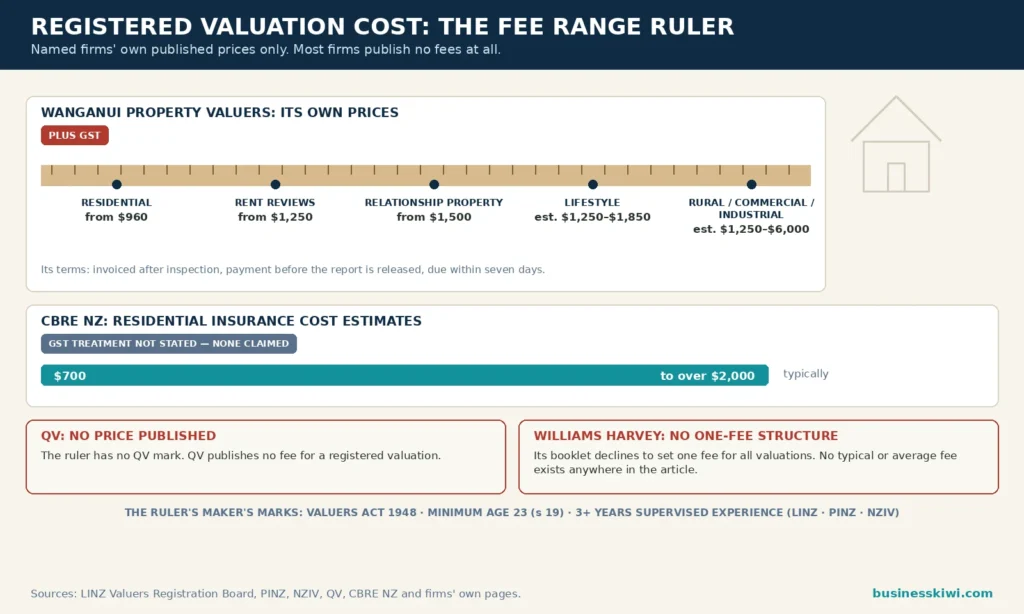
Here is the part most articles on this topic handle badly, so it is worth being precise. There is no regulated fee for a registered valuation in New Zealand, and there is no official schedule of charges. Most firms do not publish their fees at all. QV, one of the largest valuation providers in the country, does not list a price for its full market valuation: its service page says that once you submit your details, it will come back with a quote, and the inspection is arranged once you agree to it. Williams Harvey says in its client booklet that it is very difficult to provide a one-fee-fits-all structure for valuations because every property is different and the purpose of the job dictates the report required; it offers a discussion and a quote, and notes that the call costs nothing.
Some firms do publish, and their figures give a genuine sense of the market without pretending to be a national price list. Wanganui Property Valuers publishes a fee schedule on its website. As published by that firm, its fees are:
- Residential valuations: from $960 plus GST.
- Relationship property valuations: from $1,500 plus GST.
- Lifestyle valuations: an estimated $1,250 to $1,850 plus GST.
- Rural, commercial and industrial valuations: an estimated $1,250 to $6,000 plus GST.
- Commercial and industrial rent reviews: from $1,250 plus GST.
Read those figures for what they are: one regional firm’s published starting points, not a promise about what a firm in Auckland, Wellington or Christchurch will charge for your property. The same page notes that larger homes and complex properties may cost more, and that a travel surcharge may apply outside its central service areas.
For insurance valuations, CBRE publishes a range on its residential insurance valuations page: it says fees for its insurance cost estimate assessments typically range from $700 to over $2,000, depending on complexity, with the figure confirmed in a quote before you commit. Again, that is one provider’s published range for one type of report, useful as context rather than as a market average.
The pattern is consistent. Where firms publish, residential work tends to start in the high hundreds of dollars plus GST, and legal, rural, lifestyle and commercial work costs more, sometimes much more. Where firms do not publish, the only honest answer is that you need a quote for your property and your purpose. Anyone who quotes you a single typical fee for the whole country is smoothing over the variation that this section describes.
What pushes the fee up or down
The fee drivers are consistent across the firms and professional bodies whose material informs this guide.
Property type and complexity. A standard house is the cheapest common job. Units, apartments and cross-lease properties involve extra documents, such as body corporate rules and levies or flats plans and leases, and anything unusual, such as multiple dwellings on one site, a large lifestyle block, or potential to subdivide, adds research and reporting time. Wanganui Property Valuers prices lifestyle, rural and commercial work well above standard residential work for exactly these reasons, and notes that lifestyle properties with multiple outbuildings may attract an additional fee.
Size and condition. Bigger floor areas take longer to measure and assess, and a property with additions, alterations or obvious defects needs more analysis, not less, because the valuer must work out how those features affect value.
Location and travel. A valuer’s patch is a real constraint. Firms state openly that properties outside their central service areas can attract a travel surcharge, and a property in a thin market, where comparable sales are scarce or distant, takes longer to research wherever it is.
Purpose and report standard. A valuation for a Family Court matter or a relationship property settlement has to withstand scrutiny from another valuer and possibly a judge, and it is priced accordingly; Wanganui Property Valuers’ relationship property fees start well above its standard residential fee. A bank valuation must meet the lender’s standing instructions. The more the report has to defend itself, the more work is in it.
Tenure and title issues. Leasehold, unit title and cross-lease properties, and titles with caveats or encumbrances, all require document review that a simple freehold title does not.
Turnaround and level of inspection. A full internal inspection and a comprehensive report cost more than lighter forms of assessment. At the other end of the scale sit desktop work and automated estimates, which skip the inspection entirely; as NZIV points out, that saving comes with real limits, because no one has looked at the property’s layout, condition or setting. If a deadline is tight, ask whether speed changes the fee when you request the quote, and get the answer in writing either way.
Bank-ordered valuations versus ordering your own
One distinction saves people real money and frustration. When a bank requires a valuation, it will usually want the report prepared by a valuer it accepts, ordered in a way it specifies. Many firms advertise that they sit on the valuation panels of major banks; Wanganui Property Valuers, for instance, states that it is on the panels for major New Zealand banks and second-tier lenders. Panel membership is how banks control quality and consistency.
The practical risk is this: a report you commission privately, from a valuer the bank does not use, or addressed to you rather than prepared for the lending purpose, may not be accepted by your bank, and you could pay twice. Before ordering a valuation for a loan, ask your lender or mortgage adviser exactly what it requires: which valuers or ordering channel it accepts, what type of report, and whether the bank orders it and passes the cost to you or you arrange it yourself. If you are ordering for your own purposes, such as a negotiation or a trust transfer, that constraint does not apply, and you can choose any Registered Valuer.
Getting quotes you can compare
Because fees are quoted job by job, the quality of your request determines the quality of the quote. Use the same brief with each firm:
- Give the property address, property type and the purpose of the valuation in one or two sentences, for example, bank lending for a purchase, a relationship property settlement, or a sum insured assessment.
- Ask for the total fee in writing, and whether it is quoted including or excluding GST.
- Ask what the fee covers: the inspection, the full report, and any travel or disbursement charges, and what would trigger a higher fee than quoted.
- Ask who will sign the report, and confirm that person is a Registered Valuer holding a current Annual Practising Certificate.
- If a bank is involved, confirm the firm is on that bank’s panel and that the report will be prepared to the bank’s requirements.
- Ask about timing: when the inspection can happen and when the report will be delivered.
- Ask about payment terms. Published terms vary; Wanganui Property Valuers, for example, invoices after the inspection and requires payment before the report is released, with payment due within seven days of the invoice date. Know the deal before you book.
Two or three written quotes on the same brief will tell you more than any advertised average, and the cheapest quote is not automatically the best one if the property is unusual or the report has to stand up in a dispute.
Frequently asked questions
How much does a registered valuation cost in NZ?
There is no standard or regulated fee, and most firms quote each job individually without publishing prices. Among firms that do publish, Wanganui Property Valuers lists residential valuations from $960 plus GST, relationship property work from $1,500 plus GST, and rural and commercial estimates from $1,250 to $6,000 plus GST, while CBRE publishes a range of $700 to over $2,000 for its residential insurance cost estimates. Treat those as named firms’ published figures, not national averages, and get written quotes for your own property.
Is a registered valuation the same as a real estate appraisal?
No. An appraisal is an agent’s estimate of likely selling price, usually provided free to a prospective seller, and it has no legal standing. A registered valuation is a formal report by a Registered Valuer who has inspected the property, analysed comparable sales and signed an opinion that banks, insurers and courts can rely on.
Can I use my council rating valuation for a home loan?
No. Rating valuations are mass appraisals made to apportion council rates, updated only periodically, and PINZ and NZIV both state they are not intended for transaction or mortgage security purposes. A bank that needs a valuation will require one prepared for that purpose by a Registered Valuer.
Who pays for the valuation when a bank requires one?
In practice, you do. The valuation is a cost of your borrowing even when the bank orders it, and banks advise borrowers to budget for it; ANZ, for example, tells customers building or renovating to factor the cost of valuations into their project budget. Ask your lender at the outset how the fee will be charged so it is not a surprise at settlement.
How long does a registered valuation take?
It varies with the firm’s workload, the property and the report required, and firms generally confirm timing when you book. The inspection itself is only part of the job; research, analysis and reporting follow it. If you have a finance or settlement deadline, raise it when you request the quote and get the delivery date in writing.
What happens if the valuation comes in below the price I agreed to pay?
The bank will generally base its lending decision on the valuation rather than the purchase price, which can leave a gap you need to cover from other funds, renegotiate, or resolve under the conditions of your agreement. Talk to your lender or mortgage adviser and your lawyer promptly. A valuation condition in your offer, where the sale method allows one, is the usual protection.
Can any property valuer produce a registered valuation?
No. Only a valuer registered under the Valuers Act 1948, holding a current Annual Practising Certificate, can sign valuation reports for the public as a Registered Valuer. Registration requires an approved qualification, at least three years of supervised practical experience, and passing the Valuers Registration Board’s examinations. Ask who will sign your report and check if you are unsure.
Will a valuation I order myself be accepted by my bank?
Not necessarily. Banks usually require reports from valuers on their panels, prepared to the bank’s instructions and for the lending purpose. A privately commissioned report may not be accepted, which can mean paying twice. If the valuation is for a loan, confirm the bank’s requirements before you order anything.
Sources
- Land Information New Zealand (LINZ), Valuers Registration Board: https://www.linz.govt.nz/guidance/property-valuation/valuers-registration-board
- Property Institute of New Zealand (PINZ), About Registered Valuers: https://propertyinstitute.nz/Category?Action=View&Category_id=1587
- Property Institute of New Zealand (PINZ), The Valuers Registration Board (VRB): https://propertyinstitute.nz/Category?Action=View&Category_id=1674
- New Zealand Institute of Valuers (NZIV), About Registered Valuers: https://nziv.nz/about/about-registered-valuers
- Wanganui Property Valuers, Fees: https://www.wanganuivaluer.co.nz/fees
- Wanganui Property Valuers, Residential valuations: https://www.wanganuivaluer.co.nz/services/residential-valuations
- QV (Quotable Value), Full Market Valuation: http://www.qv.co.nz/services/property-valuations/full-market-valuation/
- ANZ Bank New Zealand, Planning your building or renovation project: https://www.anz.co.nz/personal/home-loans-mortgages/building-renovating/planning/
- Williams Harvey, Valuations to Provide Market Valuation (client booklet): https://www.williamsharvey.co.nz/_files/ugd/aea6e7_2350280e655c444ba97052b529f9349c.pdf
- CBRE New Zealand, Residential Insurance Valuations: https://www.cbre.co.nz/services/invest-finance-and-value/valuation-and-advisory-services/residential-valuation/residential-insurance-cost-estimates
This article is general information about registered property valuations in New Zealand, how they are prepared and how valuation fees are set. It is not financial, legal or valuation advice for your property or your circumstances. Valuation fees change over time and are quoted for individual properties, so confirm the fee, scope and timing in writing with the valuation firm before you proceed. If you are buying, selling or borrowing, discuss your situation with your lender, lawyer or mortgage adviser.