How Much Is Postage in NZ? NZ Post Prices and Parcel Costs Explained

Postage in New Zealand is not one price. It depends on what you are sending, how big and heavy it is, where it is going, and how fast you need it there. A birthday card to Invercargill, an online sale going across town and a box of parts heading to Sydney all sit in different parts of the NZ Post price structure, and the gap between the cheapest and dearest option can be tenfold.
This guide works through the prices NZ Post itself publishes, checked on nzpost.co.nz on 7 October 2026: letters and parcels within New Zealand, sending overseas, and the extras that catch people out, such as rural delivery and volumetric weight. Where NZ Post calculates a price in its online sending tool instead of publishing it, this guide says so rather than guessing.
The quick answer
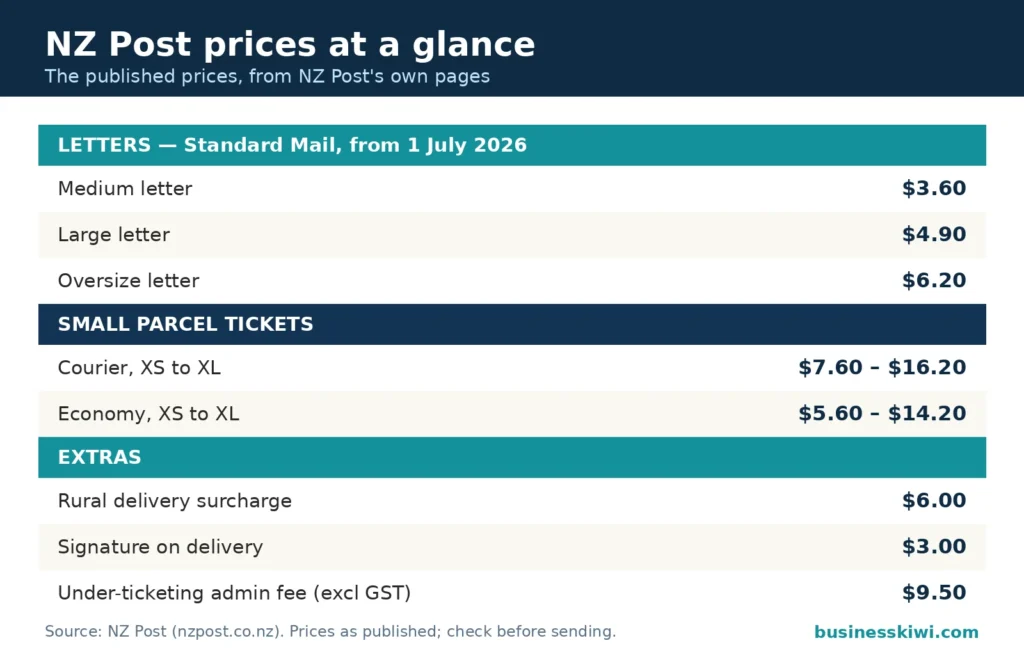
A standard medium letter within New Zealand currently costs $3.60 including GST under NZ Post Standard Mail. That is the price of one KiwiStamp, NZ Post’s non-denominated stamp, and it covers an envelope up to 130mm by 235mm and 6mm thick, weighing up to 500g. A large letter costs $4.90 and an oversize letter costs $6.20.
Parcels work differently. There is no single parcel price, because NZ Post prices parcels by size band, service speed and destination. The cheapest published way in is a small Economy parcel ticket at $5.60 for the smallest size band, and the same parcel sent by Courier starts at $7.60. Bigger parcels move onto base and excess tickets, and anything sent overseas is priced by destination zone and weight in NZ Post’s Send a parcel tool. The sections below unpack each of those numbers.
Letters within New Zealand
Standard Mail is the everyday letter service. NZ Post targets delivery within three working days nationwide, although rural and remote addresses can take longer and the target is not a guarantee. The price depends only on the size of the envelope, not on where in New Zealand it is going. A letter to the next suburb costs the same as a letter to the other end of the country.
Medium is the size most people use without thinking about it. It takes the common E9, DLE and MaxPop envelopes, the ones sold in every stationery aisle, and postcards fit in this band too. Large covers the C5 envelope, the size that takes an A4 sheet folded in half. Oversize covers C4 and E35 envelopes, which take A4 pages flat, and allows up to 20mm of thickness and a full kilogram of weight, so a thick report or a small catalogue still travels as a letter rather than a parcel.
Thickness is the trap. A medium envelope stuffed to 8mm thick no longer qualifies as medium, however light it is, and a bulky clasp, key or USB stick inside can push an otherwise ordinary letter out of the letter stream altogether. Rigid, lumpy or overweight items belong in the parcel pricing below.
These prices took effect on 1 July 2026, when NZ Post lifted Standard Mail prices by 70 cents per letter. They replace the $2.90 medium rate from the 2025/26 year, so any older list quoting $2.00, $2.30 or $2.90 is out of date.
Stamps, prepaid envelopes and printed postage
There are three practical ways to pay for a letter, and they suit different senders.
A KiwiStamp is the simplest. It carries no printed dollar value: one KiwiStamp is always worth whatever a medium Standard Mail letter costs on the day you post it, currently $3.60, so a booklet bought last year still posts a medium letter today. For large and oversize letters, add denominated stamps to make up the difference rather than stacking KiwiStamps. Two KiwiStamps on a large letter would pay $7.20 for $4.90 of postage. Stamps can also pay for small self-wrapped items sent on the Economy parcel service within New Zealand, if the item weighs under 3kg and is under 70mm thick, but those items cannot be tracked, and stamps cannot be used for Courier services.
Prepaid envelopes bundle the envelope and the postage into one purchase. You pay once, keep them in a drawer, and post without weighing or queueing. On the NZ Post online shop, a pack of 25 DLE prepaid envelopes costs $94.00 including GST and a pack of 100 costs $370.00, which works out cheaper per envelope than the medium letter rate alone once the envelope itself is counted. C5 prepaid envelopes, the large size, come in packs of 10 at $61.00, and C4 oversize prepaid envelopes come in packs of 50 at $370.00. Smaller quantities are sold in NZ Post stores. For a small business posting the same size of document every week, prepaid envelopes remove the guesswork entirely.
Printed postage is the third route, and it matters more for parcels than letters. NZ Post’s online sending tools let you enter the destination, size and weight, pay by card, and print a label at home. For businesses sending in volume, the equivalent on the mail side is PermitPost, a printed impression that replaces stamps on each item and is billed to an NZ Post credit account on deferred payment terms. PermitPost is covered in the business section below.
Parcels within New Zealand: small parcels
Most household and small business sending sits in the small parcel range, for items up to 3kg that fit one of NZ Post’s bag sizes. You choose between two services. Economy is the cheaper, slower option, with a delivery target of up to three working days. Courier targets the next working day. Both are tracked: on the current prepaid ticket range, tracking is built into Economy as well as Courier.
If you use your own packaging, you buy a service ticket to match the size band. If you use an NZ Post bag, the bag itself is included in the combined price. The ticket-only prices, including GST, are:
The bands are defined by volume and by fitting the matching NZ Post bag, running from 0.001 cubic metres for XS up to 0.010 cubic metres for XL. Buying the bag and ticket together costs $9.10 for an XS Courier bag, $10.40 for S, $12.40 for M, $13.40 for L and $18.70 for XL, with the Economy equivalents at $7.10, $8.40, $10.40, $11.40 and $16.70. The bag on its own has a recommended retail price of $1.50 for XS through L and $2.50 for XL, which explains the gap between the two sets of figures. Tickets are sold singly in store and in books of ten online, which suits anyone who sells online regularly and wants postage ready to go.
Two add-ons are worth knowing before you seal anything. Signature on delivery can be added to a Courier ticket for $3.00 per item, sold as a $30.00 book of ten upgrade tickets, and it is not available on Economy. Saturday delivery is offered as an optional add-on on Courier services booked through NZ Post’s online tools, but NZ Post does not publish a fixed retail price for it on its price pages, so the cost is shown in the sending tool when you book. Do not rely on a Saturday figure quoted anywhere else.
Rural delivery is the add-on nobody chooses but plenty of people need. If the destination is a rural delivery address, a surcharge of $6.00 applies on top of the bag or ticket price, and a rural delivery ticket is sold at $6.00 per item, or $60.00 for a book of ten. It applies to both Courier and Economy. If you sell online, build it into your shipping settings rather than absorbing it by surprise at the counter.
Parcels within New Zealand: larger items
Once a parcel outgrows the small bag range, pricing switches to base and excess tickets. A base ticket covers the first 5kg of chargeable weight and the first 0.025 cubic metres of volume. Each excess ticket adds another 5kg or 0.025 cubic metres, up to a maximum of 25kg, 0.125 cubic metres and 1.5 metres in length. Distance starts to matter here in a way it does not for small parcels.
Published base ticket prices include $12.90 for a Courier base ticket within the same island and $25.00 for a Courier Economy nationwide base ticket, with nationwide excess tickets at $25.00 each. Signature required lifts the Courier Economy nationwide base to $28.00, and a signature required Courier nationwide base ticket is $42.70. Across town, within island and nationwide bands each price differently, so the total is the base ticket plus however many excess tickets the weight and volume require. For a one-off large item, get the exact figure from NZ Post’s rate finder or Send a parcel tool, because the ticket count is doing the pricing work.
Packaging decides which band you land in, so it is worth a minute before you tape the box shut. Use the smallest box that protects the contents properly, because a half empty large box is priced on its volume, not on the empty space you wish you had not paid for. NZ Post sells its own boxes, from a Size 1 box at $2.50 to a Size 5 box at $8.50, and those prices are for the box only, with postage on top. For flat or flexible goods that need protection from bending and moisture, a stiffener cut from plastic sheet inside a snug mailer can keep an item in a cheaper size band while still arriving flat and dry.
Sending letters overseas
International letters use the Economy Letters service and a two-zone price split: Australia and the South Pacific in one group, and the rest of the world in the other. Prices are for stamps on your own envelope, include GST, and the delivery guideline is 3 to 6 working days for Australia and 6 to 13 working days for the rest of the world.
Note how much tighter the limits are than for domestic letters. A medium international letter caps at 100g, not 500g, and nothing in the letter stream can exceed 200g or 10mm in thickness. Anything heavier, thicker or in need of tracking travels as a parcel on the Economy Tracked, Courier or Express services instead. Prepaid international envelopes exist for regular senders, in separate ranges for Australia and the South Pacific and for worldwide sending.
Sending parcels overseas
International parcels are where fixed price tables stop. NZ Post prices them by destination zone, weight and size inside its sending tools, and the price you are quoted online can differ from the price in store, where a $3.00 fee applies when sending overseas across the counter. What is published, and what shapes your quote, is the service structure.
NZ Post groups destinations into six world zones: Zone A is Australia, Zone B is the South Pacific, Zone C is Asia, Zone D is Canada, the United Kingdom and Europe, Zone US is the United States, and Zone E is the rest of the world. Five services run across those zones. Economy is the lowest cost option, with a target of 3 to 10 working days, no tracking, a 2kg weight limit and a maximum item value of NZ$250. Economy Tracked, available online only, adds tracking within the same weight and value limits. Economy Plus keeps the 3 to 10 working day window but lifts the limits to 20kg and NZ$2,000, with tracking but no signature. Courier reaches around 53 destinations in 2 to 6 working days with tracking and signature, up to 30kg and NZ$5,000. Express is the premium service, reaching around 220 destinations in 1 to 5 working days, tracked with signature included, also up to 30kg, with item values up to NZ$10,000.
Customs paperwork is part of the deal, not an optional extra. Goods sent overseas need a declaration describing what is inside, its weight and its value. NZ Post supplies the green CN22 declaration for smaller Economy items up to 2kg, and consignment notes with the CN23 declaration for Economy Plus, Courier and Express. An Express item valued under NZ$1,000 also needs an export invoice. Book through NZ Post’s online postage tools and the sender, receiver and contents details are captured during the booking, so no separate paper form is required. Sending to the United States currently carries extra requirements following tariff changes, so check NZ Post’s international delivery updates page before posting anything there.

What actually drives the price
Four factors do most of the work, and understanding them prevents nearly every counter surprise.
Weight versus size is the big one. NZ Post charges on the greater of the actual weight and the volumetric weight. Volumetric weight is calculated as height in metres multiplied by length in metres multiplied by width in metres, multiplied by 200. A cushion measuring 0.4m by 0.3m by 0.2m has a volumetric weight of 4.8kg, so even if it weighs 600g on the scales, you pay as if it weighed 4.8kg. Light, bulky items are expensive for their weight, and compact, dense items are cheap for theirs.
Under-ticketing is the second factor. NZ Post reweighs and remeasures parcels in its network. If the tickets or label understate the chargeable weight, business account customers can be invoiced for the difference plus an administration fee of $9.50 excluding GST per parcel, and the same principle of paying the correct postage applies at the counter. Guessing your parcel is lighter than it is does not save money; it defers the bill.
Distance is the third factor. It barely matters for letters, matters through the island and nationwide bands for larger domestic parcels, and dominates international pricing through the zone system. The fourth factor is speed and proof: tracking, signature, Saturday delivery and higher cover all sit in the faster, dearer services, so the cheapest way to send something valuable is rarely the right way to send it.
On the receiving side, address services have their own prices. Holding mail while you are away costs $24.00 for up to two weeks arranged online, compared with $33.40 in store, and applying online saves 30 percent across hold and redirection services.
Ways to pay, and where the savings are
For occasional senders, paying per item in store or online is the sensible default. The savings appear when sending becomes routine. Books of ten prepaid tickets and bag and ticket bundles mean postage is bought in advance at the published per item rate, with no queueing to pay each time, and prepaid envelopes do the same job for letters. None of these products discount the postage itself, so the saving is time and consistency, but for a business posting daily that is the saving that matters.
Online sending is the other genuine efficiency. Send It handles domestic parcels, with quotes, payment and printed labels from home, and Print Postage Online covers international sending. Courier bookings made online can include a home pickup, removing the PostShop trip entirely. Small Business Sending adds an address book, payment history and saved cards for online traders on a pay as you send basis, while eShip and RedClick serve higher volume e-commerce senders.
Businesses sending letters at scale sit in a different structure. Bulk Mail begins at 300 or more items, requires an NZ Post Business Account and a PermitPost number, which lets the business print a postage impression on each item and settle on deferred payment instead of buying stamps. Bulk Mail pricing is zonal, and the rates sit on NZ Post’s Bulk Mail Rate Card rather than a public price page. Near that threshold, the rate card conversation is worth having, because a well sorted bulk lodgement costs materially less per item than Standard Mail.
A note on alternatives: other courier companies operate in New Zealand and some businesses split their sending between providers by destination or size. That comparison only means anything with current quotes from each provider’s own channels, because list prices and account prices diverge quickly.

PostShop, online or pickup: choosing the channel
The same parcel can involve very different amounts of your time depending on the channel. In store, staff weigh and measure the item in front of you and the price is settled on the spot; it is also the only channel where the $3.00 overseas sending fee applies. Online, you weigh and measure yourself, print the label, and either drop the parcel at a store or, for Courier services, book a pickup. Online prices can vary from in-store prices because the tools cannot physically verify your parcel, and any shortfall is corrected when it is processed.
For letters the question barely exists: stamp it or use a prepaid envelope, then a posting box or the Standard Mail slot in store. For parcels, most small businesses settle into tickets or online labels for routine domestic sending, the online tools for international sending, and the counter for anything awkward, valuable or hard to measure.
Frequently asked questions
How much is a stamp in NZ in 2026?
One KiwiStamp, which posts a medium Standard Mail letter anywhere in New Zealand, is currently worth $3.60 including GST. KiwiStamps have no printed value, so a KiwiStamp you already own still covers a medium letter even after a price change. Large letters need $4.90 of postage and oversize letters need $6.20, made up with a KiwiStamp plus denominated stamps.
What is the cheapest way to send a small parcel within NZ?
The smallest Economy ticket, at $5.60 including GST for the XS band with your own packaging, is the cheapest published tracked option. The parcel must fit the XS band, weigh no more than 3kg, and not be going to a rural address, which adds a $6.00 rural delivery surcharge to any service.
Why was my parcel charged at a higher weight than it weighs?
Because NZ Post charges on volumetric weight when it is greater than the actual weight. A large, light parcel takes up vehicle and aircraft space out of proportion to its scale weight, so the dimensions are converted to a weight equivalent using the formula height by length by width in metres, multiplied by 200.
Can I get a fixed price for sending a parcel overseas before I go to the PostShop?
Yes, by using NZ Post’s Send a parcel tool or its rate finder on nzpost.co.nz, which quote by destination, weight and size. NZ Post does not publish a fixed international parcel price list, because the zone, weight and service combinations are too numerous, and online quotes may differ slightly from in-store prices.
Do NZ Post parcels include tracking?
On the current prepaid ticket and bag range, yes. Both the Economy and Courier small parcel services include tracking, and the main international services above Economy level are tracked as well. International Economy parcels and letters are the untracked exceptions, and items paid for with stamps alone cannot be tracked.
Sources
All prices and product details in this guide were read on NZ Post’s own websites, nzpost.co.nz, shop.nzpost.co.nz and support.nzpost.co.nz, on 7 October 2026. The key pages are the KiwiStamp postage stamp page and the business pricing changes page for Standard Mail prices, the Single Bag Range page for bag and ticket pricing, the NZ Post Shop for prepaid envelopes, tickets and add-ons, the sending letters overseas page and the world zones page for international services, and the labelling standards page for volumetric weight.
Disclaimer
This guide is general information only, based on prices NZ Post published on 7 October 2026. NZ Post reviews its prices regularly, usually each July, and individual quotes depend on your item and destination. Always confirm the current price on nzpost.co.nz or in store before you send.
For more practical guides for Kiwi businesses, see the Business & Industry hub.