Home Loan Switch Offers NZ: What Lenders Offer, the Conditions, and How to Compare

The short answer: A switch offer is the package a lender puts in front of you to move your home loan across from another bank: legal fees covered, application fees waived, sometimes cash, sometimes a special rate. As published on the lenders’ own websites in October 2026, BNZ covers the legal work for eligible switchers through its own legal services provider, a saving it puts at up to $2,500. Kiwibank’s refinancing package is built the same way, with a stated saving of up to $2,500. ASB offers switchers a cash contribution toward switching costs but publishes no amount, and ANZ publishes no switch cash offer at all. Every offer comes with strings, and the strings are where the real comparison happens.
Move your home loan to a new lender and the new lender will usually offer you something for your trouble: money, free legal work, or a sharper rate than the one advertised to everyone else. Banks compete hard for switchers because a switched loan tends to stay put for years.
The catch is that switch offers are marketing packages, not gifts. Each component has eligibility rules, and most cash components have to be repaid if you leave too soon. This guide sets out what the main lenders publish on their own websites right now, and shows you how to compare two offers without being dazzled by the headline.
One honesty note before the table. Offer pages change often, and lenders can withdraw or change an offer at any time. Everything below was read on each lender’s own website in October 2026. Check the live page before you rely on any of it. Westpac also markets switch deals, but its switch page could not be read and verified line by line at the time of writing, so it is not in the table rather than in with numbers we could not check.
The switch offers lenders publish right now
Two of the four verifiable offers are built around legal costs rather than cash, because legal fees are a real cost of moving a mortgage. Switch cash, by contrast, is mostly handled case by case: ASB says switchers could get a cash contribution toward switching costs, and publishes no figure for it.
| Lender and offer | What is offered to switchers | Key conditions, as published |
|---|---|---|
| BNZ: Home Loan Switch | BNZ’s legal services provider does the refinance legal work, so you do not need to find or pay your own lawyer. BNZ puts the possible saving at up to $2,500. Documents are signed online through its eSign portal. | Eligibility confirmed case by case. Lending criteria, including minimum equity requirements, apply. An establishment fee of up to $150 may apply. Not for business purposes. |
| Kiwibank: Refinancing Package | Free legal transfer service, no application fees, and often no registered valuation needed. Kiwibank puts the possible saving at up to $2,500 of the cost of refinancing. | The package cannot be exchanged for cash. Lending criteria, terms and fees apply. |
| ASB: switch cash contribution | Switchers could get a cash contribution toward switching costs, on top of the rate they negotiate. Six months of fee-free everyday banking may also be available if you move your everyday banking to ASB. | No cash amount is published on ASB’s switching page, so the contribution is assessed case by case. The fee-free banking runs through ASB’s introductory offer, with its own terms. |
| ANZ | No switch-specific cash or legal offer is published on ANZ’s home loan rates and offers page at the time of writing. Its special interest rates are the main published drawcard. | Special rates require at least 20% equity and your salary credited to an ANZ transaction account, and cannot be combined with package discounts. |
Offers as published on each lender’s own website in October 2026. Offers can be changed or withdrawn at any time.
Notice that the published value in both legal-fee offers is a saving, not a payment. You never see the money. You get a bill you do not have to pay, worth exactly what the legal work would have cost you, and no more.

The anatomy of a switch offer
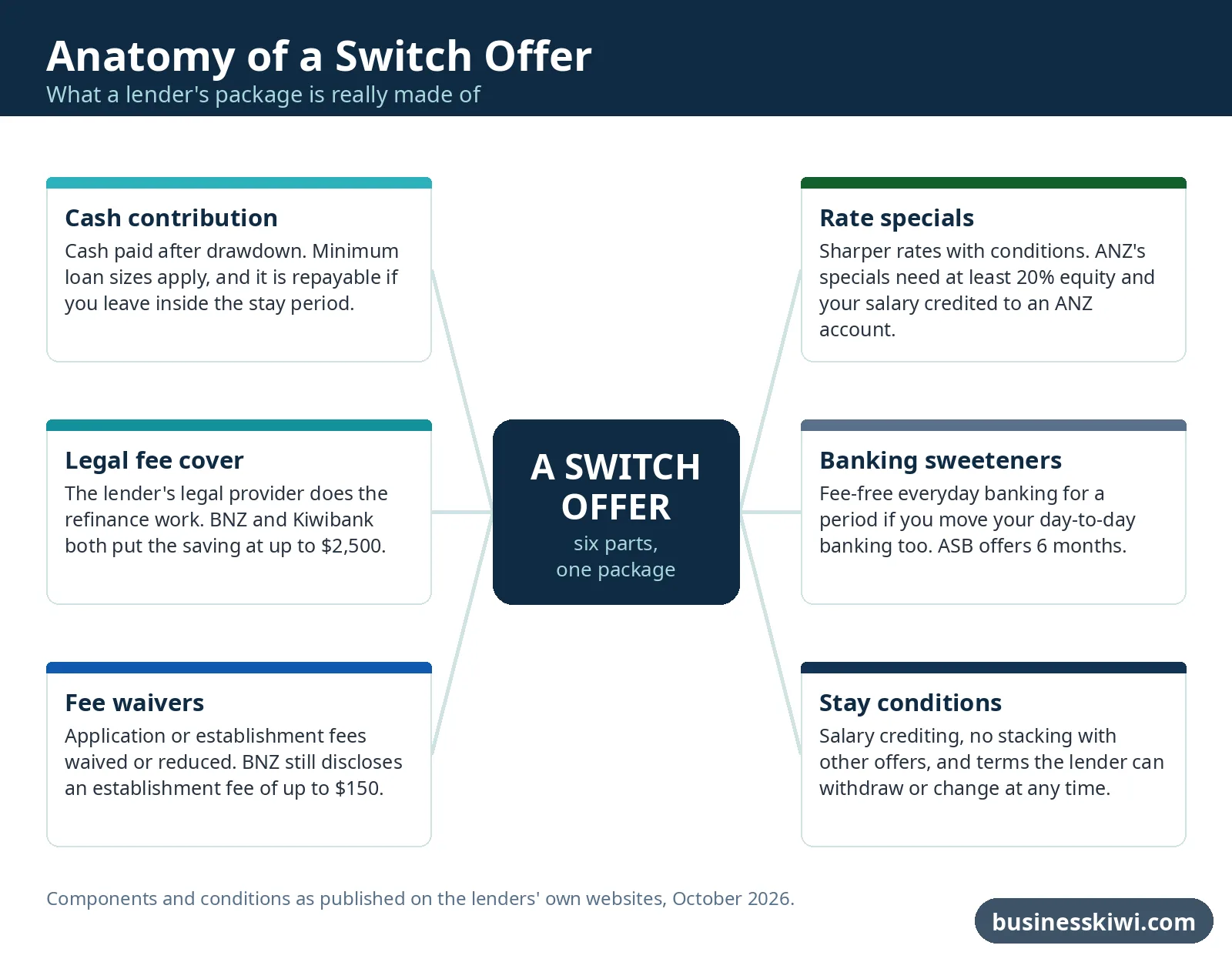
A switch offer is a bundle. Lenders mix and match the components, so it helps to pull the bundle apart and price each piece separately.
Cash contribution or cash back. The new lender pays you a lump sum after your loan draws down. It carries the heaviest conditions: a minimum loan size, a promise to keep your banking and lending with that bank for a set period, and repayment if you break the promise. Because this component is a whole topic on its own, our guide to how mortgage cash back works in depth covers the mechanics. In a switch offer, treat the cash as one line item, not the whole deal.
Legal fee cover. Instead of cash, the lender’s own legal provider handles the discharge of your old mortgage and the registration of the new one. BNZ’s Home Loan Switch and Kiwibank’s Refinancing Package both work this way. The cover is usually limited to straightforward refinances; complex situations still need your own lawyer.
Application and establishment fee waivers. Kiwibank’s package charges no application fees. Fees elsewhere are modest but real: BNZ discloses an establishment fee of up to $150 may apply even under Home Loan Switch, so covering the costs rarely means every cost.
Rate specials. Some offers are simply access to sharper rates. ANZ’s special rates are the clearest published example: at least 20% equity, your salary paid into an ANZ transaction account, and no combining with package discounts. A lasting rate special beats any cash sum, because it applies to the whole balance for the whole fixed term.
Everyday banking sweeteners and valuation waivers. ASB adds six months of fee-free everyday banking, through its introductory offer, if you move your day-to-day banking too, and Kiwibank’s package often removes the need for a registered valuation. Small in dollar terms, but they signal what the bank wants: your whole banking relationship, not just your loan.
The fine print that decides what an offer is worth
Two offers with the same headline can be worth very different amounts once you read the conditions. These are the clauses that do the damage.
Eligibility is narrower than the advertising. Offers are built for clean, simple switches: an owner-occupied home, a standard ownership structure, a loan the new lender wants. Trusts, companies, multiple securities and unusual properties are the first things filtered out, and every lender decides case by case. Minimum loan sizes are common too: where cash is published at all, it tends to start at loans of $200,000 to $250,000 or more, and smaller loans get the fee waivers, if anything, rather than the cash.
Equity and LVR conditions gate the best parts. Rate specials typically require at least 20% equity, as ANZ’s do. Below that you may still switch, but the special pricing falls away and low equity pricing may apply instead.
Your salary has to move too. Both ANZ’s special rates and Kiwibank’s cash contribution terms depend on your income being paid into an account with the new bank. The offer buys your main banking relationship, not just your mortgage.
Offers do not stack, and they can vanish. Published terms routinely exclude combining a switch offer with other promotions or package discounts, and lenders state offers may be withdrawn or changed at any time, sometimes without notice.
Clawback: the condition that matters most
If a switch offer includes cash, there is almost always a clawback clause behind it. The lender can require you to repay some or all of the contribution if you repay the loan, refinance away, or break the banking relationship conditions before the agreed stay period ends. The money is yours only once you have stayed the distance.
The two lenders that publish their mechanics do it differently, and the contrast is worth understanding:
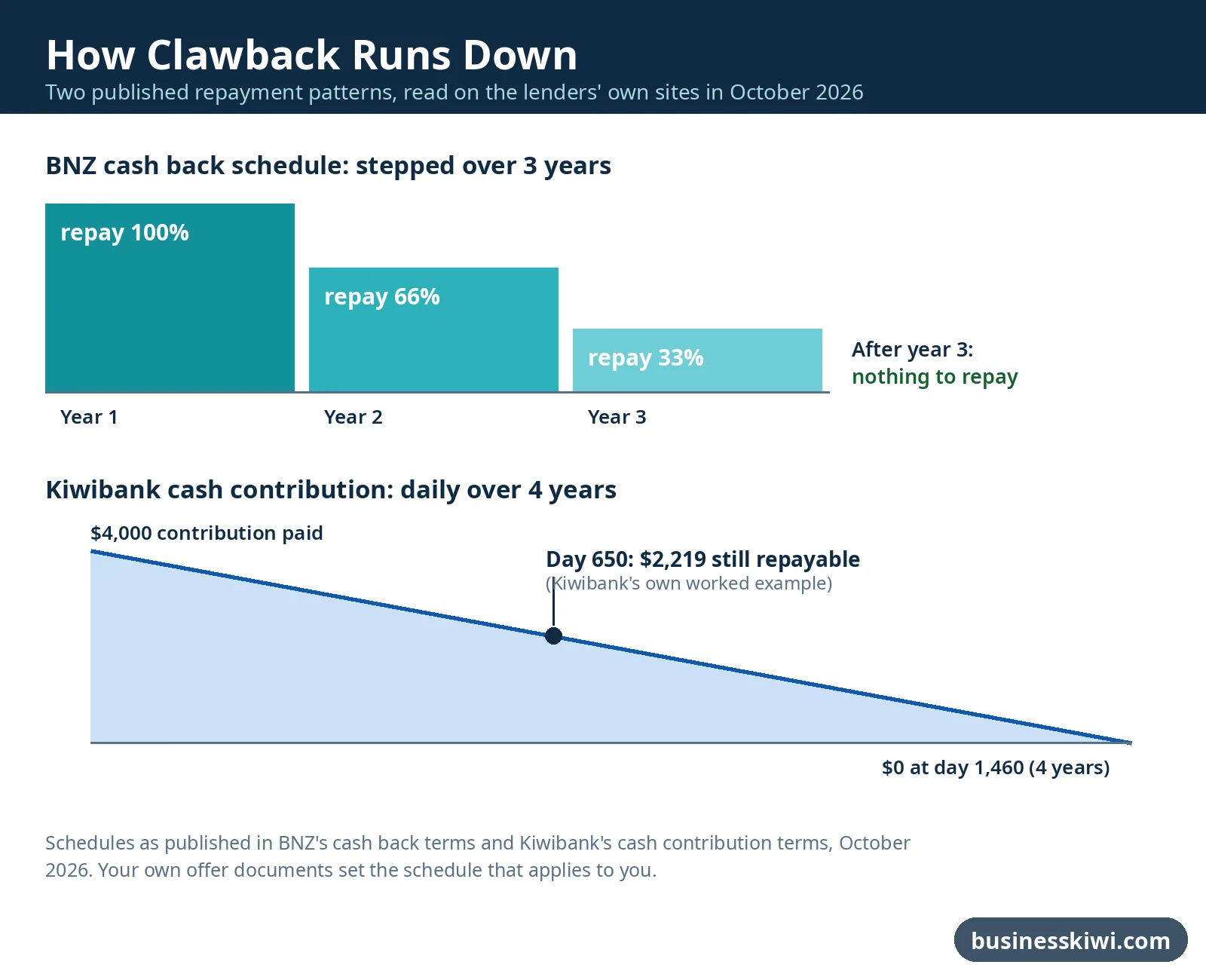
The stepped pattern. BNZ’s published cash back terms repay on a sliding scale over three years. Leave in the first year and you repay 100% of the cash. Leave in the second year, 66%. Leave in the third year, 33%. After three years, nothing is repayable.
The daily pattern. Kiwibank’s published cash contribution terms run over four years, and the repayable amount falls a little every day rather than in yearly steps. Kiwibank’s own example makes it concrete: on a $4,000 contribution the daily rate is $2.74, and if repayment is required 650 days after payment, the amount to repay is $2,219.
Two practical points follow. First, the stay period clock starts when the contribution is paid, and it binds you even if your circumstances change. Selling the house inside the period can trigger repayment too. Second, clawback runs in both directions: if your current lender gave you cash when you joined them, leaving early may mean handing that cash back first. The other costs of leaving, including break fees on a fixed loan, sit on the same side of the ledger. Our guide to switching costs, break fees and the break-even maths works through that side in full.
How to compare two offers properly
Comparing offers on the headline number alone is how switchers end up worse off. Compare them in this order instead.
Compare any two offers in this order
- Start with the rate, not the sweetener. A small rate difference on a large loan, held over a full fixed term, is usually worth more than any cash or fee offer. Put the lenders’ actual offered rates side by side against current home loan rates in NZ first.
- Add up what each offer is genuinely worth to you. Legal cover is worth what your lawyer would have charged, not the bank’s “up to” figure. Cash is worth face value only if you will stay the full period.
- Subtract everything the switch costs you. Your old lender’s discharge and break costs, any clawback on cash they gave you, and any new fees the offer does not cover.
- Read the stay period against your real plans. A four-year tie-in is a poor trade if you expect to sell or move banks again within that window.
- Check what you have to move. If the offer needs your salary, everyday accounts and lending all in one place, decide whether you want that before you sign.
- Get the offer terms in writing. Ask for the offer letter or terms document, not a verbal summary. The clawback schedule that binds you is the one in your documents.
Questions to ask before you sign

Ask the lender these, and note the answers
- Is this offer confirmed for my loan, in writing, or is it subject to assessment?
- Exactly which costs does the offer cover, and which fees still apply to me?
- What is the minimum stay period, when does it start, and what events trigger repayment?
- How is any clawback calculated: stepped by year, or daily over the period?
- What happens to the contribution if I sell the property or repay the loan early?
- Does the offer require my salary and everyday banking to move as well?
- Can this offer be combined with the rate quoted, or is it one or the other?
When a switch offer is not worth chasing
Sometimes the offer is the tail, not the dog. If your current rate is competitive, your remaining fixed term is long, or you are likely to move house within the stay period, a headline saving of a couple of thousand dollars can evaporate quickly. Offers are worth least on small loans, where thresholds and fixed costs eat a bigger share of the benefit. In those cases, asking your existing lender to match the market is often the better move: banks would rather reprice a good customer than lose one.

Frequently asked questions
What is a home loan switch offer?
It is the package a lender offers to win your home loan from another bank: legal fees covered, application fees waived, a cash contribution, a special rate, or sweeteners such as fee-free everyday accounts for a period. As published in October 2026, BNZ and Kiwibank lead with legal fee cover worth up to $2,500 in avoided costs, while ASB offers switchers a cash contribution with no published amount.
How much cash can I get for switching my home loan?
There is no standard published switch cash figure in NZ at the moment. ASB says switchers could receive a cash contribution toward switching costs but publishes no amount, and ANZ publishes no switch cash offer at all. The cash figures lenders do publish, such as $5,000 or more from BNZ and Kiwibank, are first home buyer offers with minimum loans of $200,000 to $250,000. Treat switch cash as negotiated and conditional, and get it confirmed in writing.
What does clawback mean on a switch offer?
It means the lender can make you repay some or all of a cash contribution if you leave, repay the loan or break the relationship conditions before the stay period ends. Published schedules work one of two ways: stepped by year, like BNZ’s 100%, 66% and 33% repayments across three years, or daily, like Kiwibank’s four-year term, where the repayable amount falls a little each day.
How long do I have to stay with the new bank?
Published stay periods run from three years (ANZ’s first home buyer cash condition, and the span of BNZ’s cash back repayment schedule) to four years (Kiwibank’s cash contribution agreement). Your own offer documents set the period that binds you.
Do switch offers cover my legal fees?
Some do, in kind rather than in cash. BNZ’s Home Loan Switch uses BNZ’s own legal services provider for eligible switchers, so there is no lawyer’s bill to pay, a saving BNZ puts at up to $2,500. Kiwibank’s Refinancing Package includes a free legal transfer service and no application fees. If your situation is complex, such as a trust or multiple properties, expect to use your own lawyer at your own cost.
Can I get a switch offer with less than 20% equity?
Possibly, but the best components are usually gated. ANZ’s special rates require at least 20% equity plus your salary paid into an ANZ account, and every lender applies minimum equity requirements. With less equity you may still switch, but expect standard pricing and fewer sweeteners.
Will switching banks trigger break fees on my current loan?
It can, if you are partway through a fixed term. A switch offer from the new lender does not cancel your old lender’s break fee, and the two calculations are separate: what the new bank offers you, versus what leaving costs you. Do that arithmetic before you sign anything.
The bottom line
Switch offers are real money, but they are packaged money. The published offers in October 2026 are dominated by legal fee cover worth up to about $2,500 in avoided costs, plus conditional cash and conditional rates, not big unconditional cash payments. Compare the rate first, price each component at what it is worth to you, subtract your exit costs, and read the clawback schedule before you sign.
For more guides on buying, borrowing and owning property in New Zealand, browse our property and home loan guides.
Sources: BNZ, Switch your home loan to BNZ, Refinancing your home loan, and Cash back home loan offer pages; Kiwibank, Cash contribution and Switch your home loan pages; ASB, Move your home loan to ASB; ANZ, Home loan interest rates and offers. All read on the lenders’ own websites in October 2026. Offers can be changed or withdrawn at any time.