Waterproof Bathroom Wall Panels in NZ: Types, Wet-Area Rules and How They Stack Up Against Tiles
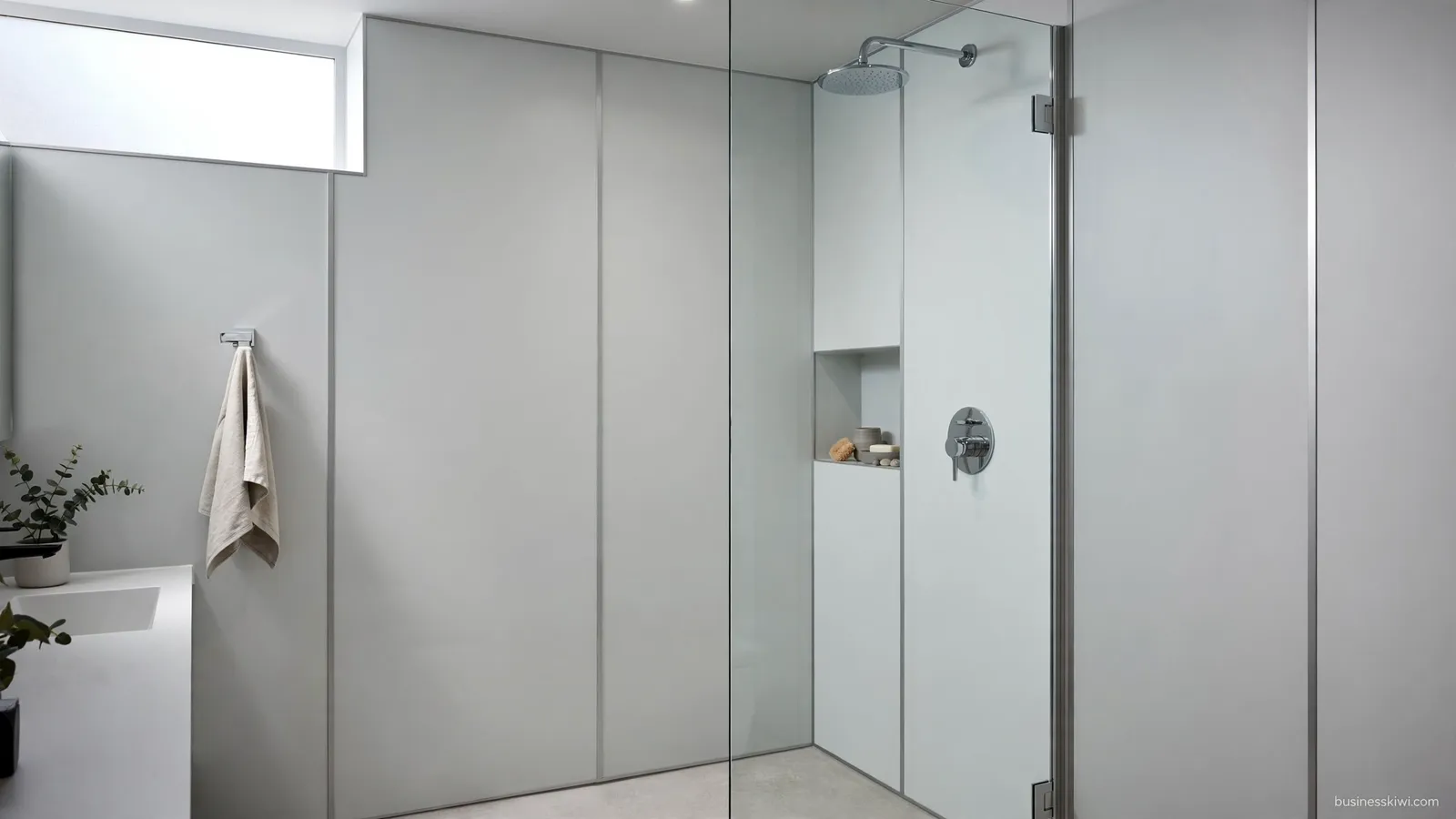
Tiles have been the default NZ bathroom wall for decades, and they still do a good job. But they come with grout lines to scrub, a membrane to install and cure, and a tiler to book. Waterproof wall panels are the other route: large prefinished sheets or interlocking panels fixed straight to the wall, with no grout anywhere.
The word “waterproof” on the box is only half the story, though. Each system has its own rules about what sits behind it, where it can go and how its joints are sealed. Get those details wrong and a waterproof panel can still front a leaking wall. This guide works through the main types sold in New Zealand, the Building Code rules, installation, and an honest comparison with tiles.
The short answer
Waterproof bathroom wall panels are a legitimate wet-area lining in New Zealand. The Building Code’s Acceptable Solution for internal moisture, E3/AS1, expressly recognises sheet linings of this kind, including integrally waterproof sheet material with sealed joints and modular lining units installed with impervious joints. The panels sold here fall into four families: compact laminate, mineral composite board, rigid uPVC, and acrylic liners supplied as part of complete shower units. Three things decide whether a panel wall performs: the product must be impervious and approved by its maker for shower use; the joints and penetrations must be sealed the way the system specifies; and where the maker requires a waterproof substrate behind the panels in a shower, that requirement is part of the system, not an optional extra. Panels need no grout and wipe clean, and they usually go up faster than tiles, but they are not a licence to skip the detailing.
What a waterproof wall panel actually is
A waterproof wall panel is a prefinished sheet lining built for areas that get splashed. Instead of hundreds of small tiles bedded in adhesive, the wall is covered by a few large pieces, sometimes full height, sometimes in a tile-sized format with printed grout lines. The face you see is the finished surface, with nothing left to paint or grout afterwards.
The waterproofing works differently from a tiled wall. On tiles, the membrane behind them does the real waterproofing work, because cement-based grout lets water through, as BRANZ points out in its tiled shower guidance. A panel flips that around. The sheet itself is impervious, either right through its thickness or through a factory-applied surface system, and the joints are closed with tongue-and-groove profiles, aluminium jointers or silicone sealant. That makes the joints the weak point of every panel system.
Panels are wall linings only; floors have their own list of acceptable finishes under E3/AS1.
The main panel types sold in NZ
Compact laminate panels
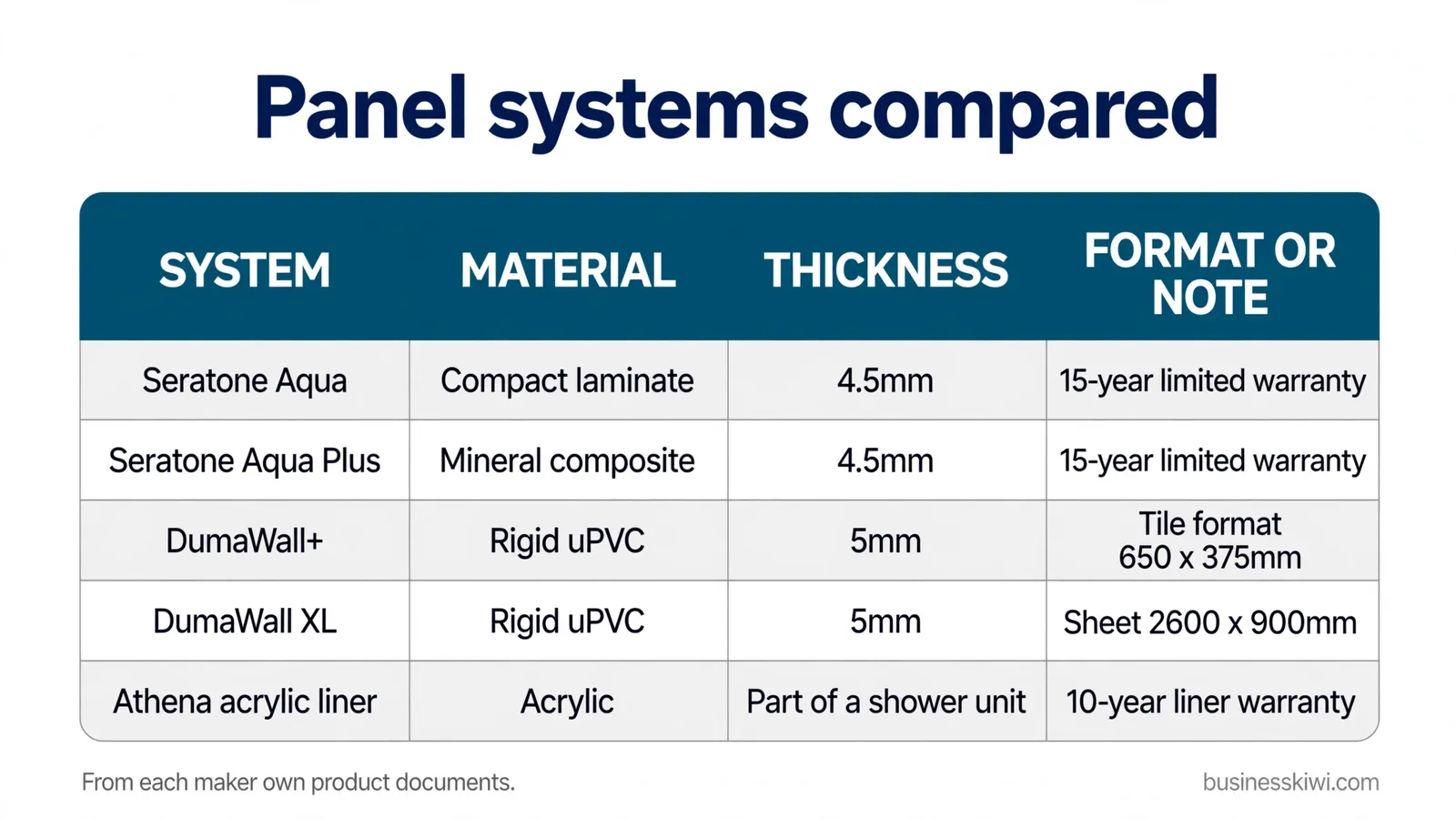
The longest-established NZ example is Seratone Aqua from Laminex New Zealand. It is a compact laminate: layers of kraft paper impregnated with resin, formed under high pressure and heat into a 4.5mm sheet. Laminex describes it as impervious to water throughout the panel thickness, and it shows a black or dark brown core at a cut edge. It will not rot. One caveat comes from the maker itself: the sheet can expand and swell in high humidity, so follow the manual on storage and installation.
Mineral composite panels
Seratone Aqua Plus is the same maker’s newer range. The panel is a high-density mineral composite board finished with a multilayer paint system, 175 microns thick, fully cured with ultraviolet light to give a smooth, glass-like face. Where the compact laminate is waterproof by construction, the mineral board is waterproof through that cured surface system. Laminex states it will not rot, swell, expand or contract. Both ranges are 4.5mm thick, share the same colour-matched aluminium jointers, and carry a 15-year limited warranty that depends on the current technical manual being followed.
Rigid uPVC panels
PSP New Zealand’s DumaWall range is the local example of the uPVC family. The panels are 5mm thick, built on what PSP calls RCB (Rigid Core Board) technology, and interlock with tongue-and-groove edges. DumaWall+ comes as tile-format pieces of 650 x 375mm with a printed grout line, while DumaWall XL is a full panel at 2600 x 900mm for fewer joins. PSP’s data sheet records testing for water penetration, impact resistance of 23–35 joules, excellent detergent resistance, and a New Zealand fire Group 3 rating. The panels fix with MS polymer adhesive and finish with aluminium trims. The catch with this family is heat, covered in the watch-outs below.
Acrylic wall liners
Acrylic rarely sells as a loose sheet in NZ. It usually arrives as the wall liner inside a complete shower unit. Athena Bathrooms, which makes its showers in New Zealand, supplies flat or moulded acrylic liners with its Soul range, paired with a low-profile tray and a glass door. The liner carries a 10-year residential warranty. Because liner, tray and door are designed together, junctions such as the tray upstand are solved by the system, not improvised on site. The trade-off is choice: you buy the unit as designed, in set sizes, rather than lining any wall shape you like.
Where panels can go, and where they cannot
Inside a shower is the headline use, and the makers above all approve their systems for shower walls when installed to their manuals. Around baths and basins, and on the remaining bathroom walls, panels sit in the watersplash territory E3/AS1 is concerned with, and they suit it well. Seratone also lists laundry walls and kitchen splashbacks among its uses, splashbacks subject to its manual’s conditions.
The exclusions matter just as much:
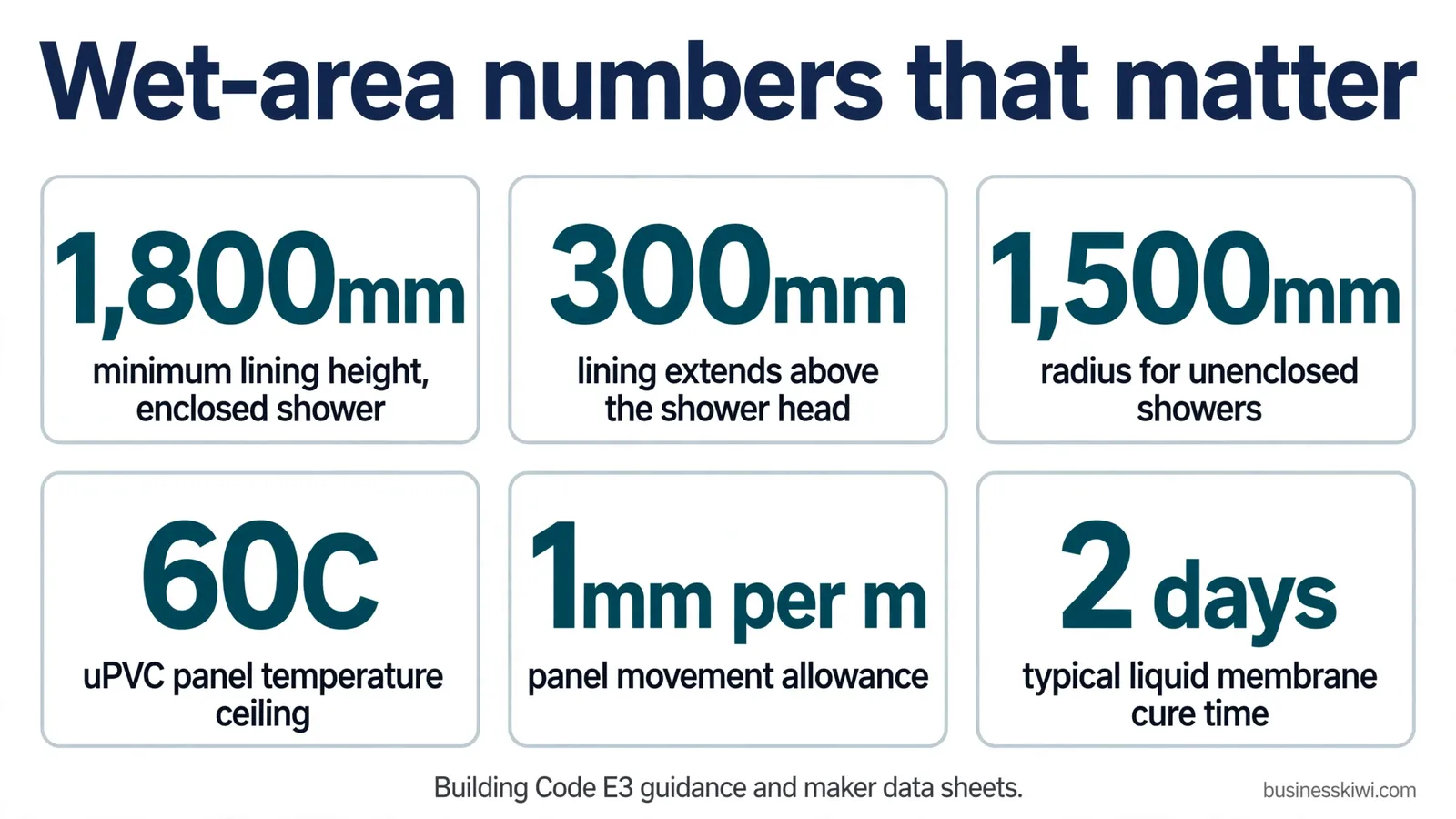
- Saunas and steam rooms are out. Laminex states Seratone is not suitable for areas of extremely high humidity and prolonged elevated moisture. PSP excludes DumaWall anywhere sustained temperatures exceed 60°C, saunas included.
- Keep uPVC away from heat. PSP says DumaWall must not be installed within 1 metre of a heat source, and it is not to go behind stoves or cooktops.
- Not straight onto masonry or concrete. Laminex requires dry timber or steel battens in that situation.
- Not on the floor. These are vertical linings; PSP’s data sheet scopes DumaWall to a vertical substrate, and the same applies across the category.
The Building Code position: Clause E3 and E3/AS1
Clause E3 of the Building Code deals with internal moisture. Three of its performance requirements drive everything in a bathroom. Wall surfaces next to sanitary fixtures must be impervious and easily cleaned (E3.3.4). Surfaces likely to be splashed must also be impervious and easily cleaned (E3.3.5). And splashed surfaces must be built so water cannot penetrate behind linings or into concealed spaces (E3.3.6). Impervious has a plain meaning here: it does not allow the passage of moisture.
The Acceptable Solution E3/AS1 then lists the wall linings that satisfy that performance in watersplash areas, and panel systems appear on the list in their own right: integrally waterproof sheet material, such as PVC, with sealed joints; water-resistant sheet linings finished with decorative high-pressure laminate; and modular or multiple lining units that are themselves impervious and easily cleaned, installed with impervious joints. The Code does not treat panels as a shortcut around the rules. It names them as one of the recognised ways to meet the rules.
Showers get stricter treatment. E3/AS1 requires all shower spaces to have impervious floor and wall finishes, and it withdraws a couple of the general watersplash options inside a shower: sheet linings finished with vinyl wallpaper or a gloss coating are not permitted there, which is why ordinary painted plasterboard is not a shower lining. Tiles are allowed in showers only when laid on a continuous impervious substrate or membrane. For the extent of the wet zone, BRANZ guidance puts figures on it: impervious linings in an enclosed shower must be continuous, at least 1,800mm high and extend at least 300mm above the shower head, and an unenclosed shower needs that protection across a 1,500mm horizontal radius from the showerhead.
Two practical consequences follow. Compliance lives in the whole installed system, product plus joints plus substrate, which is why a maker’s manual matters more than a marketing claim. And as BRANZ notes, the Building Act requires building work to comply with the Code whether or not it needs a consent, so a consent-free relining job is not a rule-free job.
Where a tiled wall or a panel system needs a membrane behind it, our waterproof membrane guide covers how those membrane systems work.
Installing panels: the guide-level outline
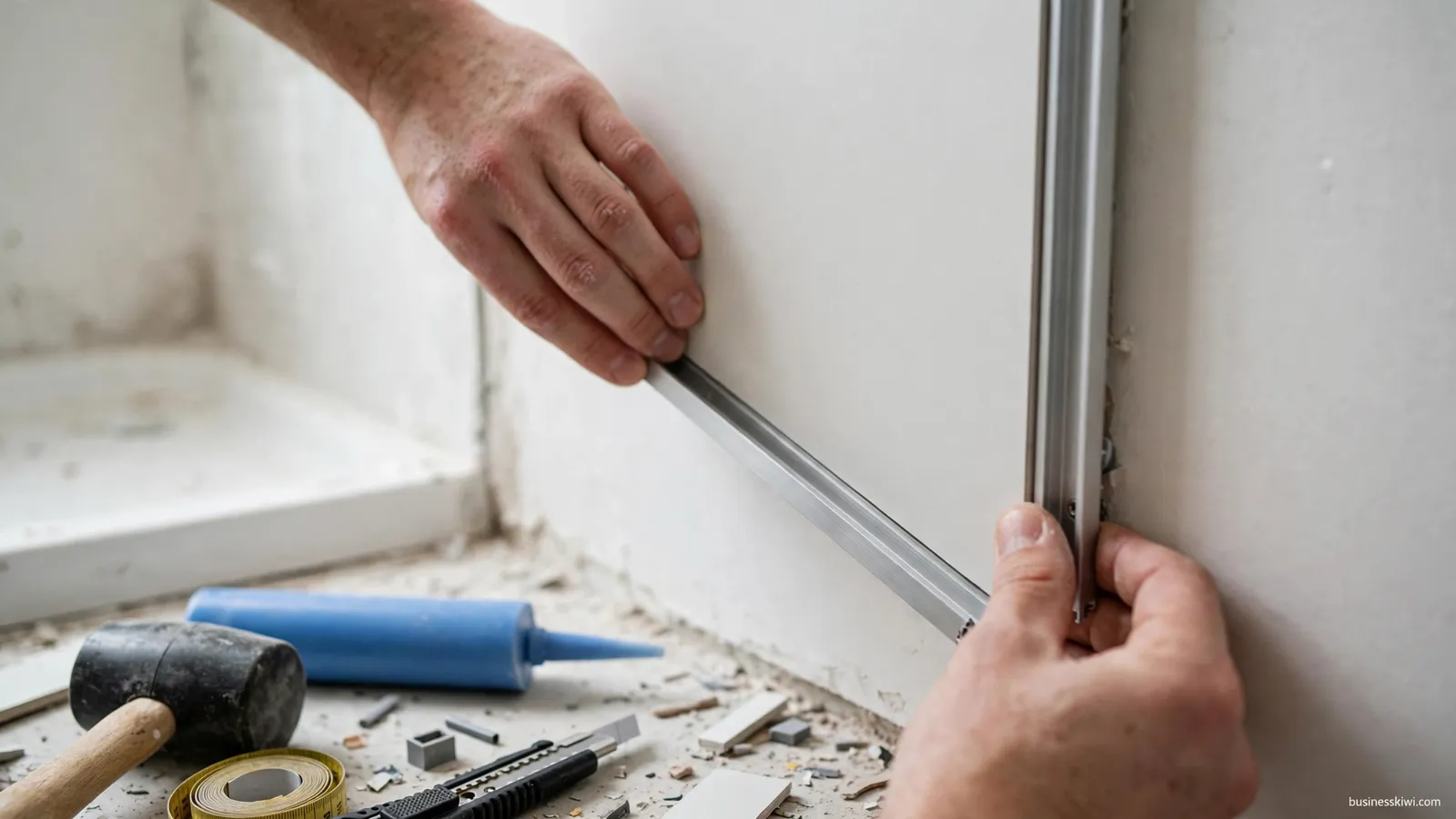
Every system has its own manual, and the manual wins. What follows is the shape of the work, not a substitute for it.
- Sort the substrate first. It must be sound, flat and dry. In a shower, some systems require it to be waterproof as well: PSP states this outright for DumaWall, with the waterproofing and the panel adhesive required to be compatible. Concealed surfaces behind baths and vanities should be sealed before the units go in, per BRANZ’s wet-area tips.
- Plan the set-out. Work out sheet widths against the wall, where joints will land, and how trims and corners will run, before anything is cut. Patterned sheets may need trimming to align.
- Cut to size. PSP says DumaWall cuts with standard tools. For Seratone, Laminex draws a line between its ranges: a competent DIYer with basic carpentry tools could install Aqua Plus, while Aqua needs specific power tools.
- Fix the sheets. Seratone fixes with adhesive used with double-sided foam tape, and a slightly bowed sheet should be propped while the adhesive cures. For adhered liners generally, BRANZ’s advice on acrylic shower liners is worth stealing: adhesive in vertical strips leaves vertical paths for moisture to track down behind the liner, over a substrate with no protective coating. BRANZ recommends adhesive right around the perimeter, so moisture cannot migrate behind the panel at all.
- Joint and seal. Close the joints with the system’s jointers or tongue-and-groove profile, then seal corners, the base junction and every penetration. BRANZ’s tips are blunt about penetrations through an impervious finish: they must be sealed, including around tapware.
- Leave room to move. PSP allows for DumaWall XL expanding and contracting up to 1mm per metre, with gap allowances at the trims.
Panels or tiles? An honest comparison
How they keep water out. Tiles rely on a membrane behind them because grout is not impervious. Panels carry the impervious layer on their face and seal the joints. Neither forgives bad junctions; both fail at corners, bases and penetrations when detailing is sloppy.
Time on site. A tiled shower is a programme: membrane application, curing, tiling, grouting. BRANZ allows typically at least 2 days for liquid-applied membranes to cure in favourable conditions, and its shower guidance talks of at least 24 hours between coats and before flood testing. Panels compress that to measure, cut, fix and seal, although a system needing a waterproofed substrate in the shower still inherits that substrate’s curing time.
Cleaning and upkeep. Panel faces wipe down, and there is no grout to scrub, reseal or dig out when it cracks. The upkeep moves to the silicone joints, a maintenance item on any wet-area wall. Laminate faces have one firm rule, covered next.
Damage and change. A single cracked tile can be cut out and replaced. A damaged panel usually means replacing the whole sheet, and matching a discontinued décor years later is not guaranteed. Tiles also shrug off heat that uPVC cannot, which is why they remain the safe splashback behind a cooktop.
Cost. There is no honest “typical panel cost” to quote. Laminex and PSP do not publish panel list prices on their own product pages, and most systems are priced through merchants and installers, so the useful move is an itemised quote that separates sheets, trims, adhesives and labour. The one maker-published figure found for this guide is for a complete unit rather than panels alone: Athena lists an RRP of $2,640 for its Soul 1000 x 1000 two-wall shower, tray, door and acrylic wall liner included. Compare like with like: a tiled quote needs the membrane and its applicator in it before it is comparable.
Care and cleaning
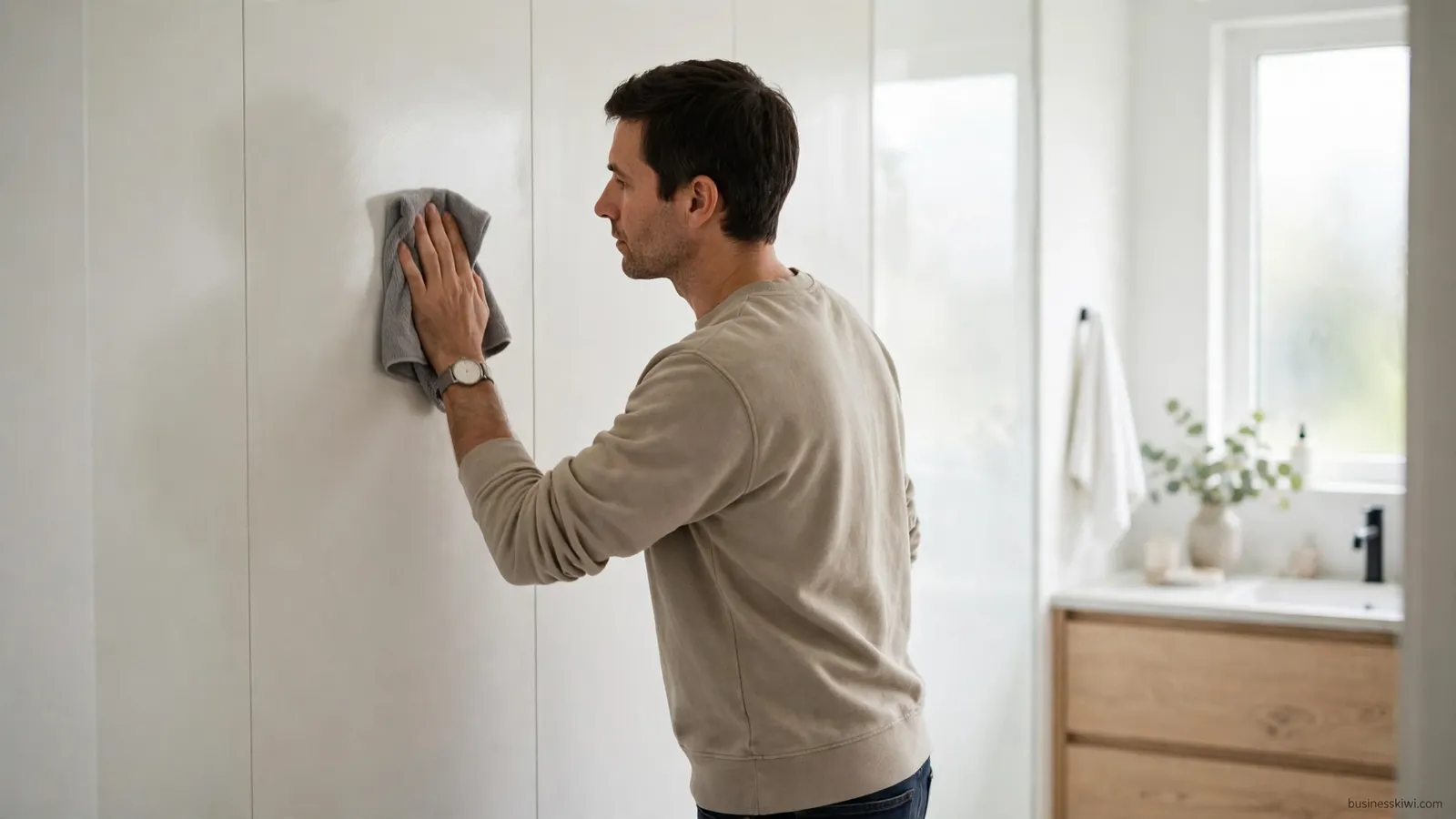
Panels are low-maintenance, not no-maintenance. Laminex’s cleaning rule for Seratone is specific: use non-abrasive household cleaners, and do not use scouring pads, abrasive cloths or cream cleaners on the face. PSP’s data sheet gives DumaWall excellent detergent resistance, which suits a wipe-down routine, but the maker’s own care instructions still govern.
Check the silicone joints around the base, corners and fittings as part of normal bathroom upkeep, and renew any bead that has split or lifted. Ventilation matters as well: Clause E3 is as much about moisture in the room as water on the wall, and BRANZ recommends mechanical extraction in bathrooms so steam does not sit on every surface.
Watch-outs before you buy
- “Waterproof panel” is a product claim, not a system. Ask what the maker requires behind the panel in a shower, and get the answer from its own datasheet. DumaWall’s requirement for a waterproof substrate surprises people who assumed the panel did everything.
- No documents, no deal. A panel with no NZ technical datasheet, appraisal or installation manual gives you nothing to install to, and nothing to point to if a warranty claim is questioned. The recognised systems above all publish theirs.
- Do not panel over a rotten wall. If the existing lining or framing is wet or damaged, find and fix the cause first. A new impervious face over a failed substrate hides the problem while it gets worse.
- Mind the heat limits, and the manual. uPVC distorts with heat, so respect the 60°C ceiling, the clearances around heaters and cooktops, and keep every panel out of saunas and steam rooms. And whoever installs the system, DIY or trade, the maker’s manual is the contract: Laminex is explicit that variations from its instructions can void the limited warranty.
Panels are one use of sheet plastics: our plastic sheet guide covers the materials themselves. For more home and building guides, browse the Business & Industry section.
Frequently asked questions
Are waterproof wall panels really waterproof, or just water resistant?
It depends on the construction, and the makers use the words carefully. Seratone Aqua is impervious through its full thickness. Seratone Aqua Plus is impervious through its cured paint system on a mineral board. DumaWall is a solid 5mm uPVC sheet that PSP’s data sheet records as showing no traces of water penetration under test. Either way, the installed wall is only as waterproof as its joints and sealing.
Do I still need a waterproof membrane behind wall panels in a shower?
Sometimes. PSP requires a waterproof substrate behind DumaWall in a wet area, achieved with a membrane or another waterproofing product that is compatible with the adhesive. Other systems are tested and approved for shower zones as a complete lining system. There is no category-wide answer, so check the specific product’s datasheet.
Can wall panels go over existing tiles or old linings?
Laminex lists refurbishment over existing linings among Seratone’s uses, a common reason people choose panels. The existing surface still has to be sound, flat and dry. If the old lining is loose, bowed or hiding water damage, it needs to come off first.
Are wall panels allowed in a shower under the NZ Building Code?
Yes, when the installed system meets Clause E3. E3/AS1 expressly lists integrally waterproof sheet material with sealed joints, sheet linings finished with decorative high-pressure laminate, and impervious modular lining units with impervious joints as satisfying the performance for watersplash areas, and showers require impervious floor and wall finishes. The product’s appraisal and manual are how you show a specific panel fits those descriptions.
Can I install bathroom wall panels myself?
Some systems, yes. Laminex says an experienced, competent DIYer could install Aqua Plus with basic carpentry tools, while Aqua needs specific power tools. PSP says DumaWall cuts with standard tools. Either way, the warranty point applies: the install has to follow the maker’s manual, whoever holds the tools.
How long do waterproof wall panels last?
The makers put warranty terms on it rather than lifespan promises. Seratone carries a 15-year limited warranty when installed and maintained to its technical documents, and Athena warrants its acrylic wall liners for 10 years in residential use. PSP’s documents reviewed for this guide state no warranty term for DumaWall. Joints and sealant will need renewal well inside those periods.
What do waterproof bathroom wall panels cost in NZ?
There is no reliable typical figure, because the panel makers do not publish list prices for the sheets themselves and installed prices turn on the room, the system and the installer. Budget from itemised quotes that include trims, adhesives and labour. For a sense of scale at the complete-unit end, Athena publishes an RRP of $2,640 for its Soul 1000 x 1000 two-wall shower including tray, door and acrylic liner.
The bottom line
Waterproof wall panels earn their place in NZ bathrooms when they are treated as systems rather than sheets. Pick a product with real technical documents behind it, approved by its maker for shower zones. Respect what it requires behind it, seal the joints and penetrations properly, and keep heat away from uPVC. Do that, and you get a grout-free wall that meets the same Clause E3 performance asked of tiles, with a fraction of the cleaning. Skip the detailing, and the panel’s waterproof face is guarding a wall that leaks behind it.
Sources
- MBIE Building Performance, E3 Internal moisture (building.govt.nz), including the E3/AS1 Acceptable Solution
- MBIE Determination 2015/009, Appendix A reproducing E3/AS1 (building.govt.nz)
- BRANZ Build, Linings and finishes in wet areas (buildmagazine.org.nz)
- BRANZ Build, Wet area tips (buildmagazine.org.nz)
- BRANZ Build, Waterproofing tiled showers (buildmagazine.org.nz)
- BRANZ Build, Edge sealing of acrylic shower wall liners (buildmagazine.org.nz)
- Laminex New Zealand, Seratone brand page (laminex.co.nz)
- PSP New Zealand, DumaWall+ and DumaWall XL wall linings (psp.co.nz)
- PSP Limited, DumaWall Product Data Sheet v1.1, November 2024
- Athena Bathrooms, Soul 1000×1000 Two Wall Shower (athena.co.nz)
This article is general information about waterproof bathroom wall panels in New Zealand. It is not building or design advice for a specific project. Panel products and their technical documents change over time, and each maker’s current manual governs how its system must be installed. Building work has to comply with the New Zealand Building Code whether or not it needs a building consent, so check the requirements with your council, your designer or a licensed building practitioner before you start.